Wikio - Top Blogs - Religion and belief

Saturday, 20 August 2022

At the heart. On the edge.


I wrote the following article on HeartEdge for the latest edition of the CMD Bulletin for the Diocese of Chelmsford:

Churches are closest to the heart of God when they at the heart of their communities and with those on the edge. That is the contention and belief of HeartEdge, an international, ecumenical movement that is about church becoming fully alive as it seeks to transform church and society through commerce, culture, compassion and congregational life.

HeartEdge is about churches developing four Cs:
  • Commerce: Generating finance via enterprise, creatively extending mission.
  • Culture: Art, music, performance re-imagining the Christian narrative for the present.
  • Congregation: Inclusive liturgy, worship and common life.
  • Compassion: Empowering congregations to address social need.
The network supports churches in reimagining themselves and society by working with churches moving beyond conventional notions of church, being open to partnership and collaboration with others in the wider world. Fundamentally, HeartEdge is about recognising the activity of the Holy Spirit beyond and outside the church and about a church that flourishes when it seeks to catch up with what the Spirit is already doing in the world.

There was a time when church meant a group that believed it could control access to God – access that only happened in its language on its terms. But God is bigger than that, and the church needs to be humbler than that. Kingdom churches anticipate the way things are with God forever – a culture of creativity, mercy, discovery and grace – and are grateful for the ways God renews the church through those it has despised, rejected, or ignored.

HeartEdge seeks to do all this through:

Transforming Practice
  • Encouraging, fostering, training practitioners in imaginative and holistic approaches to mission.
  • Through training, education, consultancy, peer support, signposting and examples.
Transforming Discourse
  • Coining new language and engaging topical issues through the lens of God’s abundance.
  • Through seminars, summer schools, events and conferences live and online.
Transformative Programmes
  • Offering tested ‘products’ that practitioners can swiftly implement.
  • Through cultivating and promoting specific mission initiatives that can be adapted for local use.
HeartEdge is active in the Diocese and in Essex through two hubs; the Harlow Archdeaconry Learning Hub (see https://www.facebook.com/Learning-Hub-545693942608410) and Shoeburyness and Thorpe Bay Baptist Church (see https://www.stbbc.org.uk/heartedge). A number of excellent awareness events have already been held as a result, that have grown and deepened the network here. 

The next focuses on Congregation and is called ‘Signs of Hope’. This is an evening at Shoeburyness and Thorpe Bay Baptist Church on Wednesday 14 September beginning at 7.30 pm where Rev Erica Wooff, Rev John Goddard and Rev Claire Nicholls will tell stories from their congregations. To book a place email Nicky Snoad at nicky.snoad@stbbc.org.uk. Then, on 8 November, there will be a similar event focusing on Culture.

In between is a further opportunity to explore the relationship between churches and Culture, this time with Revd Dr Sam Wells, Vicar of St Martin-in-the-Fields, on whose theology much of HeartEdge’s thinking is based. Sam Wells sees churches as meeting places of human and divine, gospel and culture, timeless truth and embodied experience, word and world. As a result, they are like estuaries.

Estuaries, where salt water mixes with fresh in a confluence of river and tidal waters, are environments of preparation where, for example, young salmon, striped bass, and other fish come downstream after hatching. Churches that regard themselves as meeting places of the human and divine are essentially functioning as estuaries. Creating cultural estuaries in churches happens when the creative capital of an artist, the social capital of a minister or community leader, and the material capital of finance or business, converge.

Explore these ideas further with Sam Wells, Revd Paul Carr (Team Rector, Billericay and Little Burstead Team Ministry), Nicola Ravenscroft (Sculptor), Sarah Rogers (HeartEdge), and myself in ‘Gospel and Culture: Churches as meeting places’ at St Andrew’s Wickford on Tuesday 20 September, 10.30 – 3.30 pm. To register, go to https://www.eventbrite.co.uk/e/gospel-and-culture-churches-as-meeting-places-tickets-391772731787.

For more information about HeartEdge, see https://www.heartedge.org/, including information about their online learning and support groups.

------------------------------------------------------------------------------------------------------------

Johnny Cash - Where We'll Never Grow Old.

Windows on the world (391)


 London, 2022

---------------------------------------------------------------------------------------------------------------

Elvis Presley - Always On My Mind.

Friday, 19 August 2022

Church Times - Art review: The Small House by Richard Woods, Southwark Cathedral

My latest review for Church Times is of The Small House by Richard Woods at Southwark Cathedral:

'The playful temporary disruption that this installation causes in the space enables rich biblical reflection on the house of God: as memorial stone at Bethel, as a tabernacle in the wilderness, and as the Temple in Jerusalem. Psalm 23 promises that we shall dwell in the house of the Lord and sit at table there; and Jesus pictures heaven as a house with many rooms, one for each of his followers.

This small house is, therefore, a temporary sign of what is to come.'

Other of my pieces for Church Times can be found here. My writing for ArtWay can be found here. My pieces for Artlyst are here and those for Art+Christianity are here. See also Modern religious art: airbrushed from art history?

---------------------------------------------------------------------------------------------------------------

Madness - Our House.

Thursday, 18 August 2022

Can Prunera Museu Modernista, Sóller


Can Prunera Museu Modernista is located in an old art nouveau mansion built in the early 20th century. A combination of sinuous, natural and animal-like shapes welcome visitors to a museum which has become one of the features of the town of Sóller. Can Prunera, together with other buildings in Palma such as the Grand Hotel, Can Forteza Rey and Can Casasayas, belongs to a large set of buildings erected in Mallorca in the early 20th century following the models of Catalan Modernisme and French Art-nouveau. 

Can Prunera was restored through the joint efforts of the Sóller Railway company and the Serra Art Foundation who formed the Tren de l'Art Foundation to foster the cultural and artistic development of the Sóller valley. Two exhibition halls, Joan Miró and Pablo Picasso, were created at Sóller railway station plus a Sculpture Park at the end of the tramway line that links Sóller and Port de Sóller. In Palma, at the Sóller Railway Station, there is also a hall showing “50 Landscapes of Majorca”. After almost three years of restoration and refurbishing, Can Prunera Museu Modernista was opened in August 2009. Since its creation, the Foundation has organized a large number of exhibitions, which have turned Sóller into an important meeting point for artistic creation.

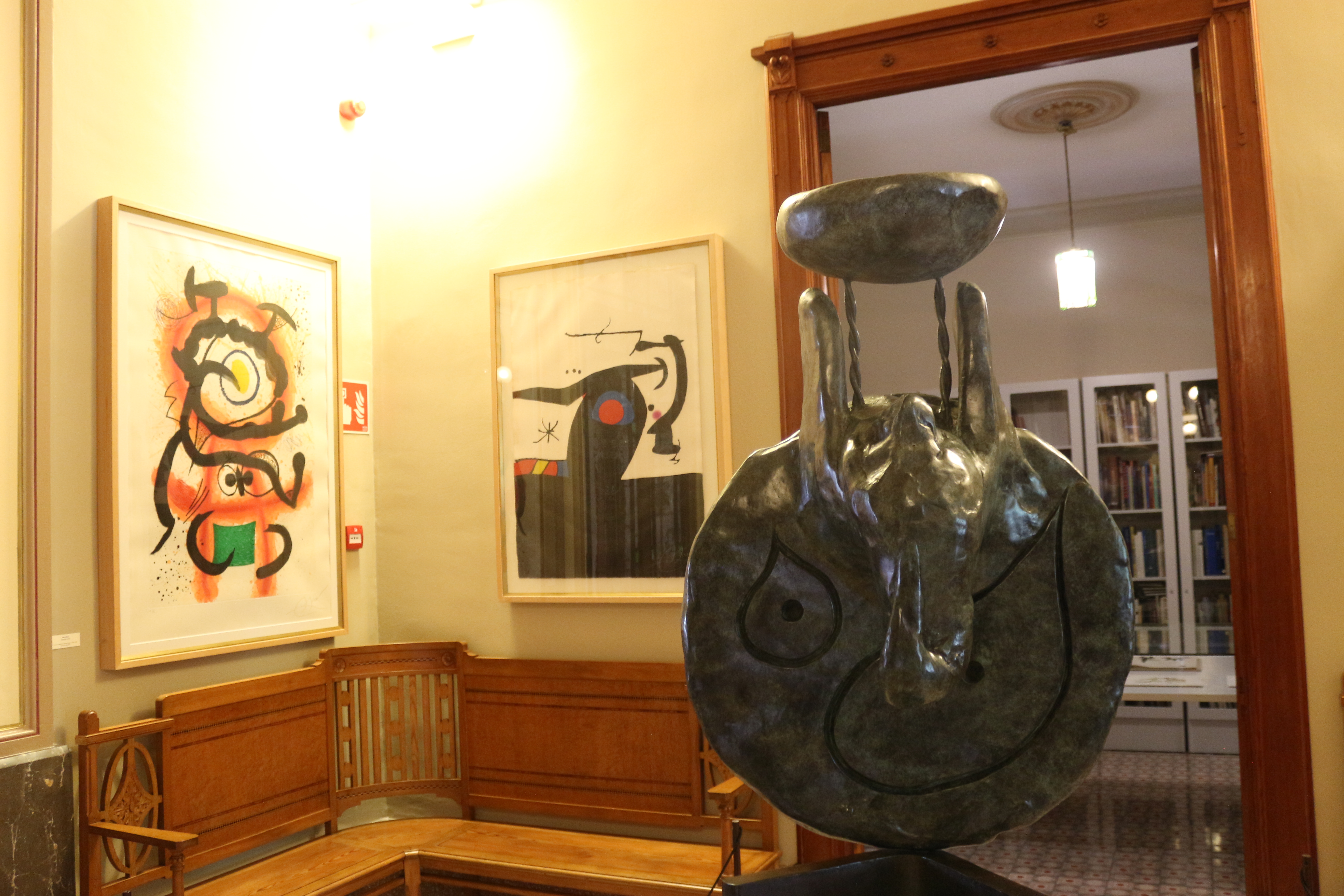
The ground and main floor rooms contain some of the original furniture along with paintings and sculptures from the Collection. On the second floor, is the exhibition Del Modernisme al segle XXI [From art nouveau to the 21st century], a set of paintings belonging mainly to the Serra Art Collection. The collection’s masterpieces encompass works by important artists from the 19th and 20th centuries, such as Miró, Henri de Toulouse-Lautrec, Paul Klee, Fernand Léger and Maurice Vlaminck. Alongside, are painters who were either born in Mallorca or have some link to the island and have reached international recognition, such as Rusiñol, Mir, Joan Fuster, Eliseu Meifrén, Ritch Miller and Miquel Barceló. The collection has been enlarged over the past few years with works donated by private owners and artists to the Tren de l’Art Foundation. On my visit I saw works by Helen Frankenthaler, Albert Gleizes, Rebecca Horn, Hermann Nitsch, Jaume Plensa, Diego Rivera, and Antoni Tàpies, among others.

In the basement, there are the rooms popularly known as botigues – the domestic service spaces and stores - which nowadays host temporary exhibitions and rooms devoted to Juli Ramis, a pioneer of materic abstract painting in Spain. In the 1960s Ramis achieved international recognition, with Time magazine including him in a list of the best one hundred painters in the world. He was friends and shared his atelier with Wilfredo Lam, Jean Fautrier, Serge Poliakoff and Nicolas de Staël. He also had friendships with Picasso, Juan Gris and Miró. As a result, he is the most internationally recognised Majorcan painter of the first half of the 20th century. The collection includes canvases from three of the most representative periods in his oeuvre: early years, Cubism and abstract works. Finally, in the garden, visitors can contemplate the Foundation’s collection of sculptures.

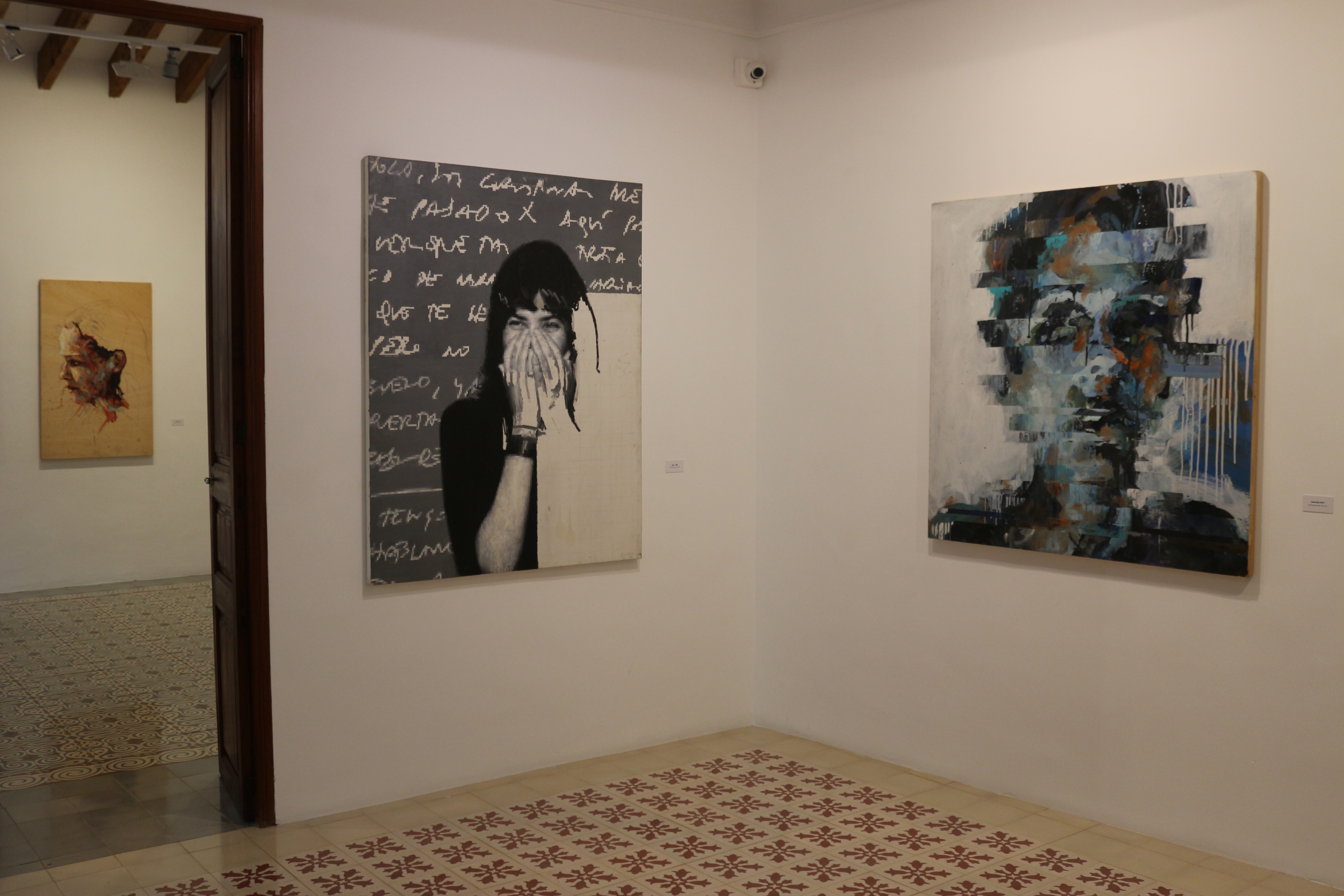
The current temporary exhibition Salva Ginard 20/20 presents 20 paintings from a 20-year project of painting human faces “as a secret, intimate and personal language, a partially veiled confession,” that lives in the “landscape of experiences” which “regrouped and forced to live together,” shape each face “in a sort of hallucinated and revealing cryptogram.” Across that 20-year period, Ginard moved from “absolute darkness”, scratching the surface until he could see “dull colours that drew out the map of a wounded heart” to vivid, pure, even brilliant colours sliding along the fringes combined with “partial or wholescale elimination of the image to take advantage of its echo to begin again.” In between, are figures that have been “deconstructed into layers, pieces or blotches of colour, even until their disappearance” - scratched, uprooted violently, in order to delve “deeper into the idea of destruction / reset, wounding / curing.”

-----------------------------------------------------------------------------------------------------------

Peter Sheppard Skaerved - Telemann B-Minor Fantasie.

Wednesday, 17 August 2022

Pollença: Art and museums


The town of Pollença has a “leading role in spearheading musical, artistic and cultural activity” in Mallorca. Its annual Festival began in 1962 and, since 1999, there has also been an annual summer installation in the Convent Church, Església del Convent de Sant Domingo, the Convent now being the location for the Municipal Museum. Click here to read about the 2018 installation - ‘It’s time to open the Black Boxes!’ by Danae Stratou.

Pollença has been linked to the world of painting from the first years of the XXth century, when artists like Anglada Camarasa, Tito Cittadini, arrived from Paris and its international renown attracted other artists like Joaquin Mir and José de Creeft. The influence of these artists led in the 1960s to the creation of the Summer Exhibition of Painting, which later became the International Competition of Plastic Arts and which now constitutes the content of Pollença's Museum.

The Museum of Pollença was officially founded in 1975. In its halls were exhibited the works which won that Exhibition and a group of gothic altarpieces. With time the painting collection has increased and the contents have been enriched with works of archeological character, a Buddhist mandala and a collection of works by Atilio Boveri. Argentine artist, Boveri painted Stations of the Cross for the Església de la Mare de Déu del Àngels in Pollença and founded a mutual aid society for fishermen. He continued to combine art, spirituality and social action on his return to Argentina, making him a precursor to artists such as Theaster Gates.

Local artist Dionís Bennàssar, a good friend of Cittadini, followed in the footsteps of Santiago Rusiñol and Mir to become a Post-Impressionist whose work rivals that of Vincent Van Gogh and Paul Gauguin for vibrancy of colour and vigour of brushstrokes. His seascapes are among the most magical of his works (one of which was awarded first place in the second Summer Exhibition of Painting), while his range of work extends from village scenes, landscapes, portraits and nudes to symbolism and erotica. The Dionís Bennàssar Museum, located in his Pollensan home, has an extensive collection of his work showing his range, with much that dates from the 1960s prior to his death in 1967.

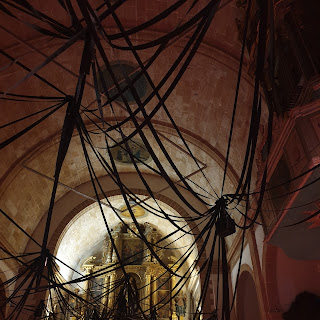
Tremolor, this year’s installation for the Church of Santo Domingo is by José Luis Vicario, a multi-disciplinary artist who wishes to return to us to a fundamental experience that people down through the ages have had in sacred spaces; that of gazing upwards into an expanse – whether of sky or images – that connects us to infinity and enables contemplation of the eternal questions. Vicario senses that, “perhaps due to excessive stimuli or the lack of calm,” we “appear to have forgotten the overwhelming tremor that accompanies our realisation of the invisible immensity of the space we live in.” His installation seeks to recover “the threads and artefacts whose tremors are capable of dissolving time.”

Vicario has created a sky-cavern within the nave of the church using 2,500 metres of black ribbons affixed to the dome by 19 anchor points through existing holes. Operated by small motors and suspended over the observer, the entire structure trembles as subtle shudders – tremors - run through it, creating a work that contrasts with the stability of the room itself. A soundscape by Derek van der Bulcke provides a mono-tonal atmospheric polyphony that uses the tremor of the glissando and of vibrating exhalations to ensure that everything in the exhibition space quivers.

Hidden within this overwhelming and dramatic installation are three further less immediately visible elements. Foldable objects formed of aluminium lengths bolted together and shaped into astrological signs, including a soft star, are placed at intervals across the floor among the shadows of the ribbons above. A long gold wire – a vertical line measuring 20 metres - descends from one of the holes in the dome with a mechanism that gives it a continuous upward and downward oscillation. A video on a side altar is made up of more than 3,500 images taken from Facebook and containing information about the cosmos grouped as maps, constellations, stellar creations, archaeology, stars, architecture, photographs, instruments, stars with faces, books, planets, graphic effects and art. Additionally, a set of haiku-like poems in the catalogue adds to the overall experience and reflection – “Like a fractured cry / such is the uncertainty of wisdom / tremor.”

Vicario's aim – recognising that today, “due to the overstimulation we are subject to, contemplating the onset of darkness requires immense will and determination” - is “to revive an archaic yet valid connection between the landscapes we inhabit and our everyday inertias.” The exhibition can be visited from July 16 to September 25.

Nearby, at Galería Dionís Bennàssar from 16 July to 11 August, was Rubén Martín de Lucas: The garden of Fukuoka. The exhibition by Rubén Martín de Lucas was a tribute to the Japanese philosopher and farmer Masanobu Fukuoka who, through observation, developed a strategy based on “Wu Wei”, the principle of non-action or minimal interference. Under the premises of not ploughing, not using chemicals or fertilizers, not removing weeds and not pruning, Fukuoka came to develop what is now known as natural agriculture, equaling the best yields of industrial agriculture without impoverishing the soil and without use chemical or mechanical means. This is a tremendously respectful methodology that he shared with the world through books, numerous talks and stays, such as the one he carried out in Mallorca in the spring of 1999.

The exhibition highlighted two opposite ways of understanding agriculture and life. On the one hand, there are “deserts” where, as an analogy to industrial agriculture, a monoculture policy is represented by a single gesture that is repeated in a thick layer of oil. There were metaphors of a monotonous, poor and forced system, whose essence is far from the balance and diversity of any natural ecosystem. On the other hand, the "orchards" or "wild gardens", were represented through a gestural and free painting that is a metaphor for the diversity of all ecosystems and the strategy of "minimum interference" that Masanobu Fukuoka brought to agriculture and life.

-----------------------------------------------------------------------------------------------------------

Santana - Smooth ft. Rob Thomas.

Tuesday, 16 August 2022

National Gallery - Crossing Borders (8 September, 6-7:30 pm)


You are invited to a National Gallery public event: Crossing Borders.

This exciting and free public event, held at the National Gallery and livestreamed online, celebrates the Gallery’s new networks for the exploration, study, and enjoyment of sacred art.

Thursday, 8 September 2022
6.00 – 7.30pm (BST)

Sainsbury Wing Lecture Theatre, The National Gallery. Entrance via the Sainsbury Wing.

This event is generously supported by Howard and Roberta Ahmanson.

To learn more about the programme and book your free ticket for in-person or remote attendance, please click below.

Book tickets

Crossing Borders

Focusing on the theme ‘Crossing Borders’ and Orazio Gentileschi’s 'The Finding of Moses', this exciting free event includes a panel conversation with eminent curators and art historians, and a new film presenting different voices discussing the painting in relation to young people, contemporary art, and migration.

The event will be introduced by Dr Gabriele Finaldi, Director of the National Gallery, and will be hosted by the National Gallery’s Ahmanson Fellow in Art and Religion.

Image credit: Orazio Gentileschi, The Finding of Moses, early 1630s The National Gallery, London.

---------------------------------------------------------------------------------------------------------

Larry Norman - Moses In The Wilderness.

Mallorcan scenes


-------------------------------------------------------------------------------------------------------------

Fryderyk Chopin - "Raindrop" Prelude in D flat Major, Op.28 No.15.