Wikio - Top Blogs - Religion and belief

Tuesday, 18 April 2017

The Cross: designs & reflections - Set-up & Preview


You are invited to the Preview of ‘The Cross: designs & reflections’ at 6.30pm in The Hostry at Norwich Cathedral on Wednesday 19 April.

‘The Cross: designs & reflections’ is an exhibition of works, talks and seminars by members of commission4mission which will be held in The Hostry from 20 April to 29 May 2017.

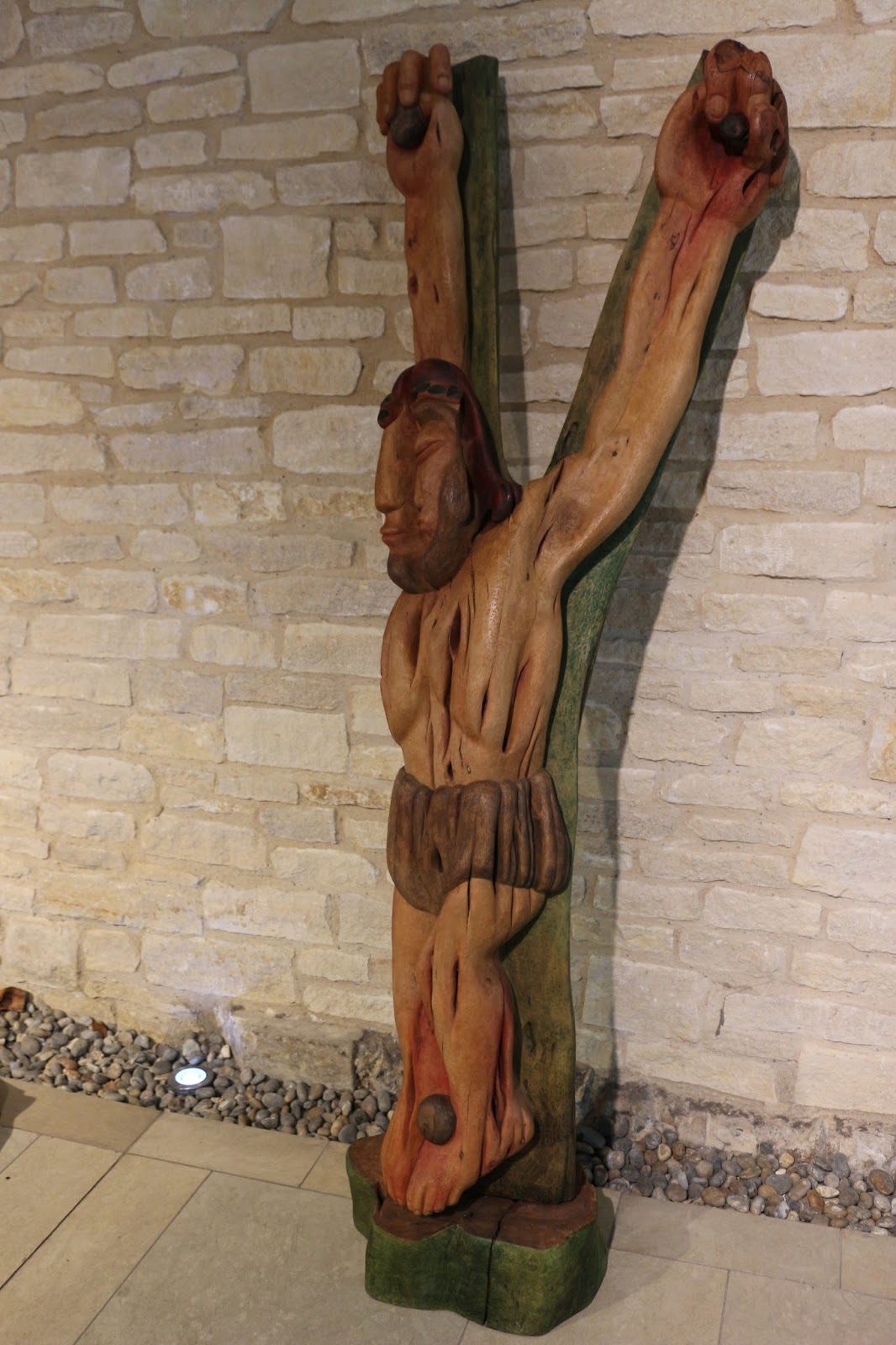
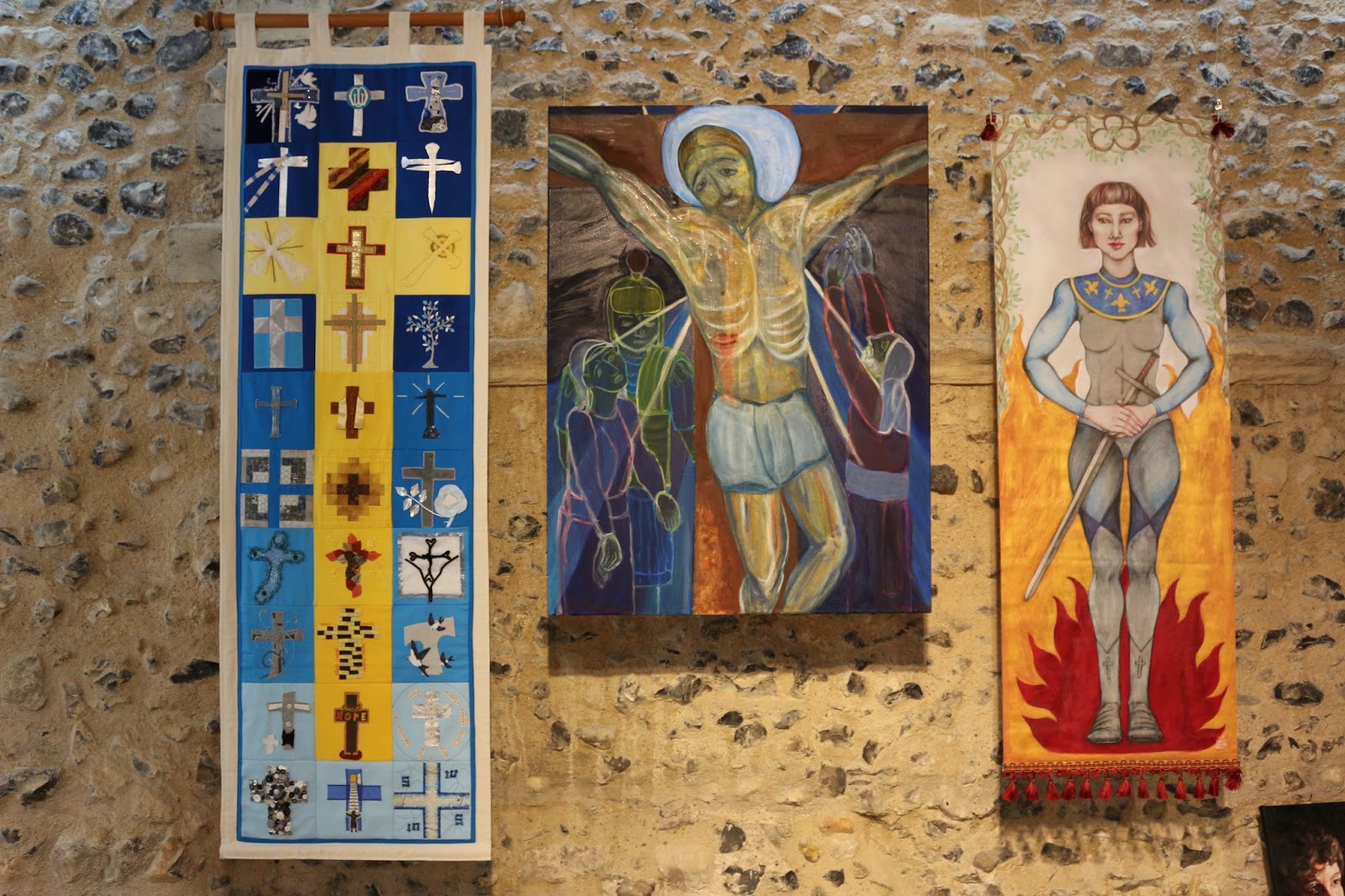
The exhibition is based on personal responses to the cross through designs, concept drawings, digital prints, wood & stone carvings, pottery & jewellery, textiles, sculpture, paintings and drawings.


The exhibition is free to attend. It will be open from 9.30am – 4.30pm Monday to Saturday and 10.00am – 3.00pm on Sundays.

The exhibition includes work by: Hayley Bowen, Harvey Bradley, Irina Bradley, Jonathan Evens, Terry Ffyffe, Rob Floyd, Dorothy Gager (USA), Maurizio Galia (Italy), Michael Garaway, John Gentry, Michelle Gillam-Hull, Clorinda Goodman, Judy Goring, Deborah Harrison, Tim Harrold, Anthony Hodgson, Jean Lamb, Mark Lewis, David Millidge, Victoria Norton, Colin Riches, Janet Roberts, Henry Shelton and Peter Webb. In addition, a church congregation project has been completed by members of St Mark’s Church, Oulton Broad, Suffolk where people of all ages contributed individual crosses for a large banner to be displayed at this exhibition, as well as later in their church.


commission4mission is also organising a programme of art talks during the exhibition. These will include interpretations of The Cross in contemporary art and culture, exploration of issues in contemporary commissioning, and an exposition on themes from ‘The Bridge’ using spoken word, poetry and song. The programme includes:
  • Understanding abstraction as a door to the spiritual – 2.30pm, Thursday April 20th (The Hostry) – Understanding abstraction as a door to the spiritual: Mark Lewis will offer thoughts about the way in which abstraction, particularly in its non-objective form, can give access to spiritual experience or awareness. In doing so, he will use his works included in ‘The Cross’ exhibition to illustrate his thoughts and ideas.
  • Icons in the Making – 5pm, Saturday 29 April (Weston Room) – Icons in the Making by Dr Irina Bradley: The lecture will explore the history of Byzantine art as well as the icon painting process with its rich symbolism and spirituality. Dr Bradley is a scholar and an icon painter, who was awarded a PhD for her thesis Spiritual Striving in Icon Painting with the emphasis on images of St George and the Dragon and a series of icons and contemporary paintings she created. Upon her graduation Dr Bradley’s work was exhibited at the Prince’s School of Traditional Arts in London, where she undertook her studies and where she is a visiting tutor for the MA and general public programs. Dr Bradley’s work is worldwide including churches, private chapels and private collections.
  • Congruity and controversy: exploring issues for contemporary commissions – 2.00pm, Monday 1 May (Weston Room) – St Stephen Walbrook in the City of London has been described as one of the few in which the genius of Sir Christopher Wren shines in full splendour. As Priest-in-charge at St Stephen Walbrook, Revd Jonathan Evens is regularly called on to tell the story of how this English 17th-century masterpiece by Wren acquired a modern altar by Henry Moore complemented by a circular re-ordering and further commissions from Patrick Heron, Hans Coper and Andrew Varah. In this lecture Jonathan will show how this story brings into focus some of the key issues and questions regarding modern or contemporary commissions while furthering discussion of those same issues.
  • Exposition on ‘The Bridge’, 12 & 19 May, 1.00pm (The Hostry) – Exposition of ‘The Bridge’: Anthony Hodgson will take the viewer on a journey exploring the themes of his painting ‘The Bridge’ by using spoken word, poetry and song.
  • Interpretations of the Cross in Contemporary Art and Culture, 2.30pm, 20 May (Weston Room) – ​In today’s secular society, it is perhaps surprising that artists still find themselves drawn to the Christian cross as a means of expression. The cross has never been an event about which one can remain neutral; from the start it was an offence. Contemporary artists’ interpretations have taken many forms. Wendy McTernan will look at some examples and see how, in unexpected and sometimes shocking ways, Jesus’ story becomes part of theirs – and ours.​


------------------------------------------------------------------------------------------------

Van Morrison - Full Force Gale.

Monday, 17 April 2017

Stations2017: Stations of the Cross


Stations of the Cross grew out of a collaboration between Mark Dean (artist), Lizzi Kew Ross (choreographer) and Lucy Newman Cleeve (curator).

It brought together 14 video works by Mark Dean that re-interpret the Medieval tradition of making a spiritual pilgrimage through contemplation of the path Jesus walked to Calvary on the day of his crucifixion. The videos are not literal depictions of this journey. They rely upon Dean’s trademark appropriation of iconic film and video footage and music, to introduce visual and aural puns that behave as the generators and interrogators of meaning within the work, setting up a series of disputations between the different elements being sampled. They were projected onto the circular Henry Moore altar at St Stephen Walbrook throughout the night on Easter eve. Audience members were invited to stay for the duration but free to come and go, as part of a vigil event that culminated in a performance of A Prelude to Being Here by Lizzi Kew Ross and Co, and an optional dawn eucharist.

Stations of the Cross was the first of a 2-part series, the second of which takes place on 26th April at St Paul's Cathedral. Tickets can be booked here. The event at St Paul's includes the premiere performance of Here Comes The Sony, a 12 monitor video and sound installation by Mark Dean that re-interprets the less definitive tradition of the Stations of the Resurrection, which emerged to encourage meditation on the resurrection appearances of Jesus, and will be installed for the first time under the dome of St Paul’s Cathedral during Eastertide. Being Here, devised by choreographer, Lizzi Kew Ross and the dancers, connects the two events and will be performed in the middle of the circular stage formed by the placement of the television equipment. It combines images of human presence, comfort, hope, loss and regret implicit in the Resurrection stories with the shifting qualities of colour and sound formed by the installation. While not enacting the narratives, the dance performance is an interpretation of the moment, producing a sense of a shared journey and progression through time and space and enabling the audience to curate the tension and the distance between the installation and their own responses.

St Stephen Walbrook, designed by Christopher Wren in 1672, accommodates the first classical dome to have been built in England and was his prototype for the dome of St Paul’s Cathedral. Wren designed his churches to be ‘auditories’ in which everyone present could see, hear and feel themselves part of the congregation. Stations of the Cross and Stations of the Resurrection function in a similar way to the Mystery Plays, providing a contemporary re-interpretation of the story of Easter. The audience is an integral part of each event that, like the Visitatio Sepulchri liturgical dramas from the 10th - 11th centuries, are firmly placed in local contexts and intended to involve the whole community.

For more information visit: stations2017.org

Supported by The City of London Corporation, The Chapter of St Paul's Cathedral, The Diocese of London, Capital Vision 2020 Creatives Network, The Jerusalem Trust, commission4mission, Trinity Laban Conservatoire of Music and Dance, Shoot the Sound, gigCMO and the Worshipful Company of Marketors.

-----------------------------------------------------------------------------------------------

The Beatles - Here Comes The Sun.

Resurrection - The only way is up!

Here's the sermon I preached in yesterday's 8.00am Eucharist at St Martin-in-the-Fields:

In his great book The Gulag Archipelago Alexander Solzhenitsyn wrote of the way the Siberian labour camps to which the Soviet government consigned those they deemed enemies of the state robbed him of everything that makes life meaningful: “He is robbed of his name – he is known only by a number. He is robbed of books and pen and paper – a dreadful deprivation for a writer of his stature. He is robbed of work he can do with dignity. Instead he must labour as a slave. He is deprived of sufficient food and sleep. He gets no letters. He hears no news of his family or of the outside world. He is stripped of his own clothes and dressed in verminous rags. He is robbed of his health – he succumbs to cancer.

Solzhenitsyn, robbed of everything, sinks as it were to the bottom, to the very base of being. And then he says something extraordinary. He writes of the day, ‘when I deliberately let myself sink to the bottom and felt it firm under my feet – the hard rocky bottom which is the same for all.’

On the Friday that we call ‘good’, Jesus too descends to rock bottom. He is betrayed by a friend, arrested, deserted and denied by his friends, falsely accused, wrongly condemned, beaten and mocked, before being killed by extreme torture. More than this even, scripture implies that in death Jesus descends to hell and, if hell is separation of God and the absence of all that is good, then, because Jesus cries out “My God, my God, why have you abandoned me?” we can understand that he enters hell.

As a result, we can say that however low you go Jesus has already been there and that it is Jesus that we find when we, like Solzhenitsyn, reach rock bottom. He is the rock that we find when we have lost everything that is ours or have reached the outer limits of who we understand ourselves to be. He is the firm foundation on which a different way of life can then be built because when you do reach rock bottom and find there a firm foundation on which to stand, then the only way to go is up.

Some of you will remember these lines from Yazz’s No. 1 song:

“We've been broken down / To the lowest turn / Being on the bottom line /
Sure ain't no fun ... / I wanna thank you / For loving me this way / Things may be a little hard now / But we'll find a brighter day

Hold on, hold on / Hold on, Won't be long

The only way is up, baby / For you and me now / The only way is up, baby /
For you and me now”

That is what we celebrate today and that is why this is an Easter Day sermon and not the Good Friday sermon that it has appeared to be so far. Jesus reached rock bottom on Good Friday but that was not where the story ends. For Jesus, the resurrection meant that the only way for him, following Good Friday, was up. And because Jesus dies and is resurrected as the forerunner for each one of us, this can be our experience too. Jesus went into the depths of human sin and suffering to save us, to bring us up and out from our depths of sin and suffering into new life together with him; a life in which resurrection has begun to be our experience and will become our eternal experience.

This change was brilliantly captured in a sermon that the American preacher and sociologist, Tony Campolo has made famous. A sermon based on the repeated line; “It’s Friday, but Sunday’s coming”:

“It was Friday, and my Jesus is dead on a tree. But that’s Friday, and Sunday’s coming.

Friday, Mary’s crying her eyes out, the disciples are running in every direction like sheep without a shepherd. But that’s Friday, and Sunday’s coming.

Friday, some are looking at the world and saying, “As things have been, so they shall be. You can’t change nothing in this world! You can’t change nothing in this world!” But they didn’t know that it was only Friday, and Sunday’s coming.

Friday, them forces that oppress the poor and keep people down, them forces that destroy people, the forces in control now, them forces that are gonna rule, they don’t know it’s only Friday, but Sunday’s coming.

Friday, people are saying, “Darkness is gonna rule the world, sadness is gonna be everywhere,” but they don’t know it’s only Friday, but Sunday’s coming.

Even though this world is rotten, as it is right now, we know it’s only Friday. But Sunday’s coming!”

St John in his Revelation prophesies: “I saw Heaven and earth new-created. Gone the first Heaven, gone the first earth, gone the sea. I saw Holy Jerusalem, new-created, descending resplendent out of Heaven, as ready for God as a bride for her husband. I heard a voice thunder from the Throne: "Look! Look! God has moved into the neighborhood, making his home with men and women! They're his people, he's their God. He'll wipe every tear from their eyes. Death is gone for good—tears gone, crying gone, pain gone—all the first order of things gone." The Enthroned continued, "Look! I'm making everything new.” (Revelation 21. 1-5, The Message)

There is light at the end of the tunnel. Ain’t no valley low enough to keep us from Jesus, even the valley of the shadow of death. A change is gonna come. The times, they are a’changin’. We can move on up to our destination. We will rise from the ruins. The only way is up. The songs and the clichés find their truth in Jesus and his resurrection which is the promise of our own personal resurrection and the resurrection of our world itself.

-------------------------------------------------------------------------------------------

Yazz & The Plastic Population - The Only Way Is Up.

Saturday, 15 April 2017

The Improbable Resurrection

Here is my sermon from tonight's Easter Vigil Service at St Stephen Walbrook:

“Sherlock Holmes once remarked to Dr Watson that, ‘When you have eliminated the impossible, whatever remains, however improbable, must be the truth.’

This is what motivates Professor John Polkinghorne. As a Cambridge physicist he might be expected to disbelieve such an extraordinary miracle as resurrection, which appears to contravene the laws of nature. But in fact, it is the cornerstone of his faith. Reflecting on the remarkable rise of the early Church, he concluded: ‘Something happened to bring it about. Whatever it was it must have been of a magnitude commensurate with the effect it produced. I believe that was the resurrection of Jesus from the dead.’

“Only a tiny handful of people have founded immense, influential movements. They shared three vital assets:

• a charismatic personality
• a long life
• a fast growing number of committed followers

Muhammad is a good example. He died in his sixties after a very energetic life. His following had momentum -lots of people, good organisation, a buoyant mood. So it's no surprise to find that Muhammad's charisma gave rise to a great movement, known today as Islam.

The single exception to the 'long life and growing movement' rule is Jesus. He died young - in his thirties. He spent only three years in the public eye and that in a small country under enemy occupation. He stayed local and didn't write anything down (apart from a word or two in the sand). Towards the end his popularity ran out and his followers ran away, their lofty dreams shattered.

To sum up ... it was quite impossible for this sequence of events to give rise to a movement of any size or consequence, let alone the largest movement in all history. Yet ... IT DID!”

(John Young, Build on the Rock – Faith, doubt and Jesus’)

As Sherlock Holmes remarked, ‘When you have eliminated the impossible, whatever remains, however improbable, must be the truth.’

We are not speaking here of proof. Just as the existence or non-existence of God cannot be conclusively proved and is therefore, for both Christians and atheists, a matter of belief; so the resurrection cannot be conclusively proved or disproved and, on both sides, is ultimately a matter of belief.

What is being said though is that we have to make sense of the historical facts about the remarkable rise of the Early Church and that belief in the resurrection makes sense of that story. As John Polkinghorne has said, ‘Something happened to bring it about. Whatever it was it must have been of a magnitude commensurate with the effect it produced.’

More than that, the Christian story of Jesus’ life, death and resurrection makes sense of life itself. For the early Church and for Christians ever since, this story enables us to understand life, to make sense of it, to see it as a journey with meaning, purpose and an ultimate destination which is not death and destruction but new life and rebirth.

Death AND resurrection. Suffering AND salvation. This is the journey which Christians make, following in the footsteps of Jesus, as we travel through Lent and Easter. While it is a journey which in no way minimises the reality and pain of suffering and bereavement, it is ultimately a journey of hope. One which leads to new life, where we proclaim that Jesus is alive and death is no longer the end.

As a result, to go on this journey, builds resilience and endurance in those who travel this way. As we look at our lives, the difficulties and challenges we might face, our Christian faith tells us that this is not the end instead change and new life are possible; indeed, that they will come. The story of Christ’s death and resurrection takes us forward into a new life. The reality of his presence with us on the way helps us endure and persevere. The combination of the two brings hope for the future. Whatever we may experience in the here and now, ultimately Love wins.

In his book ‘Surprised by Joy C.S. Lewis sets out the series of moves which led him to faith in God, using a chessboard analogy’: ‘What Lewis describes in Surprise by Joy is not a process of logical deduction: A therefore B, therefore C. It is much more like a process of crystallisation, by which things that were hitherto disconnected and unrelated are suddenly seen to fit into a greater scheme of things ... Things fall into place ...

It is like a scientist who, confronted with many seemingly unconnected observations, wakes up in the middle of the night having discovered a theory which accounts for them ... It is like a literary detective, confronted with a series of clues, who realises how things must have happened, allowing every clue to be positioned within a greater narrative. In every case, we find the same pattern – a realisation that, if this was true, everything else falls into place naturally, without being forced or strained. And by its nature, it demands assent from the lover of truth. Lewis found himself compelled to accept a vision of reality that he did not wish to be true, and certainly did not cause to be true ...

Lewis finally bowed to what he now recognised as inevitable. “In the Trinity Term of 1929 I gave in, and admitted God was God, and knelt and prayed: perhaps, that night, the most dejected and reluctant convert in all England.”

Lewis ... realised that if Christianity was true, it resolved the intellectual and imaginative riddles that had puzzled him since his youth ... he began to realise that there was a deeper order, grounded in the nature of God, which could be discerned – and which, once grasped, made sense of culture, history, science, and above all the acts of literary creation that he valued so highly and made his life’s study.’

(Alister McGrath, C.S. Lewis: A Life)

So, we have seen that belief in the resurrection not only makes sense of the rise of the Early Church but also can make sense of life itself, seeing it as a journey with meaning, purpose and an ultimate destination which is not death and destruction but new life and rebirth. This gives us a means of enduring the difficulties and challenges we face now with resilience and endurance because of our belief that this is not the end and that change and new life are possible and will come.

As a result, the story of Christ’s death and resurrection takes us forward into a new life. The reality of his presence with us on the way helps us endure and persevere. The combination of the two brings hope for the future because whatever we may experience in the here and now, ultimately Love wins. That is what made sense to John Polkinghorne and C.S. Lewis and is also what has made sense for millions of Christians over the centuries since that first Easter Day. May we also know Christ’s resurrection not only making sense for us but also making sense of our lives too.

--------------------------------------------------------------------------------------------

Mark Heard - Rise From The Ruins.    


How religion became the bedrock of modern rap

Today Ryan Bassil explores in The Guardian how, from Stormzy to Kendrick Lamar, rappers are referencing Christianity in their music more than ever before:

'Kanye West’s follow-up to 2013’s Yeezus (no guesses there), The Life of Pablo, was inspired in part by Paul the Apostle. Chance the Rapper’s Coloring Book – SoundCloud’s most popular album of 2016 – is an overt reimagining of gospel. Stormzy’s aforementioned debut album repeatedly references his faith, while evangelical themes are also the bedrock of Kendrick’s career. His breakthrough album, Good Kid, M.A.A.D City, is built around the sinner’s prayer and his magnum opus, To Pimp a Butterfly, loosely manoeuvres through conversations with Satan and God ...

By placing their faith among rap tropes, these artists are drawing attention to the multifaceted lifestyle of modern believers.'

------------------------------------------------------------------------------------------

Chance the Rapper - Blessings.

Windows on the world (340)


Margate, 2016

----------------------------------------------------------------------------------

Friday, 14 April 2017

Concrete crucifixions


For The Cross: designs & reflections exhibition by commission4mission in The Hostry at Norwich Cathedral I have visually reworked the poetic meditations I wrote for The Passion and those based on the Nine Lessons & Carols readings. Following the inspiration of concrete poetry, I have re-designed both meditations into cross shaped sequences which then explore the cross in content and design. 

The Passion: Reflections & prayers features pictures, poems and prayers by Henry Shelton and I which enable us to follow Jesus on his journey to the cross reflecting both on the significance and the pain of that journey as we do so and published as a double-sided A3 sheet with all the images, haiku-like meditations and prayers laid out in sequence for ease of devotional use.

My alternative Nine Lessons are poetic meditations drawing on the thinking of René Girard in interpreting the Bible readings traditionally used in services of Nine Lessons and Carols.

-------------------------------------------------------------------------------------------

Larry Norman - Be Careful What You Sign.