Wikio - Top Blogs - Religion and belief

Saturday, 20 May 2023

Windows on the world (426)


 London, 2023

----------------------------------------------------------------------------------------------------------------

To Kill A King - Compassion Is A German Word.

Thursday, 18 May 2023

Art Trail with exhibitions & poetry reading


Saturday 20 May: 9.30 am – 4.00 pm, Wickford and Runwell Art Trail

See artworks by Val Anthony, William Butterfield, Enid Chadwick, Antony Corbin, Christine Daniels, David Folley, David Garrard and Julia Glover at St Andrew’s, St Catherine’s and St Mary’s churches, plus the photographic exhibition at the Salvation Army, Jackie Burns’ Space Art at St Andrew’s, Tim Harrold’s assemblages at St Catherine’s and paintings by Pam Jones at St Mary’s.

Art talks/tours at St Andrew’s (10.00 am), St Catherine’s (11.30 am), and St Mary’s (2.00 pm). The artworks in these churches feature in a case study for the Gods' Collections project. Jackie Burns will paint live at St Andrew's Church throughout the day and Mike Fogg will give a talk on Composition in Photography at The Salvation Army at 11.00 am.

Jackie E. Burns is a Fellow of the International Association of Astronomical Artists and seeks to foster the inquisitive joy of art and astronomy while inspiring people to the awe and beauty of space and astronomy. Her One Beautiful World exhibition of space art by Jackie E. Burns is at St Andrew's until 23 July 2023.

Friday 19 and Saturday 20 May, 10.00 am to 4.00 pm: One Beautiful World photographic exhibition by Compass Photography at The Salvation Army, Jersey Gardens, Wickford SS11 7AE.

Photographs by Mike Fogg and Terry Joyce of the Essex based Compass Photography Group whose approach is summed up in a quote attributed to Matt Hardy, a Dorset based photographer: “Beauty can be seen in all things, seeing and composing beauty is what separates a snapshot from a photograph.”

Mike Fogg will give a free talk (50mins) at 11am in The Salvation Army on the Saturday, as follows:

Composition in Photography – Mike Fogg FCIPS: When you “take a photograph” you are really creating a work of art! Many of the same principles that apply to artists apply to photographers. In this session, Mike will use examples of his own “good” and “bad” photographs to highlight a number of easy to grasp techniques which will allow participants to improve their own photographs. In both 2019 and 2021 Mike won an international photography competitions with his images.

Saturday 20 May: 4.00 pm, St Catherine’s Church: One Beautiful World poetry reading with Tim Harrold and Jonathan Evens

Tim Harrold is a poet who creates images of profound challenge and change, of pause and process, of chrysalis and catalyst. His most recent publication is ‘Verses versus Viruses’. Jonathan Evens is a creative writer whose poems and stories have been published by Amethyst Review, International Times and Stride Magazine.

What to see at St Mary's, St Catherine's and St Andrew's:

St Mary's Runwell is a magnificent mediaeval building which boasts an interesting and mixed history. The church is often described by both visitors and regular worshippers as a powerful sacred space to which they have been drawn. This powerful impact comes in part from the art and architecture in the space.

The colouring of the screen at St Mary's and the murals the one pillar in the south aisle dates from the 1930s-1950s and was undertaken, by his sons, under the guidance of then Rector, Revd John Edward Bazille-Corbin to 'reproduce as closely as possible' the decoration of the medieval church. The painting of St Peter and the crucifix below it were by Anthony Corbin and are 'restorations of medieval work which had been well and truly scraped out, but the traces of which could, at that date, still be faintly seen.' The large painting of 'The Baptism of Our Lord' by Enid Chadwick of Walsingham was gifted to the church by Fr David John Silk Lloyd. Local woodworker David Garrard has crafted Stations of the Cross using the motif of the Runwell Cross which have been placed around the church. Garrard also built an altar for the side chapel together with an inscribed cross on the side chapel wall.

The building of St Catherine’s Wickford is beautiful and peaceful and is like a beacon on the hill. There has been a church on the site for hundreds of years but the present building dates back to 1876 and is Grade II listed; however, there are records showing a church has been in existence since 1154. Throughout most of its existence, the story of St Catherine's has been one of a small country church serving a village community. From the late 20th Century, this role has changed dramatically and today it ministers to a large bustling town. Although much of the village has been lost under bricks and tarmac, the church and churchyard still seem to retain an atmosphere of the rural heritage of Wickford's past.

The reredos at St Catherine's was given to the church by Vicar and Churchwardens of All Saints' Margaret Street. It is by William Butterfield, the architect of All Saints, and is said to be one of the finest of its kind. Additionally, on the West wall of the church is a small part of a wall painting, believed to have been salvaged from the previous building. The church also has a range of stained-glass, each with their own dedication, which range from the Madonna and Child to the Crucifixion and on to depictions of saints.

St Andrew’s Wickford was rebuilt in the 1960s: the church’s simple, spacious interior has been enhanced over the years by the skill of church members who have designed and made banners, window paintings, altar frontals and kneelers. St Andrew's has stained-glass by local artists Val Anthony and Christine Daniels and banners by Julia Glover, plus a hidden painting by internationally exhibited artist David Folley. Folley's large 'Descent from the Cross' is a major work by an artist who has exhibited widely across the UK and Europe, including at the Royal Society of Portrait Painters, in London, in Sweden and Germany, and at important contemporary international art fairs in Edinburgh and Dublin.

--------------------------------------------------------------------------------------------------------

Wednesday, 17 May 2023

A conversation that explores how we shall now live and who it is that is our neighbour

Here's the sermon I shared at St Andrew’s Wickford this morning:

St Paul began a discussion when he stood before the Areopagus and spoke about an altar with the inscription, ‘To an unknown god’ (Acts 17.22-31). The Areopagus was the rock of Ares in Athens, a centre of temples, cultural facilities and high court, and also the name of the council that originally served as the central governing body of Athens, but came to be the court with jurisdiction over cases of homicide and other serious crimes. In speaking to the Areopagus Paul was giving a guest lecture, whilst also being, in some senses, on trial.

Pope John Paul II likened the modern media to the New Areopagus, where Christian ideas needed to be explained and defended anew, against disbelief and the gold and silver idols of consumerism. Understanding how St Paul did so in the original Areopagus can assist in understanding how we might initiate or contribute to debate and dialogue in our own day and time, whether virtually or in person.

Paul began where people were by referring to the altar to an unknown god which was to be found amongst the cluster of temples around him. He didn’t criticize those to whom he was speaking. Instead, he commended the breadth of their engagement with religion. He didn’t tell them they were wrong by suggesting they were pagans worshipping the wrong god or gods. Instead, he overaccepted their religious story fitting it into the larger story of what he believed God was doing with the world. Nor did he dismiss their culture. Instead, he made it clear that he had heard and appreciated their poets by making connections between those poets and the message he had come to share. In these ways, he began a dialogue with them about the nature of faith and its engagement with their lives and culture. We read that some scoffed but others said, ‘We will hear you again about this’, and some joined him and became believers.

Paul was able to be in Athens because he had a trade – tentmaking – which enabled him to be supported financially as he travelled and which opened doors and provided contacts that might not otherwise have been open to him. In each place to which he travelled he formed new congregations led by those who came to faith. In each place that he visited he went to the synagogue and sought to speak with those at the heart of the Jewish community, but also welcomed those who were on the edge, often Gentiles, slaves and servants.

Over the past year we have been making use of the HeartEdge model of mission in this parish. It’s called the 4Cs – compassion, culture, commerce and congregation. It is a pattern for ministry that we share with other churches throughout the UK, and the world, through the movement to renew the church that is called HeartEdge. HeartEdge is about churches developing these 4Cs. Generating finance and impacting communities via social enterprise and commerce. Culture, in the form of art, music, performance, that re-imagines the Christian narrative for the present. Congregations that develop welcoming liturgies, worship, and day-to-day communal life while also addressing social need and community cohesion. Nurturing each of these is essential for renewal of the church.

HeartEdge churches are seeking to begin and develop a conversation with our communities and nations, as Paul sought to do in Athens. As one example, St Mark’s Church in Pennington, within the Diocese of Winchester, used their churchyard hedge as a site for yarn bombing to focus the attention of their community on Holocaust Memorial Day, Holy Week and Easter, and the VE Day anniversary. Organising online community events and services combined with the organisation of knitting and crochet work for the different yarnbombs placed St Mark’s at the heart of their community while connecting many who were isolated because of the Covid-19 lockdown. St Mark’s demonstrated that the boundaries of ‘church’ should be much more porous than they had previously imagined. Rachel Noel, the Vicar of St Mark’s, said she hoped that we will all get so used to worshipping with, and being led by, a variety of people, that we will always seek to find ways to include and value diversity and richness.

As with Paul in Athens and HeartEdge churches like St Mark’s Pennington, we are seeking to connect compassion, culture, commerce and congregation to draw all engaged in those forms of community into a conversation that explores how we shall now live and who it is that is our neighbour.

What we have done over the past year has begun a conversation where the ‘good news’ of community compassion and culture, with church at the heart and on the margins, can be heard and is being valued. We are inviting others to join that conversation, to have their say, so that the margins can speak to the centre that we might encounter God in everyone.

As we do so, we will together find a story which connects a series of otherwise inexplicable circumstances, begin to live in that story and then act our part within it. In this way, like those who joined Paul in Athens, we, too, may discover it is the story of what God is doing with the world that reveals where we are and what we are to do.

-------------------------------------------------------------------------------------------------------

Pissabed Prophet - Waspdrunk.

Sunday, 14 May 2023

Awake, my soul!

Awake, my soul! from St Mary’s Runwell was livestreamed and can be watched at https://www.facebook.com/WickfordandRunwellCofE/videos/141883318872982.

Awake, my soul! is a unique event combining performances of new sacred music with discussion. Performed by acclaimed violinist Emma-Marie Kabanova, this interactive event features new psalm-inspired works written by an international collection of Jewish and Christian composers. It was curated and produced by Deus Ex Musica with Delvyn Case presenting.

PROGRAMME
  • Introduction Delvyn Case
  • *My heart within me is desolate (Psalm 143:4) Judith Lang Zaimont
  • Why do you bury your face in the pillow? (Psalm 44) Ng Yu Hng
  • *Psalm 133 Delvyn Case
  • *Ura (Psalm 57) Michel Klein
The performance of each piece was followed by an informal discussion moderated by Delvyn Case.

*These three works appear on SEARCH ME, O GOD, a unique recording that brings together over a dozen world-class composers and performers to explore the psalms through contemporary music. This interfaith and ecumenical project is a collaboration among artists representing Jewish, Protestant, Roman Catholic, and Eastern Orthodox traditions. Available on all streaming platforms, or listen for free at www.deus-ex-musica.com/search-me-o-god.

------------------------------------------------------------------------------------------------------------------

Deus ex Musica - Awake, my soul! 

Windows on the world (425)


 London, 2023

------------------------------------------------------------------------------------------------------------------

The Amazons - How Will I Know?

I have not left you as orphans

Here's the sermon that I preached at St Andrew's Wickford this morning:

In his poem Flood: Years of Solitude, Dionisio D. Martínez raises a glass:

“To the one who sets a second place at the table anyway.
To the one at the back of the empty bus.
To the ones who name each piece of stained glass projected on a white wall.
To anyone convinced that a monologue is a conversation with the past.
To the one who loses with the deck he marked.
To those who are destined to inherit the meek.
To us.”

Bob Dylan famously asked “How does it feel to be on your own?” and Martínez captures the experience perfectly in the opening lines of his poem by conjuring up for us “the one who sets a second place at the table anyway” and “the one at the back of the empty bus.”

Jesus spoke to his disciples about the fact that he would shortly leave them. Firstly, he was about to be killed and they would be left bereft as a result. Secondly, after his resurrection, he would ascend and return to God his Father. He would be gone, yet he would not leave them, and would not leave them orphaned. His discourse at the Last Supper is intended to show how those two seemingly contradictory things can both be true and how, as a result, they would not find themselves in the situation described by Martínez.

Jesus promised that, following his ascension, he would send his Spirit to be with his disciples and be in them (John 14:15-21). That is what happened on the Day of Pentecost. The Holy Spirit is sent to act as a helper for them. The Greek word used is paracletos. There is more than one way of translating this – ‘comforter’ or ‘helper’ (providing whatever is needed to fulfil God’s plan), ‘advocate’ (one who will speak up for us), or ‘intercessor’ (one who will pray and mediate between us and God).

The Holy Spirit can be all of these things for us. Jesus has sent the Spirit to us and so we can ask for his comfort and help in our need, for his advocacy with God when we need to repent, and for the Spirit to give us the words to pray to God when we don’t know what to say. Jesus knew that life would be tough for the disciples after he returned to the Father, so he provided for them at their point of need and does the same for us too.

The Spirit is Jesus with us and in us forever, as well as the one who continues to reveal Jesus to us. As the disciples found after Pentecost, when we have the Spirit of Jesus in us and reminding us of all that Jesus did and said, we are increasingly able to live as Jesus did.

This is where Jesus’ words about his commandments come into play. Jesus said, ‘If you love me, you will keep my commandments’ and ‘They who have my commandments and keep them are those who love me’. What are his commandments? When Jesus was asked to give his summary of the law, he said: ‘You shall love the Lord your God with all your heart and with all your soul and with all your mind.’ This is the greatest and first commandment. And a second is like it: ‘You shall love your neighbour as yourself.’ On these two commandments hang all the Law and the Prophets.” Then, at the last supper, he said: ‘I give you a new commandment, that you love one another. Just as I have loved you, you also should love one another. By this everyone will know that you are my disciples, if you have love for one another.’

Therefore, his commandments are simply that we love; love God, love one another and love ourselves. And these commandments are taken up and repeated throughout the New Testament. In the first letter of John we read: “The command that Christ has given us is this: whoever loves God must love his brother also.” (1 John 4: 21) Similarly, St Paul talks about obeying the law of Christ. How does he describe the law of Christ? “… the whole Law he says is summed up in one commandment: ‘Love your neighbour as you love yourself.’” He goes on to say that we obey the law of Christ by bearing one another’s burdens.

Christianity then has a simple core, which is love. It is not about a lengthy list of do’s and dont’s. It is not about a detailed set of laws covering each and every eventuality. It is not about rules and regulations. It is not about those things, but it is about love. At the heart of all the laws and commandments which the Bible contains there is love and if we are not loving in the way in which we understand and apply the laws and commandments found in the Old Testament then we work against the thing which is at their heart, which is their spirit, which is love.

When he summarised the law for the Pharisees, Jesus was saying that there are three loves; love of God, love of neighbours (by which he meant particularly those in need and those who are our enemies) and love of self. All three are legitimate but all three are not equal. The greatest commandment is to love God with all that we have and are. The second is to love ourselves and to love others in the same way that we love and accept ourselves. The second follows from the first because it is only in a love relationship with God that we are able to accept ourselves as we really are and therefore are able to accept and love others as we accept and love ourselves.

As ever, we see this lived out by Jesus. In John chapter 13 we read about the occasion on which Jesus demonstrated his service of his disciples by washing their feet. John tells us that: “Jesus knew that the Father had given him complete power; he knew that he had come from God and was going to God. So, he rose from the table … and began to wash the disciples’ feet.” It was because Jesus knew and accepted who he was that he was then able to love and serve his disciples. When we know that we are unconditionally loved by God then we are set free for the risk of loving others in the same way.

The particular kind of love that is at the heart of Jesus’ life and which is at the heart of the Bible is a love that serves. Jesus said: “The greatest love a person can have for his friends is to give his life for them.” Likewise, Paul says to the Galatians: “let love make you serve one another.”

This gives us another reason why we will not be alone although Jesus is no longer with us in the flesh. That is because he is also to be found in those we love and serve. St Martin of Tours followed in the footsteps of Jesus by getting off his horse and cutting his cloak in two to give half to a beggar shivering outside the gates of Amiens on a cold day. That night, Jesus appeared to Martin in a dream to say that Martin had clothed him. Martin met Jesus in the beggar to whom he gave his cloak and we, too, will meet Jesus in those we serve.

We are not left orphaned by Jesus because he gives us his Spirit within us, because his Spirit reminds us of all that he did and said so we can live in him and become like him and, when we do so by loving and serving others, we discover that Jesus also comes to us in the form of those we love and serve. In this way, we can be swept up in Jesus and surrounded by him; receiving his Spirit, living the Jesus life of love, and receiving him in those we love.

Gillian Welch sings a song called ‘Orphan Girl’ in which she is “an orphan on God’s highway” with “no mother no father / No sister no brother.” She prays:

“Blessed Savior make me willing
And walk beside me until I'm with them
Be my mother my father
My sister my brother”

That prayer comes true as we receive Jesus’ Spirit, the Advocate, who is given to be with us for ever. Amen.

----------------------------------------------------------------------------------------------------------

Gillian Welch - Orphan Girl.

Saturday, 13 May 2023

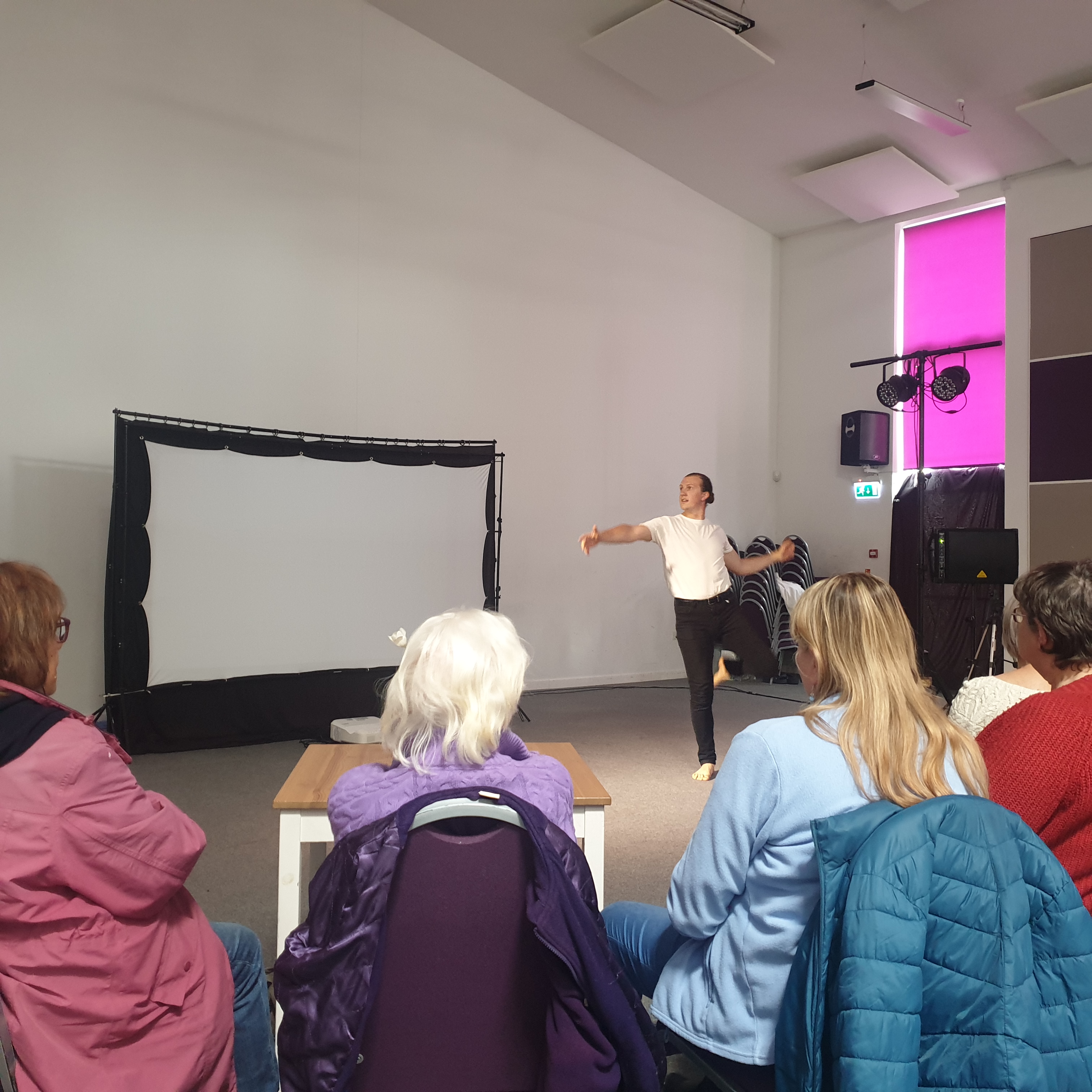
Steven Turner - One Beautiful World dance performance


Today, as part of the One Beautiful World Arts Festival, Steven Turner gave the premiere of a wonderful new dance, exploring the creation of the world and the science that holds it together. The performance included 8 new music tracks, 29 minutes of graphics edited and over 100 lighting cues programmed.

--------------------------------------------------------------------------------------------------------------

Steven Turner - Mess.