Wikio - Top Blogs - Religion and belief

Wednesday, 7 September 2022

The upside-down kingdom

Here's the reflection that I shared in today's Eucharist at St Andrew's Wickford:

In 1997 guests at Spring Harvest, an annual teaching and worship event, created a set of alternative beatitudes, which read as follows:

Blessed are the wealthy, because there is the Dow Jones index. 
Blessed are those who enjoy a good party, for they will drown their sorrows.
Blessed are the assertive, for they will get to the top of their career.
Blessed are those who hunger and thirst after chemical stimulation, for designer drugs are more widely available with every passing year.
Blessed are the ruthless, because no one will get in their way.
Blessed are the cold of heart, for they won’t get hurt when relationships break down.
Blessed are those who are involved in the arms trade, for theirs are the best deals in developing nations.
Blessed are the directors of privatised utilities, for theirs are the fat cat bonuses.

(created by Spring Harvest guests, 1997, compiled by Rob Warner)

That was a set of beatitudes for our times, a set of beatitudes which are the complete reverse of those which Jesus gave us (Luke 6.20-26). Wealth replacing poverty, partying replacing mourning, assertion replacing meekness. That is the way of the world. That is the way we are told to live today. It is the way of selfishness not the way of saintliness and Jesus calls us to something different. He calls to live as saints.

Jesus’ radical heartbeat can be sensed in every word of the Sermon on the Mount. The core of the sermon is a call for God’s people to be entirely different. One writer identifies the key text of the sermon to be Matthew 6: 8, “Do not be like them.” Like lights set on stands (Matthew 5:14), like flavourful salt (Matthew 5:13) or like saints, the children of God are not to take their cue from the people around them but from God, and to be known by their radical lifestyle.

Some of the greatest examples of the call to be different are found in the Beatitudes. The Beatitudes give us a sense of the radical kingdom lifestyle that Jesus calls us to. It is as if Jesus has crept into the window display of life and changed the price tags. It is all upside down. In a world where ‘success’ and ‘self-sufficiency’ are applauded, and ‘the beautiful people’ are ambitious, accomplished and wealthy, Jesus teaches: “Blessed are the poor in spirit.” Our culture encourages us to discard guilt and the sorrow that accompanies pangs of conscience. Happiness is everything, entertainment is king but Jesus teaches: “Blessed are those who mourn.” In our competitive world, self-help seminars teach assertiveness and power is to be sought and used but Jesus teaches “Blessed are the meek.”

Donald Kraybill writing about this upside down kingdom says: “Jesus startles us … good guys turn out to be bad guys. Those we expect to receive the reward get a spanking instead. Those who think they are headed for heaven land in hell. Paradox, irony and surprise permeate the teachings of Jesus. They flip our expectations upside down. The least are the greatest. The immoral receive forgiveness and blessing. Adults become like children. The religious miss the heavenly banquet. The pious receive curses. Things aren’t like we think they should be. We’re baffled and perplexed. Amazed we step back. Should we laugh or should we cry? Again and again, turning our world upside down, the kingdom surprises us.”

The difference that Jesus highlights, David Oliver and Howard Snyder argue, is between Church people and Kingdom people. Kingdom people seek first the kingdom of God and its justice. Church people often put church work above work, above concerns of justice, mercy and truth. In the church business people are concerned with church activities, religious behaviour and spiritual things. In the kingdom business, people are concerned with kingdom activities, all human behaviour and everything which God has made, visible and invisible. Church people don’t usually like parties, alcohol or bad people. The King of the kingdom liked all three. When Christians put the church ahead of the kingdom, they settle for meetings and spend increasing amounts of time with the same people. When they catch a vision of the kingdom of God, their sight shifts to the poor, the orphan, the widow, the refugee, the wretched of the earth, and to God’s people. They also see with real insight and fresh vision the stressed, the fearful, the hopeless at work and both their heart and time reach out. If the church has one great need, it is this – to be set free, for the kingdom of God, to be set free to become relevant exactly as God intended.

We are called to be kingdom people, called to be saints who act out the upside-down values of the kingdom in all of our life and work. God calls us to turn our backs on the kingdoms of this world and simply maintaining the churches and piety of this world and to embrace an upside-down home. How will we respond?

Based on King of the Hill, Spring Harvest 2001 Study Guide by Jeff Lucas

----------------------------------------------------------------------------------------------------------

Delerious? - Love Will Find A Way.

Monday, 5 September 2022

Runwell Art Club exhibition


Today we have set up the second of three exhibitions in St Andrew's Wickford (11 London Road, Wickford, Essex SS12 0AN) this autumn. This exhibition is by the Runwell Art Club and features animals, children and nature, as a complement to Nicola Ravenscroft's mubcub sculptures. The third exhibition will be a heritage display on Wickford’s children by Basildon Heritage from 18 September – 22 October (followed by a display on Wickford’s shops).

We are holding an Opening Event for the autumn exhibitions at St Andrew's Wickford on Friday 16 September at 7.00 pm. The exhibition’s Opening Event is part of our new programme of regular Friday night arts and performance events called 'Unveiled' which will include concerts, exhibitions, open mic nights, performances, talks and more! Those coming will also be able to see the hidden painting at St Andrew's; 'Descent from the Cross' by the acclaimed artist David Folley. The Opening Event will include an illustrated talk ‘Controversy and conversation: Art and churches’ on the hidden painting and other controversial works of art found in churches. All are welcome.

St Andrew’s Church is usually open: Saturdays from 8.30 am to 12.30 pm; Sundays from 9.30 am to 12.00 noon; Mondays from 1.30 to 3.45 pm; Tuesdays from 1.00 to 4.30 pm; Wednesdays from 10.00 am to 12.00 noon; and Fridays from 10.00 am to 1.30 pm. See http://wickfordandrunwellparish.org.uk/whats-on.html for fuller information.

-----------------------------------------------------------------------------------------------------------

Whitney Houston - Greatest Love Of All.

Sunday, 4 September 2022

Windows on the world (393)


 London, 2021

---------------------------------------------------------------------------------------------------------------

Karen Peris - Song For A New Day.

Creative shaping and co-operation with God

Here's my sermon from today's Eucharist at St Catherine's Wickford: 

I wonder how many of you have watched 'The Great Pottery Throw Down', a reality TV, Bake-Off style competition between potters to see who can perform the best in as many different styles of pottery as possible.

The show has had some great presenters who have been amusing, engaged and empathetic, the judges – rather than being catty and critical – are affirming – with expert ceramicist Keith Brymer Jones famously crying with pleasure whenever one of the competitors exceeds expectations. The competitors, as well as being talented potters, are always fascinating people with interesting back stories, but the ultimate star of the show, and the thing that keeps viewers tuning in, is the clay and the amazing range of artefacts that can be fashioned from it.

Clay that has been dampened and kneaded is a malleable, flexible substance that can be formed into elegant tall shapes, expansive wide forms, or moulded, pinched, cut and patted to form detailed figures or structures. It is only once the work of shaping and moulding is complete that it is fired to become hard and set in its final, finished form. Up until that point, however far the formation process has gone, it can always be returned to a lump or ball of clay and the process begun again.

That is what Jeremiah saw happening when God told him to go and view the local potter at work (Jeremiah 18: 1-11). What he saw was an initial attempt to form a pot that was unsuccessful. As a result, the potter ended his first attempt, returned the clay to its initial form and began the process again, creating a different pot from the same lump of clay.

In Jeremiah’s prophecy, the people of Israel are the clay and God is the potter shaping the people into the people of God. The people, like the clay, don’t always form in the way the potter intends and so, God returns the people to the beginning of the formation process and starts again, shaping them differently as a result of the flaw that developed and the change that resulted. The implication is that God works in a similar way in our lives and wants to do the same with us as a church and team, not just as individuals.

There are two key reflections that emerge from this image for us. Firstly, it is always possible for God to begin again with us. Second, we need to be as supple and flexible as possible in order that God can work as effectively with us as possible.

Jeremiah saw the vessel that the potter was making being spoiled in the potter’s hand, and him reworking it into another vessel, as seemed good to him. This was God’s way of showing us that it is always possible to begin again. Within all of our lives, we can go down tracks or paths in life that aren’t helpful to us and that ultimately do us harm as well as perhaps to others. We can easily think we are stuck in those ways of acting and behaving. This image or vision is God’s way of showing us that that isn’t so. There is always the opportunity for a fresh start and a new beginning. That is what Jesus offers to us through his death on the cross because there he shows us that there are no depths to which God will not go to draw us back to him and give us a new beginning. That’s what forgiveness is all about, turning around and starting again. Jesus, through his death on the cross, shows us that that opportunity is always there for us.

Kneading or wedging involves the potter in throwing the clay down and rolling it into a tight spiral before working the clay into a uniform mixture by pressing, folding, and stretching. This makes the clay more pliable, ensures a uniform consistency, and removes air pockets as well as small hard spots in the clay before you use or reuse the clay. Air added to clay bodies, can cause cracks and breaks when pots are fired in the kiln. Kneading or wedging is used to remove air from clay before it is used in hand building or wheel throwing.

Jeremiah’s image of the potter and the clay can appear to be one in which God is active and we are entirely passive. However, that is not how Jeremiah ends his reflection. He ends by calling on Israel to turn back to God. He is, therefore, looking for active co-operation with God from us. We are not inert like the clay and God can only do his creative shaping work in us, if we co-operate with him.

Unlike the inert clay, we can actively co-operate with God to enhance our flexibility and malleability by being open to change and development. Change is often what worries churches most and can be something that is resisted. For many the Church is the one unchanging element in their world and, as a result, change is resisted in order to provide the sense of security that people think they need in an ever-changing world. Yet, the reality is that change is natural and something that is always occurring throughout our lives. The cells in our bodies - trillions of them - are not all the exact same cells that we had yesterday; our body's cells are constantly replicating, creating their own replacements.

If change is natural and if change is God’s plan, then, like the clay becoming pliable enough to be shaped and moulded, we also need to develop a similar pliability in order that God can achieve a process of change in us. We can do this by pro-actively seeking change or by co-operating with change, rather than resisting it.

In 2006, the artist Theaster Gates made his home in a former confectionery store on South Dorchester Avenue in the heart of Greater Grand Crossing, one of Chicago’s most deprived areas. In 2009 he purchased the neighbouring building, which became known as the Archive House, home to 14,000 books from the former Prairie Avenue Bookshop. Reconstructed using discarded resources from across the city, it fulfils his Rebuild Foundation’s remit of regeneration via “individual empowerment and community engagement.” His most ambitious projects are those which use abandoned buildings in Chicago as sites of community transformation and gathering in a bid to reverse the trends of social and economic fragmentation in the city.

Before developing these projects, Gates was first a potter. He says: “Clay made me and is forever the root of my artistic interest.” Clay feels to him like “a philosophy,” as potters “learn how to shape the world.” He has then gone on to apply that philosophy more widely recognising that all his starting points for inspiration - blackness, clay, immateriality, and space – “are all launch pads that encourage advanced practice, reflection, trial, and iteration” and, as a result, he is constantly “practising acts of creation.” As someone who, as a youth, joined the New Cedar Grove Missionary Baptist Church choir, Gates sees this philosophy as one that connects with the Bible. The first words in his film called ‘A Clay Sermon’ are: “In the beginning, there was clay. Clay was without form.” This echo of the Book of Genesis comes at the beginning of a film that combines music, images, and words to paint a picture of the limitless potential of clay and working with clay. 

Theaster Gates is, therefore, a contemporary example of what God is calling us to be through Jeremiah’s prophecy, a people who are open to change, pro-active about change, and creatively enabling change to occur in ways that reflect God’s kingdom and its values. That is what God is calling us to be and do in the Wickford and Runwell Team Ministry, as that this the call that God is continually sharing with his people, just as was the case when he told Jeremiah to visit his local potter. We are more likely today to watch ‘The Great Pottery Throw Down’ that we are to visit a local potter. However, may we be inspired, as was Jeremiah, to see ourselves as a constantly evolving work of art and also to become those who initiate new projects that bring change within our communities, as Theaster Gates has done in his.

----------------------------------------------------------------------------------------------------------

Saturday, 3 September 2022

Artlyst - Spiritual Joseph Beuys Plus More: September Diary

My latest diary piece for Artlyst has mentions of Joseph Beuys, Mathias Goeritz, Wallace Berman, David Miller, Idris Murphy, Colin McCahon, Yvette Coppersmith, Roger Kemp and Vasily Kandinsky:

‘Telushkin concludes by sharing a portion of a letter written by Kandinsky in 1913 where he “mused about the similar avenues of rupture and rebirth that religion and art offer”:

“Art in many respects resembles religion. Its development consists not of new discoveries that obliterate old truths and stamp them as false (as is apparently the case in science). Its development consists in moments of sudden illumination, resembling a flash of lightning, of explosions that burst in the sky like fireworks, scattering a whole ‘bouquet’ of different colored stars around them. This illumination reveals with blinding clarity new perspectives … the continuing growth of earlier wisdom, which is not canceled out by the latter, but remains living and productive as truth and as wisdom. Christ, in his own words, came not to overthrow the old law, [but] he transformed the old material law into his own spiritual law. In this way, I have since come to conceive of nonobjective painting not as a negation of all previous art. I have always been put out by assertions that I intended to overthrow the old tradition of such painting.”

Kandinsky’s argument regarding the synergies between developments in religion and those in art might just be a thread connecting all those artists and movements that have been considered in this piece.'

See here for my review of David Miller's 'Some Other Shadows'.

My other pieces for Artlyst are:

Interviews -
Articles -

-----------------------------------------------------------------------------------------------------------

David Miller and SpiritWORK - Voice.

Friday, 2 September 2022

Unveiled and Autumn Exhibitions


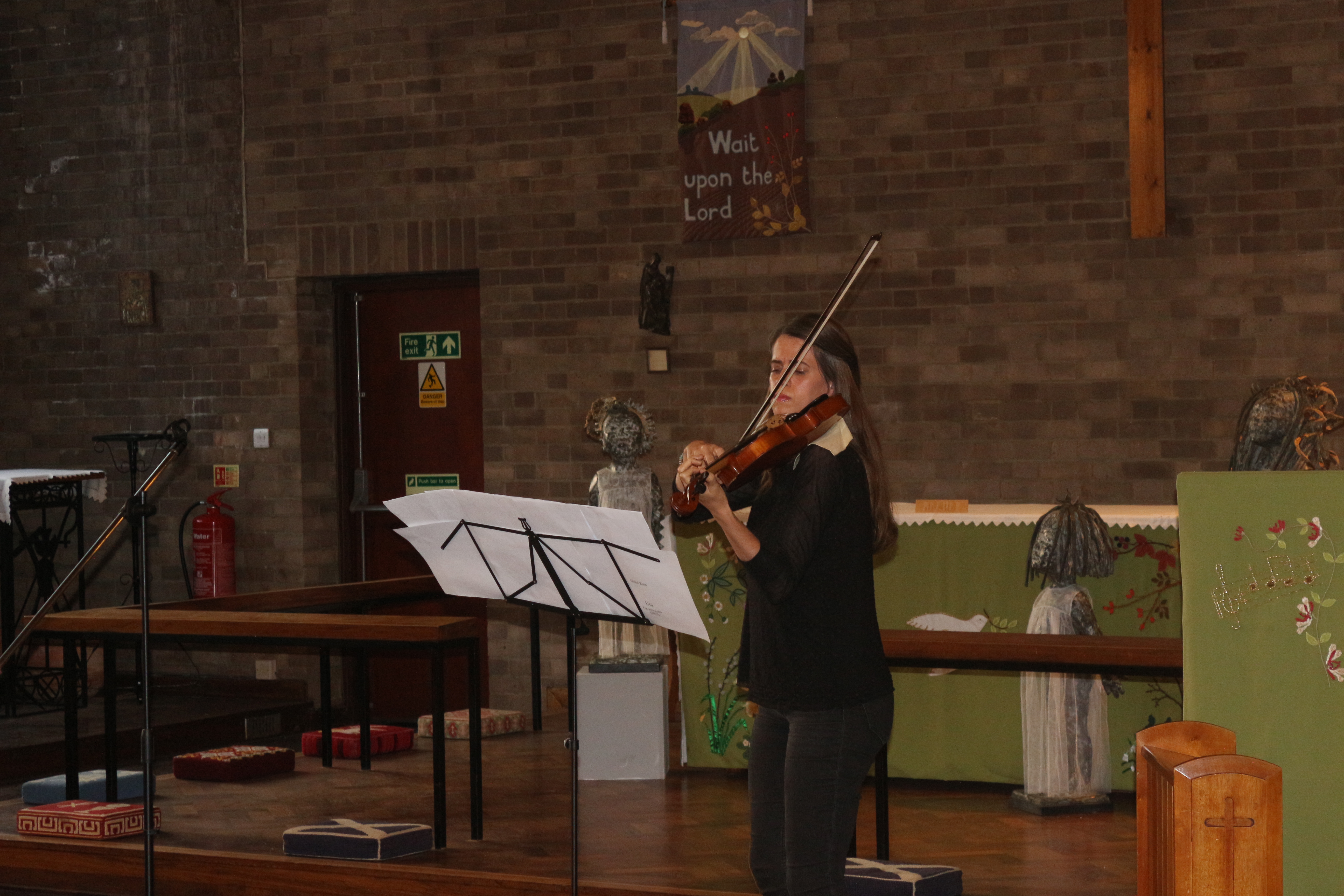
Tonight, at St Andrew's Church, we shared details of 'Unveiled', our new Friday night arts event plus our Autumn exhibitions.

Unveiled
A regular Friday night arts and performance event
at St Andrew’s Church, 7.00 – 9.00 pm
11 London Road, Wickford, Essex SS12 0AN
Exhibitions, open mic nights, performances, talks and more!

  • Unveiled – a wide range of artist and performers from Essex and wider, including Open Mic nights (come and have a go!).
  • Unveiled – view our hidden painting by acclaimed artist David Folley, plus a range of other exhibitions.
Initial Autumn Programme
  • 2 September – ‘The Psalms Project’ with violinist Emma-Marie Kabanova and Delvyn Case from Deus Ex Musica. New pieces of sacred music plus discussion of the Psalms.
  • 9 September – No meeting (but Quiz Night at St Mary’s Runwell).
  • 16 September – Opening Event for our current exhibitions (mudcub sculptures & Runwell Art Club) with an art talk ‘Controversy & conversation: Art & churches’, including discussion of our hidden painting.
  • 23 September – Open Mic Night (come along and have a go at performing).
  • 30 September - Simon Law in concert. Simon has fronted the rock bands Fresh Claim, Sea Stone and Intransit, as well as being a founder of Plankton Records and becoming an Anglican Vicar.
  • 7 October – Conversing with composers – Hear Classical composer Ho Wai-On speak about her work and view videos of her work - https://www.howaion.co.uk/aboutme.html.
  • 14 October – Visit to Luke Jerram’s ‘Gaia’ installation at Chelmsford Cathedral. Measuring seven metres in diameter and created from 120dpi detailed NASA imagery of the Earth’s surface the artwork provides the opportunity to see our planet, floating in three dimensions. Tickets cost £4.00.
  • 21 October – ‘Wickford Famous’ – a talk by Ken Porter (Basildon Heritage)
Unveiled’s Autumn Programme will continue to 25 November.

Advance notice: 18 November – Matt Simpkins in concert. Sinner songster, guttural gospeller & pop-poet-priest, the Rev’d Matt Simpkins’s music is an unholy brew of bruising freak blues, string-snapping finger-twanged folk, and sanctified psychedelia.

With the exception of the Gaia trip, these events do not require tickets (just turn up on the night). There will be a retiring collection to cover artist and church costs.

See http://wickfordandrunwellparish.org.uk/whats-on.html for fuller information.

mudcubs… touching earth, bringing peace
5 September – 31 December 2022
St Andrew’s Church, 11 London Road, Wickford, Essex SS12 0AN


Nicola Ravenscroft’s mudcubs are children intimately connected to the earth – reminding us of our duty of care to life, to love, to planet Earth.

This exhibition is complemented by a heritage display on Wickford’s children from Basildon Heritage (Web: http://www.basildonheritage.org.uk/) from 18 September – 22 October (followed by a display on Wickford’s shops) and an exhibition by members of Runwell Art Club (https://community.saa.co.uk/art-clubs/runwell-art-club/) featuring animals, children and nature. All their works are for sale.

St Andrew’s Church is usually open: Saturdays from 8.30 am to 12.30 pm; Sundays from 9.30 am to 12.00 noon; Mondays from 1.30 to 3.45 pm; Tuesdays from 1.00 to 4.30 pm; Wednesdays from 10.00 am to 12.00 noon; and Fridays from 10.00 am to 1.30 pm.

See http://wickfordandrunwellparish.org.uk/whats-on.html for fuller information.

Nicola Ravenscroft’s mudcubs are children intimately connected to the earth – reminding us of our duty of care to life, to love, to planet Earth.

Children pay attention to the world finding wonder in it. A child’s journey from the front of the house to the back will ‘be full of pauses, circling, touching and picking up in order to smell, shake, taste, rub, and scrape’, ‘every object along the path will be a new discovery’ because ‘the child treats the situation with the open curiosity and attention that it deserves’ (Sister Corita Kent). That is why the children are our future and can lead the way into a better future. This is also why Jesus said a child is greatest in the kingdom of heaven.

. . mudcubs . . are Earth’s messenger-angels: they silently call us to live in PEACE .. with nature and with each other.

Previously exhibited at St Martin-in-the-Fields, St John’s Cambridge, HSBC global headquarters Canary Wharf, Churchill College Cambridge, Cambridge University Faculty of Education and coming to us from the Talos Art Gallery’s ‘Natural Elements’ exhibition where they spent three months outdoors standing guard at the base of an old tree, these are sculptures to touch and feel and cherish. Nicola says: “Earth’s children are life’s heartbeat: they are her hope, her future ... they are breath of Earth herself. Creative, inquisitive and trusting, children are Earth’s possibility thinkers. They seek out, and flourish in fellowship, in ‘oneness’, and being naturally open-hearted, and wide-eyed hungry for mystery, delight and wonder, they embrace diversity with the dignity of difference.”

Nicola Ravenscroft is a British sculptor and songwriter whose sculpture has a lifegiving presence and a peaceful stillness. A graduate of Camberwell School of Art, London, UK she has owned and run a sculpture gallery and, as an art teacher, has nurtured many young people into celebrating their inherent creativity and thinking beyond the walls. Her sculpture installation With the Heart of a Child was part of a project exploring what the arts in transdisciplinary learning spaces can contribute to primary education. Nicola has been commissioned to create the Westminster National bronze memorial, honouring the sacrifice of NHS and careworkers on the covid front line.

Web: https://nicolaravenscroft.com / https://nicolaravenscroft.com/mudcubs/.

------------------------------------------------------------------------------------------------------------

Matt Simpkins - In The Marsh A Desert.

A Musical Exploration of the Psalms


ST. ANDREW’S CHURCH PRESENTS 
Presents 
A Musical Exploration of the Psalms 

FRIDAY 2 SEPTEMBER 2022 19:00-21:00 BST 
St. Andrew’s Church, Wickford 11 London Road SS12 0AN, United Kingdom 

Delvyn Case, moderator 

Produced in association with Deus Ex Musica. 

PROGRAMME 
  • Introduction Delvyn Case 
  • My heart within me is desolate (Psalm 143:4) Judith Lang Zaimont 
  • Discussion 
  • A Song of Ascents (Psalm 121) Tatev Amiryan 
  • Discussion 
  • Psalm 133 Delvyn Case 
  • Discussion Ura (Psalm 57) Michel Klein 
  • Discussion 
Listen to these pieces for free at www.deus-ex-musica.com/search-me-o-god. 

QUESTIONS FOR DISCUSSION 
  • How would you describe the overall mood or “emotional landscape“ of the musical composition? 
  • How does this piece affect your experience, understanding, or interpretation of the psalm? Does it amplify or enrich it? Does it expand on it or challenge it? 
  • Are there any words, phrases, or verses in the psalm which the musical composition seems to reflect most powerfully? 
THE PSALMS 

PSALM 143 

1 Hear my prayer, O Lord, give ear to my supplications: in thy faithfulness answer me, and in thy righteousness. 2 And enter not into judgment with thy servant: for in thy sight shall no man living be justified. 3 For the enemy hath persecuted my soul; he hath smitten my life down to the ground; he hath made me to dwell in darkness, as those that have been long dead. 4 Therefore is my spirit overwhelmed within me; my heart within me is desolate. 5 I remember the days of old; I meditate on all thy works; I muse on the work of thy hands. 6 I stretch forth my hands unto thee: my soul thirsteth after thee, as a thirsty land. Selah. 7 Hear me speedily, O Lord: my spirit faileth: hide not thy face from me, lest I be like unto them that go down into the pit. 8 Cause me to hear thy lovingkindness in the morning; for in thee do I trust: cause me to know the way wherein I should walk; for I lift up my soul unto thee. 9 Deliver me, O Lord, from mine enemies: I flee unto thee to hide me. 10 Teach me to do thy will; for thou art my God: thy spirit is good; lead me into the land of uprightness. 11 Quicken me, O Lord, for thy name's sake: for thy righteousness' sake bring my soul out of trouble. 12 And of thy mercy cut off mine enemies, and destroy all them that afflict my soul: for I am thy servant. 

PSALM 121 

I will lift up mine eyes unto the hills, from whence cometh my help. 2 My help cometh from the Lord, which made heaven and earth. 3 He will not suffer thy foot to be moved: he that keepeth thee will not slumber. 4 Behold, he that keepeth Israel shall neither slumber nor sleep. 5 The Lord is thy keeper: the Lord is thy shade upon thy right hand. 6 The sun shall not smite thee by day, nor the moon by night. 7 The Lord shall preserve thee from all evil: he shall preserve thy soul. 8 The Lord shall preserve thy going out and thy coming in from this time forth, and even for evermore. 

PSALM 133 
1 Behold, how good and how pleasant it is for brethren to dwell together in unity! 2 It is like the precious ointment upon the head, that ran down upon the beard, even Aaron's beard: that went down to the skirts of his garments; 3 As the dew of Hermon, and as the dew that descended upon the mountains of Zion: for there the Lord commanded the blessing, even life for evermore. 

PSALM 57 
1 Be merciful unto me, O God, be merciful unto me: for my soul trusteth in thee: yea, in the shadow of thy wings will I make my refuge, until these calamities be overpast. 2 I will cry unto God most high; unto God that performeth all things for me. 3 He shall send from heaven, and save me from the reproach of him that would swallow me up. Selah. God shall send forth his mercy and his truth. 4 My soul is among lions: and I lie even among them that are set on fire, even the sons of men, whose teeth are spears and arrows, and their tongue a sharp sword. 5 Be thou exalted, O God, above the heavens; let thy glory be above all the earth. 6 They have prepared a net for my steps; my soul is bowed down: they have digged a pit before me, into the midst whereof they are fallen themselves. Selah. 7 My heart is fixed, O God, my heart is fixed: I will sing and give praise. 8Awake up, my glory; awake, psaltery and harp: I myself will awake early. 9 I will praise thee, O Lord, among the people: I will sing unto thee among the nations. 10 For thy mercy is great unto the heavens, and thy truth unto the clouds. 11 Be thou exalted, O God, above the heavens: let thy glory be above all the earth. 

ABOUT THE ARTISTS 

Danish/British violinist Emma-Marie Kabanova completed a Master’s degree at Goldsmith’s College, University of London where she specialized in performance of music by late Soviet composers. She completed further studies in violin performance at the Novosibirsk Conservatory and studied privately with a principal violinist of the Bolshoi Theatre Orchestra in Moscow, Russia. Formerly based in Moscow, Emma-Marie was a guest Principal with the Moscow Baroque Soloists, performed with Opera Omnia early opera company and was the artistic director of Globus Music baroque ensemble where she created collaborative projects with singers and dancers from the Bolshoi Theatre, the Helikon Opera and the Stanislavsky Theatre. Recent concerts include appearances with the Oxford Alternative Orchestra UK, The National Chamber Orchestra of Moldova, and at festivals in the UK, Hungary and Turkey. Emma-Marie teaches violin and has worked as a classroom music teacher. Between 2007 and 2014 she set up musical education projects working with terminally ill children in Siberia and young offenders in an institution in Moscow. In 2017 was given a ‘Points of Light’ award by the UK Prime Minister for this work. After Russia’s invasion of Ukraine Emma-Marie found it impossible to stay in Russia and returned to the UK where she has been working as a freelance violinist. 

Judith Lang Zaimont is internationally recognized for her music’s distinctive style, characterized by expressive strength and dynamism. A grantee of both National Endowments, winner of the 2015 The American Prize in Chamber Music Composition and a 2003 Aaron Copland Award winner, she has enjoyed a distinguished career as composer of over 100 works with performances by the Philadelphia Orchestra, Baltimore Symphony, Camerata Bern, Berlin and Czech Radio symphonies, and the Kremlin Chamber Orchestra. Her music is widely performed throughout the U.S. and Europe and has been recorded for the MSR Classics, Naxos, Navona, Koch Classics, Arabesque, Milken Family Foundation, Albany, Jeanne, Leonarda, Northeastern, and 4Tay labels. Her principal publishers are Subito Music, Galaxy/ ECS, Jeanné and Vivace. She is a distinguished teacher and pianist, and creator and editor-in-chief of the critically acclaimed book series The Musical Woman: An International Perspective. 

Tatev Amiryan is an Armenian-American award-winning composer and pianist. Her music has been performed in the United States, Armenia, Russia, Ukraine, Israel, England, Poland, Spain, Italy, France, Germany, Netherlands, Belgium, and Japan by such renowned ensembles and performers as, German Chamber Philharmonic of Bremen, Portland Youth Philharmonic, National Chamber Orchestra of Armenia, CMEA Central Coast Honors Orchestra, Carpe Diem String Quartet, Ensemble Oktoplus, Metropolitan Choral of Kansas City, Juventas New Music Ensemble, Globus Music Ensemble, Playground Ensemble, pianists Jeffrey Jacob, Hayk Melikyan, and thereminist Thorwald Jorgensen. Her pieces have been featured at 4 such prestigious festivals and projects as MITO Settembre Musica International Festival, GogolFest, Królewskie Arkady Sztuki, Blurred Edges, Women Composers Festival of Hartford, London International Piano Symposium, and Crossing Borders Music. 

Delvyn Case, Deus Ex Musica founder, is an American musician, scholar, writer, speaker, and educator. He has spent 25 years developing projects for secular and religious audiences that explore music’s unique power to explore questions of spirituality in the contemporary world. His writings on music, faith, and theology have appeared in The Christian Century, Sojourners, Books and Culture, numerous online magazines. He has collaborated on projects with the Yale Institute for Sacred Music, Harvard Divinity School, Hebrew College, Boston College, and the parish of St Martin in the Fields (London), and many others across the United States and Canada. As a composer, his music has been performed by over 80 orchestras across the world, as well as by the Borromeo Quartet, the New York Virtuoso Singers, and Grammy-winning artists Richard Stoltzman and the Chestnut Brass Company. A graduate of Yale and the University of Pennsylvania, Dr. Case is Professor of Music at historic Wheaton College, a secular liberal arts college in Norton, Massachusetts. 

Michel Klein is an LA-based composer and Jewish music scholar. He recently received his Ph.D in composition and ethnomusicology where he studied with David Lefkowitz, Ian Krouse, and Richard Danielpour. Prior to UCLA, Michel attended Ithaca College where he received his B.M. in composition and studied with Dana Wilson and Sally Lamb. After graduating, Michel spent a year traveling and studying at a Jewish theological seminary in Israel. In his music, Michel seeks to tap into and express his Jewish roots through a unique musical voice by fusing various elements of contemporary music and traditional Jewish sacred musical material. His work has been read by ensembles such as Wild Up! and the Moscow Contemporary Music Ensemble and has been performed by the Syrinx Collective, the Bay Area-based Celloscape Collective, and at the Music from Salem Cello Seminar. His opera Akeidah received a concert workshop with Opera UCLA. 

ABOUT DEUS EX MUSICA 

DEUS EX MUSICA is an ecumenical organization that promotes sacred music as a resource for learning, discipleship, and spiritual growth. Since our founding in 2018, we have presented unique music-oriented faith formation events in collaboration with dozens of institutions in the US, Canada, Russia, and the UK, including the parish of St. Martin in the Fields (London), the Kirby Laing Centre for Public Theology (Cambridge, UK), the national conference of the United Church of Christ (USA), Wheaton College (Illinois), Eden Theological Seminary (USA), the Wabash Center for Teaching and Learning in Theology and the Arts, and churches in Moscow, California, and Massachusetts. 

OUR PROJECTS 
  • Our Composers Project brings together performers and composers to create new works that engage with the Christian tradition in contemporary ways. Since 2019, we have premiered over 40 new vocal and instrumental works in contexts that promoted discussion about Scripture and faith. In October 2022, Deus Ex Musica will present a unique performance/discussion event in Boston featuring twelve newly-composed solo viola works inspired by the psalms. 
  • Our record label, Deus Ex Musica Records, provides opportunities for composers to share their music in ways that support its use in the church outside of the worship service. In July 2022, DEM Records releases Search Me, O God, featuring world-premiere recordings of ten psalm-inspired violin works by contemporary Christian and Jewish composers. 
Visit our website to sign up for monthly email updates about events, new blog articles and podcast episodes, and other projects: www.deus-ex-musica.com.

-----------------------------------------------------------------------------------------------------------

Judith Lang Zaimont - My Heart Is Desolate.