Wikio - Top Blogs - Religion and belief

Friday, 19 August 2016

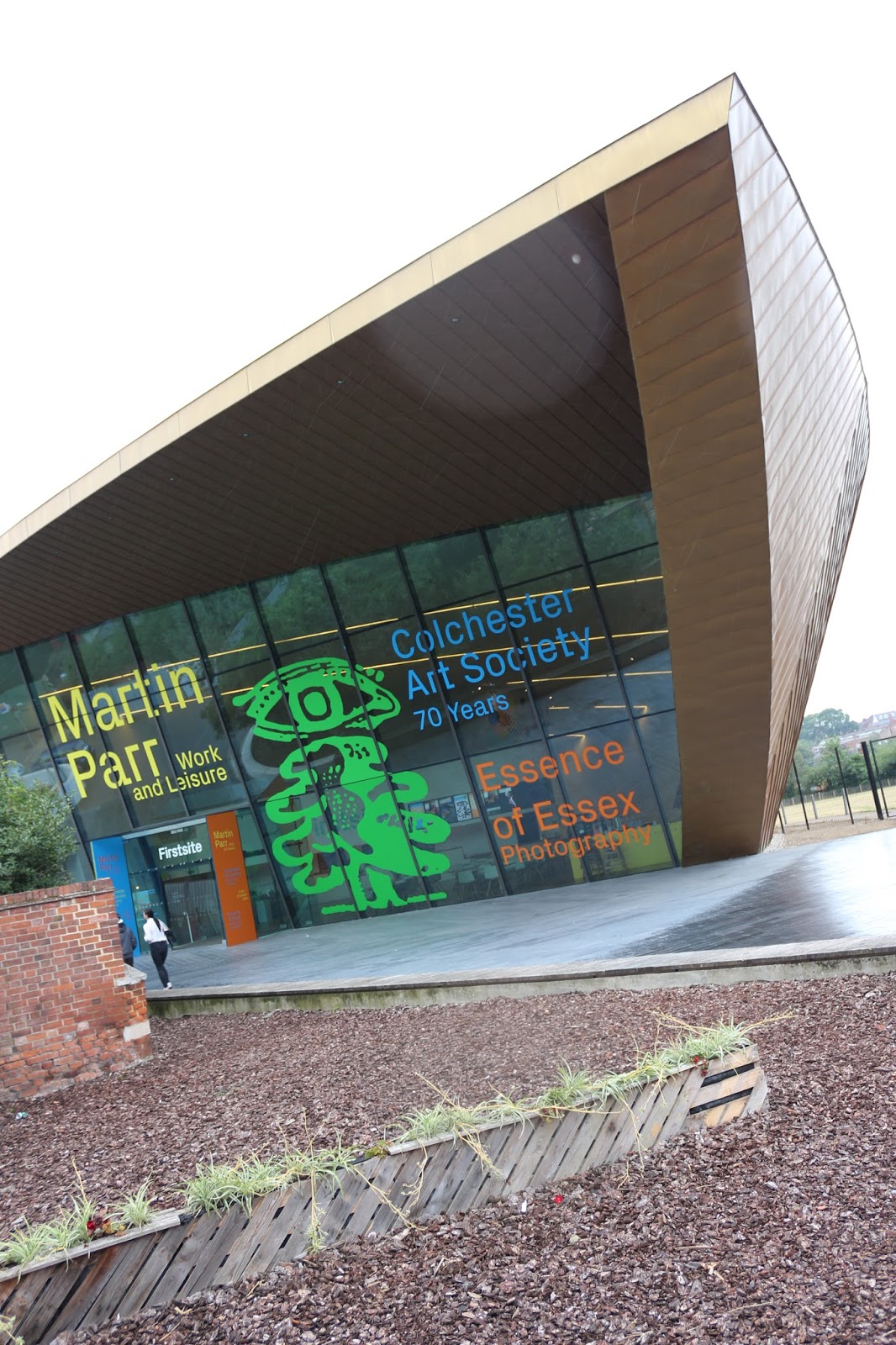
Martin Parr: Work and Leisure


Firstsite is currently presenting the largest Martin Parr exhibition in the UK since 2002 coming direct from The Hepworth Wakefield and tailored especially for Firstsite with additional content including Martin Parr’s own extraordinary personal collection of postcards. Martin Parr: Work and Leisure comprises more than 300 photographs that span the past 40 years, presenting a chronological overview of Parr’s most celebrated works.

From his early Yorkshire-based black and white photographs of rural communities through to his more recent vivid explorations into consumerism, this exhibition includes rarely seen images from his series The Non-Conformists taken at the beginning of his career reflecting his experiences of living in Yorkshire, and The Last Resort, one of the most significant bodies of British photography, documenting leisure time in the seaside town of New Brighton, as well as a universal shift from monochrome to colour photography.

In addition to this Hepworth Wakefield touring exhibition, Parr has also, in 2016, exhibited at the Guildhall Art Gallery and curated an exhibition at the Barbican. 

Unseen City: Photos by Martin Parr at the Guildhall Art Gallery celebrated Parr's tenure as the City of London’s photographer-in-residence, a position he took up in 2013. He has documented life in the City ever since – from private ceremonies, processions and banquets to high-profile public occasions. Granted unprecedented access to these events, he has been able to capture moments that would usually go 'unseen'; on display in the exhibition were behind-the-scenes shots of unguarded moments featuring Lord Mayors, dignitaries and even the Queen. His photographs provided a unique visual account of contemporary London.

For Strange and Familiar at the Barbican, Parr brought together over 250 compelling photographs and previously unseen bodies of work, in order to present a vibrant portrait of modern Britain. From social documentary and portraiture to street and architectural photography, the exhibition celebrated the work of leading photographers, including Henri Cartier-Bresson, Rineke Dijkstra, Robert Frank and Garry Winogrand, and considered how international photographers from the 1930s onwards captured the social, cultural and political identity of the UK.

Martin Parr has been described as 'arguably Britain’s greatest living photographer.' These exhibitions make that argument.

-----------------------------------------------------------------------------------------

Duke Special - Step To The Magical.   

Wednesday, 17 August 2016

Religious concerns in Greek poetry

In reflecting on the increasingly prominence of existential concerns and religious imagery in the poetry of Tasos Leivaditis from the second period of his work onwards, N. N. Trakakis notes that ‘It seems that many other poets at the same time were similarly turning to the centuries-old language and tradition of Orthodoxy. [Odysseus] Elytis published To Axion Est (1959, Worthy It Is), [George] Seferis wrote his final collection, Three Secret Poems (1966), influenced by the Book of Revelation (having formerly rendered this, and The Song of Songs, into Modern Greek), and the former leftist Nikos Karouzos frequently deferred to religious themes.’

Philip Ramp writes that ‘… identity is at the centre of all Elytis' poetry … Elytis insisted on a "Greek" way, rejecting the murk and decay of the modern world and proclaiming the moment of the "mad" pomegranate tree his most enduring symbol …

Elytis was never to forget these experiences [during the Second World War]. His quest for Greece would continue but this new perspective would now be at its center. For a number of years after the war he produced little poetry, seemingly unable to find a way to express these new. more complex positions to his satisfaction. When he did find it, he produced his greatest work and one of the major works of this century: Axion Esti. The title literally means "Worthy It Is" but as the phrase forms a major part of the divine liturgy of the Greek Orthodox Church a literal translation is of little use.

The poem is divided into three parts, each of incredible complexity and each one completely different from the others. One of the focal points of the poem is the phrase 'This/small, this great world!" which is frequently repeated in a variety of contexts with the cumulative effect of showing how the end is in the beginning and the beginning is renewed by the end where death is as much a miracle as life and the entry into death is but the entry into an "eternal moment". So the "everyday" images, as it were, in this poem vibrate, ripple sensuously with the energy of distant realms. The complexity of his forms helps Elytis draw antitheses together into one large unity without any apparent strain. But this was not his major point. His aim was to show that no matter what we experience it calls for total praise, it calls for our complete involvement. He does not deny the world is evil and oppressive but it is worth living through. And the emphasis here must be placed on through for in the end "it is the hand of Death/that bestows Life! and sleep does not exist." This is the price that all of us must pay but Elytis repeatedly stresses it: "WORTHY is the price paid". All of his old images and themes can be found here, and in abundance, but now the conclusion the poem builds slowly and inexorably toward, like a Mass, is more exalted than any one image for what is worthy is NOW and what is NOW is FOREVER (or AYE in the Friar translation). "NOW to the wild beast in the myrtle Now to the call of May/AYE to consciousness filled and Aye to the full moon's ray.. . Now to the blending of peoples and the Number Black/Aye to the statue of Justice and the Mighty Eye that's staring back/Now to the humbling of the gods Now to the ashes of mankind/Now now to Nothingness and Aye to the small world, to the Great!"’

Peter Mackridge notes that ‘Seferis’s poetry seems to have acted as a beacon on the youthful [Philip] Sherrard’s path, lighting the way to stages beyond itself.’

‘… Seferis’s final collection, Three Secret Poems (1966), which is Seferis’s most mystical work, imbued with his experience of reading and living with the Revelation of St John the Divine, which he was ‘transcribing’ (as he called it) into Modern Greek at the same time. In these last poems, it could be argued, Seferis not only depicts but enacts what Sherrard called, in the first of his astonishingly perceptive pieces on Seferis’s work, ‘the transfiguration of this world’(p. 74).’

‘In Mythistorema the poet shows his awareness that history, which seems to be characterized by injustice, is apparently at odds with nature, but that a reconciliation between the two at a deeper level is possible. Sherrard writes of Seferis’s umbilical attachment to the earth, and one of the things that impressedhim about Seferis’s poetry — and about Greek culture in general — was the bond between human beings and the natural world that, he believed, had been fatally severed in the West. Thus Seferis’s poetry combines the use of a living myth with abundant references to nature.

In these verses, then, the elements of nature accumulate human experience as a repository to be drawn upon by later generations — but only on condition that they ‘know their prayer’. This last point must have struck Sherrard forcefully: it is impossible to tap into the ancient wisdom stored up in the natural elements unless one has prepared oneself by means of a rigorous spiritual ascesis. It is this spiritual ascesis — the effort to establish one’s relationship with the physical world, with one’s cultural tradition and with one’s fellow men — that Philip Sherrard was engaged in during the first few years of his contact with Seferis and his poetry (especially from1948 to 1955), and Seferis acted as a kind of sounding board that helped the young Englishman to formulate the principles of his metaphysical quest.’

‘Having passed this beacon on his spiritual journey, Sherrard retained his respect and affection for Seferis and his poetry, and indeed his translation of the Complete Poems in collaboration with Edmund Keeley enabled the full range of Seferis’s poetic voice to be heard in the English-speaking world. For his part, Seferis was assisted by Sherrard and their mutual friend [Zissimos] Lorenzatos in working out his relationship with the Eastern Orthodox Christian tradition, but eventually Sherrard passed into realms where Seferis was unwilling or unable to follow him.’

‘There was, however, another Greek poet whose outlook Sherrard had discovered to be more congenial to his own. This was the older poet Angelos Sikelianos (1884–1951), who, like Seferis, combined a living mythology with sensuous natural imagery, but was not afraid to move freely between the physical and the metaphysical worlds — indeed, did not recognize any distinction between them.’

‘Seferis recognized the older poet as one of the few people he had known (Philip Sherrard was another) who totally devoted themselves, body and soul, to their spiritual quest.’

In introducing the poetry of Nikos Karouzos, Nick Skiadopoulos and Vincent W.J. van Gerven Oei write that ‘poetry is not an affirmation of difference, but the surprising beauty of chiming antinomies. We might never transcend them, but it is up to us to put them together. Yet again, this voisinage is not to be identified with the necessity of chance as an eternal return. On the contrary it is a return from that very return:

Let us treat Yes as a No to No and No as a Yes […] And let us not forget
that this pissed affirmation crumbled down Nietzsche’s intellect in the dark
paths of this world. (2002, 88)

This return from the “vicious circle” should in no way be taken as a form of artistic prudence. Rather it can be seen as a dribble of demonic inconsistency as Dionysus transforms himself into a Christ that is in turn de-theologized: “Who can forbid that? Every man is capable of his own theology, nothing can stop him.” (2002, 73-74) This is a turn towards an existential vision of the world, historically coinciding with a particular political defeat of the Left, to which the poet devoted all his life:

after the defeat of the popular front I raised the question “why do we
exist?” while others were asking “why we failed.” (2002, 57)

But most of all it is a return to poetry that exceeds the existential question itself, going beyond the issue of faith.

Poetry comes in as a question of return after a defeat that is confessed in full profanity. Though it accepts the necessity of the defeat, it does not affirm it. Though it negates it, the negation is not in the name of a promise to be delivered in the kingdom of heavens. Following a historical and existential defeat, poetry is born post mortem. It signals a return to Christ as “groundless religiousness in the surprise of the real as such” (2002, 72) which is at once a return to the refuge of childhood. It is not a question of endurance towards an eternal return. Rather it is a question on the possibility of an existential return. Returning in a world as someone who cannot enjoy any returns exactly because he is averse to guarantees. A return without returns.’

Finally, in this review of religious concerns among Greek poets, Alexis Ziras writes of Greek ‘poets who wrote at great length on religious themes and created in the shadow of the overall Greek poetic canon, such as Joseph Eliya, G. Veritis, et al … our thought goes to Odysseus Elytis, Nikos Gatsos, D. Papaditsas, Nikos Engonopoulos, not to mention left-wing lyric poets: in particular Yannis Ritsos and Tassos Livaditis or ... Nikiforos Vrettakos … only little has been written … regarding the function of the transcendent element in modern poetry … However, the transcendent element, the expectation of incarnation through someone dear to us or through the state of the future, is manifest, whether we like it or not, in a series of 20th century Greek poets, such as Yorgos Vafopoulos, Takis Varvitsiotis, Nikos Karouzos, and not least Ektor Kaknavatos, Lefteris Poulios, and other descendants … I find that transcendent revelation traverses the poetry of Iossif Ventura.’

-------------------------------------------------------------------------------------------

Aggelos Antonatos - Sunflowers.

Niki Gorick: Religion in the City (3)

Niki Gorick's aim in her ‘Religion in The City’ photo-project is to capture as much as possible of the spiritual life of The City and the day-to-day work of its clergy

Niki is a UK fine art photographer specialising in black & white images of London. She wants to find out what’s going on with religion in The City of London? How do these historical beauties survive today? Are they still a spiritual force? How do they work as non-parish churches without resident congregations? And how do they relate to the financially-obsessed community surrounding them? What exactly is the contemporary clergy up to?

Niki says, "Already, in my new ‘Religion in The City’ photo-project, I’ve come across a diversity I never expected — pop-up art exhibitions, huge wet fish displays for Harvest Festival, a Chinese choir rehearsing, high-calibre debate about policing in Britain today, jazz bands leading congregations into hidden gardens to eat jerk chicken … all I can say is that modern-day ministering appears to be both thriving and full of surprises.

The latest photographs in the series which Niki has taken at St Stephen Walbrook were of the Service of Thanksgiving for the Lord Mayor of London and his work with the City Livery Companies and Ward Clubs which we hosted in July and the 'Women in the City' networking event organised by Sally Muggeridge. Niki said that both were very special and fascinating occasions to capture for the project. Here are a sample of her images:


-------------------------------------------------------------------------------------------

Charles Villiers Stanford - Te Deum in C.

Monday, 15 August 2016

Thomas Merton and Latin American poets

Thomas Merton had a real curiosity about Latin American faith. His description of a visit to Cuba formed a key part of his popular autobiography, The Seven Storey Mountain. Later he ‘explored Latin American poetry and translated poems by a number of noted poets, including Ernesto Cardenal of Nicaragua, who was one of Merton’s novices at Gethsemani, Alfonso Cortes, César Vallejo, and Ruben Dario.’

‘From 1948 (when he first wrote to Evelyn Waugh, who was editing The Seven Storey Mountain for publication in England) until his death in 1968, Thomas Merton corresponded with writers around the world, developing an ever-widening circle of friends in Europe, the Soviet Union, South and North America. Merton wrote, and heard from, many prominent writers of the stature of Waugh, Jacques Maritain, Czeslaw Milosz, Boris Pasternak, James Baldwin, Walker Percy, Henry Miller, and Victoria Ocampo. He also corresponded with and encouraged newer writers in Latin America, like Ernesto Cardenal. Merton sensed in these writers a hope for the future of humanity and believed that the courage for truth was their special gift. Writing to Jose Coronel Urtecho, Merton asserted that poets "remain almost the only ones who have anything to say ... They have the courage to disbelieve what is shouted with the greatest amount of noise from every loudspeaker." Courage rooted in true freedom is evident in Merton's own life. He shared with his literary friends his concerns about war, violence and repression, racism and injustice, and all forms of human aggression. Forbidden to publish on the subject of war by his superiors, he obeyed but continued to circulate his famous "Cold War Letters." He did not hesitate to criticize his church when he saw there was more concern for the institutional structure than there was for people. Merton especially admired those who had the courage to write under oppression, like Pasternak, Milosz, and Cardenal.’

Merton’s correspondence with the Argentinian writer, editor, lecturer and publisher Victoria Ocampo began soon after his ‘Fourth and Walnut experience in downtown Louisville which broadened his view of the type of issues he would address, namely, moving from writing exclusively personal reflections about the spiritual life and poetry centered around life at Gethsemani to writing essays and poetry that brought his religious convictions to bear on the social issues of the day and that addressed global concerns.” Mark C. Meade writes that “Scholars like William Shannon have noted that not long after this experience, Merton entered into dialogue with people from outside the monastery, from various places globally, and from religious and cultural traditions quite different from his own.’

Brendan Jordan notes that in the same time period Ernesto Cardenal was admitted to the Abbey at Gethsemani under Merton’s counsel:

‘For two years, Merton advised Cardenal on matters of the spirit, as well as matters of poetry and politics. In his recollections of Merton, Cardenal often expressed surprise at how wide-ranging and often secular their conversations were. “At first I was disconcerted by the way in which he imparted spiritual direction,” Cardenal wrote. “I had the incredible privilege of receiving my instruction from the grand master of mysticism who for so many years I had admired. And when [we began speaking], he began to ask me of Nicaragua, of Somoza, Nicaraguan poets, other Latin American poets, other dictators…” Cardenal at first expressed great frustration at having wasted so much time for spiritual guidance on secular matters.

However Cardenal eventually conceded that the secular discussions had a purpose, and that he had learned through them that renouncing all political and social concerns was not only unhealthy for a monk, but that it ran counter to a monastic’s duty to engage with the world.’

Paul M. Pearson sums up this period well: ‘In the late 1950’s Thomas Merton’s writings began to undergo a radical change as he moved from his initial embrace of the monastic ideal, in fleeing the world, to a new position where he was free to embrace the world. It is impossible to identify any single influence on this sea change. Merton’s work with the novices at Gethsemani was certainly significant, as was his growing correspondence. It was also during the mid to late 1950’s that Merton’s interest in Latin America was re-awakened. He had growing contacts there relating to the translations of his books into Spanish and Portugese; there was talk of a possible monastic foundation in Latin America by Gethsemani, with which Merton was keen to be involved; as well as a growing interest from Latin Americans in embracing the monastic life at Gethsemani. Merton’s interest was stimulated further by the arrival at Gethsemani of Ernesto Cardenal to join the novitiate. Cardenal, with his own literary and political interests, was influential in introducing Merton to the writings of a wide variety of literary figures from Latin America.’

Stefan Baciu, the author of the seminal essay, "Latin America and Spain in the Poetic World of Thomas Merton," reflected on this period:

‘Already forty years have passed, if memory is "not betraying me," since the poetical oeuvre of Thomas Merton started the process of "penetration" in Latin American literature which the monk of Gethsemani in Kentucky knew, better than all others of his colleagues from the United States.

I still remember the decade of the 1950s when the Brazilian poet and translator, Manuel Bandeira, and the essayist and Catholic leader, Alceu Amoroso Lima, started writing essays, critiques and book reviews and translated several of his poems and short essays. At approximately the same time, in Nicaragua where Pablo Antonio Cuadra was one of his first "discoverers" and exegetes and "via" Pablo Antonio the poet, Cuadra and Ernesto Cardenal distinguished themselves as his first serious researchers and publishers.

The rest is already a page of literary history. I was not surprised when, through the years, I found more and more frequently translations or reviews of Merton, sometimes in Mexico, and later in El Salvador, in Argentina and in Chile.’

In correspondence with Baciu regarding his essay, Merton listed the Latin American writers that he particularly appreciated. These were:
In a separate letter to the Origenes poet Cintio Vitier, Merton also listed the Cuban poets which he was reading: Cintio Vitier, Fina Garcia Marruz, Eliseo Diego, Octavio Smith and Roberto Friol.

Baciu wrote: “During the last two decades, Merton was one of the constant and most accurate spokesmen for this realm [the realm of Latin American poetry] through a series of translations without equal in the literature of the United States, or, for that matter, in world literature.” Merton “knew how to love, understand, and interpret the Spanish and Spanish-American worlds.” Merton valued these poets because they were ‘alive,’ with ‘something honest to say’ and were ‘sincerely concerned with life and humanity’.

Merton's Message to Poets was read at a meeting, to which he had been invited by Miguel Grinberg, of the “new” Latin-American poets – and a few young North Americans – in Mexico City, February 1964. Merton, in a statement that could stand for all his contacts with other writers, stated:

'We believe that our future will be made by love and hope, not by violence or calculation. The Spirit of Life that has brought us together, whether in space or only in agreement, will make our encounter an epiphany of certainties we could not know in isolation.'

-------------------------------------------------------------------------------------------

Thomas Merton - First Lesson About Man.

Sunday, 14 August 2016

Window on the world (405)


London, 2016

----------------------------------------------------------------------------------

Barry Rose - Psalm 121.

Walbrook Art Club programme

Walbrook Art Club Advent programme

This year's Walbrook Art Club Advent programme will be themed on the faith inspired work by the Pre-Raphaelites. There will be lectures on three Wednesday afternoons starting from 13:00pm at St Stephen Walbrook as usual, from 30th November to 21st December 2016.

Dharshan Thenuwara will be giving all three lectures:
  • Wednesday 30th November 2016 ... William Morris and his faith inspired art work
  • Wednesday 7th December 2016 ... Burne Jones and his religious art
  • Wednesday 21st December 2016 ... The Pre-Raphaelite brotherhood religious pictures
Please note that there is no lecture on 14th December 2016.

All above lectures are free but voluntary donations directly to St Stephens welcomed. Please RSVP directly to: darshan.dfge@outlook.com.

To complement this year's Advent Lectures a series of special tours related to the lectures have been
organised at 1 Red House, Bexleyheath, William Morris's house at Red House Lane, Bexleyheath. A National Trust property. Nearest station Bexleyheath, Kent. Zone 6. Please bring your National Trust or Art fund cards for free entry. Pre booking with Dharshan Thenuwara essential - darshan.dfge@outlook.com:
  • Wednesday 14th September, 2016 - Meet 12 to 12.30pm for 13.00 start. 
  • Saturday 17th September 2016 - Meet at 14.00 for 14.30 start at Red House.
  • Wednesday 21st September 2016 at Red House - Meet 12 to 12.30pm for 13.00 start.
Above tours to last approximately 2 hours. Property closes 5pm. Guided tour of house and garden by Dharshan Thenuwara who is a NT guide at Red House. There is a café and lavatories on site.

Walbrook Art Society National Gallery Tours 2016

In addition to the above Darshan will also give guided tours at the National Gallery to Walbrook Art Club members on:
  • Monday 10th October, 12 noon
  • Tuesday 18th October, 12 noon
  • Friday 21st October, 12 noon
  • Saturday 22nd October, 2.00pm
Please RSVP directly to darshan.dfge@outlook.com.

Art exhibitions at St Stephen Walbrook

London Ablaze: the Glass Sellers' Great Fire Schools Project exhibition: 

As part of celebrations to mark the 350th anniversary of the Great Fire, the Worshipful Company of Glass Sellers has chosen 10 London secondary schools each to design a piece of glass artwork on the theme of the Great Fire, in collaboration with a leading contemporary glass artist. The ten works are also being judged and the winner will be announced at a reception in the Church on the evening of Thursday 1st September.

commission4mission's 'Reflection' exhibition:Tuesday 6th – Friday 16th September (Weekdays 10am – 4pm, Weds 11am – 3pm)
An exhibition reception (6.30pm) and commission4mission’s AGM (5.30pm) will be held on Tuesday 6 September. This is commission4mission’s fourth group exhibition in the setting of St Stephen Walbrook.

The Shadow of Angels - Kim Poor, Monday – Friday 10.00am – 4.00pm 3rd – 29th October
Brazilian artist Kim Poor will exhibit a series of paintings in various mediums, including her unique technique of glass fused on steel plate. She is based in London and Rio de Janeiro and her work has been exhibited worldwide. The theme of the exhibition, which is curated by Edward Lucie-Smith, is the universal appeal of angels and their presence and significance in our lives.

National Society of Painters, Sculptors & Printmakers, Monday 21st November – Friday 2nd December, Monday – Friday 10.00am – 4.00pm

The second group show by National Society artists to be held at St Stephen Walbrook. The National Society was formed in 1930 to meet a growing desire among artists of every creed and outlook for an annual exhibition in London, which would embrace all aspects of art under one roof, without prejudice or favour to anyone.

-----------------------------------------------------------------------------------------------

Christina Rossetti - None Other Name.

Thursday, 11 August 2016

Against whom should we compare ourselves?

Here is my sermon from today's Eucharist at St Stephen Walbrook:

Against whom should we compare ourselves? Our answer makes all the difference in the world. The Pharisee in Jesus’s parable (Luke 18. 9 - 14) compared himself against other people: ‘God, I thank you that I am not like other people: thieves, rogues, adulterers, or even like this tax collector. I fast twice a week; I give a tenth of all my income.’

This is generally what we do when we make comparisons; we compare ourselves with others and so compare ourselves with those we think are worse than or similar to ourselves. We’ve all heard others and, maybe, ourselves saying ‘I’m alright, Jack!’ or ‘I’m as good as the next person, if not better!’ On the basis of these comparisons we think we are ok; at least no better or worse than others, at best, better than many others around us. On the basis of these comparisons we are comfortable with who we are and see no need to change.

The Pharisee in this story lived in a simplistic world of legalism where he could look down on those like the publican because he kept certain rules and fulfilled certain practices. Therefore he could say, I am not like other people because I fast twice a week and give a tenth of all my income. For him, there was no wrestling with difficulty and no struggling with conscience but the world he inhabited was, ultimately, a harsh world without understanding, without compassion, without forgiveness. Our common response as human beings to our own fallibility and failure is that, instead of acknowledging our own shortcoming, we attempt to distract attention away from our selves by identifying a scapegoat and angrily pointing out that person’s many failings. We are often very successful in covering up our own shortcomings when we adopt this tactic but, of course, the reality is that we are being hypocritical.

The true comparison that we make should not be with others, but with God. Jesus challenged us to ‘Be perfect, therefore, as your heavenly Father is perfect.’ On the basis of that comparison, we all fall short. As St Paul writes, ‘for all have sinned and fall short of the glory of God.’ Jesus, through his life and death, showed us the depth of love of which human beings are really capable and, on the basis of that comparison, we come up well short and are in real need of change. In the light of Jesus’ self-sacrifice, we see our inherent selfishness and recognise our need for change. Those are the kind of comparisons that the publican in the parable was making when he stood far off, not even looking up to heaven, beating his breast and saying, ‘God, be merciful to me, a sinner!’

In the light of the way that Jesus lived his life, we see our lack of love, joy, peace, patience, kindness, goodness, faithfulness, humility, and self-control. If we say that we have no sin, we deceive ourselves, remain in darkness, and there is no truth in us. But when we live in the light of Christ, seeing ourselves as we really are, then we become honest with ourselves and with God. By coming into that honesty we confess our sins and are purified; as we say in this service, we make our humble confession to Almighty God truly and earnestly repenting of our sins.

That honesty undermines the simplistic legalism of the Pharisee’s world by revealing the hypocrisy at its heart. The reality is that each one of us has broken the Law and each one of us is a sinner. If that is so, on what basis can one sinner presume to judge or condemn another? To do so is a gross act of hypocrisy which multiplies one sin upon another. The publican, by contrast, lives in a world of without condemnation because he lives in a world where second chances and fresh starts are available.

On Ash Wednesday the sign of the cross is marked in ash on our foreheads and these words are said: "Remember that you are dust, and to dust you shall return. Turn away from sin and be faithful to the Gospel." In that service, we acknowledge both our sinfulness and our mortality recognising the link between the two – that the wages of sin are death. The ash mark on our forehead is a public acknowledgement of our sinfulness but, because it is formed as a cross, it is also a sign of the forgiveness we have received. We are saying that we no longer live in the legalistic, unforgiving world of the Pharisaical Law where we compare ourselves with others in order that we come out best; instead, like the publican, we are those who compare themselves against God only to then realise that we have been accepted and welcomed into the world of love by Jesus himself.

Against whom should we compare ourselves? Our answer makes all the difference in the world. Jesus said one of the two men went down to his house justified; and it certainly wasn’t the Pharisee!

-----------------------------------------------------------------------------------------

Kindred Spirit - Ask Me No Questions.