Wikio - Top Blogs - Religion and belief

Sunday, 16 February 2014

The love we give away is the love we keep

“God so loved the world that he gave his one and only Son, that whoever believes in him shall not perish but have eternal life.” (John 3. 16)

“God so loved that he gave ...”

There is a saying that: “Love grows by giving. The love we give away is the only love we keep. The only way to retain love is to give it away.” (Elbert Hubbard)

“God so loved that he gave his one and only Son ....”

There is another saying that, “If you love someone, set them free. If they come back they’re yours; if they don’t they never were.”

In terms of romantic, parental and community love, this is saying that love isn’t owned and cannot be taken - it can only be given. So if we love someone, we have to give that person the freedom to choose for his or herself. That means letting go of our control over them. At times, this means that those we love leave us and ultimately, of course, it means we have to let those we love go into death.

We see love involving letting go and setting free most obviously in parents giving their children space and time in which to grow and make their own decisions. It is a risky business; parents don’t know how the choices their children make will turn out in the long run and so they have to battle against the tendency to control, in order that they can genuinely love their children by letting them go and grow into independence.

Sacrificial love is deeper still. God gave his one and only Son - not in order that his Son would benefit personally from this act of giving but that, through the loving sacrifice of his Son’s life, all peoples everywhere can be saved. This is the ultimate in giving love away.

Yet, through this sacrificial giving away by God the Father, all things are returned to him. Jesus’ death brings all people back to God and his resurrection returns Jesus himself to God. The Christian story therefore promises that, “The love we give away is the love we keep.”

-------------------------------------------------------------------------------

Bob Dylan - Is Your Love In Vain?

Love fulfils the Law

In The Lion, the Witch and the Wardrobe the Deep Magic “was a set of laws placed into Narnia by the Emperor-beyond-the-Sea at the time of its creation. It was written on the Stone Table, the firestones on the Secret Hill, and the sceptre of the Emperor-beyond-the-Sea.

This law stated that the White Witch, Jadis, was entitled to kill every traitor, and if someone denied her this right then all of Narnia would be overturned and perish in fire and water.

However, unknown to Jadis, a deeper magic from before the dawn of Time existed, which said that if a willing victim who had committed no treachery was killed in a traitor's stead, the Stone Table would crack, and Death would start working backwards.”

So in this story, there is a Law which is about actions and consequences and there is a deeper Law which is about love.

C. S. Lewis, who wrote the Narnia stories, was a Christian who drew on his understanding of Christian faith in writing his stories. It may be that he had passages like these in mind when he wrote about the deeper magic from before the dawn of Time.

Jesus is saying in his teaching from Matthew 5. 21 - 37 about the Law that it is not enough simply to keep the Law. He wants us to go deeper than simple obedience of the Law and the deeper place into which he wants us to go is Love.

Most of us actually keep the laws of this land most of the time. On the whole, because the laws are prohibitions – do not’s, like do not murder or do not steal – and because we live in a time of relative wealth, our laws are not that difficult to keep.

But prohibitions simply keep us from doing harm to others. They don’t enable us to love others. Simply refraining from murdering others or stealing from others is enough to keep the Law (we call it keeping the peace) but doing these things doesn’t mean that I am actively loving anyone at all.

To love means that I have to do something more that simply keep the Law. That is what Jesus is teaching and illustrating here and it is what C. S. Lewis shows us in Narnia through his imaginative story.

Let’s think briefly about the way laws and love work together. Parents teach their children the rules of the road. To begin with, when children are very young, the rules of the road are very restrictive i.e. the child must never cross a road without a parent and must always cross at a crossing with the parent and while holding the parents hand. As the child grows, they are taught new rules for crossing the road; for me, that was the Green Cross Code - stop, look and listen. Now, the aim is that the child learns to judge for him or herself when it is safe to cross the road.

Eventually, the rules with which we began – don’t cross on your own, don’t cross unless you are at a crossing – are left behind because the child has learnt how to cross the road safely using their own initiative. Elbert Hubbard has said, “Initiative is doing the right things without being told.” We are able to use initiative because we have not only learnt the rules but have learnt to apply in our lives and situations. At this point, we are no longer restricted just to crossing the road at specific crossing places but can cross wherever we judge it to be safe to do so.

So, we have gone beyond the rules by learning and applying the rules. In other words, we have found the true purpose of those rules which our parents enforced when we were young; which is that we learn to cross the road safely by ourselves wherever we are.

Jesus is saying the same thing. The Law starts by keeping us safe – do not murder, do not steal. If we all abide by the Law then we do not harm each other. That is good, but it is not enough. We also need to learn to love one another. That means doing more than the Law requires but to do that is also the fulfilling of the Law. If the Law is about maintaining good relations between us, then love is the fulfilment of the Law’s intent.

Jesus said: “Do not think that I have come to abolish the Law or the Prophets; I have not come to abolish them but to fulfil them.” (Matthew 5. 17) and he commended, as being the heart or summary of the Law, these words: “‘Love the Lord your God with all your heart and with all your soul and with all your strength and with all your mind’; and, ‘Love your neighbour as yourself.’” As Paul writes, “Love is the fulfilment of the law.” (Romans 13. 10)


So, in order to fulfil the Law and these teachings we are to love as Jesus loved: “Love is patient, love is kind. It does not envy, it does not boast, it is not proud. It does not dishonour others, it is not self-seeking, it is not easily angered, it keeps no record of wrongs. Love does not delight in evil but rejoices with the truth. It always protects, always trusts, always hopes, always perseveres.” (1 Corinthians 13. 4 – 7).


----------------------------------------------------------------------------------

Ben Harper - Don't Give Up On Me Now.

Saturday, 15 February 2014

Enterprise Club

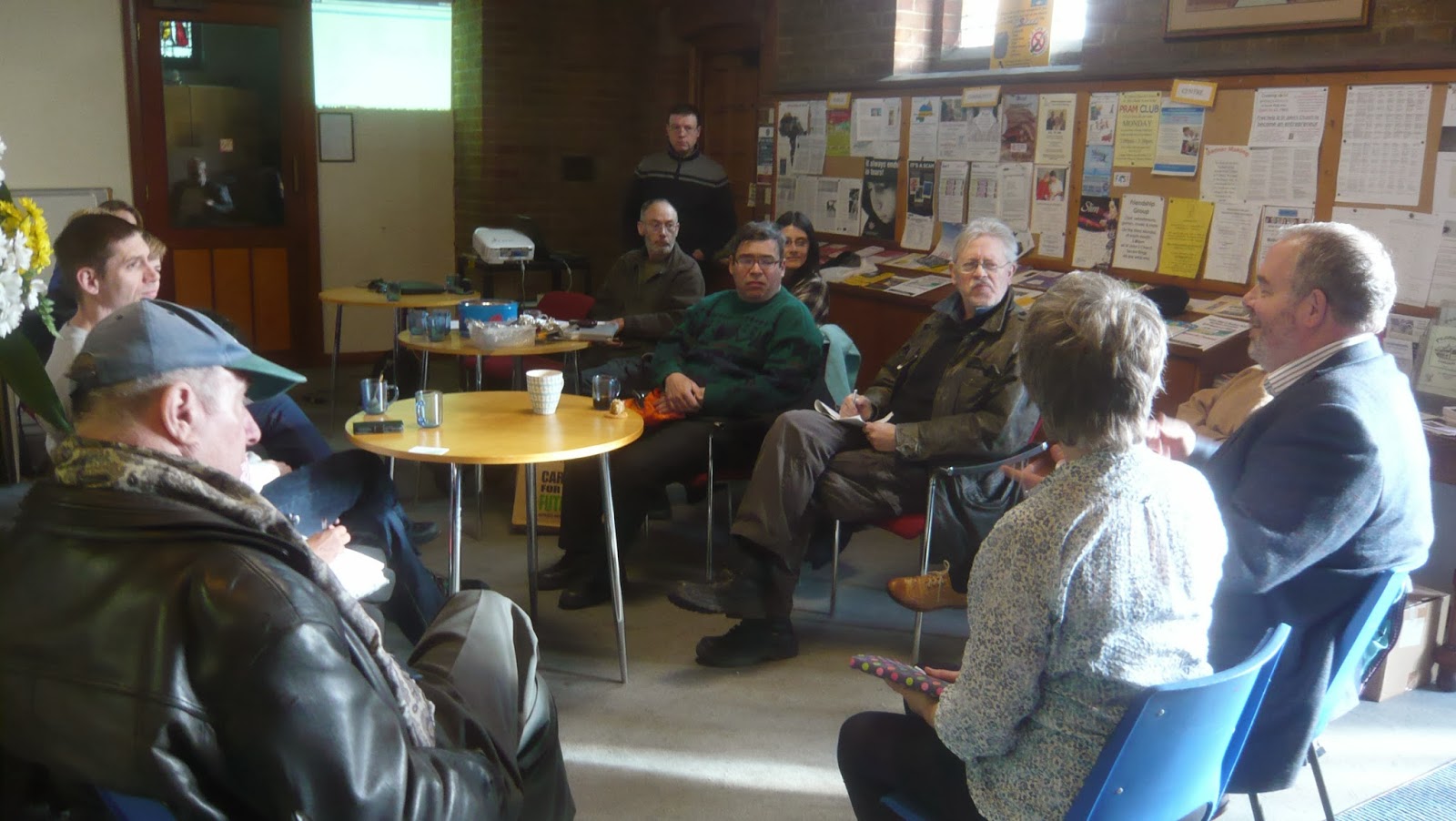
There were 15 of us last Tuesday at the Sophia Hub Enterprise Club and as numbers pick up we are able to build up our expertise in running a vibrant and useful support network for small and emerging businesses and community connections.

Please feel free to come along this coming Tuesday between 1 and 5.  This is the schedule:

1-1.45 refreshments and networking
1.45-2.00 Introductions
2.00-3.00 Speaker and group discussions:  This week the speaker is Aidan Ward and the topic is 'balancing the needs of your business'
3.00-4.00 more discussion and support
4.00-5.00 Networking

More info is on the St John's Church website and we hope that our website may be running by next week: http://stjohns7kings.org.uk/sophia-hub.

-----------------------------------------------------------------------------------------------

Ed Kowalczyk - Grace.

Friday, 14 February 2014

Brutalist churches

Several churches feature in the A - Z of Brutalism by Jonathan Meades in yesterday's Guardian. Meades writes:

"Vatican II was a godsend to architects. The Roman Catholic church was a generous, adventurous patron, and its buildings were to be advertisements for the church's newfound modernity. With few functional demands to take into consideration, architects enjoyed carte blanche. God can, apparently, live anywhere – and in the 1960s, he shared the widespread taste for open-plan spaces and theatre-in-the-round."

-----------------------------------------------------------------------------------------

Scott Stapp - Jesus Was A Rockstar.

Thursday, 13 February 2014

Why there's no faith without doubt


The Lent Course organised by the Seven Kings Fellowship of Churches is featured in the current edition of the Ilford Recorder.

Our Lent Course this year is entitled Build on the Rock: Faith, doubt - and Jesus! Based around Matthew 7.24 (Therefore everyone who hears these words of mine and puts them into practice is like a wise man who built his house on the rock), the course starts by looking at faith and doubt. Is it wrong – or is it normal and healthy – for a Christian to have doubts? Is there any evidence for a God who loves us? We will hear from many witnesses. At the heart of a Christian answer stands Jesus himself. We consider his ‘strange and beautiful story’ and reflect upon his teaching, his death, his resurrection and his continuing significance.

The Course has five sessions: (1) Believing and doubting; (2) Jesus - our teacher; (3) Jesus - our saviour; (4) Jesus - conqueror of death; and (5) Jesus - Lord and brother. Produced by York Courses, the course comes with a good choice of wide-ranging questions designed to involve all members in lively discussion and also brings the thoughts of prominent Christian leaders into our own discussion group.

The Course Booklet has been written by best-selling author, Canon John Young. The Course CD contains five 14-minute radio-style starters for group discussion, with former BBC broadcaster Canon Simon Stanley putting questions to the participants: Bishop Richard Chartres (Bishop of London), Dr Paula Gooder and Revd Joel Edwards. Each session closes with a Reflection by Methodist minister David Gamble. Former Archbishop of York, Dr David Hope, introduces the course.

Why do a York Course? Tens of thousands of people study a York Course each year:

"I like the format. Listening to the speakers on the CD helped to clarify my own thoughts as well as inspiring me with new ideas… The questions were challenging and well thought out. Altogether a very enjoyable course."

"York Courses are by far and away the best thought-out house-group material that I have come across. Excellent notes, a really useful range of questions, and stimulating audio contributions."

"Along with thousands of other Christians I have benefited greatly from participation in York Courses over the past few years, mainly as a group leader."

The Lent courses are organised by the Seven Kings Fellowship of Churches (SKFC) and will run at:

· 2.00pm on Tuesday’s at St John’s Seven Kings (11 March, 18 March, 25, March. 1 April, 8 April)
· 11.15am on Wednesday’s at St Peter’s Aldborough Hatch (12 March, 19 March, 26 March, 2 April, 9 April)
· 8.00pm on Wednesday at St John’s Seven Kings (12 March, 19 March, 26 March, 2 April, 9 April)

Our SKFC Lent Service will be at 8.00pm on Monday 14th April at Seven Kings United Free Church.

-----------------------------------------------------------------------------------------

The Call - I Still Believe.

Mentoring Matters

I've just finished an excellent mentoring course delivered by CPAS for the Diocese of Chelmsford. This was an exemplary course with clear, relevant material delivered using a range of styles in a well weighted programme. James Lawrence was an excellent trainer.

CPAS has a new resource designed to enable the setting up of church-based mentoring networks, including identifying, equipping and resourcing mentors.

Many in our churches are looking for help as they grapple with how to be a disciple and leader in such a fast moving, rapidly changing world.

Those young in the faith seeking to lay good foundations; those who've been Christians a while, wanting to deepen their ongoing service of Christ; and people of every generation looking to grow as leaders.

A mentoring relationship provides an intentional way of engaging with God's agenda. Be it formal or informal, short or long term, the mentor offers encouragement, perspective and challenge.

-----------------------------------------------------------------------------------------

The Staple Singers - Touch A Hand, Make A Friend.

Wednesday, 12 February 2014

Seven Kings Sophia Hub


There is lots of activity and engagement occurring currently through the Sophia Hub at Seven Kings as the numbers attending our Enterprise Club are growing and as we work with a new group of participants on the Sophia Course.

-------------------------------------------------------------------------------------------

Arcade Fire - We Exist.