Wikio - Top Blogs - Religion and belief
Showing posts with label diocese of chelmsford. Show all posts

Thursday, 17 September 2026

Assistant Diocesan Director of Ordinands (part time) and Team Vicar of Wickford & Runwell (half time)

Are you passionate about enabling people to explore God’s call to ordained ministry?

And are you an inspirational and collaborative Leader who can contribute to Christ’s mission in a thriving Essex community?

The Diocese of Chelmsford has an exciting opportunity for an Assistant Diocesan Director of Ordinands (part-time) and benefice of Wickford and Runwell are seeking a half time Team Vicar to join a ministry team in an expanding town that is grasping significant opportunities to grow ministry among young people, creatives and seniors. We are connecting churches, connecting with individuals, with our community, and with God.

The total package for both the ADDO role and Team Vicar role will be equivalent to £34,950 per annum

We are looking for an exceptional candidate to be appointed to this dual role.

For further details and to apply, please see click here.

For an informal conversation about the Team Vicar role, please contact: The Venerable Dr Sue Lucas on 01245 982642.

For an informal conversation about how the appointments will be structured, please contact: Revd Canon Rob Merchant at rmerchant@chelmsford.anglican.org

Closing Date: 20 September 2026
Interview Date: 21 October 2026

Job description:
Download

-----------------------------------------------------------------------------------------------------------

Delerious? - Find Me In The River.


Friday, 28 August 2026

Basildon Deanery Vacancies

We are currently advertising for three exciting clergy opportunities in the Basildon Deanery:

Rector of Pitsea with Nevendon

The Parish of Pitsea with Nevendon is seeking a new Rector. This busy parish with two churches hopes to appoint a new Rector who will help our faithful worshipping community to grow both in faith and in number. We do not have an exact image of the ideal candidate, but we know we want you to have passion and drive and be someone who lives the Gospel in your daily life and demonstrates it in all you do.If you think this could be you, do please get in touch. 

Click here for more information.

See here for videos about the Parish - Part 1, Part 2, and Part 3.

Team Rector of Billericay & Little Burstead Team Ministry

The Billericay Team, in the vibrant town of Billericay, seeks and will warmly welcome a Team Rector who can lead them through change with wisdom and grace, helping them grow in faith and unity and equipping them to become a confident and outward-looking parish ready to share the good news. Click here for more information.

Click here for videos of services - Christ Church, Emmanuel, St John's

Assistant Diocesan Director of Ordinands (part time) and Team Vicar of Wickford & Runwell (half time)

Are you passionate about enabling people to explore God’s call to ordained ministry?

And are you an inspirational and collaborative Leader who can contribute to Christ’s mission in a thriving Essex community?

The Diocese of Chelmsford has an exciting opportunity for an Assistant Diocesan Director of Ordinands (part-time) and benefice of Wickford and Runwell are seeking a half time Team Vicar to join a ministry team in an expanding town that is grasping significant opportunities to grow ministry among young people, creatives and seniors. We are connecting churches, connecting with individuals, with our community, and with God. Click here for more information.

--------------------------------------------------------------------------------------------------------

Wednesday, 12 August 2026

Weekly Sermon for the eleventh Sunday after Trinity


I have recorded the weekly sermon for the Diocese of Chelmsford for the eleventh Sunday after Trinity, Sunday 16 August, titled: ‘Making a family out of strangers’. Download the transcript here.

The Weekly Sermons are written and recorded by clergy and lay ministers for people who want to watch online or for ministers looking for sermon ideas.

To have the latest weekly sermon delivered straight to your inbox, you can sign up to the mailing list here.

My previous Weekly Sermons can be viewed here, here, and here.

------------------------------------------------------------------------------------------------------------

Sunday, 31 May 2026

Diocese of Chelmsford Weekly Sermon: The Trinitarian Grace


The Weekly Sermons for the Diocese of Chelmsford are written and recorded by clergy and lay ministers for people who want to watch online or for ministers looking for sermon ideas. To have the latest weekly sermon delivered straight to your inbox, you can sign up to the mailing list here.

I have recorded this week's sermon, which is entitled 'The Trinitarian Grace':

“The grace of the lord Jesus Christ, the love of God, and the communion of the Holy Spirit be with all of you.” It is common practise in church meetings for those present to close the meeting by saying the grace out loud, and to each other. (https://tauntonurc.org.uk/grace-for-trinity/) John Wesley wrote of this prayer, “Let us study it more and more, that we may value it proportionably; that we may either deliver or receive it with a becoming reverence, with eyes and hearts lifted up to God.” (https://www.lords-prayer-words.com/famous_prayers/may_the_grace.html)  

I would like us to do what John Wesley commends and study the Grace more and more today by reflecting together on the amazing grace of Jesus, the extravagant love of God, and the intimate communion of the Holy Spirit.

Let’s begin by thinking about where this prayer comes from. “It comes right at the end of a letter, or letters probably, that Paul wrote to a church he founded, but a church that had turned on him.” “It’s clear when you read between the lines that Paul had been getting the first century equivalent of on-line abuse, that this church that he had set up had been getting at him for being too poor, too scruffy, for working with his hands, for not having the right qualifications.” He’s under attack and has to defend himself but, “at the end of this long, passionate, sometimes weary and difficult correspondence”, he “writes these simple and ageless words, ‘The grace of the lord Jesus Christ, the love of God, and the communion of the Holy Spirit be with all of you.’”

So, “These are not just pious, empty, words. He is saying them to people who have criticised him, hated him, attacked him, and abused him. He is wishing the grace of Jesus, the love of God, the fellowship of the Holy Spirit, upon those who cast him as an enemy. He says, in a way, it doesn’t matter what you say about me or what you think of me. Your abuse and attack isn’t going to make me anything different from the person I am determined to be; a person shaped by God’s grace, living God’s love, seeking fellowship, friendship, community with anyone.”

The effect of the Grace here is “to offer us the full resources of the faith”: “When Paul wrote to the Corinthians, he and they were both aware that they were doing and enduring some pretty terrible things. But Paul told them that God wanted to give them the grace of Jesus Christ, the love of God and the fellowship of the Holy Spirit. That is what God wants to do with all of us – to bless us with the gifts of the beautiful Trinity and to show us what human life – touched by such blessing – could really be like.” (https://tauntonurc.org.uk/grace-for-trinity/)  

Let’s now look briefly at the individual parts of this prayer, beginning with amazing grace. U2’s song called ‘Grace’ defines the amazing grace of Jesus as follows: Grace “takes the blame”, “covers the shame” and “removes the stain”. “What once was hurt / What once was friction / What left a mark / No longer stings / Because Grace makes beauty / Out of ugly things / Grace finds beauty / In everything / Grace finds goodness in everything.” (https://www.u2.com/lyrics/53)  

Jesus told a story about a son who squandered his father's inheritance (the parable of the prodigal son). When the son returns, rather than rejecting or disciplining him, the father runs to greet him and celebrates his return. That story gives us an insight into the kind of love that God gives. Grace is the unmerited favour of God which finds goodness in everything. We do not deserve the love and goodness that is freely and unconditionally given from heaven and all we can or need do is receive it. That is truly amazing grace.

When we understand grace in this way, we can see why God’s love is described as extravagant. There is no holding back in the economy of God’s love, the currency of the kingdom of God is of abundant generosity of things that never run out. Sam Wells suggests that:

“The secret of happiness is learning to love the things God gives us in plenty. There’s no global shortage of friendship, kindness, generosity, sympathy, creativity, faithfulness, laughter, love. These are the currency of abundance.

The Church of today needs to rediscover this teaching because God gives us the abundance of the kingdom to renew the poverty of the church. In our generation God has given his Church a financial crisis, and this can only be for one reason: to teach us that abundance does not lie in financial security, and to show us that only in relationships of mutual interdependence, relationships that money obscures as often as it enables, does abundant life lie.”

As John McKnight and Peter Block have noted in their book ‘The Abundant Community’, we live in a consumer society which is an economy of scarcity because it “constantly tells us that we are insufficient and that we must purchase what we need from specialists and systems outside of our immediate community.” Instead, they argue that “we can do unbelievable things by starting with our assets, not our deficits. We all have gifts to offer, even the most seemingly marginal among us. Using our particular assets (our skills, experience, insights and ideas) we have the God-given power to create a hope-filled life and can be the architects of the future where we want to live.” Finding ways to thrive in our churches and communities by releasing the gifts of all and building on one another’s assets is a sign of the extravagant love of God.

Finally, we come to the intimate communion of the Holy Spirit. Sam Wells and Abigail Kocher have noted “the subtlety of the word ‘communion’: com means with and union means in – we are at the same time with God and in God, which combines our two heavenly aspirations.” (https://www.stmartin-in-the-fields.org/keeping-the-feast/)

In communion God takes our lives into the Godhead, the Trinity, and blesses us. In a Communion Service that happens particularly when the bread and wine and money and prayers are brought to the altar: “In that moment we each bring our different qualities, resources, hopes and dreams to God. And then the pastor recalls the sacred story of how God took what we are and made it what he is. And in that transformation we each receive back the same. What this is depicting is a new society in which we each bring our differentness to God but we each receive back from God the same bread of life. We each have different hungers, but God satisfies them all.

And in this dynamic of transformation we see how salvation works. God takes a simple people and their simple offerings and gives them a sacred story and sacred actions and in the regular telling of that story and performance of those actions they are transformed into God’s holy people. And that’s exactly what the regular celebration of the Eucharist is about: God taking an ordinary people and through this story and these actions turning them into the body of Christ, God’s companions forever.” (https://chapel-archives.oit.duke.edu/documents/sermons/Sept20TeachingEucharist-1.pdf)

As we have been exploring grace, love and communion, notice that the Son, the Father and Holy Spirit are all involved all the time. It’s not that Jesus is the only expression of grace or the Father, the only expression of love. All three are one, so they are all involved in showing and sharing grace, love and communion. We are drawn in to the relationship of love at the heart of the Godhead where grace, love and communion are constantly being shared and exchanged between Father, Son and Holy Spirit. It is out of this relationship of love that Jesus comes into our world to be with us and thereby open up a way for us to participate in the relationship of love that is constantly being shared between Father, Son and Spirit.

So, this wonderful prayer - “The grace of the lord Jesus Christ, the love of God, and the communion of the Holy Spirit be with all of you” – is not simply for the ending of meetings but for the whole of life and the whole of eternity. It is what Christianity is all about. It is a description of the Trinity and the love that exists at the heart of all things because it exists at the heart of God. And it is an invitation for us to become part of that love and participate in it. So, let us, as John Wesley commends, “receive it with a becoming reverence, with eyes and hearts lifted up to God.” Amen.

---------------------------------------------------------------------------------------------------------

Holy, Holy, Holy! Lord God Almighty.

Thursday, 7 May 2026

Deanery Prayer Walk

Deanery Prayer Walk
with Bishop Adam Atkinson, Bishop of Bradwell
from St Mary’s Runwell to Our Lady’s Well


Saturday 23 May, 9.00 am (beginning in St Mary’s Runwell)
A contemplative walk from the Prioress’s tomb in St Mary’s Runwell to the Running Well.

Walk in the footsteps of those who have prayerfully visited the well previously to collect water for use in baptisms at St Mary’s.

Recall the stories of the nunnery based at the Running Well and the last Prioress who was buried in St Mary’s.

All are welcome.

Parking available in the Church car park beside the Church Hall

St Mary’s Church, Runwell Road, Wickford SS11 7HS

+Adam will visit Basildon Deanery to visit and pray at and for every church in the Deanery. He will also leave a pack of prayer resources for each church. This is part of the 100 days of prayer initiative in the Diocese (https://www.chelmsford.anglican.org/about-us/travelling-well-together/travelling-well-together-sustaining-ministry/#Prayer). The day begins with a Deanery Prayer Walk to which there is an open invitation.

--------------------------------------------------------------------------------------------------------

Contemplative Prayer Saturday 27 September

Wednesday, 25 February 2026

Art Trail: Bishop of Chelmsford's Lent and Holy Week Pilgrimage


This year, Bishop Guli Francis-Dehqani is walking the Barking Area Art Trail for her Lent and Holy Week Pilgrimage. The Pilgrimage is taking place on six days across Lent and Holy Week, starting on 25 February and concluding on 31 March.

This year's Pilgrimage started on Thursday 25 February with a 5 mile walk, starting at St Paul's Stratford and ending at St Bartholomew's East Ham, via St Michael & All Angels' Manor Park and St Barnabas Little Ilford. 

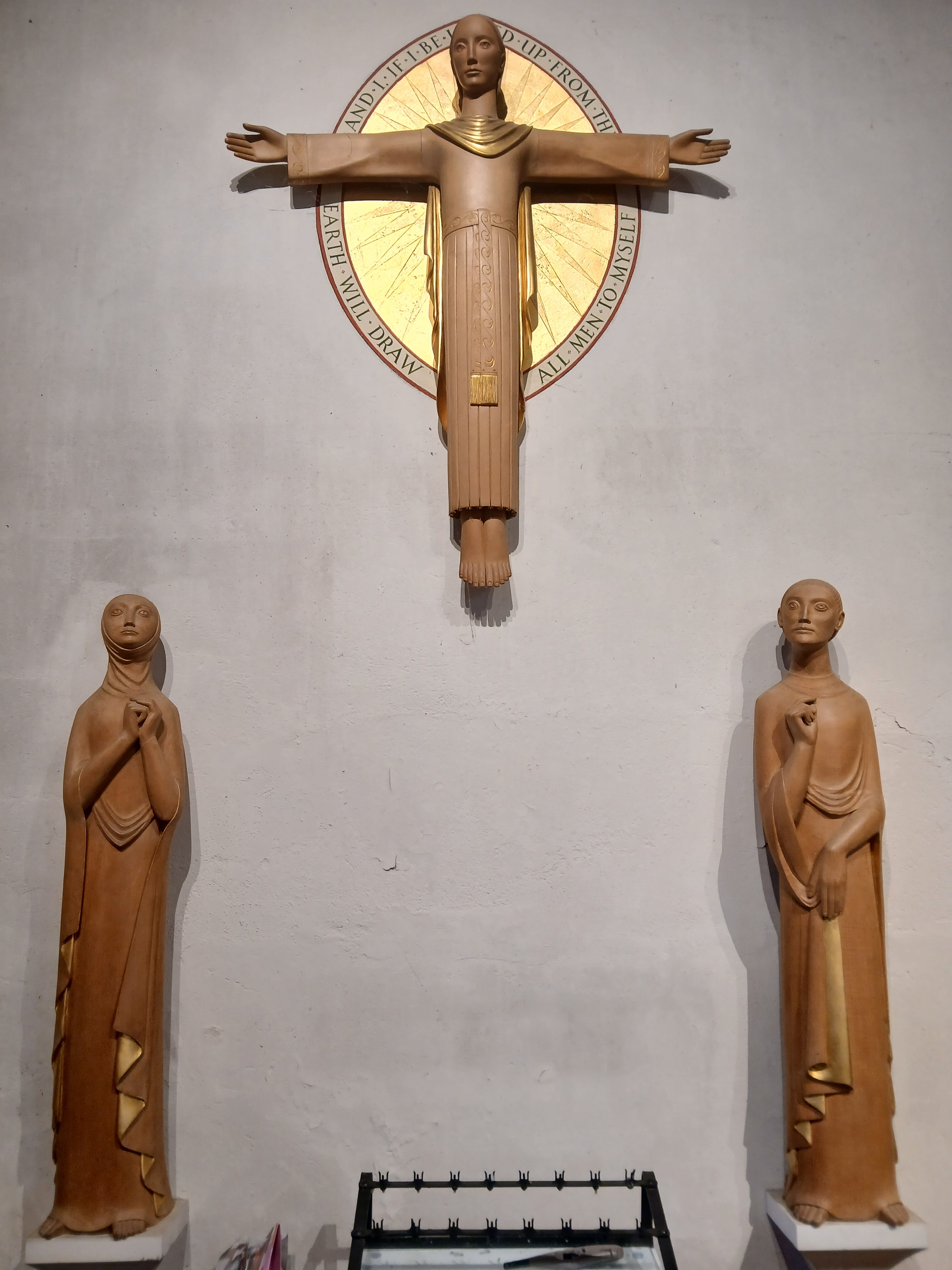
At St Paul's Stratford, the pilgrims are gathered in front of a striking wooden cross and matching altar front from the 1950s (both unattributed). From St Paul's, the pilgrims walked to St Michael and All Angels' Manor Park where they saw a sculpture of St Michael subduing the Devil, by Robert Crutchley, 1990. Onwards they went to St Barnabas Little Ilford to see the 1954 stained glass East Window, which has an image of Christ in Glory at its centre. The final stop of day 1 was St Bartholomew's East Ham. A stone cross (2007) on the exterior angled wall is by Nicholas Mynheer and represents St Bart's diverse congregation and community. They also saw John Bridgeman's sculpture 'The Family' (1983) which is situated on the south exterior wall of St Bartholomew's.

The Lent and Holy Week Pilgrimage resumes in Barking Deanery on 12 March.

The aim of the Barking Area Art Trail was to raise awareness of the rich and diverse range of modern and contemporary arts and crafts from the last 100 years which can be found within churches and, in particular, the 36 churches featured on the Trail. The significant works of art in these churches, taken collectively, represent a major contribution to the legacy of the church as an important commissioner of art.

These include past contributions by significant artists such as Eric Gill, Hans Feibusch, John Hutton and John Piper. In more recent years, churches continued to commission work by many important artists such as Mark Cazalet, Jane Quail and Henry Shelton together with other emerging artists who are now coming to prominence.

Work on the Art Trail was initiated by commission4mission, an arts organisation that encouraged churches to commission contemporary art, with the hope of increasing interest and stimulating engagement with the visual arts in the service of contemporary Christian faith.

A leaflet documenting the Art Trail, which was researched and developed by commission4mission member, artist and Fine Arts lecturer, Mark Lewis, publicised the Trail and provides information about the featured artists and churches. The leaflet included a map showing the churches featured on the Trail together with contact details, so that visits to one or more churches could be planned in advance.

Mark Lewis’ brief was to research commissioned art and craft in the Episcopal Area from the past 100 years. While stained glass is the dominant Ecclesiastical art form, he was also concerned to show a diversity and variety of media and styles within the selections made. He highlighted works such as the significant mosaic by John Piper at St Paul’s Harlow and the striking ‘Spencer-esque’ mural byFyffe Christie at St Margaret’s Standford Rivers. Churches with particularly fine collections of artworks included: St Albans, Romford; St Andrew’s Leytonstone; St Barnabas Walthamstow; St Margaret’s Barking; St Mary’s South Woodford;; and, the church chosen as the location for the launch event, St Paul’s Goodmayes.

The Trail was launched at St Pauls Goodmayes on Thursday 17th February by the Bishops of Chelmsford and Barking. At the launch event, The Rt. Revd. Stephen Cottrell, Bishop of Chelmsford, said: “I do not know what other art form could convey and hold the possibility of converging in so many layers. Not just do the visual arts comment on biblical narrative, but they illuminate it in a way that written or spoken forms cannot, being linear forms. Art opens windows on a set of concepts and ideas and brings them together. These windows offer a fresh perspective onto the faith we share, that other forms simply cannot.”

The Bishop of Barking stated that: “Our inspiration for understanding Christianity comes from the visual arts … The visual arts continue to be an important way of communicating our faith. Words are not enough to express the breadth, depth and height of what we want to communicate. It’s then that the visual arts express what we want to communicate.

God knew that: for centuries he relied on the words of the prophets and then he realized that he needed to send his Son to communicate in ways that words could not, the breadth, depth and height of his love. The word became flesh: the most beautiful living sculpture ever created – Jesus Christ.”

There are many interesting artworks to be found in the Diocese of Chelmsford; a fact I have been involved in highlighting previously through art trails in the Barking Episcopal Area - see here, here, here, here, here, here, here, here, here, and here. Most recently, I have included a listing of artworks to be found in the Basildon Deanery here and the Wickford and Runwell Team Ministry here and here. See also my post about artists in Broomfield - here. On the back of these and other sources of information, here is a partial listing of artists with work which can be found in churches within the Diocese of Chelmsford can be found here.

--------------------------------------------------------------------------------------------------------

Van Morrison - Hymns to the Silence.

Friday, 31 October 2025

Stride Magazine - Deflated Ego 18: Jonathan Evens on Jonathan Evens

Here's an article I've written for Stride Magazine about my 'Five Trios' series of poems. 'Five Trios' is a series of five long poems on thin places and sacred spaces in Essex and East London, each of which are also located within the Diocese of Chelmsford. The five poems in the series are:
These poems have been published by Amethyst Review and International Times.

The article explores the inspiration for the series and includes information about each of the locations included.

Several years ago, Stride Magazine published a series of texts by authors about themselves and their poetry called 'Deflated Ego'. This month a new series has begun.

Authors have been invited to choose their own approach to the piece, be that self-interview, review, manifesto, contextual/social material, statement of poetics, personal comment, or whatever. The first pieces in this new series can be read here and here.

I am also contributing to another Stride series. This second series is called 'Five' and simply involves writing about five linked items. My piece on entries in Prog 50 will be published on 24 November.

To read my poems published by Stride, click here, here, here, here, here, and here. My poems published in Amethyst Review are: 'Runwell', 'Are/Are Not', 'Attend, attend' and 'Maritain, Green, Beckett and Anderson in conversation down through the ages'.

I am among those whose poetry has been included in Thin Places & Sacred Spaces, a recent anthology from Amethyst Press. I also had a poem included in All Shall Be Well: Poems for Julian of Norwich, the first Amethyst Press anthology of new poems.

IT have also published several of my poems, beginning with 'The ABC of creativity', which covers attention, beginning and creation, and lastly 'The Edge of Chaos', a state of existence poem.

Stride magazine was founded in 1982. Since then it has had various incarnations, most recently in an online edition since the late 20th century. You can visit its earlier incarnation at http://stridemagazine.co.uk.
I have read the poetry featured in Stride and, in particular, the work of its editor Rupert Loydell over many years and was very pleased that Rupert gave a poetry reading when I was at St Stephen Walbrook.

Rupert Loydell is a poet, painter, editor and publisher, and senior lecturer in English with creative writing at Falmouth University. He is interested in the relationship of visual art and language, collaborative writing, sequences and series, as well as post-confessional narrative, experimental music and creative non-fiction.

He has edited Stride magazine for over 30 years, and was managing editor of Stride Books for 28 years. His poetry books include Wildlife and Ballads of the Alone (both published by Shearsman), and The Fantasy Kid (for children).

------------------------------------------------------------------------------------------------------

Belle and Sebastian - Another Sunny Day.

Sunday, 14 September 2025

Ordination - Revd Nik Wright


Nik Wright, our curate in the Parish of Wickford and Runwell, was ordained as a Deacon this morning in an Ordination Service held at Chelmsford Cathedral. 

Find out more about new Deacons who were ordained at services held at Chelmsford Cathedral throughout the day today at https://www.chelmsford.anglican.org/newrevs/.

Later, we enjoyed a Parish afternoon tea celebrating Nik's ordination, together with his family and friends.

Before beginning ordination training, Nik was involved in work ensuring community engagement, community empowerment and the management of services and operations designed and delivered to improve, protect and save lives, both locally and internationally.

----------------------------------------------------------------------------------------------------------

Here I Am, Lord (I the Lord of Sea and Sky).

Saturday, 9 August 2025

Vacancy – Deanery Mission Support Administrator

The Basildon Deanery is advertising for a Deanery Mission Support Administrator

The Deanery Mission Support Administrator will work for three days per week to relieve parishes of administration burdens in order to free up others in the parish (clergy and lay people) for mission and ministry.

S/he will identify parishes which have key roles unfilled or where the same people are undertaking multiple tasks and parishes which through pluralities and/or other forms of joint working have an increased administration load for clergy. Tasks involve: identification of parishes; visits to parishes and resulting support plans; and delivery of succession planning/ training.

• Salary: £15,192 per annum
• Work schedule: 3 days per week
• Time-limited: One year

Click DMSA Job Description to see the DMSA Job Description.

Person specification

This role would ideally be filled by a person currently actively engaged with an Anglican Church, but with an emphasis on and experience of organisational skills and practical project management experience.

Applications

To apply please send a CV and covering letter to Revd Jonathan Evens, Area Dean, at jonathan.evens@btinternet.com by 05/09/25. To discuss the role, please phone Elizabeth Murdoch Atkinson on 07880258262. Interviews to be held in w/c 15/09/25.

----------------------------------------------------------------------------------------------------------

Damien Jurado - Jericho Road.

Saturday, 2 August 2025

Three special Essex locations for retreats and contemplation


I have been reflecting this week that we are very fortunate to have in Essex three wonderfully unique and very different locations for retreats and contemplation in the Pleshey Retreat House, the Othona Community at Bradwell, and the Monastery of Saint John the Baptist at Tolleshunt Knights. Each is well worth exploring and visiting.

Pleshey was the first Diocesan Retreat House to be established in the country. Amongst the list of Retreat conductors is Evelyn Underhill. Arguably the most distinguished Conductor of that time, it is largely due to Underhill that the Retreat house became so popular. When you come to the Retreat House in Pleshey you sense an atmosphere created by six hundred years of prayer.

My poem called 'Pleshey', which was published by Amethyst Review, celebrates the Diocesan Retreat House at Pleshey and the legacy of Evelyn Underhill as a retreat director. The poem is part of a series of poems on thin places and sacred spaces in the Diocese of Chelmsford which is called 'Five Trios'. The five poems in the series are: 'Barking'; 'Bradwell'; 'Broomfield'; 'Pleshey'; and 'Runwell'. 

The Othona Community began as an experiment in Christian community back in 1946. Its founder, Norman Motley, was a Church of England priest who served as a young chaplain in the RAF during World War II. Othona is now an open and inclusive Community rooted in the Christian faith and drawing on a wealth of other inspirations. They welcome people of all ages, abilities, backgrounds, and beliefs to their two Centres on the quiet coasts of Essex and Dorset. Through sharing in the daily rhythm of work, worship, study, and play, they seek personal renewal and glimpses of the sacred. In community they explore the relationship between faith and life and encourage one another in caring for the world and its people.

The fourth poem in 'Five Trios', which was published by International Times, is called 'Bradwell' and is a celebration of the history of the Chapel of St Peter-on-the-Wall, the Othona Community, and of pilgrimage to those places.

The Monastery of Saint John the Baptist, (also known as Community of Saint John the Baptist) is a monastic community which was founded in 1959 by Archimandrite Sophrony Sakharov (1896-1993). On 27 November 2019, Archimandrite Sophrony was added to the list of Saints by the Ecumenical Patriarchate in Constantinople. His Feast Day is on the day of his repose, the 11 of July. The Monastery is situated in Tolleshunt Knights near Tiptree, in the United Kingdom. It belongs to the Eastern Orthodox Christian Church, and is under the jurisdiction of the Ecumenical Patriarchate in Constantinople.

During the first decades after the community had moved to England, the building and decorating of the churches of the monastery required much of his prayer and attention. After having abandoned painting for many years, he began to paint icons and frescos for the new places of worship. He strove to express the Face of Christ which had been revealed to him in the Light. However, he was never satisfied with his work and often adjusted and repainted the icons of Christ he had created.

Sister Gabriela joined the Community of Saint John the Baptist in 1983 after studying iconography in Paris on Saint Sophrony’s insistence. She was part of the team which was painting the murals of Saint Silouan’s Chapel and worked closely with the saint. After the mural work, Saint Sophrony continued to teach her the art of icon painting, and she assisted him in some larger works. Since Saint Sophrony’s repose, to the extent that she has been able to understand them, Sister Gabriela has tried to further his vision and ideas in various artistic projects. This includes painting the icons and murals for the round chapel which was completed earlier this year.

----------------------------------------------------------------------------------------------------

Denison Witmer - Lost In My Head.

Friday, 4 July 2025

A Service for the Third Sunday after Trinity | The Church of England |


This Sunday, the national Church of England online service comes from St Mary's Church, Runwell. Check out the trailer above. An earlier service recorded in the Parish can be viewed below.


My recorded sermons for the Diocese of Chelmsford's Weekly Sermon series can also be viewed below.


-------------------------------------------------------------------------------------------------------------

St Martin-in-the-Fields - Morning Song.

Saturday, 21 June 2025

Sermon for the first Sunday after Trinity, Sunday 22 June, titled ‘Release and change’


Here's the sermon for the first Sunday after Trinity, Sunday 22 June, titled ‘Release and change’, that I've recorded for the weekly sermon series of the Diocese of Chelmsford. 

All the sermons in the series can be found on the 'Weekly Sermon Videos' playlist. My earlier sermons in the series can be viewed here and here.

Imagine for a moment what it must be like to hear many voices in your head. Some of us will have had such experiences when events have overwhelmed us and, in our anxiety, we cannot see a way through and so the issues and options we experience run round and round in our minds without finding a resolution. Others of us may have had diagnosed mental health conditions which have included the experience of hearing competing voices. Each of these experiences are distressing and are hard to deal with.

Such experiences give us some insight into the story told in today’s Gospel reading (Luke 8.26-39) and the experiences of the man that Jesus healed, all described in the understandings of Jesus’ time rather than the understandings of today. The man describes his experience in terms of having a legion or mob of voices in his mind and the distress caused leads him to live in a distressed state away from his local community.

Our society, too, sometimes responds to the mental distress that people experience by isolating people from their communities, although, generally, we try to support people as much as possible within their homes, families and communities.

When confronted by this man, Jesus stops, listens and then responds him. Similarly, as Jesus’ followers, we also need to be those prepared to give time and space to any who are anxious or distressed, and especially to listen in ways that enable people to unpack their experiences and those things that are a source of distress for them.

In our Parish, Kintsugi Hope Wellbeing Groups are one of the ways in which we offer such space. Kintsugi Hope Wellbeing Groups provide a structured yet flexible program designed to help participants accept themselves, understand their value and worth, and grow towards a more resilient and hopeful future. These groups are places where people can experience:
  1. Safety and support, where there is no shame in struggling
  2. An increase in self-worth, confidence and wellbeing
  3. A deeper understanding of the reality of God's love for them
  4. Clear pathways to receive additional support if needed
As a result of the groups that have run in our Parish, I am aware of people who have been able to discuss past experiences in their families that hadn’t been talked through previously and others that have been empowered to begin to address issues that have needed addressing for some time.

Many of us respond to uncertainty, anxiety or distress by bottling up our thoughts and feeling; keeping them inside, rather than sharing them with someone else and thereby allowing them to be expressed, explored and understood. Our bottled-up feelings have to go somewhere – they have to expressed – because, if that doesn’t happen, they build up and build up inside us until they finally explode and, by exploding, do more damage that would have been the case if they had been expressed earlier.

It may be that this is what is being depicted for us in the strange part of today’s Gospel reading where the many strong forces in the life of this man are sent, by Jesus, into a herd of pigs which then rush down a steep bank into the lake and are drowned. His pent-up emotions needed to come out – to be expressed – in order to leave him and go elsewhere.

The man needed to see something that symbolised his full and final release in order to believe that he was finally free and that is what the episode with the pigs provided for him. A key part of what happened for them was that their pent-up emotions found a different kind of release which then enabled him to be free of them and to begin to share positively out of the experiences he had had.

I wonder what is bottled-up inside of us that we need to express and release in order to begin to become free from its negative effects on our lives. Again, our Kintsugi Hope Wellbeing Groups can potentially offer safe spaces in which that sort of disclosure is possible but talking to counsellors or psychologists might also be helpful.

This man was able to walk away free from all that had been tormenting him through his encounter with Jesus. More than that he began to share positively out of the difficult experiences he had had. That is also the experience of several from our Kintsugi Hope Wellbeing Groups.

When we are able to address the difficult experiences in our lives – express, explore and move beyond them, so they no longer constrain and limit or harm us – then these wounds in our lives can become the places from which we are able to support and help others. We become wounded healers in the same sort of way that Jesus through his suffering became the source of salvation for each one of us. It is by his wounds that we are healed and, once we have received healing, as with the man in our Gospel reading, then we are often able to support and help others going through similar experiences because of our personal knowledge of what they are currently going through.

Kintsugi Hope works with the centuries-old Japanese repair technique which uses urushi (Japanese lacquer) dusted with powdered gold to restore broken ceramic and porcelain vessels. Rather than masking fractures, kintsugi highlights them with gold to tell an object’s story. Items which have been restored using the kintsugi technique are often considered even more precious than they were before. It is the same with those who receive healing as did the man in today’s Gospel reading as, by becoming wounded healers, we become even more precious than we were before.

-------------------------------------------------------------------------------------------------------

Graham Kenrick feat. Natasha Petrovic w/ mental wellbeing charity Kintsugi Hope - Jesus Of The Scars.

Thursday, 27 March 2025

Weekly Sermon: An Enduring Love.


This week I have recorded the weekly sermon for the Diocese of Chelmsford which is for Mothering Sunday, Sunday 30 March, titled ‘An enduring love’. All the weekly sermons can be found on the Diocesan YouTube page in the 'Weekly Sermon Videos' playlist. The recording of this sermon is above and the text is below:

At the back of Aston Parish Church in Birmingham is a small memory garden planted in memory of my brother, who died tragically in a plane crash in 1999. Most years, my sister takes our Mum to the memory garden on the anniversary of Nick's death to tend the garden and to remember. Last year, because Mum was staying with us at the time of that anniversary and because Nick had served in the armed forces and died as a result of doing relief work following the Bosnian conflict, we went to the local arboretum, the Living Memorial at Rettendon, and prayed in their chapel.

Such experiences parallel those found in the choice of readings used for Mothering Sunday. These include Moses born into slavery and only able to survive as his mother finds a way to have him adopted by the Egyptian royal family (Exodus 2.1-10), as well as Hannah praying into the experience of childlessness and then dedicating her firstborn to serve God in the Temple (1 Samuel 1.20-28). The Gospel readings including Simeon prophesying that Mary's heart will be pierced through her experiences as the mother of Jesus (Luke 2.33-35), a prophecy fulfilled when Mary sees Jesus die on the cross, and Jesus, on the cross, asking John, his disciple, to care for Mary after his death (John 19.25-27).

These stories and experiences take us into the heart of the mix of pain and pleasure involved in first, carrying, then giving birth to, and then supporting a child through life. The experiences and emotions involved are so many and so varied, even where the tragedy of a shortened life is not involved, that it would take a series of novels to really do justice to all that is involved.

At the heart of these stories is the understanding that, at its best, a mother's love will endure through all the challenges that being in a deep relationship with another human being will inevitably bring and that that love will adapt and change in order to be there for their child whatever circumstances may be. That is why motherhood can be used as a parallel for the love of God towards us, a parallel that we celebrate particularly on Mothering Sunday.

While, our personal experience of receiving parenting may not have had that same degree of consistency or care, the reminder that comes to us on Mothering Sunday is that God's love is like that of mothers whose love for their children endures through all the vicissitudes and changes of life, including the challenge of your child dying an early death, as was the experience of both Mary and my mother. The Bible celebrates love expressed in the challenges posed by the messiness of real life, rather than presenting us with an ideal from which we will always fall short.

I have seen, at first hand, how losing a child pierces a mother’s heart, as that is what happened to my Mum when my younger brother died. My love for and appreciation of my Mum grew through seeing her response to sharing the same experience as that of Mary. These are experiences from which we should all seek to learn, seeing them, as was the case for Mary, as being bound up in God’s good purposes for humanity; even, as in her story, as the seedbed for the greatest acts of liberation in human history.

Jesus remembered his mother while he was undergoing the most extreme agony personally. For some of us, to remember our mothers in the way we have just been discussing, might involve complex and conflicted memories which bring back to mind some of our more painful moments in life. Jesus ministered in and through and out of his pain; remembering particular people (his mother and John, his disciple), forgiving those who tortured and mocked him, and dying for the salvation of all.

It is from reflection on those experiences and actions of Jesus, that the idea of the wounded healer has come. This is the idea that our own pain and difficulties - our wounds - do not necessarily preclude us from ministry but may provide a resource or source from which our ministry can flow. To remember and reach out to support, sustain and strengthen others whilst remaining wounded ourselves may be, as was the case for Jesus, among the deepest and most profound of our ministries to others.

In bringing his mother into a mother-son relationship with one of his disciples, Jesus was extending our understanding and concept of what constitutes family life. For John to view Jesus' biological mother as his mother and for Mary to view John as her son, went beyond ties of blood into other forms of relationship. We could talk in terms of adoption (although in our day and time that word has a legal definition that is narrower than what is happening here) or we could talk in terms of extended families (a more helpful phrase, which we have, in part, lost sight of in a time when we still think primarily of nuclear families). However, we choose to categorise what Jesus did here, we need to recognise that he was initiating a family relationship which was not based on ties of blood and that this necessarily opens up space in which a range of family structures and family ties become possible.

In Jesus’s life and teaching there is less of a focus on the structures of our relationships and more of an emphasis on relationships which are characterised by qualities of compassion, kindness, humility, meekness, and patience. These are qualities with which one of New Testament readings for Mothering Sunday (Colossians 3. 12 - 17) calls us to clothe ourselves. These are qualities that we can easily associate with motherhood but which are applicable to all of us as Christians. In Colossians 3 we are called to bear with one another, forgive each other; clothe ourselves with love, which binds everything together in perfect harmony, and let the peace of Christ rule in our hearts, to which we were called in the one body. These are all actions which are consistent with what we understand mothers, at their best, to do for their children. But the call, here, is to practice these qualities not just in our families and among our blood relatives, but with all those we encounter and, especially, here in Church. They are, perhaps, then, maternal qualities for application in Mother Church.

These are the qualities we need to practice and express if we are to share God's love in ways that endure through all the vicissitudes and changes of life as was the case for Mary and my own mother whose love for their children endured through the tragedy of their children’s shortened lives. May we learn from their example and follow in their footsteps. Amen.

-----------------------------------------------------------------------------------------------------

Saturday, 8 February 2025

St Mary with St Leonard Broomfield: Thomas Huxley-Jones and Gwynneth Holt

Today, I gave a talk at Broomfield Parish Church about Thomas Bayliss Huxley-Jones and Gwynneth Holt, two of the Broomfield artists who, along with Rosemary Rutherford, created artworks for many churches in the area covered by the Diocese of Chelmsford in the twentieth century. 

Some of the works I included in the talk were the following:


Given the amount of work by the Broomfield artists within the area covered by the Diocese of Chelmsford, I suggested that it might be possible to create an art trail around the Diocese as a way to highlight their contribution to the churches of the Diocese. Such a trail would begin at Broomfield Parish Church with the artworks the, the graves of Rutherford, Huxley-Jones and Holt in the churchyard, and the wonderful Rutherford exhibition, but would then take those following the trail around the Diocese to demonstrate the importance to the churches of the Diocese of these three Broomfield artists.  

Broomfield in Essex became a village of artists following the arrival of Revd John Rutherford in 1930. His daughter, the artist Rosemary Rutherford, also moved with them and made the vicarage a base for her artwork including paintings and stained glass. Then, Gwynneth Holt and Thomas Bayliss Huxley-Jones moved to Broomfield in 1949 where they shared a large studio in their garden and both achieved high personal success. My poem 'Broomfield', part of my 'Five Trios' series, reviews their stories, work, legacy and motivations.

For more on the artists of Broomfield, all of whom are commemorated there with blue plaques, see here, here, here, here and here.

---------------------------------------------------------------------------------------------------

Bono, The Edge & Friends - Invisible.