Wikio - Top Blogs - Religion and belief
Showing posts with label congo. Show all posts

Saturday, 11 July 2015

Artists must make people think

The creative spirit of the Democratic Republic of the Congo is currently being celebrated in the exhibition Beauté Congo – 1926-2015 – Congo Kitoko presented at the Fondation Cartier pour l’art contemporain in Paris.

Taking as its point of departure the birth of modern painting in the Congo in the 1920s, this ambitious exhibition traces almost a century of the country’s artistic production. While specifically focusing on painting, it includes music, sculpture, photography, and comics, providing the public with the unique opportunity to discover the diverse and vibrant art scene of the region.

Among those whose work features in the exhibition are Bodo Pambu and Chéri Samba:

'Bodo Pambu was one of the founders and key proponents along with Moke and Chéri Samba of what has come to be known as the Zaïre school of popular painting. Their works state vigorously and candidly their belief in their capacity to create art that could change the course of history.

Camille-Pierre Bodo chose to paint anything and describe everything that he had seen and experienced. His works then successively became chronicles, pamphlets, manifestos, demands or advice. His objectives were not selfish: he was a popular painter. One of Bodo's main themes was the “Ndoki Zoba” (sorcery) and the aim of these paintings was to advise on abandoning the practice of sorcery.

He dealt with symbolic or fantasy subject matter, with a strange imagination that was fed by his dreams. “I express everything that happens to me, so that I am no longer focused on specifically African topics and can address myself to the entire world.” The titles of his works: River of Delights, Ignorance, or Love, the Source of Life, perfectly echo his beliefs and his aesthetic aims.'

'Chéri Samba was a founding member of the “Popular painting” school along with Pierre Bodo, his paintings exposing everyday life in the Democratic Republic of Congo’s capital city, Kinshasa. His representative, often fantastical paintings incorporate graphic narrative and figures with text and word bubbles that address forefront social and political issues, including AIDS, social inequity, and corruption. Starting in the 1980s, Samba began to portray himself frequently and literally in his works, taking on a direct role as the reporter of his ideas and personal story. “I appeal to people’s consciences,” he says. “Artists must make people think.”' 

He concluded, 'I believe everyone in earth has a mission and I believe that God gave me the tools to paint and speak my messages through my paintings.'

-----------------------------------------------------------------------------------------------

Adorons L'Eternel - Yahveh Okumama.

Sunday, 5 October 2014

Patronal Festival


St John's Seven Kings celebrated its 110th Anniversary over its Patronal Festival weekend on Saturday 4th and Sunday 5th October. Our celebrations included Choral Evensong (Saturday 4th October, 6.00pm) followed by refreshments, Patronal Festival Service (Sunday 5th October, 10.00am) followed by a Bring & Share Lunch, plus photographic displays and the celebration of special anniversaries/birthdays for congregation members.

Choir members from several local churches supported the St John's Choir in leading worship for our Choral Evensong. The service included the anthem 'A Clare Benediction' by John Rutter.

Many former members of St John's returned for the weekend including:
  • Revs. John & Rosemary Enever, who preached at the Patronal Festival Service. Rosemary is a former curate at St John's who became Vicar of St Andrews Great Ilford and Area Dean of Redbridge; and
  • Judy Acheson, our former Church Mission Society Link Worker in the Democratic Republic of the Congo . Judy was celebrating 50 years as a Christian. As a result of her ministry in the Congo , St John's continues to support youth work in that country.
Returning and current members gave testimonies in our Patronal Festival Service to the work of God in their lives through St John's. We heard from Michael Blackstaff, Margaret Willmott, Dr. Winston Solomon, Chris & Veronica Watts, Charity Anyika, Julia Beaman, Lester & Margaret Amann, and Judy Acheson. 

Michael Blackstaff, a former server at St John's , had written a reminiscence in which he said, ' St John’s was, and is, a very special place. I was a bit short on blood relations (though very rich in adoptive ones) and came to regard it and its many good people as part of my family. I shall always feel greatly privileged to have been welcomed into its loving embrace.'

There have been more that 15 different significant anniversaries/birthdays which are being celebrated within our congregation this year and all these people were congratulated as part of the Patronal Festival Service. They included two 60th wedding anniversaries, one 50th wedding anniversary, and two 90th birthdays, among others. We prayed for these folk using the following prayer: 

Lord Jesus, we thank you for the special milestones which these people have reached in the course of this year. Such moments provide a reason for stopping and remembering all that we have experienced up to that point in our lives; times of great joy and great challenge. In all, as we look back, we see your presence alongside us supporting and equipping us for life. Enabling us to enjoy and share those times of intense joy and pleasure, to bear and share those times of deep anxiety and pain, and to live fully the times in between – those times of ordinary, everyday life in families, church, community, and at work. Thank you for all that you have done and continue to do in the lives of these people and may they know a special joy and blessing from you in the celebration of these particular milestones. Amen.

We also presented a gift to our former curate, Rev. Santou Beurklian-Carter. Following the service, we enjoyed a delicious and varied Bring & Share lunch and viewed photographic displays from the extensive Church archive.

Former Vicar Rev. Gordon Tarry sent a message saying, 'St Johns will always be a very special place and people for Julia and I, and our family. We hope you have a great week-end, with much joy and laughter.'

The weekend was a great encouragement and inspiration through the many testimonies to God's work in many lives through St John's.

At our 8.00am service I preached the following sermon:

The traditional image for our Patron Saint, St John the Evangelist, is the eagle and that is, of course, why images of eagles can be seen in different parts of our church. This image for John and the writings we traditionally attribute to him wasn’t chosen at random but was selected because it expresses something of what John’s writing do for us.

Richard Burridge, in his important book Four Gospels, One Jesus? tells us that the eagle was used to represent the Evangelist because he gives us the high-flying, far-seeing perspective of the eagle when he writes about Jesus. These writings give us the big picture about Jesus and his significance.

We can see this in our Bible readings. In 1 John 1, we read that Jesus, the Word of life, has existed from the very beginning and in John’s Gospel we read of Jesus speaking of his coming again at the end of time. This is the big picture into which John sets the stories and theology that he gives us about Jesus. When John writes about Jesus, he is not simply saying that these are interesting stories about a great human being. Instead he is saying that this is God himself, the alpha and omega, the beginning and the end, walking, talking and acting in the flesh.

In 1 John 1 there are two key features of God that John wants us to grasp in our to understand the significance of the big picture. The first is that God is someone that we can see and the second that God is someone who enables us to see.

John uses the image of the Word made visible to tell us that God is someone that we can see. The heart of the Christian faith, he is saying, is the incarnation; the reality that God, in Jesus, became a human being and lived in a particular culture and time. John was able to say of this Word; “we have heard it, and we have seen it with our eyes; yes, we have seen it and our hands have touched it.” God is no longer detached from us and unknowable to us, instead he has chosen to come close to us, to move into our neighbourhood, to become one of us.

The incarnation is at the heart of Christianity because it is a sign of the love that God has for us. God loves us so much that he is prepared to become one of us, even though this means huge constraints and ultimately leads to his death. As a result, he understands us and understands human life. Now whatever we go through, God has been there before because he has experienced life in all its wonder and heartache.

However, God is not simply someone who can be seen by us. He is also the one by whom we can see. John gives us the image of God as light to help us grasp this facet of God’s being. Light is not something we can see directly but something that enables us to see ourselves and our world. This is what Jesus does for us through the incarnation; he shows what humanity was originally intended to become. For the very first time in the history of the world a human being lives a fully human life.

As a result when we see ourselves and our world in the light of the life of Jesus, what we see is our failure and inability to be the people that we were created to become. In the light of the way that Jesus lived his life, we see our lack of love, joy, peace, patience, kindness, goodness, faithfulness, humility, and self-control. As this letter says, if we say that we have no sin, we deceive ourselves, and there is no truth in us. But when we live in the light, seeing ourselves as we really are, then we become honest with ourselves and with God. By coming into that honesty we confess our sins and are purified of them.

Both these understandings of Jesus are necessary for us to become fully human. If God was just light that exposed our failures then we would be condemned by God. If God was just alongside us as the Word made flesh then there would be no prospect of change for us. But because God, in Jesus, is both the light revealing our failings and the Word made flesh understanding our failings, we can receive forgiveness and change to become more fully human.

John gives us many paradoxes and parallels in his writings. Jesus is both this and that; both Word and flesh; both flesh and light; both message and image; both human and divine. As a result, his writings can seem difficult and dense; yet it is only because Jesus is both/and that we can know what real humanity looks like and have some real prospect of moving towards that reality in our lives. To repeat, it is only because God, in Jesus, is both the light revealing our failings and the Word made flesh understanding our failings that we can receive forgiveness and change to become more fully human. So this Patronal Festival, let us be thankful for the big picture that John paints for us and thank God for the salvation that comes to us because he is Word and flesh; flesh and light; message and image; human and divine.
-----------------------------------------------------------------------------------------

John Rutter - A Clare Benediction.

Tuesday, 8 May 2012

The vine and the branches

Stephen Verney begins his commentary on John 15. 1 - 8 with a great evocation of the way in which vines are grown:

“On a stony hillside above his house, where the thyme grows and the prickly pear, and a wild fig tree fights for its existence in a pocket of shallow soil, a farmer decides to plant a vine. In the autumn he clears a terrace, and brings top soil. He sets a post for the vine to climb, and fixes horizontal supports for its branches. Then in the spring he plants it and fences it against the goats; as it grows he trains it, and in the following autumn he prunes it back.

The vine depends for its life on the farmer, but equally the farmer depends on the vine. For the vine can do what the farmer cannot; it can take the rain that falls on the hillside and convert it into grapes, which the farmer can harvest and tread out in his wine-press, and pour the juice into his vat to ferment and bubble. The farmer and the vine are dependent on each other, and the purpose for which they work together is that water should be turned into wine.”

Jesus is the vine, his Father is the farmer. They are dependent one on the other although their roles are different. Their shared purpose is that water is turned into wine; that the vine is fruitful and that its fruit becomes wine shared with others as the sign and symbol of Jesus’ blood. The process for achieving this can itself be painful; involving pruning and crushing. 

We are part of this picture because there is one vine but many branches. Each one of us as we become Christians is grafted into the vine to become part of the vine itself. Verney writes:

“I AM the vine, and you are the branches. Dwell in me, and I in you. Here is teaching both simple and profound, to move the human heart. If the branch dwells in the vine, then the life of the vine dwells in the branch. If the branch grows out of the stem, and out of the roots which are drawing up the goodness of the soil and the rain, then the sap of the vine flows into the branch, and the pattern of the vine’s life unfolds itself through each branch to produce bunches of grapes. So it will be, says Jesus, between you and me. If you do not dwell in me you cannot bear fruit …”

How do we dwell in Jesus? To keep our life dwelling in Christ’s, we must continually renew our decision that “what has been done once for all on the cross by Jesus shall the basis, the starting point, the context of all my thinking and deciding and doing,” writes Lesslie Newbigin. We feed this decision by protecting time for prayer, bible study and worship in our busy lives and schedules.

As we do so, the sap of the vine, the life of Christ, flows into us and we produce fruit. The fruit of the vine is, as Newbigin again writes, “the life of Jesus reproduced in the midst of the life of the world, the pure love and obedience by which people will recognise the disciples of Jesus, the branches of the real vine.”

This fruit, the life of Jesus reproduced in our lives, is the real test of whether or not we are actually dwelling in the vine, in Jesus. In recent years, we have come to know much more about the spiritual life of Mother Teresa, someone whose face shone with the all-encompassing joy of one for whom “to live is Christ.” Everyone who knew her assumed that she was supported in her ministry through a deep and abiding sense of Christ’s presence with her.

Yet the opposite was true. Mother Teresa lived feeling as if she did not believe:

“I have no faith” – “They say people in hell suffer eternal pain because of the loss of God … in my soul I feel just that terrible pain of loss – of God not being God – of God not really existing.”

Her sense of feeling that there was no God has been revealed in letters that she wrote to her spiritual confidantes. Yet, as Sister Wendy Beckett has written, “this woman who felt that there was no God and lived in emotional anguish was also profoundly aware, intellectually, that God was her total life and that she lived only to love him.” This was what was apparent in her life and ministry and this fruit showed that whatever she felt about the absence of God in her life, she was still a live branch in the vine.

Ultimately, the fruit of our lives - the life of Jesus reproduced in our lives – is the sign of whether we are healthy branches dwelling in the vine. Prayer, bible study and worship are channels for the life of Christ to flow into our lives rather than the sign than his life is flowing into our own.

As we are grafted into the vine, into Jesus, we receive his life flowing through us and take on his characteristics – love, joy, peace, patience, kindness, goodness, faithfulness, humility, and self-control. These characteristics result in acts of love because love must act, as we saw in the life of Mother Teresa. While hate could be indifference or inaction, love is always active and must respond practically to the needs we see around us.

Several years ago, Nadia Kabula’s father died and her family became desperately poor. She lives in Kinshasa in the Democratic Republic of Congo where family loss and poverty often lead to children being forced to live on the streets, where violence and prostitution can claim their future as well as their youth. This did not happen to Nadia because of help that she received from Humanitié Nouvelle, a Christian Aid partner in Kinshasa. Nadia took a sewing course with Humanitié Nouvelle which has given her back the chance of a full life. Her unique eye for style is already earning her commissions, and she hopes to open her own business.

Nadia is trusting God as she struggles towards this vision. A talented singer, she encourages others with songs of worship. She say, “Music is an important part of life here … When I sing I feel good – it is like food. My favourite song is ‘Lord I Lift Your Name On High’.” Nadia is also displaying extraordinary determination and selflessness as she sacrifices her time to care for her four younger siblings, and helps teach other young women to sew. Her life of love is an example to us all.

This Christian Aid week we can use our spheres of influence to give, act and pray, particularly by helping with the door-to-door collection, and in this way support the loving, sacrificial selflessness of people like Nadia and the Christian Aid partners who support and empower them. We can choose active love over inactive indifference and, together with Nadia, Humanitié Nouvelle, Christian Aid and others like them, create a powerful force for change which derives from the life of Christ flowing into us as we dwell in him and where our active love is the fruit of the vine - the life of Jesus reproduced in our lives.

--------------------------------------------------------------------------------

Gungor - Brother Moon.

Sunday, 6 November 2011

Building on firm foundations


This morning at St John's Seven Kings, our young people did a sponsored car wash during the main morning service to raise funds for the Agape Youth work which we support in the Democratic Republic of Congo. They washed 11 cars in under an hour and raised £120.00.

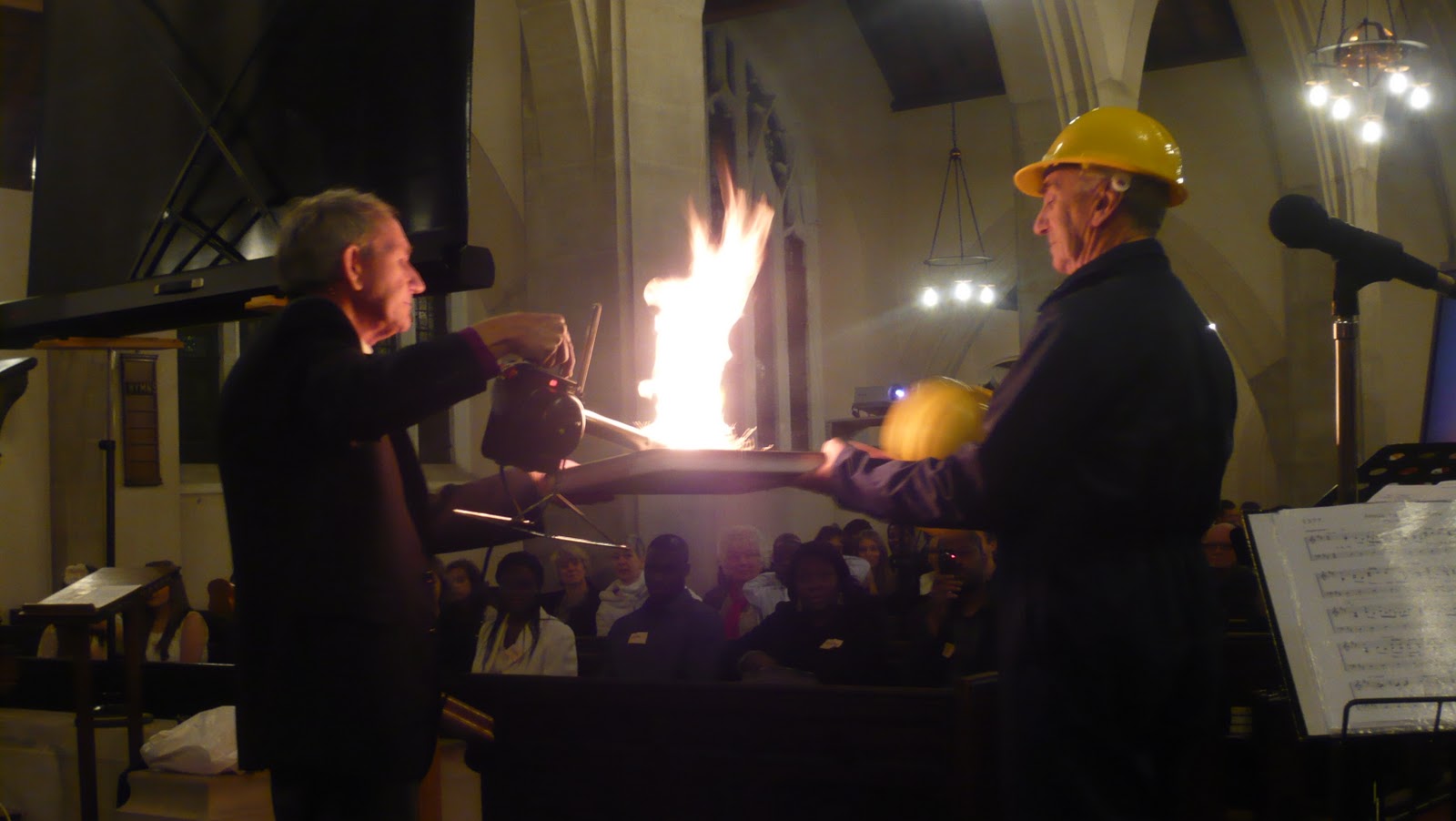
This evening we joined with All Saints Goodmayes for a Confirmation Service at which 14 were confirmed, including three candidates from St John's. The Bishop of Barking spoke about the candidates having made Jesus the foundation for their lives and then discussed the kinds of materials we should use in building on that foundation. He gave a real-time demonstration of the flammability of straw and then asked the grandfather of one of our candidates to demonstrate bricklaying. He concluded that we need to be built together as a community of God's people all standing firm in our faith as we build on the foundation of Christ.

-----------------------------------------------------------------------------------------------

Sixpence None the Richer - The Melody of You.

Sunday, 23 October 2011

Bible Sunday and Give A Bible


Members of St John's Seven Kings took part today in the 'Give A Bible' Bible Year 2011 initiative in the Diocese of Chelmsford to encourage Church members in the Diocese to bring a Bible to church on Bible Sunday with the intention of subsequently giving it to a neighbour, work colleague or friend. This initiative was inspired by a 90-year-old lady in the Havering area who, when she was given a Bible by her parish church, said: “It's been too long since a Bible was in this home.” It is hoped that this 'Give a Bible' initiative might place a Bible back in many other homes.

At St John's, members chose a range of different translations and versions of the Bible to give away to work colleagues, grandchildren, relatives and friends. These included a Polish translation for one work colleague. Several St John's members also bought a children's storyteller version of the Bible to give to Downshall Primary School for future use in their RE lessons.
All these different versions of the Bible were brought to St John's for Bible Sunday where the following prayer was prayed before the Bibles were given away:
This is a Bible – filled with stories of people who have encountered God. Those people are our people. Their stories are our stories. We share these stories so that others will live in these stories with us. We read these stories because we want to remember who God is, who we are and what we believe, so that we will know how to live today. May God’s abundance uphold us and those to whom we give Bibles. May God’s love instruct us and those to whom we give Bibles. May God’s dream motivate us and those to whom we give Bibles. May the Scriptures be made real in our lives and theirs today and in the days to come. God is with us. Amen.
Our other Bible Year 2011 activities have included an Art Competition for children and young people illustrating Bible stories on the theme of hope and HISstory, a session led by Redbridge Area Dean Paul Harcourt, which outlined the big story of salvation told by the Bible. These events and activities have underlined the significance of the Bible for us and for our culture and have inspired us to share the Bible, and the story it tells, more fully with others.

Here is the sermon I preached for Bible Sunday (which makes use of Bible Society materials):

Storytelling has been around as long as human language. Storytelling is what makes us human. Our ancestors probably gathered around the evening fires and expressed their fears, their beliefs and their heroism through oral narratives. This long tradition of storytelling is still evident in ancient cultures such as the Australian Aborigines. Community storytelling offered the security of explanation; how life and its many forms began and why things happen, as well as entertainment and enchantment. Communities were strengthened and maintained through stories that connected the present, the past and the future.

So, from earliest times human beings have told stories and the stories we tell commonly seek, either explicitly or implicitly, to answer questions such as, “How did we get here?”, “Where are we going?”, and “What is the meaning of our existence?” We call these overarching stories metanarratives or worldviews and we live within the meanings which they provide.

For example, a humanist may tell a story of a universe which comes into being by chance leaving human beings free to create their own meanings for life and society. To give another example, the theologian
Stanley Hauerwas says: “The story of modernity is the story that you should have no story except the story you chose when you had no story. We call that freedom. But as Christians we believe that we are creatures born into a story that we haven’t chosen.”
Christians are “a people who have been formed by a story that provides them with the skills for negotiating the danger of this existence, trusting in God’s promise of redemption.” In other words, the Church is founded on the premise that the creator God decisively calls and forms a people to serve him through the history of Israel and through the work of Jesus Christ to bring about the redemption of the creation.

We must constantly remember that we are a story formed community and that story is what defines our existence as Christians. This is something that we can see occurring in
Nehemiah 8. 1-12, which is one of the rare and exciting public readings of the Scriptures found in the Bible. It shows how inseparable the Bible was from the lifeline of the people. In Nehemiah 8 the people of Israel recognise that the scripture is central to their lifeline and their identity. In fact, it is inseparable from their story. It is their story. The New Testament then shows us that this is true for all of us, Jew or Gentile, who choose to live in relationship with God.
The people in Nehemiah’s day would usually have been very reluctant to have men and women gathering together in an act of worship. Even more so children – even those old enough to understand were likely to have been excluded. But what happened in the square that day was a remarkable and radical worship event. Men, women and children all recognised that, through the Scriptures, God had something transforming to say to them. No one should read the Bible without finding themselves in it. The Bible speaks to all kinds of people, whatever their status, and in all types of situations. If we allow God to speak, he will do – whoever we are! The Bible speaks across gender – to men and women, to everyone old enough to understand – to children too!
What is the story of which we are part? Tom Wright has described the Bible as being like a five act play containing the first four acts in full (i.e. Act 1. Creation, Act 2. Fall, Act 3. Israel, and Act 4. Jesus): "The writing of the New Testament ... would then form the first scene in the fifth act, and would simultaneously give hints (Romans 8, 1 Corinthians 15, parts of the Apocalypse) of how the play is supposed to end ...”
“The church would then live under the 'authority' of the extant story, being required to offer an improvisatory performance of the final act as it leads up to and anticipates the intended conclusion ... the task of Act 5 ... is to reflect on, draw out, and implement the significance of the first four Acts, more specifically, of Act 4 in the light of Acts 1-3 ... Faithful improvisation in the present time requires patient and careful puzzling over what has gone before, including the attempt to understand what the nature of the claims made in, and for, the fourth Act really amount to."

Wright concludes that he is proposing "a notion of "authority" which is ... vested ... in the creator god himself, and this god's story with the world, seen as focused on the story of Israel and thence on the story of Jesus, as told and retold in the Old and New Testaments, and as still requiring completion."
The book of Nehemiah is the story of the people of Israel returning to Jerusalem following exile. After some 70 years of exile in Babylon, many of the people had returned to Jerusalem but all was not well. Nehemiah returned to Jerusalem to lead the people in rebuilding of the walls of the city; dealing with corruption and inequality; boosting morale; carrying out a meticulous census; reforming and re-establishing the priesthood and completing the settlement of land. Scripture was deeply at work driving these reforms. Nehemiah’s social and economic reforms, for example, were guided by the book of Deuteronomy’s restrictions on usury and his anger about indentured slavery was based firmly on the Levitical Laws. God’s Word had so shaped the minds and standards of Nehemiah and Ezra that its deep influence became a basis for social and economic reform.
All this led up to the public reading of God’s Word in our passage today. Despite all that had been achieved, the people knew that something was still missing. It was as though all their efforts for a better society, and the relative stability and prosperity they were starting to experience, revealed a gaping spiritual void which still existed. So when they met in the public square, they asked Ezra to read God’s Word.
Having achieved so much, they could easily have rested on their laurels. But amazingly, they – not Nehemiah – asked for the scriptures to be read. Nehemiah had enforced many reforms, but the people themselves felt the need to hear God’s Word.
It seems clear from our text that more is needed in a nation than real or relative wealth and security. We still need spiritual values guiding all aspects of our lives. This was the challenge for William Wilberforce. Years after Wesley’s great revival in Britain, Wilberforce
was still moved in 1797 to write and distribute his book, A Practical View of Real Christianity, to revive Christian values in all areas of life – in what he described as a ‘reformation of manners’. In the same way, our commitment to God’s Word should lead us to apply ourselves to ways in which we may prayerfully lead people to revive or discover a thirst for the Bible and how it applies to our lives today.
That is how we live in the story today. Let’s end with a story as a practical example. At a trauma workshop in the Democratic Republic of Congo, people displaced by civil war listened to a dramatised reading of Lamentations 5. As they heard the story of the Israelites’
invasion by the Babylonians, they said, ‘This is our story! We had a beautiful land and we lost it. Now we can’t get to our fields. It’s too dangerous.’ A Bible Society trainer who helped lead the programme said these Congolese people ‘felt so similar to the people of Jerusalem’ and realised for the first time that it was acceptable to cry out to God in their pain and grief.
The Bible was never meant to be an alternative telephone directory. It’s far more interested in transformation than in passing on important information. But in order to transform, it really needs to be understood. It is the comprehension that makes all the difference so that we are able to see how we can be part of and live in the big story that the Bible tells.

----------------------------------------------------------------------------------

The Call - What's Happened to You.

Wednesday, 12 October 2011

Servant leadership

This was my sermon for St Edward's Day at St Edward's Church of England School and Sixth Form College on Tuesday:


Thirty years ago Judy Acheson was a Sunday School teacher at St John’s Seven Kings, the church where I work now. While at St John’s, she felt called to serve God in the Democratic Republic of Congo. She went to the Congo in 1980 with the Church Mission Society (CMS) to be a nursery nurse, but, as the children she cared for grew, she carried on caring for them, eventually training and handing over responsibility to local leaders. “When I was first simply doing Sunday school work, I trained someone to take over … I always felt that we were there in a country to share the experience we had and enable people to carry it on."

The recent history of violence in the DRC is legendary. There is a legacy of 30 years of a both brutal and incompetent dictatorship, followed by one of the worst civil wars in post colonial Africa. Almost every participating force has been guilty of massacres and rapes. And the north-east region, where Judy was originally, was described by Human Rights Watch as "the bloodiest corner of Congo".

Judy could have left the country during the civil war but chose to stay and develop pioneering youth work. She says, “it was always my philosophy to empower the young people to do the work.” Bisoke Balikenga was one of her original youth team members. “You could see his leadership potential. People would listen to him and do what he asked. When we had visitors he looked after them.” Seeing his potential, CMS gave him and his wife a scholarship to study at Daystar University in Nairobi, then he took over the diocesan youth work Judy had begun, so she could start youth work nationally. Now that she is about to retire, he has taken over the national youth work as well.

The youth department they set up, called Agape Mahagi, visited young men who joined the tribal militias during the civil war to persuade them to leave the militias, runs rehabilitation centres for young women raped and traumatised during the civil war, and, now the war is over, runs seminars to reconcile those who fought against each other during the war. When the Archbishop of Canterbury visited in July of this year, a group of about 50 former militia members spoke about how the Church, in the form of Agape, never forgot them. One by one, they gave their testimony. "We were taught to repay bad for bad," one said, "but the people from the church came to visit me." One after another they spoke about how, thanks to Agape's seminars and con­ferences on peace, they retuned to God and their families, rediscover­ing the love of Jesus. Many of them were now at college or university, slowly putting their trauma behind them.

Throughout these years Agape was been training young people to think for themselves, to have, give and express their own opinions, and make their own decisions. God began to show Judy, Bisoke and others that he is going to bring mighty changes within the country and has chosen to use children and young people as a means of doing so. This led them to write a manual for young people, Young people, with God, let us rebuild our beautiful country. With Government support this book is being used by thousands of teenagers and young adults in schools and in youth groups with the result that they are learning to make their own decisions and become aware of their role and their responsibility towards their own country.

In our Gospel reading we heard Jesus say to his disciples, ‘You know that among the Gentiles those whom they recognize as their rulers lord it over them, and their great ones are tyrants over them. But it is not so among you; but whoever wishes to become great among you must be your servant, and whoever wishes to be first among you must be slave of all. For the Son of Man came not to be served but to serve, and to give his life a ransom for many.’

St Edward the Confessor is an example of that kind of leader. When Pope Benedict spoke about St Edward at Westminster Abbey last year, he described him as 'a model of Christian witness, of fidelity, of humility and obedience, grounded in the example of our Saviour'. There was something in the life of Edward, as King of England, that was regarded as out of the ordinary. He was a man who exercised gentleness and prudence in high office, whose reign between 1042 and 1066 was one of almost unbroken peace. He had a great devotion to the Church, including having Westminster Abbey built. He was humble, and opted for a certain simplicity of life, manifested by his manner of dress we're told, and who was generous, having a special love and care for the poor and afflicted.

One story told about him comes from his particular devotion to the Apostles Saint Peter and Saint John the Evangelist. He had made a promise never to refuse alms asked in the name of the latter. One day when he had no money with him, a poor man reached out his hand in the name of St John the Evangelist and the king gave him a valuable ring. Some time later, Saint John appeared to two pilgrims returning from the Holy Land. He gave them a ring and said: “Take it to the king. He gave it to me one day when I asked for alms in the habit of a pilgrim. Tell him that in six months I will visit him and take him with me, to follow the unblemished Lamb.” The King received it from them after hearing their relation of this incident, and broke into tears. According to the story this was six months before Edward died on January 5, 1066.

Edward is a past example of a leader who put Jesus’ words into practice. Judy and Bisoke give us contemporary examples of leaders doing just the same and by doing so having a massive impact on their country. Their story is particularly inspiring because they are clearly ordinary people just like us. If they can do it, so can we. Their story is doubly inspiring because it is about encouraging, equipping and enabling young people to become the kind of leaders about which Jesus spoke; those who come not to be served but to serve, and to give their lives for others.


******************************************************


Interestingly, after the Service, one of the teachers at the School told me that, as a child, she had been in Judy's Sunday School class at St John's Seven Kings. Judy will be speaking at St John's on 27th November at 10.00am.


The latest news we have comes from both Bisoke and Judy. Bisoke wrote to say, "We greet all of you in the name of our Lord Jesus Christ. We are well in Congo but we are approaching the election in our country please pray for it, we will start voting from 28th of November. Also pray for Judy Acheson because for the moment she is in the Diocese of Boga where she has started her work, and we are going to visit all the Archdeaconry to say goodbye before the 16th of October when she will say goodbye to many people here in Bunia.”

“We are doing well but have a lot to do, please continue to pray for our work because we have a lot of needs for our work to be done. We were in Goma for a workshop and Judy Acheson was with us. While there she said goodbye to our staff. In June we had a ladies workshop in Butembo which helped those who lead the ladies in the parishes and dioceses to manage their groups well. Also in June the Archbishop of Canterbury visited our country and he went up to Boga. The British Ambassador was also here in Bunia to welcome the Archbishop. The Archbishop had his first meeting with the youth which encouraged our young people. Praise the Lord.”

“I would like to inform you that I will be ordained full priest on 9 October. It is amazing because most of us who will be ordained on this date are from the Youth Ministry. It also makes us proud to know that most of us including the Bishop of Boga diocese are the fruits of the work of CMS mission partner Judy Acheson. Praise the Lord! Keep praying for that day and for us who are so eager for this to happen. Pray also for the upcoming general elections in Congo. We need Jehovah Shalom to dwell amongst us during this period.”

He then wrote saying, "Thanks alot for your prayers because my ordination went so well , and many people came to celebrate it with us. It is the first ordination where we had many of the people who become Pastors are from the Youth Ministry Agape. Praise the Lord. Judy was so happy to see her people become Priest and among us one of us is a lady, and that lady is the first lady to be ordained in the Diocese of Boga, and the lady is from the Youth Ministry. Praise the Lord.

Tomorrow Judy with some people is visiting the Parish of Mafifi , Komanda , Sota , Tekele , and Nyankunde . We will come in Bunia on thursday and friday we will go to Kasenyi. The purpose of her visit is to say bye to the people who she worked together for 31 years in Congo."

Judy has also written to say she has now finished her work at Mahagi and has moved to Bunia. She reported that the handover at Mahagi went really well. There is much to be thankful for at Mahagi, including guttering for rainwater harvesting and a new generator. “But the best thing has been our morning bible studies which God has used to talk to each person. We have seen such changes, a growth in faith, love for each other and understanding of what it means to be the Body of Christ. Please pray that these studies continue.” Please join with Judy in this prayer.

Judy also writes, “Only just over two weeks before I leave so much to be done and visits made.  But praise God everything is going smoothly.  We are looking forward to the Thanksgiving/farewell service on 16th October.  Please pray for Bisoke and Bishop Willy as they arrange this and that it will bring much glory to the Lord.”


-------------------------------------------------------------------------------


Neal Morse - The Land Of Beginning Again.

Tuesday, 6 July 2010

Judy Acheson MBE


Many congratulations to Judy Acheson, our CMS mission partner from St John's Seven Kings working in the Democratic Republic of Congo, who's been awarded the MBE in the Queen's birthday honours list.

Stephen Burgess, CMS transcultural manager for Africa, said of the award that, "It's a fitting tribute to her 30 years' mission partner service in DRC," and we would fully agree as Judy, through her willingness to serve God, has enabled young people across the country to fulfil their God-given potential, recovery and healing for those traumatised by acts committed in the Civil War, and reconciliation combined with forgiveness between those who fought each other in the conflicts.

The award - for services to young people in the Democratic Republic of Congo - comes as Judy prepares to retire next year. For many years she was the youth coordinator for the Anglican Church in Congo, a role which she has now handed over to Congolese colleagues. She now acts as a consultant at a new youth ministry training centre in Mahagi. Over the years she has helped developed a vibrant youth movement in the church, which among many other intiatives has been active in peace and reconciliation work.

Judy has also co-authored a series of manual for young people now being used in schools across the country as well as in churches.

Judy has written that having been in the Congo 30 years, she has had the privilege of seeing part of their history worked out. She has watched God empower new leaders who will continue to help young people to find the Saviour and to take them further in their service to the church and to their country for the glory of God. As Westerners, she says:

"what we do is always important to who we are and where we find our identity. But to the Congolese, it is through relationships, sharing oneself with others, even the vulnerable, weak parts that one discovers who one truly is. To them relationships are more important than the work done."

---------------------------------------------------------------------------------

Gael - Eh Yahwe.

Sunday, 20 December 2009

Inspirational stories


This weekend at St Johns Seven Kings we have been hosting Bisoke Balikenga, Provincial Youth and Children's Work Co-ordinator for the Anglican Church in the Democratic Republic of Congo. This is Bisoke's second visit to St John's, as he came once before as part of a youth team brought by our CMS Mission Partner, Judy Acheson. His story since that time, as told in a 2007 article from CMS, is an inspirational one of making an impact in the community by helping young people to thrive in spite of the difficulties brought on by years of war in the DRC:

"Back in 1989 youth ministry in the Diocese of Boga was launched in Bunia. CMS mission partner Judy Acheson was serving as Co–ordinator at the time and was instrumental in the starting of the youth ministry, which was called ‘Agape’. It became a model that was replicated in other dioceses in the DRC.

In 1999, Bisoke Balikenga and his wife Furaha received CMS scholarships to study at Daystar University in Nairobi while the youth ministry in Boga Diocese remained in the hands of other capable leaders such as Jijika Kambonesa. By this time Judy was the Provincial Co–ordinator of Agape. So, although Balikenga and Furaha were away for four–and–a–half years, the youth ministry grew rapidly and it touched many young people’s lives.

Fresh from training, the couple brought in new expertise that helped to sustain the work and to create strategies for further growth, and made all the difference. Balikenga’s qualifications are in Business Administration and Management, and Peace and Reconciliation. Furaha majored in Accounting and also took Community Development.

“First of all, my mind has been opened and I have no fear of making any change in this world, especially in our church. I know how to manage the youth and how to meet their expectations and those of adults. I also know how to reconcile people and how to build peace among people,” says Balikenga.

For Furaha, the many needs of women in her community were among the issues at the forefront of her plans following her training. “In Ituri, only five per cent of women have been to primary school, and only one per cent of them have gone to secondary school. My vision is to help the women to learn how to read and write, and to encourage those who want to study, so they’re not seen as just housewives, cooks or mothers. They have to contribute to the development of our society in other ways too,” Furaha says.

Her activities involve encouraging women to gain literacy skills and to start small businesses. She also teaches women how to manage and plan for their homes as well as teach their children God’s word.

The youth ministry has experienced tremendous growth in the various areas of its operation. The evangelism programme reaches out to young people with the Gospel. During holidays there is a programme for the youth that helps to keep them active and to behave responsibly.
There’s also a team, which runs Peace and Reconciliation seminars to help to bring about healing from ethnic clashes and civil strife.

In the Development Section the youth are taught life skills and to start projects and co–operatives in their villages. There’s an agricultural centre, which provides seeds and seedlings. A trainer gives instructions on how to grow them. The centre is also used to give the numerous people raped in the war a new lease on life. They are given seeds to plant, taught God’s word and how to interpret the Bible as well as to read and write.

The youth ministry also runs the “Girl Hope Centre” in Bunia, where 176 women and girls come four times a week to learn various skills including knitting, sewing, reading and writing. It is a trauma–healing centre, which caters for people who suffered greatly in the war: some lost all their property; some were raped; and others received no education.

In the Community Health Section, the youth receive training on HIV/AIDS awareness and prevention. Blood testing is provided so people can know their serostatus. They are taught nutrition and how to take care of their bodies.

Balikenga and Furaha started Hope for Orphan Children in Ituri (HOCI) in 2005 to respond to the problem of parentless children in the Ituri Province, where the town of Bunia is located.
Money was raised to purchase the buildings that now house the ministry. The centre is called “Bunia Children Hope Centre”.

The project aims to help children who are victims of civil war, ethnic killings and HIV/AIDS.
Over 100 children who come to the centre do not have any extended family. They rely on the centre to meet their physical, social and spiritual needs. They do not stay at the centre. Local people have taken them into their homes, providing them with overnight shelter and an evening meal. The centre provides porridge at midday.

Many host families are very poor and unable to feed an extra child. At one point, a local farmers’ association agreed to provide each host family with 10 kg of rice and 5 kg of beans for each orphan once a month, but that service ended in June 2006.

Approximately 200 other children take part in some of the weekend programming, particularly the spiritual–growth and HIV/AIDS training. Funds are limited so most of the HOCI staff do not receive pay. The teachers and counsellors are given a small amount of money to buy soap and sugar each month. They agreed to start work on a voluntary basis on the understanding that the centre would start paying them when funds became available. In the face of such challenges, children and adults alike have learned to look to God for their every need."

Although some of the programmes run by the Agape Youth Department in the Diocese of Boga have changed since that article was written in 2007, as a result of changes to funding, St Johns Seven Kings has continued to fund a post in the Agape Youth Department throughout. Bisoke meanwhile has been appointed as Judy Acheson's successor at Provincial Youth and Children's Work Co-ordinator and has become a CMS Mission Partner through the Timothy Fund, which supports local mission partners who are talented servant leaders only lacking in financial support.
--------------------------------------------------------------------------------------

Steeleye Span - Gaudete.

Thursday, 3 September 2009

Making things happen

The enthronement of the 3rd Archbishop of the Anglican Church in the Democratic Republic of Congo, Henri Isingoma, was held in the Conference Centre at the Botanical Gardens in Kinshasa on 9th August.

There are high expectations among the Anglican Church in Congo of their newly appointed Archbishop, who, several years ago was Bishop in Lubumbashi and has a reputation for his ability to 'make things happen.' Pray for the Archbishop as he takes on this huge responsibility and has a number of big decisions to make about the future direction of the Anglican Church organisation in Congo.

Archbishop Isingoma writes, “Thank you for your prayer. All was fine at the enthronement service in Kinshasa. We felt the presence of God's Spirit. We still need your prayer for the organisation of our Province and a common vision for the progress of our church mission. In the fellowship of prayer, God bless you.”

------------------------------------------------------------------------------
Fr. Guelord Yamfu - Elika.

Tuesday, 4 August 2009

Archbishop Isingoma

At St John's Seven Kings we will be praying for the enthronement of Bishop Isingoma, formerly of Boga Diocese, as 3rd Archbishop of Anglican Church in Congo on Sunday 9th August. The ceremony will be in Kinshasa.

Bishop Isingoma and his wife Mugisa visited St John's in 2008 just prior to the Lambeth Conference and posts about his visit can be found here, here, here and here.

----------------------------------------------------------------------------

Lor Mbongo - Nkosi Na Yuda.

Wednesday, 22 July 2009

Taking youth work forward in the DRC


In her latest prayer letter from the Democratic Republic of Congo, Judy Acheson writes:
"I feel so at peace about handing over the [Provincial Youth] department to Bisoke and Jean-Bosco, knowing that the team will take the department on so much further and thankful that I will no longer have this responsibility. But please pray I finish this stage well as there is still much to do.

Bisoke visited Lubumbashi in April. We are so grateful to CMS for financing that because it was a brilliant time of team-building; as a result the staff are determined that the work will go forward as they pull together, each one using his own particular gifts. They discussed all the knotty questions concerning money – ways of bringing in funding in order to become more and more self-reliant – and an agreement was drawn up with the staff to contribute from their salary each month for when any of the team have problems over health, death, marriage, etc.
It was a time when we really praised the Lord for bringing this team together who are all so deeply committed to serving him amongst children and young people.
Bisoke also developed excellent relationships with the diocesan staff here and began to understand the culture here in the South. He visited churches in three different
archdeaconries and made a great impact on the youth."

--------------------------------------------------------------------------------

Eric Bibb - Don't Let Nobody Drag Your Spirit Down.