The connections nurtured between contemporary art, spirituality and faith by churches are often of a one-off or temporary nature – an exhibition, an installation, a residency – rather than a sustained programme integrated into other aspects of that church’s mission and ministry. Where such programmes do exist, they tend to be in larger churches or cathedrals, where greater resources can be found, than in local parish churches.
In over 20 years of ordained ministry in the Church of England, I have sought to build longer-term programmes in each of the four parishes where I have ministered. In each parish, I have used a different combination of cultural programming in each Parish because of the different contexts and the range of resource available to me. Along the way, I also encountered and used the 4 Cs model of mission (culture, compassion, commerce, congregation) that provides an effective means to review and create integrated approaches to mission and ministry which include cultural programmes.
In this case study, I briefly review the programmes set up in each Parish, including several with smaller congregations and available resources, and draw out key learning from each initiative.
Regeneration initiativesMy curacy was served at St Margaret’s church in Barking, East London, which was set alongside the ruins of Barking Abbey at the cultural end of the town in a deprived multicultural borough undergoing regeneration. The key initiative here was to engage with the public arts programme of the local authority which was accompanying the wider regeneration initiatives within the borough.
Three different projects included: an art workshop for young people creating designs for vitreous enamels by Dale Devereux Barker located in Barking Town Centre (Making Barking Brilliant); interviews of older church members for a film (RE:Generation) by Michael Cousin that was premiered at the church alongside an exhibition of archive and contemporary photographs showing change and continuity in the area; and film of the church environment and congregation members that was projected onto its clear glass windows by visual jockeys SDNA (Abbey Happy), as part of a wider projection installation (Love and Light) which highlighted the key heritage buildings in the town.
These engagements were made possible because the local authority needed community groups able to provide access to hard-to-reach communities in the area. Churches in the UK are often a key gathering place for a diverse range of the local community, both for worship and because facilities are hired out to other community groups. As a result, we were able to offer the local authority access to a diverse range of people in the local community, including those they found harder to engage in the Arts. The benefits for our congregation included involvement in an interesting range of Arts activities which drew specifically on the diversity of our congregation and the sustainability over time of our ministry.
Other cultural initiatives which also connected to the diversity and heritage of our church included: commission - a painting by Alan Stewart of a black Christ offering breakfast to a multicultural group of disciples (Early in the Morning) to counter-balance the images of white Biblical figures and saints found elsewhere within the building; concerts – utilising the talents of those in the congregation and community including South African concert pianist Manuel Villet, Nigerian juju singer Jide Chord, and Nigerian oboist Althea Ifeka; exhibition – loans to ‘George Jack (1855 - 1931) Architect & Designer-Craftsman’, an exhibition at the William Morris Gallery; gifts - an art book made by George Emmerson, a local artist, depicting the church and its environs and an icon of ‘Christ blessing the children’ by Kjellaug Nordsjö, a Scandinavian iconographer, from our Swedish partner church for our Youth Chapel; and Workshops – workshops for young people in Fashion and Graffiti art, as part of the SOULINTHECITY mission, included creation of a mural by graffiti artist AKS that included the words ‘one’, ‘heart’, ‘soul’, ‘unity’, ‘community’ and ‘together’.
These initiatives drew people from outside our congregations to the church while encouraging people of all ages within our congregation to see themselves as affirmed and valued through the imagery and activities of the church.
Art trails and festivalsMy first incumbency was at St John’s Church in Seven Kings, East London, in a multicultural suburban residential area. The key initiative here was to connect artists and churches to maximise the impact of existing and new art.
Churches locally, and more widely in the Episcopal Area, had interesting examples of art which had been previously commissioned but which were not publicised or viewed to any great extent. St John’s had a recently installed East Window by Derek Hunt, as well as other stained glass by the Kempe and Whitefriars Studios. To create wider awareness, encourage visits, and organise additional activities (such as art workshops, exhibitions, guided tours, open days, and sponsored walks), art trails were created firstly for the local churches and then for the Episcopal Area. Leaflets and website pages for the trails described the artworks able to be viewed at each church on the trail, together with contact/opening information and maps showing locations. We drew on a combination of paid and volunteer researchers to find the artworks that were included and to write about them and the artists who made them.
The basis for the Art trails was that people would be unlikely to travel to view one or two artworks in one church but would be more likely to travel if they could see a range of interesting artworks in different churches in the course of a day’s or half day’s visit. This proved to be the case with people attended the organised activities linked to the trails or visiting on an individual basis and, over time, visiting all the churches on the trails.
I was also involved in linking churches together to create Art Festivals that opened church buildings for a range of Arts events and drew people from outside church congregations to those events. The fundamental insight for this initiative was that, if each church in a defined locality organised one or two Arts initiatives in a defined time period, an Arts Festival would be created without any one church having to do a large amount of organisation. If those events could also be organised within the time period of an annual locally run Arts Festival, so much the better in terms of marketing, publicity, and community awareness.
At this time, I was also involved in setting up and running an artist’s collective called commission4mission, the members of which were artists interested in undertaking commissions for churches. Their work was publicised through newsletters, exhibitions, and art talks. 13 commissions were undertaken over an 11-year period and exhibitions held at locations including Chelmsford Cathedral, Coventry Cathedral, Norwich Cathedral, St Martin-in-the-Fields, and Methodist Central Hall Westminster.
Asset-based community development commends looking for resources in the local area and this is particularly important and effective for smaller churches with more limited resources. Identifying how churches can work together and who and what is available outside the church congregation in the wider community can be key to setting up effective and wide-ranging cultural programmes. My experience in Seven Kings clearly demonstrated the value of these approaches.
Participatory initiatives and the 4 C’sSt Martin-in-the-Fields is a large, significant church located at the heart of the UK’s capital city, with a history of innovation in regard to the 4 Cs of culture, compassion, commerce, and congregation. I joined the clergy team at St Martin’s in order to develop their wider partnerships with other churches by setting up and running a network of churches called HeartEdge, which sought to share the 4 Cs as an encouragement to churches to be at the heart of their local communities while being with those on the edge and facing marginalisation. Within the St Martin’s congregation, I also had a role in working with artists and craftspeople.
St Martin’s has a reputation as a church that has effectively and creatively commissioned contemporary artists, such as Shirazeh Houshiary (East Window), to create new work for the church building and its environs. However, through meeting many artists in the congregation after my arrival, it became apparent that the major programme of aspirational commissioning of artists from outside the congregation had left artists in the congregation feeling under-valued. What was needed, as a balance, was a participatory programme led by the congregation’s artists. Following consultation with artists and craftspeople themselves, a programme including a monthly drawing group, seasonal contemplative art workshops, a monthly display of work by the artists on a rota basis, and an annual exhibition was introduced and generated significant energy and involvement from artists and craftspeople whilst adding significantly to the contemplative and educative offerings available to the congregation as a whole.
A community art initiative led by the artist Anna Sikorska provides an excellent example of participatory art that helped the congregation and community at St Martin-in-the-Fields reflect on themes of light seen through fallibility and flaws as inspired by 2 Corinthians 4.6-12. Sikorska’s installation was set in the Light Well of St Martin’s during November and December 2017 and was the culmination of a community art project in which individuals from across St Martin’s – church congregation, Chinese community, clergy, staff and members of the International Group – gathered together over time and tables of clay to carefully form the porcelain lanterns which filled the Light Well for the installation. Each of these porcelain lanterns was filled with light from a simple string of light bulbs.
These cracked translucent lanterns lit from within were a visible realisation of St Paul’s image of light in clay jars. By linking the lanterns together, this installation also showed that it is as we come together, linked, like the lanterns, by the light of Christ that we become the Body of Christ. This installation and community art project enabled reflection on the understanding that there are fractures and flaws running through each of our lives and these imperfections actually enable the light of Christ within to be seen more clearly. Our vulnerabilities are, therefore, the most precious aspect of our lives; of more significance than a confident pride in ourselves that will not acknowledge weakness.
Having observed such initiatives in practice and the ways in which they brought energy to the congregation, Revd Dr Sam Wells, Vicar of St Martin-in-the-Fields suggested the following threefold approach to use of the Arts by churches:
‘A congregation may encourage art on three levels. One is the participatory: a local church may host an artists’ and craftspeoples’ group; it may take participants of all abilities; there’s no reason why it can’t host members of all faiths and none; perhaps each month a member of the group may be invited to exhibit their work in a valued and visible place, and be given the opportunity to write or speak about it. Another is the aspirational: a competition might be held for an artefact to be placed permanently in the church building, tenders invited, donors sought, publicity encouraged, visitors attracted. Similar approaches might apply for temporary art installations. A third level is the commercial. A church building might be a suitable venue for a display and sale of artworks; yet another host of new faces drawn in, conversations triggered, relationships made; and the church perhaps taking a 20% cut of all piece sold. In a short time a secluded, secretive space may be opened out to become a centre of community activity, energy, and creativity.’
[i]In these ways, the participatory initiatives at St Martin’s brought new energy to congregational life while also providing an example of the 4 Cs in practice and enabled the identification of new models within the culture strand.
A cultural and heritage centreMy current Parish is that of Wickford and Runwell within the Diocese of Chelmsford and in the southern part of the county of Essex. Wickford is an expanding market town in rural Essex and Runwell is a village on the northern edge of the town which development is now incorporating into the town itself. The rapid growth of Wickford means that it has not fully embraced its new identity and does not have all of the facilities in its town centre that would be expected in a town of its current size.
Through use of the 4 Cs model of mission to review missional activity within the Parish and opportunities latent within the community, we identified that Wickford did not have a cultural and heritage in the town centre, that the only public buildings which could house such a centre were the churches, and that St Andrew’s Church was of a sufficient size and suitability to be developed as a cultural and heritage centre, while also remaining as a church.
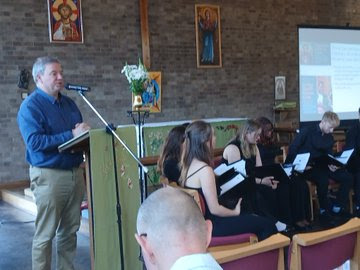
We began exploring this possibility by sharing the idea with creatives locally and then by setting up an initial programme of culture and heritage. This involves regular art exhibitions and heritage displays combined with a fortnightly arts and performance evening that has included art talks, concerts, dance performances, exhibition viewings, heritage talks, open mic nights, and readings of poetry and prose. We have also organised concerts and workshops outside of this basic programme, including working with schools to hold art workshops for pupils based on our exhibitions.
We have worked with local artists and groups, while also bringing in creatives from further afield. In this way, we are seeking to be both aspirational and participatory in our practice. Our programming has supported local creatives in developing their careers and practice whilst also bringing people into our building who would not have attended our services.
More recently we obtained government funding for a feasibility study to explore how best to scale up the development of St Andrew’s as a cultural and heritage centre. The feasibility study involved considerable community consultation combined with assessment of government arts funding and options for the structuring of the project’s governance. Following the recommendations of this study we are setting up an Advisory Group formed of local creatives, expanding our partnerships including working with the local Business Improvement District on a community cinema initiative, and formulating plans for a grassroots music venue initiative.
This supports our wider vision of connecting effectively with the wider community by increasing the range of entry points to the building and congregation while improving the sustainability of both through commercial hire of our spaces.
Learning lessons
My engagement with congregations and the wider community through the Arts in the context of faith has involved community engagement, partnership working, creation of inclusive images, explorations of current social issues, attractional events, and pilgrimage style trails. These have drawn new groups to churches and have enabled other agencies to engage with diverse congregations. Art trails, in particular, have provided a marvellous way to encourage visitors to engage with the diversity of art found in many churches, and open to all the spirituality inherent in such art.
Cultural programming needs to be organised with the input and ideas of creatives. It needs to engage with the wider ministry initiatives and topics of the church whilst also being open to what God is doing amongst the community of creatives more widely. Identifying how churches can work together and who and what is available outside the church congregation in the wider community is key to setting up effective and wide-ranging cultural programmes. In this respect, partnership working with others such as other churches, the local authority, national and local Trusts or grant funders, Arts groups, and others, is vital.
As each context is different, time must be spent initially in community/congregational consultation and through use of frameworks such as the 4 Cs to identify the opportunities that exist within the Parish. Such consultation will also often identify several creatives willing to become involved in the development of new initiatives. In his writing on culture, Sam Wells has used the metaphor of churches as estuary space; a metaphor that derives from the artist Makoto Fujimura and which describes ‘a transitional place where cross-fertilisation can take place and creativity can thrive amid diverse conversation partners’.
[ii] This, even more than the bringing to church of new people who might not otherwise attend, is where the true missional activity stimulated by culture takes place. The Arts open up conversations about fundamental aspects of life and belief.
A visitor to an exhibition I organised noted that the exhibition was extraordinarily broad-minded, human and thought-provoking and that churches are extraordinary places for such exhibitions to be held. It is the thought-provoking nature of these interactions which open the already religious to the wonder of art and the non-religious to the possibility of faith.
As such, while each of the examples included in this case study is different due to the differing contexts of each Parish, taken together they demonstrate the value of including culture within a balanced approach to mission as advocated by the 4 Cs model of mission.
Further information:Books:S. Wells, ‘A Future That's Bigger Than The Past: Towards the renewal of the Church’, Canterbury Press, 2019
S. Wells ed., ‘Finding Abundance in Scarcity: Steps Towards Church Transformation A HeartEdge Handbook’, Canterbury Press, 2021
References:[i] S. Wells, ‘A Future That's Bigger Than The Past: Towards the renewal of the Church’, Canterbury Press, 2019, pp.66-67.
[ii] Ibid, p.66.
Images:
- Graffiti artist AKS with the SOULINTHECITY mural in Barking
- 'Early in the Morning' by Alan Stewart in the Youth Chapel at St Margaret's Barking
- Cover of Art Trail leaflet for the Barking Episcopal Area
- Installation view of Anna Sikorska's 'Light the Well' project at St Martin-in-the-Fields
- Installation view of Anna Sikorska's 'Light the Well' project at St Martin-in-the-Fields
- Concert by Rev Simpkins & the Phantom Notes at St Andrew's Wickford
- Performance by Infusion Physical Theatre at St Andrew's Wickford. Exhibition by Runwell Art Club
- Exhibition viewing evening at St Andrew's Wickford for 'Adventures in Joy' by Max Blake
--------------------------------------------------------------------------------------------------------


.jpg)


.jpg)


.jpg)
.jpg)
.jpg)