
Everyday Wonder to Revelation: an exhibition of paintings by Alan Caine
Date: Friday 10 October – Thursday 20 November 2025
Location: Clare Hall, Herschel Road, Cambridge CB3 9AL
Clare Hall is honoured to host an exhibition of paintings by Alan Caine (1936–2022), running from 10th October to 20th November 2025. Visitors are welcome daily between 10am and 5pm.

“Landscape (recollections)” 2000, 122x91cm, Acrylic on plywood
Alan Caine was an innovative and quietly charismatic teacher of art in the Adult Education Department of Leicester University. He took a primary role in the conception, funding and design of the University’s Attenborough Arts Centre, which opened in 1997. He was its associate director and continued teaching there until he was almost 80 years old.
In the midst of that busy academic life he took time, in the upstairs studio of his redbrick terrace house, to paint and draw. Caine’s art grasps at the essence of the everyday natural world. Its detritus found its way into that Leicester studio: fallen leaves, dried grasses, tangled vine stalks, eggs, rugs, and string. In these humble elements, their unfolding patterns, colour and geometry, Caine discovered a profound sense of wonder. Through the familiar and ordinary, he opens our eyes to the possibilities of the beyond.
Alan Caine was an innovative and quietly charismatic teacher of art in the Adult Education Department of Leicester University. He took a primary role in the conception, funding and design of the University’s Attenborough Arts Centre, which opened in 1997. He was its associate director and continued teaching there until he was almost 80 years old.
In the midst of that busy academic life he took time, in the upstairs studio of his redbrick terrace house, to paint and draw. Caine’s art grasps at the essence of the everyday natural world. Its detritus found its way into that Leicester studio: fallen leaves, dried grasses, tangled vine stalks, eggs, rugs, and string. In these humble elements, their unfolding patterns, colour and geometry, Caine discovered a profound sense of wonder. Through the familiar and ordinary, he opens our eyes to the possibilities of the beyond.
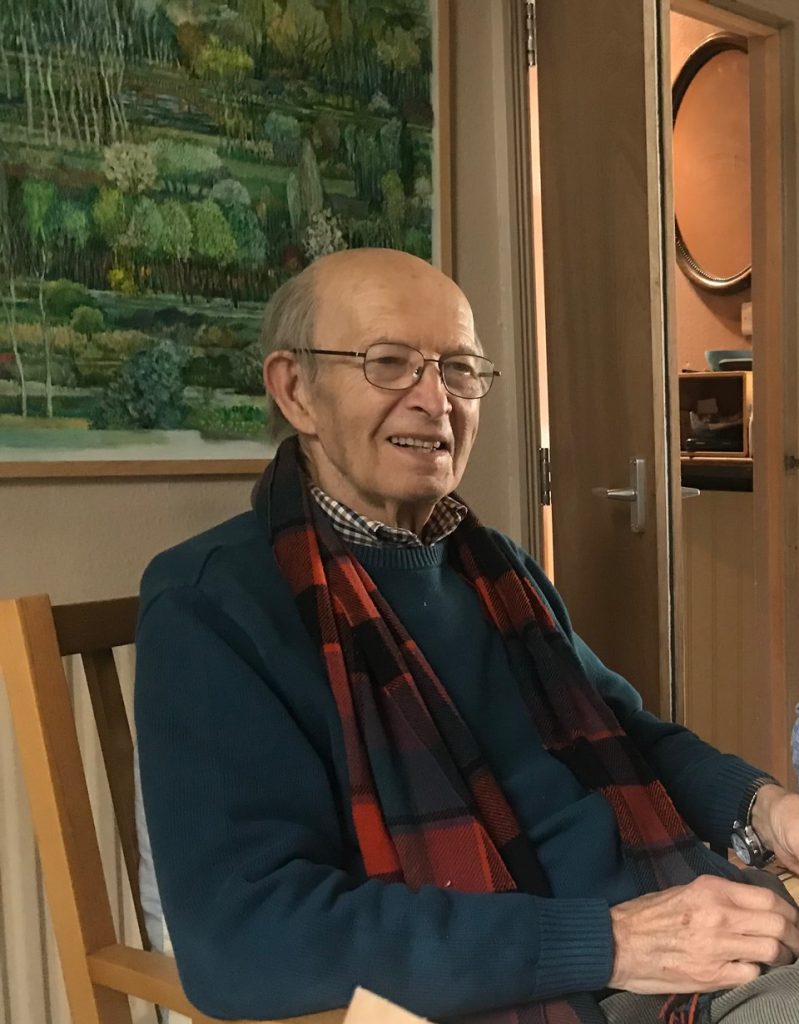
Alan Caine 2006
Caine was born in South Dakota. After graduating with degrees in art and theology, he moved to France and then to England, where he settled in the mid-1960’s. He would speak of always feeling European. What he meant by European was centrally and crucially being an inheritor to its artists. From his teaching, it was evident Caine claimed for himself a grand succession of masters: Giotto, Fra Angelico, Piero della Francesca, Rembrandt…. of these, it was Piero who was the most important to him. Piero’s Christian Neo-Platonism and his creation of new, or at least relatively unexplored, scenes and images were a magnet to him.
Caine was born in South Dakota. After graduating with degrees in art and theology, he moved to France and then to England, where he settled in the mid-1960’s. He would speak of always feeling European. What he meant by European was centrally and crucially being an inheritor to its artists. From his teaching, it was evident Caine claimed for himself a grand succession of masters: Giotto, Fra Angelico, Piero della Francesca, Rembrandt…. of these, it was Piero who was the most important to him. Piero’s Christian Neo-Platonism and his creation of new, or at least relatively unexplored, scenes and images were a magnet to him.
'…spirituality (in art) is not a matter of being, or not being, religious or pious. It is about finding and using marks, shapes, materials; about the pursuit of ideas and visions which may be scarcely understood, but matter.' Alan Caine
Consequently, Caine’s paintings delve into the core, the Neo-Platonist idea of the one-ness of the world, the nodus mundi. We see this in his depictions of everyday objects: rugs, mopheads, carpets, and bundles of cloth. Though his subject matter is humble, the deep intricacy of his draughtsmanship reveals unity and cohesion. We see it too in his expansive and luminous landscapes. When Caine blends his perceptions of space and shimmering light in the landscape with his exploration of the core in everyday things, he presents us with a vision of worlds beyond. His images invite us to step through a veil into barely imagined possibilities. Through his exploration of the small, the infinite beckons; through his exploration of the wonder of the everyday, revelation becomes possible.
--------------------------------------------------------------------------------------------------------
Anna Lapwood - Make You Feel My Love.

