Wikio - Top Blogs - Religion and belief
Showing posts with label b. read. Show all posts

Friday, 15 May 2015

Barking Episcopal Area Art Trail

To understand why an Art Trail like the Barking Episcopal Area Art Trail is needed it is necessary to know some of the background to the relationship between Christianity and the Arts in the 20th century.

After classical antiquity, ‘Christianity became the predominant power shaping European culture between the 13th and 19th centuries. Biblical texts, commentaries, and apocryphal stories inspired artists and patrons alike to create these objects of devotion ...’ and ‘to evoke the nature of ... sacred mysteries in visual terms.’

‘Artists and their advisors were faced with the challenge of suggesting, in visual terms, the nature of Christian mysteries – such as the visions experienced, or miracles performed, by the saints – as well as other profound theological beliefs and debates.‘

However, by the time Impressionism initiated modern art, art had already freed itself in many ways from the patronage of the Church and, as form not content became the primary focus of modernism, the developments of modern art led to an increasingly strained relationship between the Church and the visual arts.

Andrew Spira, writing in The Avant-Garde Icon, notes that ‘Avant-garde artists were passionate and vociferous in their denunciation of the credulity, passivity, manipulation and conservatism of conventional religiosity.’

Mark C. Taylor has noted that ‘the development of modern art follows an "inexorable logic" that leads from figuration and ornamentation to abstraction and formalism. The process of abstraction reaches closure when the work of art becomes totally self-reflexive and transparently self-referential ... Painting that is essentially about painting seems to leave little room for religious and spiritual concerns.’

Additionally, as Dan Fox has stated in frieze, ‘For most of the 20th century, art aligned itself with progressive rationalist secularity and radical subjectivity; the ideas that have fed into art come from modern philosophy, liberal or radical politics, sociology and pop culture rather than theology.’

Fox also writes that ‘It’s also a question of finance: the money that funds art doesn’t come from churches or religious orders like it did hundreds of years ago.’

Anselm Franke, head of visual arts and film at the Haus der Kulturen der Welt in Berlin, sums the situation up by saying that: ‘The historical break with religion continues. We would not think of hanging something that someone prays to in a museum ... Faith is incompatible with art end even destroys the sovereignty of art and the kinds of experiences we are looking for when we frequent art spaces.'

As a result, Dan Fox states, ‘contemporary artists who openly declare affiliation to Judaeo-Christian or Islamic religions are usually regarded with the kind of suspicion reserved for Mormon polygamists and celebrity Scientologists.’

Modern art looked, sounded and felt very different from the art that had traditionally been made for the Church, meaning that the Church avoided using modern art while many modern artists were excitedly exploring new ways of creating art and couldn’t see any connection between what they were doing and the styles of art which the Church continued to use. As a result, there was a whole segment of society – artists and art lovers – that were not being impacted by Christianity.

The Church has often not valued sufficiently the artworks it has commissioned; at times their significance has not been understood or shared, at other times the works have been controversial and may have been banned or not publicized as a result. Often the artworks have been regarded as subsidiary to the liturgy and have not been publicized in order that the focus of the faithful would not be deflected. ‘Christian Art’ has become a contested term and the Church has been unsure whether to continue to use it and, if not, how else to speak of its commissions. There has also been significant debate about the relative values of commissioning artists who are Christians and contemporary ‘masters’ who may not be Christians.

The Rt Revd David Hawkins, former Bishop of Barking and Patron of commission4mission, has said that, ‘There is a great need for the Church to re‐engage with the visual Arts. The Church has enjoyed a long and happy marriage with art in the past but in recent centuries has suffered something of a separation.’

Despite this sense of conflict and separation, there is a more positive story to tell of engagement between Christianity and the Arts. There has been a continuing engagement by the Church with contemporary art from the Post-Impressionists to the present day. This engagement has often been contentious and contested but it has nevertheless been a continuing relationship involving both mainstream artists with a Christian faith and church commissions undertaken by mainstream artists who have not professed the faith.

Mark C. Taylor insists that, ‘One of the most puzzling paradoxes of twentieth-century cultural interpretation is that, while theologians, philosophers of religion, and art critics deny or surpress the religious significance of the visual arts, many of the leading modern artists insist that their work cannot be understood apart from religious questions and spiritual issues.’

Benedict Read in his 1998 lecture to the Royal Society of British Sculptors noted that following the Second World War: ‘Churches were being repaired. New work was being installed in them. There was an expansion of church buildings with works of art in them … There is an alternative world there of the commissioning of art for specific purposes that, with no disrespect to established art historians, simply doesn't feature in our notion of cultural history in the post-war period.’

Read was speaking of the UK but a similar situation occurred in mainland Europe and in both settings, while the church building programme has slowed somewhat, the commissioning of contemporary art has not, meaning we have and are witnessing something of a renaissance of commissioned art for churches and cathedrals.

Key figures in initiating and then sustaining aspects of this renaissance in its initial phases included the artists Maurice Denis and Albert Gleizes, the philosopher Jacques Maritain, and the churchmen Bishop George Bell, Dominican Friar’s Couturier and Régamey, and Canon Walter Hussey.

Commission, a relatively recent exhibition at the Wallspace Gallery, and the Art + Christianity Enquiry monograph Contemporary Art in British Churches brought that story up-to-date. Artists featured in Commission included Tracey Emin, Henry Moore, Craigie Aitchison, Mark Cazalet, Stephen Cox, Chris Gollon, Shirazeh Houshiary, Iain McKillop, Rona Smith and Alison Watt.

The central argument of Contemporary Art in British Churches is that we are witnessing something of a renaissance of commissioned art for churches and cathedrals in this country. Paul Bayley argues that this upsurge of commissioning from the church sees many significant contemporary artists, such as those featured in Commission, creating art for church spaces. The approach underpinning this upsurge is synonymous with that of Bell and Hussey, Couturier and Régamey, who argued that ‘each generation must appeal to the masters of living art, and today those masters come first from secular art.’

The aim of the Art Trail is to raise awareness of the rich and diverse range of modern and contemporary arts and crafts from the last 100 years which can be found within churches and, in particular, the 36 churches featured on this Trail. The significant works of art in these churches, taken collectively, represent a major contribution to the legacy of the church as an important commissioner of art.

These include past contributions by significant artists such as Eric Gill, Hans Feibusch, John Hutton and John Piper. In recent years, churches have continued to commission work by many important artists such as Mark Cazalet, Jane Quail and Henry Shelton together with other emerging artists who are now coming to prominence.

Work on the Art Trail was initiated by commission4mission, an arts organisation encouraging churches to commission contemporary art, with the hope of increasing interest and stimulating engagement with the visual arts in the service of contemporary Christian faith.

The visual arts can contribute to the mission of the church by speaking eloquently of the Christian faith; providing a reason for people to visit a church; making a link between churches and local organisations and providing a focus around which local people can come together for a shared activity.

A leaflet documenting the Art Trail, which was researched and developed by commission4mission member, artist and Fine Arts lecturer, Mark Lewis, publicises the Trail and provides information about the featured artists and churches. The leaflet includes a map showing the churches featured on the Trail together with contact details, so that visits to one or more churches can be planned in advance.

Mark Lewis’ brief was to research commissioned art and craft in the Episcopal Area from the past 100 years. While stained glass is the dominant Ecclesiastical art form, he was also concerned to show a diversity and variety of media and styles within the selections made. He highlighted works such as the significant mosaic by John Piper at St Paul’s Harlow and the striking ‘Spencer-esque’ mural byFyffe Christie at St Margaret’s Standford Rivers. Churches with particularly fine collections of artworks included: St Albans, Romford; St Andrew’s Leytonstone; St Barnabas Walthamstow; St Margaret’s Barking; St Mary’s South Woodford;; and, the church chosen as the location for the launch event, St Paul’s Goodmayes.

The Trail was launched at St Pauls Goodmayes on Thursday 17th February by the Bishops of Chelmsford and Barking. At the launch event, The Rt. Revd. Stephen Cottrell, Bishop of Chelmsford, said: “I do not know what other art form could convey and hold the possibility of converging in so many layers. Not just do the visual arts comment on biblical narrative, but they illuminate it in a way that written or spoken forms cannot, being linear forms. Art opens windows on a set of concepts and ideas and brings them together. These windows offer a fresh perspective onto the faith we share, that other forms simply cannot.”

The Bishop of Barking stated that: “Our inspiration for understanding Christianity comes from the visual arts … The visual arts continue to be an important way of communicating our faith. Words are not enough to express the breadth, depth and height of what we want to communicate. It’s then that the visual arts express what we want to communicate.

God knew that: for centuries he relied on the words of the prophets and then he realized that he needed to send his Son to communicate in ways that words could not, the breadth, depth and height of his love. The word became flesh: the most beautiful living sculpture ever created – Jesus Christ.”

The Barking Episcopal Area Art Trail has inspired at least two similar initiatives. The Revd David New has created a leaflet as a guide to stained glass windows created by Thomas Denny for churches in the Three-Choirs area (Gloucester, Hereford and Worcester Dioceses).

David writes that: "Thomas Denny, born in London, trained in drawing and painting at Edinburgh College of Art. One day a friend asked him to consider creating a stained glass window for a church in Scotland (Killearn 1983). Thus began a remarkable career that has produced over 30 stained glass windows in Cathedrals and Churches of this country. Tom’s love for painting and drawing, especially the things of nature, is evident in his windows ... All of Tom’s windows express biblical themes and are conducive to silent meditation. Find a seat; feel the colours; give time for the details to emerge; reflect."

In addition, and also inspired by the Barking Episcopal Area Art Trail, Beat Rink is organizing an Art & Church Trail in Lucerne, in the context of a Christian conference, at the end of this year. Church leaders in this beautiful city are very excited about the concept and are currently working to develop their plans.

The web page for the Art Trail on the website for the Chelmsford Diocese also features new and additional works which could not be included in the original Trail. This includes:
  • Altar frontal by Anne Creasey at Christ Church Thamesview, Bastable Avenue, Barking IG11 0NG. Contact: Gerry Williams. Tel: 07914 676079 (http://www.christchurch-thamesview.org.uk); 
  • Graffiti Love, a mosaic by Viki Isherwood Metzler, and a Trinity sculpture incorporating a mosaic by Sergiy Shkanov can be seen in the community garden at St John's Seven Kings, St John's Road, Ilford IG2 7BB. Contact Churchwardens. Tel: 020 8598 1536 (http://stjohns7kings.org.uk/);
  • Holy Water Stoup by Mark Lewis at St Margaret of Antioch, Perth Road/Balfour Road, Ilford IG1 4HZ. Contact: Fr. Stephen Pugh. Tel: 020 8554 7542 (http://www.stmargaretilford.org.uk);
  • Life of St Augustine, cast concrete achitectural frieze by Steven Sykes at Holy Trinity & St Augustine of Hippo, Leytonstone, 4 Holloway Road, Leytonstone Ell 4LD. Contact: Revd Ian Harker. Tel: 020 8539 6067 (http://www.trinityleytonstone.org/indexnext.htm);
  • Nativity reredos with cross and candlesticks by Francis Stephens (a pupil of Martin Travers) at the Church of the Holy Innocents, High Beach IG10 4BF. Contact: Revd. Gill Hopkins. Tel: 01992 760492. (http://www.highbeachchurch.org.uk/); 
  • People praising God and giving grace received to others, sculpted oak panels by Jane Quail at St Paul's East Ham, Burges Road, East Ham E6 2EU. Contact: Rev. Merrin Playle. Tel: 020 8472 5531 (http://www.achurchnearyou.com/east-ham-st-paul/);
  • Restoration, a wood engraving by Peter S. Smith (a member of the Society of Wood Engravers) commissioned by St John the Baptist Leytonstone in 2011 to celebrate the completion of restoration work at the church. Church Lane/High Road, Leytonstone. Contact: Churchwardens. Tel: 020 8257 2792 (http://www.stjohns-leytonstone.org.uk/);
  • Stained glass including a window designed by Edward Burne-Jones at Ilford Hospital Chapel, 48 Ilford Hill, Ilford IG1 2AT. Contact: Fr. Martin Hawse. Tel: 020 8590 2098 (http://www.ilfordhospitalchapel.co.uk);
  • The Good Samaritan, engraved window by John Hutton at St George's Barkingside, Woodford Avenue/Gants Hill Crescent, Barkingside IG2 6XQ. Contact: Revd Benjamin Wallis. Tel: 020 8550 4149 (http://stgeorge-barkingside.co.uk/); and
  • Graphic art and banners by Caroline Richardson at the Church of the Good Shepherd, Collier Row (http://www.thegoodshepherd.co.uk/).
All of which demonstrates that the Church is engaged with the visual Arts and that the long and happy marriage with art that the Church has enjoyed continues to this day.

-----------------------------------------------------------------------------------------------

U2 & BB King - When Love Comes To Town.

Saturday, 11 October 2014

Sabbatical art pilgrimage: Report - Part 2


Commissions can be categorized as follows:

·         single commissions;
·         series of commissions over a different time-frame;
·         series of commissions in the same time-frame; and
·         programme of temporary commissions.

Issues to be addressed within such commissions include:

(i)                  Harmonisation versus dialogue/dissonance

This relates to commissions in settings where there is existing artwork/architecture and concerns the extent to which the new commission is integrated with whatever is already there or by being dissonant raises questions about what is already there. Artworks integrated within the life and architecture of a church are not viewed in the same way as works within the white cube of a gallery space and this needs to be understood and handled with sensitivity during the commissioning process. The result can be a sense of overall integrity and harmony within a space which holds great variety and diversity. Where this occurs the whole and its constituent parts image something of the Trinitarian belief – the one and the many - which is at the heart of Christianity.

Harmonisation is used most frequently with single commissions or a series of commissions over a different time-frame. At St Alban Romford Fr. Roderick Hingley has created links of colour, shape, texture and symbol that have led to the integration of commissions into a re-ordered space which enhances worship and is also aesthetically pleasing. At Chelmsford Cathedral former Dean, Peter Judd, used this approach when he commissioned Cazalet’s engraved St Cedd window in St Cedd’s Chapel as a counter-balance to John Hutton’s engraved St Peter window in St Peter’s Chapel. St Paul’s Goodmayes provides another example of this approach.

In other situations churches such as Metz Cathedral or Sint Aldegondis Deurle seem to have commissioned work without an overall scheme or plan for harmonization, yet do not appear to have become incoherent spaces. In many Belgian churches contemporary art is integrated with the artwork of the past in a melange of different styles which, while not specifically harmonised, nevertheless possesses integrity. It must be a great encouragement to contemporary artists to see churches, already rich in heritage, wishing to continue to develop and add to that tradition from the work of their own day and time.

Expressionist images of the crucifixion introduced a sense of dialogue or dissonance by challenging sentimental images of Christ and deliberately introducing ugliness into beautiful buildings. Dissonance most often occurs in relation to temporary commissions, such as that at St Paul’s Cathedral. The interventions there fulfil the key requirement of installation art; “a friction with its context that resists organisational pressure and instead exerts its own terms of engagement.”

(ii)                Curatorial vision versus artistic vision

Artworks commissioned for churches by necessity function as an element within a broader architectural, aesthetic and liturgical scheme and, for some artists, this sense that the art and the artist's vision is subordinate to a bigger, broader vision can be a part of the reason why church commissions are unattractive and unpursued.

At St Mary & All Angels Little Walsingham a note from the Director of Art in Churches says that the artworks commissioned there have been carefully placed to distinguish them from liturgical artefacts also in the church. He wants them to be seen as ‘works of art’ in a way that differs from the liturgical artefacts and enriches the areas of our spiritual being which extend beyond 'the confines of the spiritual liturgical.' This note illustrates a strand of thinking which sees art and artists as independent of though complementary to the Church, as opposed to the thinking in the Liturgical Movement, where art is the handmaid of the liturgy. Both have value, while both also raise issues for debate and discussion. Justine Grace, in The Spirit of Collaboration, writes of church commissions being perceived in modernism as being ‘ruled by the dogmatic prescriptions of the church rather than the artistic imagination’. At the same time, the example provided at Notre-Dame de Toute Grâce du Plateau d'Assy, where contemporary ‘masters’ were explicitly commissioned by Pére Marie-Alain Couturier, is, as noted by William S. Rubin, in some instances, of artists unfamiliar with the liturgy translating the subjects chosen into ‘purely personal philosophies’ (Modern Sacred Art and the Church of Assy, Columbia University Press, New York & London, 1961).

Notre-Dame de Toute Grâce on the Plateau d’Assy was planned as showcase for the value of contemporary church commissions. Couturier took on the primary role of curator but, as most of the commissions included were on the basis of his friendships with the artists involved, his decisions he made or did not make illustrate the tricky balance required to succeed in commissioning.

Too much work was commissioned for Assy from too many artists making the resulting iconographic scheme muddled and esoteric. There are inappropriate clashes of style (e.g. the Jacques Lipchitz sculpture dominating the Rouault windows or different styles in each of the nave windows), inappropriate positioning of some works (e.g. stained glass by Bazaine and reliefs by Chagall which can barely be seen), commissions which do not work in the space (e.g. the intimiste style of Bonnard is not suited to being viewed from a distance) and central commissions with esoteric symbolism (e.g. the Lurçat tapestry).

Couturier, presumably to sustain his friendships with the artists involved, seems not to have exercised sufficient control regarding the overall scheme which therefore means that the whole is not greater than the sum of its parts. By contrast, Sutherland had to fight for aspects of his vision for the tapestry at Coventry Cathedral and needed the support of Spence in order to do so in the face of requests for change from Cathedral staff.

The architecture and artworks at a church like the Church of the Annunciation Little Walsingham illustrates what can be achieved when using artists who are either involved with the ‘alternative’ world of church decoration or who are not generally reckoned to be contemporary ‘masters’

(iii)              Treasure casket versus integrated design

Spence described Coventry Cathedral as a plain jewel casket filled with many jewels. In other words the building is architecturally plain - essentially a white rectangle - with the aim that this simplicity and minimalism will show off the artworks to best effect and that the significance and impact of these works will bring the building to life as a place of worship.

Spence was “the co-ordinator of the whole operation of commissioning artists and craftsmen with the skills to create a variety of elements, including glass, congenially juxtaposed and working together as a whole.” “Spence believed that the architect, as leader of the team, should collaborate at the earliest possible stage with his engineers and artists. With the art in progress there was also a reduced risk of it being lost in any subsequent budget cut. He was therefore careful to commission work from the outset. Artists were sought to suit each project and the artist’s freedom was maintained.”

The desire to preserve is at its strongest, however, when a church is built as a complete, integrated artistic and architectural unit in a particular style, whether Neo-Gothic/Pre-Raphaelite, as at St Michael & All Angels Waterford, or Modernist, as with Le Corbusier’s churches at Ronchamp and La Tourette. With such churches the desire to preserve is at its greatest, meaning, in the most extreme circumstances, that no development or new commissions are permissible because to do so would detract from the original designs. For many of the art sacré Churches which I visited in France this also means that they are designated as historic monuments. This guarantees their preservation while, possibly, denying their development.

The need for input/oversight from some kind of wider preservation body (e.g. the Diocesan Advisory Committee in Anglican settings) is demonstrated by the issues raised at St Peter’s Gorleston-on-Sea where for some time individuals were able to make significant changes to Gill’s original design based primarily on personal taste or preference.

The rejection of Harry Clarke’s design for St Michael and All Angels, on the grounds that the design was out of keeping with the Pre-Raphaelite windows already in the church, provides an interesting example of the complexity of issues and pressures found in such settings which has the potential for turning down work that could add considerably to the setting. The debate which preceded the work by Renzo Piano on the site of Ronchamp may well be another example of this syndrome; one which had a positive resolution. One possible solution to these dilemmas, which has been used at La Tourette, is that of commissioning temporary works that then relate in some way to the original design of the church or its artworks.

(iv)               Team versus individual stars

Couturier criticized the Ateliers d'Art Sacre as a 'world closed in on itself, where reciprocal indulgence, or else mutual admiration, quickly becomes the ransom paid to work as a team and maintain friendship.' Yet Couturier's scheme of work at Assy suffers from the opposite problem, as work by individual masters produced in isolation from each other, with work assigned on the basis of what they could with integrity contribute, results in a decorative scheme with no cohesiveness or focus.

Couturier, here, fails to be sufficiently decisive as a curator. As William S. Rubin states, 'the subject was almost as often picked for the man as the man for the subject.' It is the difference between a cohesive team of mediocre talents versus a team of individual stars. It is anyone's guess as to which will win. The ideal is usually part-way between the two and a mixed economy (of artists with significant mainstream reputations receiving occasional commissions plus artists with less significant mainstream reputations receiving commissions which form a significant part of their practice) is what we find throughout this period and into the present day.

Artists in the latter group have often worked together on commissions or to obtain commissions i.e. using broker/support organisations such as: ASP, Ateliers d'Arte Sacré, Christian Artists, commission4mission, Guild of Catholic Artists and Craftsmen, Guild of St Joseph & St Dominic, Societie de Saint Luc et St Maurice, and Society of Catholic Artists.

Commissioning several works from the same artists and positioning these at different locations within a church indicates an awareness of the differing ways in which visitors and worshippers use and respond to the space. Artworks integrated within the life and architecture of a church are not viewed in the same way as works within the white cube of a gallery space and this needs to be understood and handled with sensitivity during the commissioning process. The number and variety of commissions which feature within Chelmsford Cathedral, for example, mean that even in a packed service when each worshipper will only see from their specific place within the space a very small proportion of the artworks within the building, they will, nevertheless, be able to view something of significance and depth to enhance their experience of worship.

(v)                 Current masters versus national, regional or local artists

Couturier and Pie-Raymond Régamey argued that "each generation must appeal to the masters of living art, and today those masters come first from secular art." Hussey wrote that it had been the great enthusiasm of his life and work” to commission the very best artist’s he could.

In Contemporary Art in British Churches Paul Bayley sets up a dichotomy (as did Couturier and Régamey) between the significant contemporary artists participating in the upsurge of commissioning from the church (initiated by Hussey) and "self-styled 'Christian art' that though sincere and well-intentioned" is "often formulaic or decorative" and (tellingly) has "little or no standing within the art world." Alan Green gives a theological underpinning to this approach by pointing out that "Jesus was not afraid to associate with, and be looked after by, those who were not seen as good Jews ... Those who approached Jesus and seem to have got the best responses from him were not the religious elite, but those with no particular religious standing who nevertheless recognised something special in him and presented themselves honestly."

However the mainstream art movements of the day will not necessarily share a natural affinity with the Church (particularly when the Church is seen as a part of what is to be subverted) and, if the focus of the Church is on engaging key mainstream artists, then less attention may be paid to supporting emerging artists with a Christian faith able to engage effectively with the mainstream art world.

In addition, fashions and reputations in the art world (as elsewhere) change considerably with time. In their own day and time Pablo Picasso and Matisse were considered unassailable as the giants of twentieth century art while now, in terms of continuing influence on contemporary artists, Marcel Duchamp is generally considered to be the most influential twentieth century artist. Lurçat’s tapestry provides the central focus for the Church at Assy, where those artists commissioned were considered current masters, but his reputation has not been sustained into the current day.

The reputations of many of those who were commissioned by the Church in the twentieth century (e.g. Bazaine, Denis, Albert Gleizes, Lurcat, Manessier, Sutherland, Piper, Rouault, Severini) have declined following their deaths. The same is likely to be so for those receiving contemporary commissions (i.e. Clarke, Cox, Emin, Le Brun, Wisniewski). The pace with which modern art moved from one movement to next in the twentieth century quickly and, often unfairly, condemned as passé what had previously been avant garde.

The Church cannot, and probably should not, seek to keep up with the fickle nature of fashion and instead should value both artists with significant mainstream reputations wishing to receive occasional commissions plus artists with less significant mainstream reputations who receive commissions which form a more significant part of their practice. In my view, therefore, debates about artists with significant mainstream reputations versus those without and between secular artists and artists who are Christians represent false division and unnecessary debate. The reality is that both have happened simultaneously in the story of modern church commissions and both have resulted in successes and failures. As I shall attempt to outline in discussing the quality of commissions, the key is to pay sustained and prayerful attention to each and every artwork in order to discern what is good and of God in and through it. 

(vi)               Permanent vs temporary

Artists may, consciously or unconsciously, value permanent commissions (with churches providing one significant public context for such commissions) once they have established their reputation with a view to sustaining that reputation into an uncertain future. Permanent church commissions offer a means to escape the vagaries of the art market. However as Christianity is not currently viewed as trendy or fashionable in the West, it is seen as rarely benefitting an emerging artist to secure a church commission.

Permanent commissions raise issues of maintenance such the effect on its stained glass of building subsidence at Canterbury Cathedral or the ongoing maintenance programme for Kossowski’s ceramics at Aylesford Priory. Their cost can therefore be more than the purchase price.

The development of the idea and practice of installation art from the 1960s onwards has meant that it is no longer necessary to think of church commissions solely in terms of permanent commissions. This change in thinking has meant that St Paul’s Cathedral, rather than attempting the tricky negotiations which would be entailed by seeking to add to its existing permanent array of art (from the delicate carvings of Grinling Gibbons in the quire to Sir James Thornhill's dome murals, as well as the Victorian mosaics and Henry Moore's Mother and Child: Hood), can instead explore the encounter between art and faith through a series of temporary interventions by artists, which have included Rebecca Horn, Yoko Ono, Antony Gormley and Bill Viola.

These interventions enrich both the daily pattern of worship in the Cathedral and the experience of the thousands who visit daily. Their temporary nature offers something new even for those that are regular worshippers at St Pauls, while the contrast that they provide with the existing art and permanent architecture of the Cathedral means that they also fulfil the key requirement of installation art; “a friction with its context that resists organisational pressure and instead exerts its own terms of engagement.”

----------------------------------------------------------------------------------------

Thursday, 2 October 2014

Sabbatical art pilgrimage: Report - Part 1

The commissions that I have seen during this sabbatical tell a story of a continuing engagement by the Church with contemporary art from the Post-Impressionists to the present day. This engagement has often been contentious and contested but it has nevertheless been a continuing relationship involving both mainstream artists with a Christian faith and church commissions undertaken by mainstream artists who have not professed the faith.

Benedict Read in his 1998 lecture to the Royal Society of British Sculptors noted that following the Second World War: “Churches were being repaired. New work was being installed in them. There was an expansion of church buildings with works of art in them … There is an alternative world there of the commissioning of art for specific purposes that, with no disrespect to established art historians, simply doesn't feature in our notion of cultural history in the post-war period.” 

Read was speaking of the UK but a similar situation occurred in mainland Europe and in both settings, while the church building programme has slowed somewhat, the commissioning of contemporary art has not, meaning we have and are witnessing something of a renaissance of commissioned art for churches and cathedrals.

Key figures in initiating and then sustaining aspects of this renaissance in its initial phases included the artists Maurice Denis and Albert Gleizes, the philosopher Jacques Maritain, and the churchmen Bishop George Bell, Dominican Friar’s Couturier and Régamey, and Canon Walter Hussey.

Significant thematic developments within this period include:

·       commissions by secular artists or artists of other faiths who have brought alternative perspectives to Christian imagery, beliefs and themes. Artists such as Ervin Bossanyi and Marc Chagall, while using Christian imagery in their stained glass commissions, also recognized the 'profound inspiration' of all the great religions, possessed a 'reverence for life' and longed for a 'new cosmopolitan world order, in which ideological, racist and cultural differences no longer mattered';
·       images of the crucifixion by, for example, Albert Servaes, Germaine Richier and Graham Sutherland which viewed Christ’s sacrifice as emblematic of human suffering in conflict and persecution. These were often controversial as they challenged sentimental images of Christ and deliberately introduced ugliness into beautiful buildings;
·        in England church commissions gave émigré artists – such as Bossanyi (stained glass), Hans Feibusch (murals) and Adam Kossowski (ceramics) - the opportunity to build new careers. In writing about Feibusch, Jutta Vinzent has noted the extent to which this was “a period of intense artistic activity in Britain” which was “stimulated to an inestimable extent by émigré artists”; and
·       a move from storytelling in stained glass by means of narrative figuration (e.g. Chagall) to the creation of spiritual space using abstract colour (as pioneered by Jean Bazaine and Alfred Manessier) has occurred, primarily in France. The concept of stained glass architecture - of a light-filled architectural unit – that we find, for example, at the Chapelle Sainte-Thérèse-de-l'Enfant-Jésus et de laSainte-Face in Hem is an attempt to create spiritual space - a sense of prayer and a glimpse of heaven – through the play of light and colour within the building. In the past churches were centres for the drama of the visual - the drama and spectacle of the liturgy combined with the visual narrative of scripture in stained glass. Now people find their visual stimulation elsewhere - through the media primarily – and, as a result, churches have become centres for the opposite of visual stimulation e.g. centres of visual contemplation, where narrative is less essential than ambience and atmosphere.

This story is not one which has been well told, either by the Church or the mainstream art world. There are many reasons for this on both sides. The Church has often not valued sufficiently the artworks it has commissioned; at times their significance has not been understood or shared, at other times the works have been controversial and may have been banned or not publicized as a result. Often the artworks have been regarded as subsidiary to the liturgy and have not been publicized in order that the focus of the faithful would not be deflected. ‘Christian Art’ has become a contested term and the Church has been unsure whether to continue to use it and, if not, how else to speak of its commissions. There has also been significant debate about the relative values of commissioning artists who are Christians and contemporary ‘masters’ who may not be Christians.

In terms of the mainstream art world, the beginning of the modern period saw art and artists firmly and finally separating from dependence on Church patronage and wishing to maintain that independence. In addition, the speed with which new movements formed within modernism meant that artists engaging with church commissions in their later career could be portrayed as no longer being cutting edge and as having declined in the quality of their work. Many of the media used for Church commissions have not been central to modernism’s movements while the ‘alternative world’ of artists for whom Church commissions are a significant part of their practice tends not to feature on the radar of the mainstream art world.

Each of the above is open to question and critique. Controversy over commissions tends to fade leading to more widespread acceptance. Controversy can also generate valuable debate. The place of icons in Orthodox Churches shows that artworks can enhance rather than detract from worship. Commissions have gone to artists who are Christians and to contemporary ‘masters’ who are not Christians throughout the modern period. There are examples of successful and less successful commissions using both approaches. A mixed economy is the only practical and realistic approach. Commissions should be judged on their own merits and not on the reputation of the artist(s) involved. Reputations change over time meaning that those who are viewed as contemporary ‘masters’ may not be considered as significant by future generations while artists who do not have national or international reputations in their day may nevertheless produce high quality and/or visionary work. The quality of work produced by artists does not necessarily diminish with age or a change of style or when Church commissions are accepted, although the reputation of an artist or the perception as to whether they are or are not cutting edge may be affected by such considerations. The story of the revival of sacred art in the twentieth century can be told as one story among many in modernism and as a means of increasing the historical accuracy within the telling of the standard story of modernism.

My concern in making this story the focus of my sabbatical has been to encourage the Church to tell and to value this story. As both a parish priest and through commission4mission, the group of artists of which I am part, I have seen the value of promoting and publicising the artworks which churches have commissioned. Through the creation of Art Trails locally and regionally, we have provided churches with a means of publicity which has led to events such as art competitions, exhibitions, festivals and talks, community art workshops, guided and sponsored walks, and Study Days. Each has brought new contacts to the churches involved and has built relationships between these churches and local artists/arts organisations.

It is my contention that to tell more fully the story of the engagement which the Church has had with modern and contemporary art could have similar impact on a wider scale and would also have the effect of providing emerging artists from within the Church and the faith with a greater range of role models and approaches for their own developing inspiration and practice. The commissions themselves often speak powerfully and movingly of the Christian faith and therefore also inform the spirituality of those who see them.

------------------------------------------------------------------------------------------

Leonard Cohen - Born In Chains.

Sunday, 29 June 2014

Sabbatical art pilgrimage: St Aidan of Lindisfarne East Acton


Basil Spence described Coventry Cathedral as a plain jewel casket filled with many jewels. St Aidan of Lindisfarne East Acton, which has been described as a small echo of Coventry, is designed on a similar basis. In other words the church is architecturally plain - essentially a white rectangle - with the aim that this simplicity and minimalism will show off the artworks to best effect and that the significance and impact of these works will bring the building to life as a place of worship.

St. Aidan's was founded in 1922 but the current building was erected in 1961 by John Newton in brick and concrete with an open bell tower. The artworks, commissioned by then parish priest Fr. James Ethrington, which are the jewels in the casket include: Saints carved in limewood by Arthur JJ Ayres, George Campbell, Philip Lindsey Clark and Kathleen Parbury; Christ Crucified altarpiece by Graham Sutherland; Sacred Heart and Our Lady of Walsingham triptychs by Roy de Maistre; sanctuary and porch stained glass windows by Pierre Fourmaintraux; Stations of the Cross in concrete by Arthur Fleischmann; ceramic wall to baptistery with design by Adam Kossowski.

Benedict Read in his 1998 lecture to the Royal Society of British Sculptors uses St Aidan’s East Acton as an example of the alternative culture of church art that we find in the UK following the Second World War:

“Churches were being repaired. New work was being installed in them. There was an expansion of church buildings with works of art in them … There is an alternative world there of the commissioning of art for specific purposes that, with no disrespect to established art historians, simply doesn't feature in our notion of cultural history in the post-war period.” 

St Aidan’s also illustrates two further trends within this alternative culture. The first is that the Church in Britain frequently used the skills and creativity of émigré artists including Ernst Blensdorf, Marian Bohusz-Szyszko, Ervin Bossanyi, Georg Ehrlich and Hans Feibusch, among others.

Here, there is work by Fleischmann, Fourmaintraux, Kossowski and de Maistre. Arthur Fleischmann was born in Bratislava in 1896, but lived most of his life in London. He studied medicine in Budapest and Prague and qualified as a medical doctor but then turned his attention and energy to sculpture and was awarded a scholarship to the Master School of Sculpture, Vienna. In 1937 he travelled to South Africa, Indonesia and Bali, from where he was forced to flee to Australia as the Japanese invaded. He arrived in Sydney in 1939 where he stayed for 10 years becoming part of the Merioola artist commune. In 1949 he travelled to England with plans to return to Bratislava, but met his wife Joy in London and made it his home for over 40 years. He quickly established himself as a portrait sculptor in London, completing portrait busts of Popes Pius XII, John XXIII, Paul VI and John Paul II from life. Devotion to the Catholic Church was central to his work with a major part of his creative output being of religious themes. He received around 22 church commissions including the Stations of the Cross here which are set against a mosaic freize which surrounds much of the building.

Adam Kossowski quickly made a career in public works of figurative art after arriving in Britain in 1943. His Catholic background brought him large numbers of church commissions many of which, as here, were ceramic bas-reliefs. Working in clay enabled Kossowski to create with a greater sense of 3D animation as well as the expressiveness he was able to achieve by marking or cutting into the clay. As each panel was also painted, these effects were combined with all the variation, shade and harmonies achievable through paint. As stated on the Ecclesiart web pages,  he undertook this work “with exceptional stylistic integrity and a sophisticated theological understanding."

Pierre Fourmaintraux’s stained glass at St Aidan’s is in the dalle de verre style, consisting of abstract designs made of thick, small, dark pieces of glass set in concrete. The jewelled porch windows represent “the growth of the church in England from the missionary struggle of Roman times, through the flowering of the Middle Ages, the Reformation, and the Second Spring up to the struggle today against industrial materialism,” while on either side of the sanctuary various English saints stand guard (http://archive.catholicherald.co.uk/article/28th-july-1961/7/space-and-colour-at-e-acton).

Roy de Maistre explored the relationship between art and music in Australia's first abstract paintings, characterised by high-key colour, large areas of flat paint and simplified forms. De Maistre's theory of colour harmonisation based on analogies between colours of the spectrum and notes of the musical scale also aligned with his search for spiritual meaning through abstraction. As we will consider further in a moment, the relevance of religious themes was magnified by the Second World War and drew the attention of major artists including de Maistre, Graham Sutherland, Henry Moore and Francis Bacon in Britain and Arthur Boyd, SidneyNolan and Ian Fairweather in Australia. “De Maistre had painted major religious works prior to the Second World War such as The Crucifixion 1932-45 (in the collection of the Art Gallery of New South Wales, Sydney) but it was during the immediate post-War years that he produced his most important works including Stations of the Cross for Westminster Cathedral” and the triptychs here (http://www.bonhams.com/auctions/21282/lot/112/).

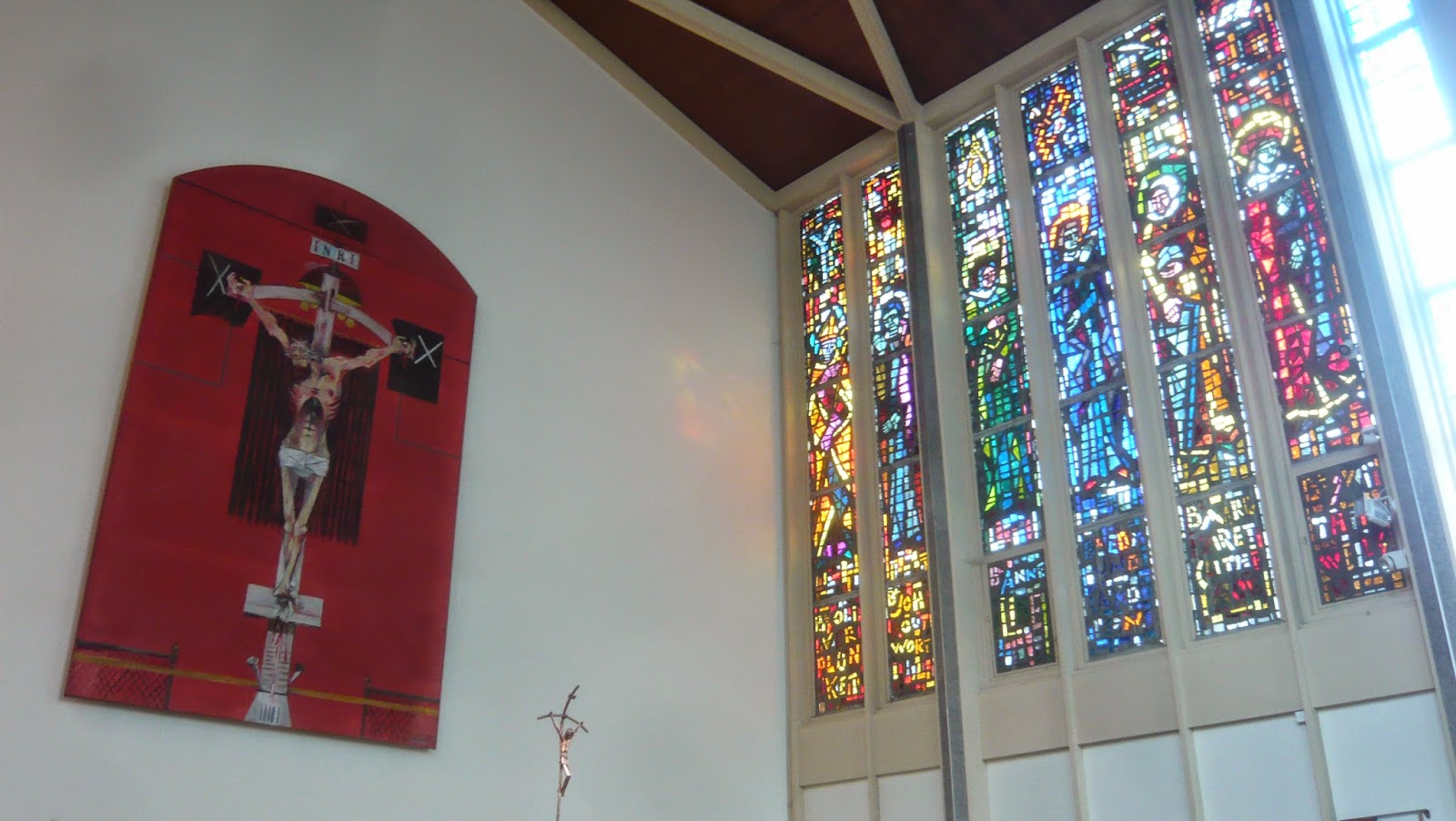
Graham Sutherland's crucifixion, unveiled in 1963, was the third he had created for a church and the first and only commission that he received from a Roman Catholic Church, despite being a Catholic himself. It taps another theme found within the revival of sacred art, a focus on the horror of crucifixion. For Sutherland this derives from reflection on the terror inherent in both Grunewald’s Isenheim altarpiece and the reality of the Holocaust. Tony Kirwan wrote in the Catholic Herald that “Sutherland's taut and terrible Crucifixion: today's Christ against a red brick wall, under an electric light … is a constant reminder to the parishioners of St Aidan's, East Acton, that Christ is crucified today if they care to look." 

When I visited for a mid-week morning Mass led by Associate Priest, Fr. Christopher McAneny, I was kindly invited to stay for refreshments by white-haired Anna who admitted that when she first came into the church, as a result of looking to move into the area, she didn't like the Sutherland painting at all. Now, she told me, she does like it. It seems that often these scandals of modern art, whether the reception of the works themselves or that of their challenging content, with time are resolved as congregations live with the works and learn to value the challenge of what initially can seem to be scandalous. 

----------------------------------------------------------------------------------

James Macmillan - Credo.

Sunday, 8 June 2014

Sabbatical art pilgrimage: Aylesford Priory


When Adam Kossowski was "deep in calamity" as a prisoner of war during the Second World War - "nearly dead" in a Russian labour camp - he made a promise to himself that if he came out of that "subhuman land" he would tender his thanks to God.

On arrival in Britain, post-War, he was "very strangely reminded" by events of this promise, which he had come to think of as an obligation. After winning a prize for a painting of The Annunciation in an international art competition, the sculptor Philip Lindsey Clark invited Kossowski to join the Guild of Catholic Artists. Lindsey Clark also introduced him to Fr. Malachy Lynch, the first Prior of the restored Carmelite Priory at Aylesford in Kent, who quickly set Kossowski to work.

Kossowski was within his comfort zone when his first commission was to paint the scenes from the history of the Aylesford Carmelites which continue to adorn the walls of the Chapter House at Aylesford. He was well outside that zone, however, when Fr. Malachy asked him to create a series of ceramic scenes for a Rosary Way. He questioned whether he was the right person for that task but Fr. Malachy replied, in terms that recalled Kossowski's own promise from the labour camp, 'Adam, I am sure Our Lady has sent you here for that purpose.'

This work was to shape not only Kossowski's future commissions at Aylesford (where, from 1950 to 1972, he decorated most of the shrine's chapels) but also the commissions he received to decorate other Roman Catholic Churches. In both instances these commissions were primarily, but not exclusively, for ceramic bas-reliefs. Working in clay enabled Kossowski to create with a greater sense of 3D animation as well as the expressiveness he was able to achieve by marking or cutting into the clay. As each panel was also painted, these effects were combined with all the variation, shade and harmonies achievable through paint.

Kossowski's obligation to God, the ongoing support of a committed patron in Fr. Malachy and the post-war church rebuilding programme combined to create the opportunity for Kossowski to become one of the greatest and most prolific religious artists in twentieth century Britain; a surprising result for the boy from Nowy Sacz in Poland. Benedict Read notes, in Adam Kossowski:Murals and Paintings, that in Britain after the war the Church was " a vital artistic culture," "the thirty years after 1945 witnessed for the Catholic Church in particular in this country an almost unprecedented campaign of church building and decoration, with the new cathedrals in Liverpool, Cardiff and Bristol just the tip of the proverbial iceberg."

Read quotes Hans Feibusch who, like Kossowski, Ervin Bossanyi and Marian Bohusz Szyzcho, was a refugee for whom Church-related commissions became a major field of endeavour: "You must realise, first of all, how very different the general atmosphere of those days was; that the relief from the dark cloud of war, the exuberance of freedom, the hope of great artistic possibilities, were still strong, and the experience of working together for a common goal had not yet faded away."

Aylesford became Kossowski's great artistic possibility, as Fr. Malachy had confidence in the rightness of Kossowski's ideas and work. With this backing he was able to create with vision, breadth and scale. His work at Aylesford extends from the intimacy of tiny painted Stations of the Cross in the Chapel of St Jude  to the imposing crowds of angels surrounding the Virgin at the exterior Shrine altar. All in a figurative style which, while sophisticated in design and expressive in execution, draws heavily on the naivety of folk art and the forgotten tradition of Romanesque art. This style seems equally suited to the drama of the worshipping angels thronging the exterior altar or Elijah's chariot of fire in St Joseph's Chapel as it is to the delicacy of the Rosary Way bas-reliefs or the Rouault-like Stations in the Cloister Chapel.

For much of the history of Western art, art and the Church were almost synonymous. This was the age of sermons in stone and stories in stained glass when art was the one book that the illiterate majority could read. As modern art actively sought separation from the constraints of Church patronage and the literary focus it had demanded, so a different approach to Church commissions was required and Kossowski's conceptions at Aylesford, both large and small, whether Stations of the Cross, the Rosary Way or sanctuary decorations; all were designed and function as prompts or aids to prayer. As prayer is the main focus of the shrine, the visual aesthetic of Aylesford, its unique atmosphere (memorably described by Fr. Malachy as "prayer in stone"), is primarily Kossowski's creation.

The Friars, to use its traditional name, is now a popular centre for pilgrimage either for large groups attending for one day or for smaller groups or individuals staying in the guesthouses. The setting, with its blend of the medieval and modern, is idyllic whether one comes as a tourist, a pilgrim, a retreatant or a regular worshipper. Some who come spend time in contemplation and prayer with Kossowski’s work, while, for others, they are part of the ambience of the spaces which are a prompt to prayer and worship. As with each denomination, the Roman Catholic Church does not always recognise the value of the artworks it possesses or subordinates that value to the use made of its art in worship. Here, however, in its publicity and online information, Kossowski's work, and that of Michael Clark and Philip Lindsey Clark, is clearly viewed as an attraction for visitors with ways suggested for reflecting on and praying through their work.

The experience of living for a week with Kossowski's work in worship, prayer and contemplation, while using The Friars as a base for the Kent and Sussex phase of my sabbatical art pilgrimage, was one of recognising the love that Kossowski had for the many saints and martyrs of the Church which had supported him in his time of need, of sharing his empathy with the sufferings of Christ, and of sensing the uniqueness of his vision which shows itself in moments of deviation from tradition such as the image of a Carmelite sister without a halo created in order to pay tribute to all the faithful who are not formally beatified but who are truly saints nevertheless. Which is, of course, where Kossowski himself would be found!

---------------------------------------------------------------------------------

Sebastian Szymański - Galilea.