Wikio - Top Blogs - Religion and belief
Showing posts with label blake prize. Show all posts

Saturday, 2 August 2014

Sabbatical art pilgrimage: Belsey Bridge Conference Centre's Norfolk Room


Via Beata way station


St Julian's Church, Norwich


'Stations of the Cross' by Irene Orgden at St Julian's Church 

'The Revelations of Divine Love of Julian of Norwich,' are a series of paintings by Alan Oldfield which were first exhibited in Oldfield's home city of Sydney before being shown at Norwich Cathedral in 1988 as part of the Norwich Festival of the Arts. These huge paintings made a sizeable impact with aged vergers heard commenting on how strange it was that such images of a mere Norwich girl should have come all the way from 'down under.'

Oldfield first became aware of Julian of Norwich through her phrase 'all manner of things shall be well' which is quoted in T.S. Eliot's 'Four Quartets'. Later he found 'Enfolded in Love', a book of extracts from her writings, on a church bookstall and decided to learn more about the medieval anchoress, the first woman to write a book in English, who lived beside St Julian's Church in King Street Norwich in the 14th century.

Oldfield spoke of these paintings as being his way of paying back what he had learned from Julian of Norwich. 'She is not a very visual mystic,' he said, 'but as she struggled to put her vision into words, so I have struggled to clarify in paint what I feel about her work.'

Struggle and passion are not, however, part of the way in which these paintings have often been viewed. Rosemary Crumlin criticises the series for lacking passion as a result of the careful staging utilised by Oldfield in his theological reflections on Mother Julian's visions. Peter Haynes writes of this more positively as 'conceptual resolution' deriving from Oldfield's 'sensitive understanding' of both source (the visions) and context (medieval art).

Oldfield described the strengths of realism as being 'draughtsmanship, line and closed composition, its success in allusiveness and anonymity.' Crumlin suggests that Oldfield's mature paintings, drawings and theatre designs carry out this brief and incorporate the insights of colour field and hard edge.' He 'often places a frame around a moment of time ... so that the picture space becomes like the theatre stage and the figures become like actors frozen in time and isolated often from each other.' His paintings often 'include explicit references to paintings and to painters he admires,' such as Piero della Francesca and Fra Angelico.

One of the series, 'A High and Spiritual Shewing of Christ's Mother according to Julian of Norwich' was joint winner of The Blake Prize in 1987. In this painting 'Julian pulls back the curtain to see the young Mary at the moment of her 'yes' to the archangel Gabriel's news that, although a virgin (symbolised by the vase of lilies), she is to become the Mother of God' (R. Crumlin, 'The Blake Book,' Macmillan, Melbourne, 2011).

The Blake Prize for Religious Art began in 1951 with an exhibition in Sydney and was 'the idea of Michael Scott, a Jesuit priest, and Richard Morley, a Jewish businessman, who saw in it a way of encouraging the Church to become patron of the arts and remedying what they considered the appalling state of the art in churches.' The Blake Committee 'looked to the European Sacred Art Renewal Movement centred in France for inspiration,' in particular to Notre-Dame deToute Grâce at Assy in the French Alps where, 'within the one building, priest, architect and modern artists had worked together in creative dialogue' (R. Crumlin, 'The Blake Book,' Macmillan, Melbourne, 2011).

Despite the fact that 'before 1940 there was little religious art in Australia' and that 'Churches in Australia rarely took the best artists seriously enough to commission their work,' as Margaret Manion has written, for a 'surprisingly large number of gifted Australian artists, the relationship between art and religion has continued to provide a creative challenge' (R. Crumlin, 'Images of Religion in Australian Art,' Bay Books, 1988). Roy de Maistre was probably the best known of these artists in the UK with commissions at Westminster Cathedral and St Aidan's East Acton, a major retrospective at the Whitechapel Gallery and his friendship with Francis Bacon. Arthur Boyd also spent time in the UK, during the Sixties and had his work championed by the art critic, Peter Fuller. In Australia itself artists such as John Coburn, Leonard French, Roger Kemp, Justin O'Brien and Eric Smith all created art which communicated religious feeling and intention.

Oldfield's work came to England primarily because of its content and then stayed when another in the series, 'The Revelations of Julian of Norwich' was purchased by the Friends of Julian of Norwich and hung in what was then the Chapel of St Gabriel's Retreat Centre at Ditchingham in Norfolk. Oldfield gave an additional work 'The Revelations of Divine Love' to the Friends of Julian and this now hangs in the Julian Centre which sits beside St Julian's Church where Julian had her cell. This image depicts the beautiful and lively child who, in one of Julian's shewings, sprang up from a foul and stinking body on the ground.

Realising that the series would be broken up, Oldfield created a film of the paintings with Sheila Upjohn (whose translation of Julian's writings Oldfield had read) reading selected extracts from Julian's shewings. Upjohn would later make a similar use of extracts from Julian in the booklet based on the 'Stations of the Cross' by Irene Ogden which can be found at St Julian's Church. 'Julian and the Scribe' found an ecclesiastical setting, at St Peter's Cremorne, while Oldfield and Earle Backen both created significant work (sometimes jointly)  for Christchurch St Laurence in Sydney where both worshipped and where Oldfield served as churchwarden.

The St Gabriel's Centre in Ditchingham has since become the Belsey Bridge Conference Centre but Oldfield's painting still hangs in the Norfolk Room, which now doubles as the chapel and a conference room. I first encountered this striking image while on a training course here and returned to it as part of my sabbatical art pilgrimage by taking an individual retreat at the Belsey Bridge Centre. On this occasion I shared the space with priests and laity from the Oratory of the Good Shepherd (OGS), who were also there on retreat. The OGS is an international community of Anglicans, ordained and lay, who share a common Rule of Life.

A new addition to the site was a Via Beata way station. These are part of a developing series of shelters running west to east across the UK from St David’s to Lowestoft, each of which contain a single piece of Christian art. The image at the Belsey Bridge Centre is of Christ and his two disciples on the Emmaus road.

The Chapel has survived several changes since its construction in 1960 when it was the chapel for a school run by nuns from the nearby All Hallows Convent. The community of Sisters took up residence in the 1850s and the All Hallows community flourished so that by the end of the 19th century they were running a hospital, an orphanage, a home for fallen women and the school. The complex of late 19th and early 20th century red brick gothic buildings survives, a maze of corridors connecting what were once separate buildings. Simon Nott writes, 'The chapel of the school was rebuilt in 1960 in memory of Herbert Palmer, Warden of the Community of All Hallows and Chaplain to the school. It is a large, light, airy building, absolutely typical of its date: ten years earlier and there would have been more of a sense of a shadowy past, and ten years later it would have responded to the reforms of Vatican II (despite being Anglican) by having an altar in the centre rather than at the east end'.
  
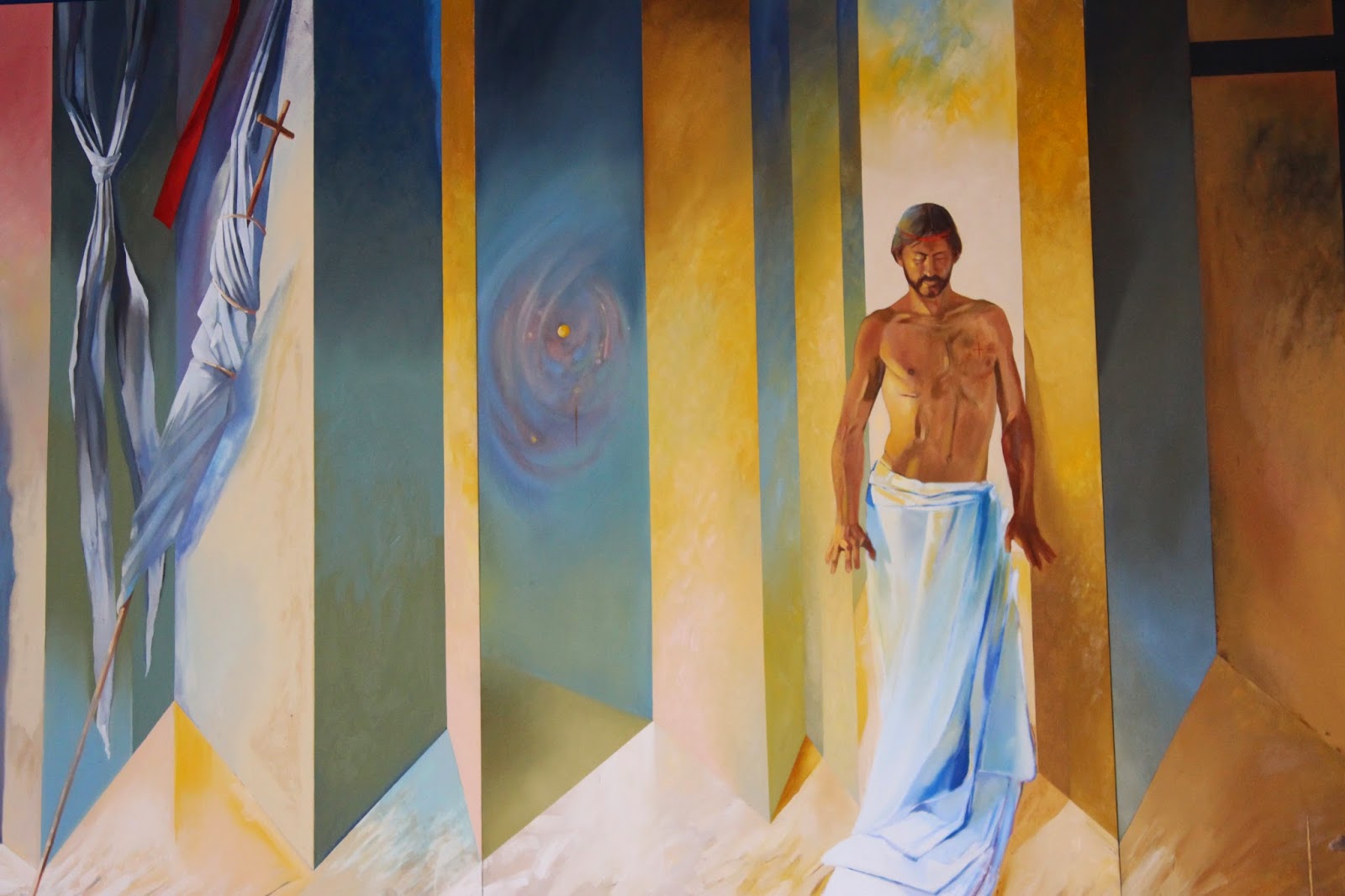
We enter the painting of 'The Revelations of Julian of Norwich' on the right in shadow; the shadow of Mother Julian on the wall of her cell. Constraining rectangles frame her for us, standing at her reading desk looking out into her field of vision. Red and white tiles circumscribe her cell-space, as sky-blue walls suggest the infinite breadth of her visions.

One painted panel contains her cell, a further three, her visions. 16 screens correspond to 16 showings set side-by-side like theatre sets; God's purposes played out on the stage of history. A tall, thin white candle levitates above the tiled floor illuminating Julian's cell; a 2D image at its apex, becoming 3D at its base. The first of several optical illusions; what we think we see never being all we see.

Julian looks back to her 16 showings and we follow her gaze to be taken back to the cross. Sombre shades and tones conceal a crown of thorns, an empty cross and barren land. Suffering indicated through absence and the shadow of death.

Beyond the cross, the resurrected Christ; his winding cloths now worn around his waist, spilling before him like the train of a bride rides behind. A red band rings him, a cross-shaped scar upon his breast, head bowed, palms held to bless those ministering and receiving at the altar below. Behind his head the stage-set of time opens revealing 'three heavens' of infinite eternity. Beyond him still the vision of the hazelnut painted planet-like in a galaxies' swirl; planet or nut, mass or pinprick, all will be well and all manner of thing be well - the resurrection initiates it!

So, finally, the cross wrapped in the winding sheets of the grave waiting for release, the sheets becoming the waved flag of victory at the return when the resurrection of all restores all to wellness and the vision of the hazelnut come to pass.


For now, vision extends beyond the painting beyond the showings, beyond ... where there is shadow, the shadow of God, revealing the limits of all our imaging. God is beyond the partial and incomplete images we construct. The shadow is God waiting in the wings for the moment of reunion when we shall see and know fully even as we are fully seen and known.

---------------------------------------------------------------------------------------------------

Sydney Carter and OHRWURM Folk Orchestra - Bells Of Norwich.

Monday, 11 November 2013

Australia at the RA

With 200 works by 146 artists, Australia is the most comprehensive survey of Australian art to have been mounted outside of Australia itself. The story told is one of cultural interaction between Australia’s indigenous peoples and its non-indigenous settlers. Sitting alongside this cultural story is the art historical story of the introduction and dominance of Modernism within Australian art.

The art of Australia’s indigenous peoples possesses an integrity and harmony with life and land which is initially absent from the figurative landscape-based art of the early white settlers. Aboriginal art is both made from the land and about the land. Shapes and symbols of the land are mapped on rocks, ground, bark, bodies and, in more recent years, canvas to enact and embody creation narratives and the balance which exists between the spiritual, natural and moral elements of the world.

While the indigenous peoples of Australia lived in the land and the land lived in them, the early white settlers brought with them an observational approach to landscape. Beginning with views of settlements and gradually expanding to depict the wilderness around them, the early settler artists established landscape as the dominant feature of Australian art. The variation and expanse of Australia’s land mass has provided endless opportunities to celebrate its terrain, vegetation, light and human settlements.

Within this has been a conflicted relationship with its indigenous peoples beginning with observational paintings of aboriginal settlements and rituals, through heroic dramatisations of settler activity which excluded on canvas, as in life, the indigenous peoples, and two-way influences (vis-à-vis Aboriginal artist Albert Namatjira mastering European styles while Margaret Preston, a supporter of Namatjira, adopted the palette, flat planes and aspects of mark marking of indigenous art), to contemporary commentaries on race relations which are intentionally provocative.

Modern art began in Australia with the plein-air Impressionism of Tom Roberts, Frederick McCubbin, Arthur Streeton and Charles Condor, among others. The work they produced adapted Impressionism to the particular light and terrain of Australia and artists began to talk of a specifically Australian tradition. The early Modernists emphasised colour and composition in cityscapes, with the newly constructed Sydney Harbour Bridge a particular focus, but the greatest period of Australian art to date featured the Expressionism of Arthur Boyd, Sidney Nolan and Albert Tucker. In their works, land, emotion and symbol coalesced by means of Modernism which, nevertheless, had parallels with Australia’s indigenous artists. In them, the land was speaking powerfully, albeit with strangeness and stress, once again.

Within both the cultural and art historical stories told within this exhibition are hints of another spirituality, the Christianity brought to Australia by the settlers. While the key catalyst for the recognition by the art world of Australia’s indigenous art is identified as being the work of Geoffrey Bardon, an art teacher at the local school in Papunya during the 1970s, Christian missions in Eastern Arnhem Land and Hermannsburg in the 1930s led to monumental panels of ancestors by Yolngu artists placed beside the altar of the local mission church together with the launch of the successful career of Albert Namatjira.
Roy de Maistre wrote that colour "constitutes … the spiritual speech of every living thing." Margaret Preston used The Expulsion to protest at the exclusion of Aborigines from their natural lands. Arthur Boyd set the casting out of the money changers from the Temple in Bendigo and Port Melbourne in his protest at materialism and greed. G.W. Bot’s Garden of Gethsemene, with its three slashes representing three crosses, was a response to the death of her daughter in 1999. These examples from the exhibition are symptomatic of a deeper, broader pool of Christian imagery and spirituality within Australian art which is not plumbed by this exhibition but includes work by Justin O’Brien, Leonard French, Eric Smith and Idris Murphy, among others, much of which has been stimulated by the Blake Prize for Religious Art. When explored alongside the spirituality of Aboriginal art, searching for meaning through this strand of Australian art and creativity can, as Sr. Rosemary Crumlin (author of Aboriginal Art and Spirituality and Images of Religion in Australian Art) has said, lead to the finding of deeper ways into our questions about life and meaning.

Similarly, as the RA’s own guide states, this exhibition "reflects the vastness of the land and the diversity of its people, exploring the implications of these realities - and mythologies - for national identity."

----------------------------------------------------------------------------------------------

Midnight Oil - One Country.

Friday, 11 January 2013

Mexico and Australia: Revolution and Land

I'm looking forward to two exhibitions at the Royal Academy in the Autumn. The first is Mexico: A Revolution in Art, 1910 – 1940, (The Sackler Wing of Galleries, 6 July – 29 September 2013) which "will examine the intense thirty year period of artistic creativity that took place in Mexico at the beginning of the twentieth century. The turmoil of the revolution between 1910 and 1920 ushered in a period of profound political change in which the arts were placed centre stage. Often referred to as a cultural renaissance, artists were employed by the Ministry of Public Education on ambitious public arts projects designed to promote the principles of the revolution.

The exhibition will explore this period both in terms of national and international artists. Work by
significant Mexican artists, such as Diego Rivera, José Clemente Orozco and David Alfaro Siqueiros,
will be placed alongside that of individuals who were affected by their experiences in Mexico. These
include Josef Albers, Edward Burra, Philip Guston, Marsden Hartley, Paul Strand, Henri Cartier-
Bresson, Henrietta Shore, Leon Underwood, Tina Modotti and Edward Weston. Mexico: A Revolution
in Art, 1910 – 1940 will reveal a dynamic and often turbulent cultural environment that included some
seminal figures of the twentieth century reflecting on their interaction with each other and their
differing responses to the same subject: Mexico."

The San Bernadino County Museum describes the Mexican Mural Movement as follows: "The Mexican Mural Movement began about 1913 when Mexican President Victoriano Huerta appointed Alfredo Martinez as director of the Escuela Nacional de Artes Plasticas. Gerardo Murillo (who called himself Dr. Alt) of Guadalajara painted the first modern mural in Mexico, and pioneered the idea that Mexican art should reflect Mexican life. After the revolution, the new government commissioned works of public art that supported and affirmed the values of the revolution and the Mexican identity: a broader knowledge of revolutionary history and the Mexican people’s pre-Columbian past.

Three muralists—“los tres grandes,” José Clemente Orozco, Diego Rivera, and David Alfaro Siqueiros—became the internationally-known leaders of the mural movement. All believed that art, the highest form of human expression, was a key force in social revolution. Together, they created the Labor Union of Technical Workers, Painters and Sculptors and devoted themselves to large-scale murals illustrating the history of Mexico, its people, its society, and the revolution. Their work was not always received positively. All spent some time in the United States creating works of art."

Rivera "did not represent religious images unless they were useful as social observations ... The most that he came close to portray religious messages was at the murals in Chapingo, where his images functioned as a catechism exhorting a new generation of Mexican farm workers and agricultural planners to uphold a modern nationally, constructive, self-respecting way of life, based on the credo "exploitation of the land, not of man."" Nevertheless, it has been noted that his Detroit Industry Murals "are rife with Christian themes and utopian symbolism."

Orozco "painted the theme, Cristo destruye su cruz, three times in his life, twice as murals — one of which still survives at Dartmouth College — and once on a 4’ x 3’ canvas." The image has been understood both as saying “It is finished!” to the violence that destroys and oppresses and as a denial of "the sacrificial destiny meant for him."

"Siqueiros painted some fifteen portraits of Christ ... on August 2, 1963, he inscribed the following quote from the most devout of Italian painters, Fra Angelico, in the back of his painting Cristo del Pueblo: "May only he who believes in Christ paint Christ." And in another occasion, during his imprisonment, he declared: "Was Jesus Christ not, like me, a victim of social dissolution, a persecuted man?" On August 9, 1963, from his cell at a crime prevention facility, Siqueiros inscribed the following words regarding the Via Crucis on the back of his painting, Mutilated Christ: "First, his enemies crucified him 2000 years ago. Then, they mutilated him from the Middle Ages on, and today, their new and true friends restore him under the political pressure of communism post-Ecumenical Council. This small work is dedicated to the latter."

The second exhibition is Australia (Main Galleries, 21 September – 8 December 2013), "the first survey of Australian art in the UK in over 50 years. The exhibition will reveal the development of Australian art through over 180 paintings, prints and drawings, watercolours, photographs and multimedia works, incorporating
settlers’ images of the land from the beginning of the nineteenth century to today, together with art by
Aboriginal Australians. The exhibition will consider the tensions both real and imagined between the
landscape as a source of production, enjoyment, relaxation and inspiration, and conversely as a
place loaded with mystery and danger.

The exhibition will include works by Aboriginal artists such as Albert Namatjira, Rover Thomas, Emily
Kame Kngwarreye and Fiona Foley. Nineteenth century European immigrants such as John Glover
and Eugene von Guerard will also feature, as well as the Australian Impressionists whose paintings
relied heavily on the mythology of the Australian bush: Arthur Streeton, Tom Roberts (a student of
the Royal Academy Schools), Charles Conder and Frederick McCubbin. Early Modernists such as
Margaret Preston, Grace Cossington Smith and Roy de Maistre will hang alongside the leading
twentieth century painters: Arthur Boyd, Rosalie Gascoigne, Fred Williams, Brett Whiteley and
Sidney Nolan RA, with the exhibition ending in the twenty-first century with internationally recognised
artists such as Shaun Gladwell, Bill Henson and Tracey Moffatt."

Margaret M. Manion has written that "for a surprisingly large number of gifted Australian artists, the relationship between art and religion has continued to provide a creative challenge." Robert Hughes suggested in The Art of Australia that Justin O'Brien "was the first Australian painter to concentrate on religious imagery" but that religious painting in Australia was "quickened" by Eric Smith and Leonard French. Rosemary Crumlin writes in Images of Religion in Australian Art that with "the founding of the Blake Prize for Religious Art in 1950, many artists turned to the Scriptures for subject matter in their paintings, some of them for the first time":

"Roy de Maistre, reconverted to Catholicism in London, worked often from the Bible and became associated with the Sacred Art Renewal Movement in England. In Melbourne, Russian immigrant Danila Vassilieff used religious subjects, often ironically, sometimes humourously and with zest. In Melbourne also, the Boyd family, always deeply religious, provided its younger generation, including Arthur Boyd and his brother-in-law John Perceval, with an easy familiarity with the Scriptures as texts of faith and guidance for living."

In The Blake Book: Art, religion and spirituality in Australia, Crumlin continues the story providing "a fascinating visual social history of Australia and an astute, well-documented history of The Blake Prize from 1951 - 2011. The book traces many significant changes in art and art movements, both within and beyond Australia. Through their work and words, the artists have room to speak of what has influenced them and found expression in their Blake entries. The influences they name range widely. Choices often surprise.
Among the winning artists presented in the book are Donald Friend, John Coburn, Stanislaus Rapotec, Roger Kemp, Ken Whisson, Maryanne Coutts, George Gittoes and Euan Macleod. Space is given to indigenous art and the many exhibited artists other than the winners."

-----------------------------------------------------------------------------------

Midnight Oil - My Country.

Thursday, 6 May 2010

Airbrushed from Art History (16)

Australia and Poland are two countries which have seen specific and successful initiatives to reconcile modern art and Christianity. Australia, through the initiation of the Blake Prize for Religious Art and Poland, through the idea of ‘sacrum’ in art.

Revd. Rod Pattenden, Chairperson of the Blake Society writes that:

“The Blake Prize is one of the more prestigious art prizes in Australia. Since 1951 the Blake Society has been awarding a prize for works of art that explore the subject of religious awareness and spirituality. In difference to art prizes that are awarded for distinct subject areas such as landscape or portraiture, the Blake has always invited a much more open, personal and idiosyncratic response, so much so that it has earned the criticism, ire and sometimes applause of critics and the public alike. After all, what is religious art?

First awarded in 1951 it has brought to the attention of the art world new and emerging artist as well as allowing for innovation and experimentation of expression. Senior artists like John Coburn, Eric Smith and Rod Milgate first came to attention through their winning entries for the Prize. In more recent years, the Blake has seen something of a revival of interest with increasing numbers of entries and a diversity of ideas being expressed in the works. Recent winners have included George Gittoes, Hilarie Mais and Rachel Ellis. The search for a visual means of expressing deeply held perceptions and beliefs is rewarded each year in an exhibition that begins its life in Sydney and then travels around Australia.”

Rosemary Crumlin is currently completing a book on the Blake Prize, Within, which covers the period from its beginning in 1950 to 2009; a period which has been of considerable significance in Australia. She writes that “its shifts and shaping have been influenced by perspectives and art movements beyond Australia.”

Pattenden notes that:

“The Prize was the brainchild of Richard Morley, a Jewish businessman, and Michael Scott, a Jesuit educationalist, who believed that such a Prize would provide contemporary works of art for the many new churches and synagogues being built in the post war suburban sprawl. While religious authorities were generally taken aback by the modern flavour of these new investigations, it was the artists who most welcomed the Blake as it allowed them to express more personal subject matter; in short, it rewarded innovation and daring. The Prize was named after the mystic artist and writer William Blake who is celebrated for his creative commitments rather than his adherence to any particular dogma.

Surprise is the more characteristic response to each year’s exhibition rather than a confirmation of any traditional iconography. In the search for fresh contemporary expressions of spirituality artists have continued to extend the envelope of the Blake to encompass a wide diversity of religious expression drawing on major religious traditions such as Christianity, Buddhism, Islam, Hinduism and Judaism, as well as indigenous spirituality. The Blake has fostered this breadth of diversity and celebrated the various rich traditions that make up the landscape of belief in Australia.

More personal responses have also found their way into the Blake’s gamut with explorations of feminism and gender, connections with the natural world and the wider referencing of the political influences of war, ecology and globalisation. There is nothing the Blake doesn’t seem to cover even tolerating parody, irony and humour over against the usually serious face of organised religion. Each year there is much to be annoyed by, seduced by, or simply inspired by. It is a thoroughly ecumenical experience for the eyes!”

In 2002 Crumlin curated a retrospective of the Blake Prize. Her main purpose in the retrospective was to show, through the paintings, how society's views on spirituality had changed over half a century: "Initially, she says, "artists - and the Blake committee - took it for granted that 'religious' meant 'Christian' and that 'Christian' was to be equated with scriptural narratives". Today, artists and judges have a less restricted view of spirituality, encompassing not just other religions such as Judaism, Buddhism and Islam, but alternative faith systems, everything from "New Ageism" to Aboriginality."

Pattenden considers that:

“A Prize for Religious Art reminds us that the arts have a valuable role to play in a society as we explore the place of passion, love, belief and action. Learning to appreciate the diversity of belief allows more opportunity to act together with understanding and compassion. Art allows us to speculate on the mystery of life, while learning to appreciate the deeply held perceptions of people different to us without needing to agree with their ideas. Art has always had a close relationship to religious expression and exploration. It is a medium suited to exploring the many creative paths that people take on their life journey and honouring that diversity.”

The Prize is managed by the Blake Society, which is currently developing a Foundation to ensure the ongoing viability of the Prize. Its membership comes from a diverse range of professions and religious interests. The common goal of the Society is to affirm the ongoing and dynamic contribution of this cultural institution to Australian society and the arts.

By contrast to the positive embrace of the arts and religion that is seen in the Blake Prize, in Poland during the 1980’s, as martial law forced virtually the entire artistic community in Poland to boycott the official exhibition spaces, we see a similar embrace developing in response to this oppression, as the only other places which found widespread approval among independent artistic and intellectual groups were the churches. So, churches became where artistic meetings, shows and exhibitions were held with most significant Polish artists and art figures participating in them, and only a very few veering away from addressing religious themes.

Agnieska Gralinska-Toborek describes the first, and probably the most famous, of these exhibitions, which was organised in 1983 by Janusz Bogucki in the church of God's Mercy in Warsaw, as follows:

“Under the title The Sign of the Cross, it brought together over fifty artists and photographers, as well as actors, musicians, art theorists, and filmmakers, who took part in the meetings, lectures and concerts accompanying the exhibition. Popularising the idea of ‘art returning home’, i.e. coming back to the sacrum, [Janusz] Bogucki managed to convert to it many respected and important artists from the Polish avant-garde. The interior of the Gothic church, ruined during the Warsaw Uprising in 1944 and in the process of being laboriously rebuilt by the parishioners, played the function of an extraordinary gallery. Without interrupting the construction work, the artists used the space of the church and the vaults, including the elements of its architecture into their arrangements. They had to learn how to co-operate and talk with the parishioners, who felt themselves to be the owners of the place and were not always willing to accept the artists' ideas. It was a good preparation for further exhibitions organised by Bogucki, such as Apocalypse – The Light in the Darkness (1984) and Labyrinth – The Underground Space (1989).”

Janusz Bogucki (1916-1995), was an important Polish critic and art historian, who noted a tendency towards the spiritual in Polish avant-garde art which, in artists such as Jerzy Tchórzewski, Stefan Gierowski and Jerzy Bereś, arose from a need to achieve transcendence and was characterised by a search for the Absolute. The work of these and other artists was, for Bogucki, confirmation of his idea that art should turn to sacrum and he, therefore, invited them to take part in his church-based projects in the early 1980s.

Most significant Polish artists participated in these exhibitions, including the Gruppa artists. It was also in this period that the work of Jerzy Nowosielski revealed its full fascination with icon paintings through the publication of "Wokół ikony" / "Around the Icon" (1985) and later "Mój Chrystus" / "My Christ" (1993). Yet the spiritual expression was not, on the whole, extended into the next decade as, when the political turning-point came in 1989, the general adherence to links with the Church became, for many artists, “a good reason to break with it - and this was particularly true of radical circles - because it was regarded as a restraint not dissimilar to those imposed hitherto by the totalitarian regime.” A sense of sacrum continued only in a very minimal way in the work, for example, of Jerzy Kalina, Włodzimierz Pawlak, and Robert Rumas.

Gralinska-Toborek writes that Bogucki:

“based his vision of contemporary culture on the distinction between three artistic attitudes: EZO, POP and SACRUM. EZO corresponded to the egocentric attitude of the avant-garde presented thus far, its attachment to the sacrum of art. POP was a new attitude, ‘a total secularisation of art, its incorporation into the scientific, technological and administrative mechanisms of civilisation and mass culture.’ The tendency within POP was for practicality and pragmatism, characteristic of the civilization of haste and success. The third attitude, in which Bogucki placed his hopes, was SACRUM, an attempt at rediscovering the relation between the sacrum of art and the primal sacrum, manifested in reflection on the timeless and non-material meaning of human existence … Art should, first of all, reconstruct the universality of meanings in its language, overcome the alienation of the artist through communal activity, and finally save from insanity or exhaustion those artists who seek spiritual metamorphosis on their own, without God and thus without any preparation. In order to attain this goal, artists were to give up the basic assumptions of modernism: egocentrism and the cult of individuality in favour of humility, group work, combining creation with spiritual experience, and going back to original sources, especially Christian ones, to deepen their faith. Bogucki’s conception came into existence around the time that the views of critics of modernism reached Poland. Those critics saw the modernist desacralization of life and art as the source of spiritual and moral crises and
cultural nihilism. Such a claim was made, for example, by Daniel Bell, who described the period of modernism as a process of rationalisation in the technological and economic spheres of life, secularisation in politics, and de-sacralization in culture. He believed that the contemporary man suspended in a spiritual void could only be saved through religious rebirth. This concept of postmodernism received a warm welcome in Poland, and was popularised by Bogucki, who held similar beliefs.”

-----------------------------------------------------------------------------------

Henryk Gorecki - Miserere.

Thursday, 15 January 2009

Australian Anglican Art Archive

The Anglican Church of Australia has an interesting archive of images which show many of the art works made for its churches in stained glass, metals, timbers, fabrics and textiles. It is designed to be of general interest, but it is particularly intended for use by those studying the fine arts, and architectural and liturgical history.

Australia has regularly taken a varied and innovative approach to modern and contemporary religious art, including the establishment of an annual prize. The Blake Prize for Religious Art is one of the more prestigious art prizes in Australia. For 55 years it has been awarding a prize for works of art that explore the subject of religious awareness and spirituality.

First awarded in 1951 it has brought to the attention of the art world new and emerging artist as well as allowing for innovation and experimentation of expression. Senior artists like John Coburn, Eric Smith and Rod Milgate first came to attention through their winning entries for the Prize. In more recent years, the Blake has seen something of a revival of interest with increasing numbers of entries and a diversity of ideas being expressed in the works. Recent winners have included George Gittoes, Hilarie Mais and Rachel Ellis.

Rosemary Crumlin, who in 2002 curated a retropective of the Blake Prize, has been described as being "Australia's version of Sister Wendy Beckett:"

"Like Beckett, Crumlin discovered she had two callings - her faith and her love of art. For the past 10 years, she has been a full-time curator and art historian specialising in modern art and spirituality. Among her books are Aboriginal Art and Spirituality, Images of Religion in Australian Art and Beyond Belief: Modern Art and the Religious Imagination.

Her main purpose in the retrospective was to show, through the paintings, how society's views on spirituality had changed over half a century:

"Initially, she says, "artists - and the Blake committee - took it for granted that 'religious' meant 'Christian' and that 'Christian' was to be equated with scriptural narratives". Today, artists and judges have a less restricted view of spirituality, encompassing not just other religions such as Judaism, Buddhism and Islam, but alternative faith systems, everything from "New Agism" to Aboriginality."

Such profound changes were reflected in the art with the first winners being essentially figurative works and later winers gradually becoming more abstract.

-------------------------------------------------------------------------------

Midnight Oil - King Of The Mountain.