Wikio - Top Blogs - Religion and belief
Showing posts with label first world war. Show all posts

Sunday, 9 November 2025

Remembering to maintain peace


Here's the Address I shared as part of the Act of Remembrance held this morning at Wickford's War Memorial:

In this Act of Remembrance, we honour all those from this town who laid down their lives in the two World Wars and subsequent conflicts. We will remember them. We also honour all from these shores who died in these conflicts. We will remember them. We also honour all those from the Commonwealth who fought and died for freedom. We will remember them. And we honour those from our Allies who also lost their lives. We will remember them. Although the counting of casualties can never be fully accurate, the number of Allied lives sacrificed in the two World Wars is thought to be in the 10's of millions. We will remember them.

What does it mean to remember, particularly when we were not present and may not have lived through those times. What is it that we need to remember. All these died in the cause of peace. They died to bring about the peace we continue to enjoy today. The work to build and maintain peace was the legacy of all those who laid down their lives in the two World Wars. Therefore, as well as remembering the sacrifice of all who died (both military and civilians), we must also remember all that was put in place after the World Wars to build and maintain peace.

There was a recognition among the Allies following the war that global cooperation between nations was necessary for the maintenance of peace and institutions such as the United Nations and agreements such as the Universal Declaration of Human Rights were quickly set up and agreed to form the foundation for maintaining peaceful relations between nations. The actions that were taken then by those who had lived through the two World Wars brought about what has become known as the Long Peace. The actions taken to build and maintain peace were taken by those who knew firsthand the horrors of war and those actions were the active legacy of those who died.

In a world where tensions between nations are growing ever more acute and where the institutions and agreements put in place to maintain peace are also being questioned and challenged, it is more important than ever to remember the reason why so many died and the understanding of how peace is achieved and maintained learnt by those who lived through the two World Wars.

Jesus called his followers to be peacemakers and that was the intent of those who died and also of those built the long peace that we still enjoy. Jesus said that those who acts as peacemakers are the children of God. If we are to live as God’s children by being true to the call to be peacemakers, it remains vital that we do remember; remembering that peace was the goal of all who died and remembering, too, how peace has been built and maintained following the two World Wars. May it be so for each one of us. Amen.

------------------------------------------------------------------------------------------------------------

Judee Sill - The Living End.

Sunday, 14 November 2021

Making the world a Eucharist

A sermon preached at St Martin-in-the-Fields on Sunday 14 November 2021 by Revd Jonathan Evens. 
Readings of address: Daniel 12.1-3; Hebrews 10.11-14 [15-18]19-25; Mark 13.1-8 
View the service at https://www.facebook.com/stmartininthefields/videos/456468419203039 

In 1917 Private David Jones of the Welsh Fusiliers was out searching for firewood. He was in the Ypres section of the Western Front. ‘As I was always cold, one of my main occupations was to hunt for any wood that was dry and could be used to make a decent fire.’ ‘Just a little way back, between our support trench and the reserve line, I noticed that a byre or outhouse … still stood and its roofing appeared to be intact … I thought that looks to be the most likely place where there might wooden objects or, with a bit of luck, a wood-store perfectly dry and cut ready for use. So I went to investigate, but there was no door on that side. I found a crack against which I put my eye expecting to see empty darkness.’[i]

Instead, he saw something that changed his life. He could make out an altar constructed from of ammunition boxes. On it were two candles. As his eye adjusted to the light, he could see half a dozen infantrymen kneeling on the floor. And in front of them, a robed Catholic priest celebrated Mass. The tinkling of a bell broke the silence, followed by Latin words, gently spoken. He realised he recognised some of the men. He felt the oneness between the priest and those tough soldiers gathered round him in the half-darkness; a unity of spirit beyond anything he had previously experienced. He was amazed, too, that this Mass was happening so close to the frontline.

In this sight a saving and redeeming God emerged from the devastating brutality and squalor of the trenches. David Jones found Christ in the darkest of places. As he witnessed his first Mass in an outhouse amid the wasteland of the western front, he started to seek for hope among the ruins.[ii] This hope was found in the unity of spirit he observed because, as he later wrote, ‘the Mass makes sense of everything.’[iii]

After the war he became both a painter of sacramental images and a poet who wrote two epic poems. The first is about his experience of being wounded during the attack on Mametz Wood in July 1916, when about 4,000 Welsh soldiers died. It has been described as ‘a book about how, even in the most appalling circumstances,’ we ‘can still discern beneath the surface of experience an ultimate significance in life.’[iv] The second is a long meditation on a man attending Mass sometime during the Second World War which encompasses the entire history of humankind because the Mass makes sense of everything.

His work is about remembrance and the ways in which remembrance transforms us in the present. It takes the shattered fragments of wartime experiences putting them together with the key stories of humanity to form poems that were bigger and more beautiful that their fragmented parts. In doing so, he mirrors the action of Christ in the incarnation and crucifixion as he goes down into the depths of destruction in order then to bring together the fragments of our broken lives.

Some years ago, Fiona MacMillan created a wonderful image of that incarnational activity in a photograph of a broken host to publicise the 2018 disability conference Something Worth Sharing. In this image: ‘seven contrasting hands belong to members of St Martin's community aged 7 to 90, of diverse gender, ethnicity, disability and experience. Each have a piece of the host: Each has something worth sharing without which some part would be missing.’ Fiona concludes, ‘The broken host is a reminder of Jesus, his life broken and shared. For me, it echoes the words of Donald Eadie, Methodist theologian whose life changed with a disabling spinal condition: 'My world cracked open and life broke through'. Being broken is sometimes the way new life begins’.’

As today’s reading from Hebrews reminds us, Christ’s was a once-for-all action that is then re-presented and re-membered in and through the Eucharist. The Eucharist being the most significant and meaningful form of Remembrance. We bring the broken fragments of our lives, including the shattering destruction of wartime experiences throughout the centuries, to the one whose own body was broken on the cross but who endured that experience out of love for us to bring us through brokenness into reconciliation and resurrection. In return we receive his body and blood into our lives through a fragment of bread and a sip of wine. Our life is joined to his. The broken fragments of our lives are gathered up and incorporated into the story of God’s saving work with humanity. The fragments of our lives are accepted – overaccepted – and unified as we are brought together to form a new body - the body of Christ – in which all things find their place and where all shall be well and all manner of thing be well.

God takes us and our offerings and places them in a far larger story than we ever could have imagined by giving them a sacred story and making them sacred actions. As we retell and re-enact what Jesus did at the Last Supper, we also remember what God did to Israel in ‘taking one special people, blessing them, then breaking them in the Exile before giving them as a light to the nations to bring the Gentiles to God.’ ‘In the telling of those stories and the performance of those actions we are transformed into God’s holy people.’ That’s what the regular celebration of the Eucharist is about. When the Eucharist is served, each of us offers all that we uniquely are at the altar and we receive from God everything we need to follow him by being a blessing to others in our daily lives. In this way, as David Jones claimed, the Mass makes sense of everything, even the destruction and damage of war. Not by explaining it away or even explaining it at all but by plumbing its depths to find a way through to renewal and restoration.

We remember that story, not simply by recalling it to mind but by re-enacting and re-inhabiting it. We join our story to that of God’s activity in the world by playing a part within that story because we are, as David Jones once wrote, ‘creatures with bodies, whose nature it is to do this, or that, rather than think it.’[v] This is what it means to live sacramentally and to truly remember. So, in the Eucharist we see, we touch, we hear, we taste our God. As Sam Wells has said: ‘The Eucharist is a whole-body experience of truthful living in a new society as God’s companions together forever.’ Only one thing more remains. We must ask, as have all those who, like David Jones, experienced war and survived, what do we need to remake the whole world like this? What do we need to do to make the whole world a Eucharist?

St Augustine said: ‘You are the Body of Christ. In you and through you the work of the incarnation must go forward. You are to be taken. You are to be blessed, broken and distributed, that you may be the means of grace and vehicles of eternal love.’ Sam has explained that: ‘The elements of bread and wine are taken, blessed, broken and shared just as Jesus was taken, blessed, broken and shared. In a similar way the congregation as a whole is taken out of its ordinary pursuits; blessed with the grace and truth of forgiveness and scripture; broken in the disciplines of intercession, peacemaking and food-sharing; and shared with the world in love and service. As the bread and wine are offered, transformed and received, the congregation, and through it the whole creation, is offered, transformed and received.’

Although he suffered throughout his life from what we know called Post-Traumatic Stress Disorder, David Jones spent the rest of his life creating poems and paintings that re-call before God events in the past so that they become here and now in their effect on us. He wrote of the Mass as being to do with the re-calling, re-presentation and re-membering of an original act and objects in a form that is different from but connected to the original act or object that is being recalled. Remembering the Lord’s Supper is not simply recalling it to mind; instead, it is remembered by the re-enacting and re-presenting of the original act. He created poems and paintings that mirror the action of the Eucharist and create a world that is a Eucharist.

In this way he discovered the mission statement of the church, which is to make the world a Eucharist. Amazingly, he discovered this in wartime in the depths of destruction and despair when nation had risen against nation and kingdom against kingdom. That was a real demonstration of the reality that we, as the people of God, are often closer to God in adversity, than in times of comfort.

We are not all artists or poets but, whatever our roles and talents, like David Jones, we too can go out from the Eucharist to make the world a Eucharist. Again, Sam has explained well what this looks like in practice. ‘Faithful service,’ he says, ‘means practices that look like worship—those that gather people and form them as one body, that reconcile and open lives to repentance and forgiveness, that proclaim truth and reveal God’s story, that embrace need and unleash gifts, that express thanks and are open to the Holy Spirit, that share food and wash feet.’ As we do such things, we will discover what David Jones discovered at the Western Front in 1917, we will create our equivalents of his sacramental poems and paintings, we will reconcile the broken fragments of our lives, we will restore the torn fabric of society, we will make the world into a Eucharist. This is the most significant and meaningful form of remembrance in which we can engage.

In 1917 David Jones went looking for wood for a fire that would temporarily warm him in the trenches. What he found in an outhouse in the Ypres sector of the Western Front was a glow, a fire which he described as ‘goldenness’, that would inspire him throughout his life. In the Mass all the fragments of his life were held together and recreated, he was connected to the bigger story of God’s work in the world throughout human history, and he was inspired to make his world a Eucharist for others to inhabit and experience.

What will you bring to the altar to be gathered up by Jesus today? Will you come forward today to receive Christ in the form of bread into your life and join your story to his, so you can play your part in the story of God’s work with this world? How will you go from here today to make the world a Eucharist tomorrow? David Jones found his answers to those questions in an outhouse on the Western Front. Will you find your answers at St Martin-in-the-Fields this morning? To do so, will be to truly remember on this Remembrance Sunday.

[i] Rene Hague ed., Dai Greatcoat: a self-portrait of David Jones in his letters, Faber & Faber Ltd, 1980, pp.248-249.
[ii] Jonathan Miles, Backgrounds to David Jones: a Study in Sources and Drafts, University of Wales Press, 1990, p.64.
[iii] Letter to Saunders Lewis 3rd March, 1971, published in Agenda, vol. 11, no..4 - vol. 12, no. 1, 1973/4, "Saunders Lewis introduces two Letters from David Jones", pp.17-29, particularly p. 20.
[iv] Atholl C. C. Murray, "In Perspective: A Study of David Jones's 'In Parenthesis'," in Critical Quarterly, Autumn, 1974, pp. 254-63.
[v] Rene Hague ed., Dai Greatcoat: a self-portrait of David Jones in his letters, Faber & Faber Ltd, 1980, p. 232.

-----------------------------------------------------------------------------------------------------------

David Jones - In Parenthesis.

Thursday, 7 November 2019

Merville


Merville is a town 15 kilometres north of Bethune and about 20 kilometres south-west of Armentieres. The Communal Cemetery is on the north-east side of the town on the north side of the road to Neuf-Berquin.

Built in the 1920s, St. Peter's Church consists of two square towers surmounted by a Byzantine cap. Its dimensions make it a prominent landmark, visible at considerable distances from the town. Merville is a parish of the Roman Catholic Archdiocese of Lille. The diocesan seminary of the Lille diocese was formerly located in Merville. It is also a very large structure, built on four storeys around a central cloister, with large chapel and refectory, and accommodation for over 200 staff and students. The seminary closed in 1970 and the extensive buildings were briefly occupied by a community of religious sisters before becoming the Lille diocese's retreat and conference centre.

The main town square is dominated by the town hall, which dates from the late 1920s and is built in the Flemish Renaissance style. It incorporates a very tall clock tower. Inside, architect Louis Marie Cordonnier laid out imposing staircases, lounges of honour and beautiful stained glass windows in the colours of neighboring towns.

Merville was the scene of fighting between the Germans and French and British cavalry early in October 1914 but from the 9th of that month to 11 April 1918, it remained in Allied hands. In October 1914, and in the autumn of 1915, the town was the headquarters of the Indian Corps. It was a railhead until May 1915, and a billeting and hospital centre from 1915-1918. The 6th and Lahore Casualty Clearing Stations were there from the autumn of 1914 to the autumn of 1915; the 7th from December 1914, to April 1917; the 54th (1st/2nd London) from August 1915 to March 1918, and the 51st (Highland) from May 1917 to April 1918. On the evening of 11 April 1918, in the Battles of the Lys, the Germans forced their way into Merville and the town was not retaken until 19 August. The cemeteries were not used again until the concentration of battlefield burials into the Extension began, after the Armistice. 

During the Second World War the river Lys was the southern end of a deep but narrow area held by British forces at the end of May 1940. Merville is on the territory over which were fought desperate rearguard actions during the withdrawal of the British Expeditionary Force to the coast, for evacuation from Dunkirk. 

Merville Communal Cemetery was used by French troops (chiefly cavalry) in October 1914, and for Commonwealth burials from that date until August 1916 (in the case of officers, to March 1918). It now contains 1,268 Commonwealth burials of the First World War, and 12 French war graves. There is also 1 non war burial. 

Merville Communal Cemetery Extension was opened in August 1916, and used by Commonwealth and Portuguese hospitals until April 1918. It was enlarged after the Armistice when graves were brought in from the battlefields immediately north and east of Merville and from the Caudescure Halte Cemetery, Morbecque. It was made by fighting units, and it contained the graves of 38 soldiers from the United Kingdom who fell in the period April-August, 1918. The Extension now contains 920 Commonwealth burials of the First World War, 345 of them unidentified. The 92 Second World War burials (18 of them unidentified) occurred mostly during the fighting in May 1940 and are interspersed among the First World War graves. The Extension also contains 19 war graves of other nationalities.

------------------------------------------------------------------------------------------------

Malcolm Guite - Lente, Lente.

Saturday, 18 August 2018

Artlyst: Art And The Consequences Of War Explored In Two Exhibitions

My latest piece for Artlyst is an article about the linked exhibitions, ‘Aftermath: Art in the Wake of World War One’ at Tate Britain and ‘Magic Realism: Art in Weimar Germany 1919 – 33’ at Tate Modern. Both feature many of the same German artists, while Aftermath also includes British and French artists from the same period:

'In a move suggesting that mainstream curating has now accepted the validity of a continuing but fractious relationship between art and faith as a strand within modernism, both feature artists who depicted biblical stories in contemporary settings to reflect on the consequences of war (including Winifred Knights, Stanley Spencer and Albert Birkle). ‘Magic Realism’ has a room exploring Faith (including Birkle and Herbert Gurschner), while ‘Aftermath’ includes Georges Rouault’s series Miserere et Guerre (Mercy and War), adapting biblical imagery to reflect on contemporary experience.'

My other Artlyst articles and interviews are:
----------------------------------------------------------------------------------------------------

George Harrison - Give Me Love (Give Me Peace On Earth).

Friday, 23 February 2018

Requiem for the Emblem of Power

My latest exhibition review for Church Times has been published today - . 

“Requiem for the Emblem of Power” by Paul Wager is at Dadiani Fine Art Gallery (30 Cork Street, London) until 20 March and is an exhibition that commemorates the centenary of the ending of the First World War by reflecting on the futility of war while remembering ‘those brave uniformed men who made the ultimate sacrifice for their countries.’

I begin the review by saying: 'PAUL WAGER uses the conventions of propaganda and memorial art to subvert their usual declarative and commemorative content. “Requiem for the Emblem of Power”, an exhibition that commemorates the centenary of the ending of the First World War, exists in the change of national consciousness bookended by Rupert Brooke’s “The Soldier” and Wilfred Owen’s “Anthem, For Doomed Youth”.'

-----------------------------------------------------------------------------------------

Saturday, 25 June 2016

Winifred Knights, David Jones & Malvina Cheek

The Guardian profiles the current retrospective of work by Winifred Knights, one of the most original, pioneering British artists of the first half of the 20th century:

'This summer the Dulwich Picture Gallery is mounting a retrospective of her work, the first ever. On display are all her significant pieces, including The Marriage at Cana (1923), shipped from New Zealand, and Scenes from the Life of St Martin of Tours (1928‑33), a stunning triptych that will be unhooked from the wall of Canterbury Cathedral and trundled up the A2 to south London. Most thrilling of all, The Santissima Trinita (1924-30), generally considered Knights’ masterpiece, has been lent by its private owners. These works appear alongside The Deluge, together with scores of preparatory sketches.'

Also profiled is In Parenthesis by David Jones:

'Part-biography, part-fiction, the book is a lyrical epic that traces, via an alter-ego called John Ball, the contours of Jones’s own wartime journey, from his embarkation for France in 1915 to the Somme in 1916 ...

The Somme did ... mark a transition, for Jones, from what he describes in the preface to In Parenthesis as “the period of the individual rifle-man, of the ‘old sweat’ of the Boer campaign”, to a “relentless, mechanised affair” of “wholesale slaughter”, that destroyed any ancient sense of continuity in the “domestic life of small contingents of men”.

It is this break, this “change in the character of our lives in the infantry” as the war shifted from the personal and the human to the impersonal and the mechanised, with which In Parenthesis is often concerned. The central opposition throughout the book is not British versus German, but rather mechanical versus natural; the “unmaking” modern science of shell and machine gun versus the “making” communities of artisan infantrymen, desperately trying to maintain the form of their collapsing worlds with nothing more than their hands and tools.'

The obituary of Malvina Cheek notes that:

'In her later career, a series of large canvases, painted with a rich autumnal palette, reflected her interest in spirituality, in particular Freud and Jung. While she was growing up, her father had not encouraged a religious leaning in his household and she may have found an equally cool reception from her husband, an atheist, but the work displays an unmistakable passion.'

-------------------------------------------------------------------------------------------

Bloc Party - Only He Can Hear Me.

Sunday, 23 August 2015

David Jones: Vision and Memory

David Jones: Vision and Memory will be on show at the Pallant House Gallery from 24 October 2015 - 21 February 2016. A concurrent exhibition The Animals of David Jones will be on show at Ditchling Museum of Art + Craft from 24 October 2015 – 6 March 2016.

'David Jones (1895-1974) was a painter, engraver, poet and maker of inscriptions. A lyrical draughtsman, he responded with delight to the visual world, yet his vision was informed by memory reaching back into the depths of time and history. This major exhibition, taking place during the centenary of the First World War, will display some 80 works from throughout Jones's life in a timely reassessment of one of the most imaginative artists of his era.'

Rowan Williams wrote in 'Grace and Necessity' that: 'Jones’ exposure to [Jacques] Maritain came through his participation in [Eric] Gill’s project. After demobilization in 1919, Jones studied first at the Westminster School of Art, where it appears that a catholic friend introduced him to Fr. John O’Connor. He became a Roman Catholic in 1921 and, prompted by O’Connor, joined Gill at Ditchling later that year … Thus, he was alongside Gill and Gill’s colleagues … during the crucial period during which they were all reading Maritain; and it is very clear that for Jones … this made sense of what he had assimilated at the Westminster School of Art.'

As Rene Hague later wrote, ‘the Post-Impressionist attitude to the arts fitted in very well with Maritain and Thomism’. Jonathan Miles and Derek Shiel write in 'The Maker Unmade' that: 'The philosophy of Maritain explored two related questions that are of importance for David Jones: signification and epiphany. By rigorous habit, the artist would not only be able to reveal this or that object under the form of paint but also make an epiphany, make the universal shine out from the particular. Thus, what is re-presented also becomes a sign of something else and if that something else is significant of something divine, then the art can claim to have a sacred character or function, a sacramental vitality.'

Similarly, Williams argues that what preoccupies Jones from the beginning is 'precisely what so concerns Maritain, the showing of the excess that pervades appearances.' As his work develops, Jones comes to see that you paint ‘excess’ by: 'the delicate superimposing of nets of visual material in a way that teases constantly by simultaneously refusing a third dimension and insisting that there is no way of reading the one surface at once. As in the Byzantine icon, visual depth gives way to the time taken to ‘read’ a surface: you cannot construct a single consistent illusion of depth as you look, and so you are obliged to trace and re-trace the intersecting linear patterns.'

Jones said that he regarded his poem, The Anathemata: "as a series of fragments, fragmented bits, chance scraps really, of records of things, vestiges of sorts and kinds of disciplinae, that have come my way by this channel or that influence. Pieces of stuffs that happen to mean something to me and which I see as perhaps making a kind of coat of many colours, such as belonged to 'that dreamer' in the Hebrew myth."

Jones believed that objects, images and words accrue meanings over the years that are more than the object as object or image as image. Therefore all things are signs re-presenting something else in another form. Recessive signs which re-present multiple signification are what Jones aims to create in works such as The Anathemata and Aphrodite in Aulis. Jacques Maritain suggested that such multiple signification is what creates joy or delight in a work of art as “the more the work of art is laden with significance … the vaster and the richer and the higher will be the possibility of joy and beauty”.

Aphrodite in Aulis
 is full of Jones’ preoccupations: “the Grail, the Lamb, the soldiers (Greek and Roman, Tommy and Jerry), Doric, Ionic and Corinthian architecture, the moon, the stars and the dove.” These disparate ideas and images are held together firstly by Jones’ composition with the whole painting revolving around the central figure of Aphrodite and secondly by his line which meanders over the whole composition literally linking every image. By holding these images and what they signify together in this way, Jones is able to create an image that both laments the way in which love is sacrificed by the violence and aggression of macho civilisations and also, through his crucifixion imagery, to hold out the hope that love may overcome that same violence and aggression.

For Jones such signification is the essence of a Christianity, which has, at its heart, the re-presenting of Christ under the form of bread and wine. When the sign is the thing signified what you have is incarnation, the union of the natural and the supernatural.

Williams notes that in several respects Jones takes Maritain a stage further. Firstly, in that 'the half-apprehended consonances of impressions out of which an artwork grows has to be realized in the process of actually creating significant forms which, in the process of their embodiment, in stone, words, or pigment, uncover other resonances, so that what finally emerges is more than just a setting down of what was first grasped.'

Secondly, in 'the way in which a life may become a significant form – as, decisively and uniquely; in the life of Christ.' He: 'illustrates a point Maritain does not quite get to. Jones implies that the life of ‘prudence’, a life lived in a consciously moral context, however exactly understood, is itself an act of gratuitous sign-making; moral behavior is the construction of a life that can be ‘read’, that reveals something in the world and uncovers mystery.'

Both are exemplified by Jones’ life and practice as he turns away 'from one mode of representation in which he excelled in order to include more and more of the interwoven simultaneous lines of signification and allusion' in 'an attempt to embody a more radical love in what he produces, a love that attends to all the boundary-crossing echoes that characterize the real, which is also the good.'

----------------------------------------------------------------------------------------------

Nick Cave - Brompton Oratory.

Saturday, 16 May 2015

Modern art and City churches


The statue of St Michael commemorating the fallen of World War I at St Michael Cornhill is a bronze from 1920 by Richard Reginald Goulden. A winged and helmeted Christian angel brandishing a flaming sword, stands on a stone which bears the inscription. To the left two wild cats prowl; to the right, four cherubic children cluster at the angelic feet.

During the Great War, 1914 - 1919, the names were recorded on this site of 2130 men who from offices in the parishes of this united benefice volunteered to serve their country in the Navy and Army. Of these it is known that at least 170 gave their lives for the freedom of the world.

In WW1 Goulden served with the Royal Engineers in France. Other London works by Goulden include: a war memorial at St John, Hackney, the Hornsey County School War Memorial now housed in the Crouch End Town Hall, the St Christopher statue on the war memorial at the Bank of England in Threadneedle Street, and a memorial in Kensal Green cemetery to Thomas Power O'Connor.


The memorial window in the narthex of St Andrew by the Wardrobe is dedicated to Sir Ivor Bulmer Thomas, who masterminded the reconstruction of the church after the war. A detailed etching of St Andrew-by-the-Wardrobe can be seen in the window.

An energetic Renaissance man – former spy, athlete and leader writer for The Times, Labour MP for Keighley and devout Christian – Ivor Bulmer-Thomas (1905–93) was determined to make a difference and gathered together his closest allies and influential friends to form a new charity, the Friends of Friendless Churches, inaugurated on 3 July 1957 in Committee Room 13 of the House of Commons. The architect Harry Goodhart-Rendel, the philanthropist Samuel Gurney, the politician Roy Jenkins, Lady Mander, the artist John Piper, the banker and politician John Smith, and the architectural historian John Summerson were all members of the first Executive Committee. John Betjeman was elected Honorary Editor, Lawrence Jones Honorary Secretary, and the architect Sir Albert Richardson a Vice President.

This window was engraved by Frank Grenier F.G.E. who has been engraving glass for over 20 years. He studied under Simon Whistler and has held exhibitions in London, Hong Kong, Maastricht, Leerdam, Oxford and Cambridge. He is a Fellow of the Guild of Glass Engravers. He engraves with tungsten points and diamond burrs. His work ranges from goblets to church windows, and includes clear and coloured glass.

-------------------------------------------------------------------------------------------------

Harold Darke - Sanctus.

Friday, 16 January 2015

Vera Brittan: Testament of Experience

It is to be hoped that the release of the film version of Testament of Youth this week will also stimulate interest in Vera Brittan's later memoir, Testament of Experience, where she writes about her Christian faith, pacifism and work with Dick Sheppard and the Peace Pledge Union.
On V.E. day walking up Whitehall she testifies to an immense “certainty” that she articulates as follows:
'I could not yet believe in the Easter morning and the meeting again; I did not expect to see Edward or Roland or Winifred in any future conceivable by human consciousness. But of the existence of a benign Rule, a spiritual imperative behind the anarchy and chaos of man’s wilful folly, I was now wholly assured; the superficial faith which the First War destroyed had been replaced by an adult conviction. Like the girl student in Glorious Morning, I knew that God lived, and that the sorrow and suffering in the world around me had come because men refused to obey His laws. The self-interested, provocative policies which had driven mankind to the edge of the abyss seemed to supply incontrovertible testimony that an opposite policy–the way of God, the road of the Cross–would produce an opposite result.'
---------------------------------------------------------------------------------

Thursday, 8 January 2015

Jazz Age Catholicism

Martha Hanna has provided a helpful review of Jazz Age Catholicism: Mystic Modernism in Postwar Paris, 1919-1933 by Stephen Schloesser:

'Jazz Age Catholicism offers an original, insightful, and penetrating analysis of an important moment in the cultural history of modern France. It argues that pervasive collective bereavement in the aftermath of World War I prompted a profound cultural shift in elite French society that made Catholicism—dismissed only a few years earlier as retrograde, essentially out of step with the modern world, and archaic—a vibrant and consoling cultural option for many of France's most innovative and creative minds ... prominent French Catholic thinkers and artists embraced modernity not by wholesale rejection of the past but by effecting a synthesis of medieval and modern philosophical principles and artistic forms. At the forefront of this experiment in Catholic renewal and redefinition were Jacques Maritain, Georges Bernanos, Georges Rouault, and Charles Tournemire. Refusing to abandon the philosophic and aesthetic traditions of the Catholic past—whether Scholasticism in philosophy (in the case of Maritain) or Gregorian chant in music (as was Tournemire's striking accomplishment)—each of Schloesser's subjects "formulat[ed] traditional Catholic ideas in modernist guise" ...

Schloesser's ... willingness to think about how sexual modernity (epitomized in the 1920's by homosexuality) often coincided with a deep respect for cultural order—most evident in Jean Cocteau's abiding friendship with, and respect for, Jacques and Raissa Maritain—offers us a new way to understand the modernist initiatives of inter-war Catholicism: "la main tendue,"once understood only as the outstretched hand that hoped to bring Catholics and Communists together, emerges here as another form of cultural rapprochement, equally unexpected by the standards of the pre-war era, by which Catholics and homosexuals could find common ground.

Jazz Age Catholicism contributes in two significant ways to our understanding of twentieth-century French cultural history: first, it prompts a serious reconsideration of the role played by, and the cultural attraction of, Catholicism in the aftermath of World War I; second, it contributes importantly to a scholarly re-assessment of the cultural consequences of the war itself.'

-----------------------------------------------------------------------------------------

Charles Tournemire - l'Orgue Mystique - L'Ascension.

Tuesday, 6 January 2015

Redbridge and the First World War

Redbridge Museum's current exhibition is on Redbridge and the First World War. It runs until 30 May 2015.

This major exhibition by Redbridge Museum uncovers some of the local impacts of the First World War. Based on new research, the exhibition explores how the war affected local life, the international nature of the conflict and the family histories of today's Redbridge residents.

The display features a wealth of historic objects, photographs and personal items, many on display for the first time. The exhibition also includes films made by Wanstead High School students and artist Victoria Lucas, working with the Museum and the National Portrait Gallery (www.npg.org.uk/nationalmemory).

A brand new website about Redbridge and the First World War will also be launched shortly, alongside a new book about the subject. These will include photographs of the First World War memorial at St John's Seven Kings. 

More information about the memorials at St John's can be found at: http://joninbetween.blogspot.co.uk/search/label/memorial%20boards; http://joninbetween.blogspot.co.uk/2011/05/world-war-1-war-memorial-updated.html; and http://stjohns7kings.org.uk/lost-generation-competition. These include research into those named on our First World War memorial.

See www.redbridgefirstworldwar.org.uk for photographs and the book once the site is fully functional and has been launched.

-------------------------------------------------------------------------------------

Ivor Gurney - Black Stitches.

Sunday, 9 November 2014

Remembrance Sunday: Are you ready?

Here is my Remembrance Sunday sermon using materials prepared by the Bible Society for the 100th Anniversary of the outbreak of the First World War:

Some 65 million men were mobilized across Europe during WW1. Nearly a third of them – 21 million – were wounded. Another 8.5 million were killed. And 7.7 million were taken as prisoners of war. That means that over half of all soldiers that went to the war were killed, wounded or captured.

It was considered vital that each man could read the Bible to search for comfort, understanding or simply a link with home. So every one of the 5.7 million British soldiers, sailors and airmen who joined up were given a copy of the New Testament with the rest of their kit. Between August 1914 and August 1918 Bible Society distributed more than 9 million copies of Scripture in over 80 languages to members of the Armed Forces and prisoners of war on all sides.

It managed this despite immense challenges. There were supply shortages. The cost of paper had risen and it was rationed. There were submarine blockades and merchant ships carrying the Bibles were sunk. There was also an emotional toll. Former Bible Society colleagues suddenly found themselves fighting on opposing sides. Bible salesmen throughout Europe (known as colporteurs) were conscripted, or volunteered into their respective armies.

Despite all the difficulties, Bibles and New Testaments continued to find their way into the hands of the millions that wanted them. Bible Society printed New Testaments in khaki, stamped with a cross, for distribution via the Red Cross among the sick and wounded as well as prisoners of war. Nationality was no bar to receiving Scriptures. We know that Germans, Austrians, French, British and more all received the Bible and found comfort in it, thanks to first-hand reports. The response from soldiers in the trenches was shared with Bible Society supporters. Here is just one of those stories:

It’s not surprising that Pte Wilf Kreibich’s tattered, khaki New Testament which he had with him during the whole of WW1 falls open at Matthew 14: the feeding of the 5,000. For Pte Kreibich, a clerk from Manchester, was involved in his very own version of the biblical miracle.

Wilf joined the Armed Service Corps at the age of 23, in 1914. By 1918, he and his colleagues were responsible for feeding some 3 million men and 500,000 horses. Every month they dealt with 67,500,000lbs of meat and some 90,000,000lbs of bread. A photograph taken at the ASC station in Rouen shows Wilf with more than 100 comrades, where they were in charge of feeding the sick and wounded as well as sending supplies, reinforcements and fresh horses to the front. His New Testament is daubed with spots of wax from where he read the Scriptures by candlelight at night.

An ‘easy-going, affable’ man, Wilf had a great sense of humour. Though he was at Ypres and Arras, he barely spoke of the war later in life. But he did refer to shooting dead three Germans who attacked his unit, and taking part in a Christmas Day football match between England and Germany. Nonetheless, according to his son Gerry (80), Wilf leant on his faith during those four tough years. ‘He was a person who took things in his stride,’ he says. ‘But it must have meant a lot to him to have his Bible with him. It must have been a comfort to him. I like to think of him being bolstered by this when he was in the trenches and behind the lines.’

Wilf was the eldest of five children and had a lifelong love of children. On his return from the war he became Sunday School superintendent at St Mary’s church in Cadishead in Manchester. But his wartime Bible speaks of his compassion for children, as he underlined Mark 10.14, where Jesus says, ‘Let the little children come to me and do not hinder them, for the kingdom of God belongs to such as these’. His wartime diary also reveals this care. In an entry entitled ‘an afternoon off’ Wilf describes playing ball with the local French children. ‘Those playing ball consider that their cup of happiness is full to the brim if they can get a Tommy to play with,’ he wrote. ‘Several French people have told me that they are very much amused at the way the English soldiers take to the kiddies.’

Only one other verse is underlined in Wilf’s much-used New Testament. And it was a verse that he clung to: Ephesians 6.10-17 – putting on the armour of God.

The day before Wilf set off for France in 1914, he wrote to his future wife Gladys to say ‘goodbye’ and that he hoped ‘to be home by Christmas’. It was four more Christmases before Wilf was safely home and he carried his New Testament with him every day of those four years separated from the people he loved.

This is a wonderful example of what Jesus meant when he spoke about the importance of being ready in the Parable of the Young Women (Matthew 25. 1 - 13). What Jesus was doing through this story was to try to get his disciples ready for a coming crisis (an attack on Jerusalem which would destroy its temple in AD70) so that they would respond appropriately. In this story, the coming crisis equates to the unexpectedly late arrival of the bridegroom and only half of those waiting for that event are ready when the moment finally arrives. Half of the women thought ahead, realised that they may well have to wait some time and brought with them sufficient supplies of oil so that when they bridegroom did finally arrive, much later than planned, they had all they needed to be ready for his arrival, unlike the other five who had to go to buy more oil and then were too late for the wedding feast. Jesus wanted his disciples to be like the wise women; he was emphasising to them the vital importance of being ready and prepared for what was to come.

How prepared are we, I wonder, for the crises that we face in our day and time and are we ready to use them as opportunities to share and show the good news of Jesus? That is ultimately, the challenge of this story for us. We can, in a sense, lay this story like a template across the crises that we remember and face and use it to assess whether we are more like the wise or foolish women in our response. As in the story, the question is, how will we respond to the crises we face? Will our response be wise or foolish? Will we be prepared or unprepared for the crises that are to come? For us, as Christians, the question of how we respond is also a question of how prepared we are to share the good news of Jesus in the face of the crises that we face now and those still to come. What have we to say as Christians about conflicts and crises that face us within our world? Jesus’ call is clear we are to be ready to face the crisis and prepared to share his good news. As we look back today to honour those who have made the ultimate sacrifice, Jesus’ question needs to echo and re-echo in our lives and world; are we ready?

How does this work out in practice? Let’s close by hearing the thoughts of two war poets. Although he grew up in the village of Good Easter, near Chelmsford, Cyril Mead was conscripted into an Irish regiment, the Royal Enniskillen Fusiliers. He fought in France, Macedonia, Palestine and Egypt. Before the war, his son-in-law, Anthony Hasler, recalls a man whose ‘faith meant a lot to him’. ‘His faith was everything to him,’ says Anthony (82). ‘He was active in the village church and was the organist and also the secretary there. His faith sustained him through the war without any doubt at all.’ Cyril wrote poems that he sent to his sister, Sissy. Many express his faith. In one about the Bible, written while he was in Satliki, Greece, Cyril claims the Bible has ‘pearls of precious worth’:

‘Oh may I read with open eyes
And with sincere desire
That God may bless me and bestow on me His Spirit’s fire’.

For Cyril, reading and applying the Bible led him to the place where, in a poem called A Trusting Soldier’s Prayer, he could write:

‘When death sweeps o’er the battle field
I pray thou wilt thy servant shield’
Or if sore wounded I should fall
Thy grace will strength me through all
Oh Lord to thy servant give grace
That bravely he may danger face

But if to me the call should come
I’ll have a hearty welcome home
Where war and turmoil all are past.

This poem tells us that he was ready; ready for war, ready for Jesus, and ready for his own death, were that to come.

Siegfried Sassoon was another, more famous, war poet. He joined the Sussex Yeomanry on the day that war broke out but a severely broken arm from a riding accident kept him out of action until 1915. Then he was commissioned as a 2nd Lieutenant in the Royal Welsh Fusiliers. His extraordinary courage, particularly on night raids, gained him the nickname ‘Mad Jack’ from his colleagues, and won him the Military Cross. He survived the war, dying at the age of 80.

Sassoon began by writing war poetry reminiscent of Rupert Brooke; he mingled with such war poets as Robert Graves and Edmund Blunden; he spoke out publicly against the war (and yet returned to it); he influenced and mentored the then unknown Wilfred Owen; he spent thirty years reflecting on the war through his memoirs; and at last he found peace in his religious faith.

He, too, was ready as we can sense in his poem entitled ‘Absolution’:

The anguish of the earth absolves our eyes
Till beauty shines in all that we can see.
War is our scourge; yet war has made us wise,
And, fighting for our freedom, we are free.

Horror of wounds and anger at the foe,
And loss of things desired; all these must pass.
We are the happy legion, for we know
Time’s but a golden wind that shakes the grass.

There was an hour when we were loth to part
From life we longed to share no less than others.
Now, having claimed this heritage of heart,
What need we more, my comrades and my brothers?

-----------------------------------------------------------------------------------------

Siegfried Sassoon - Aftermath.

Sunday, 14 September 2014

Paul Nash: Truth and Memory

Andrew Graham Dixon gave a compelling portrait of Paul Nash in the first programme of the BBC series British Art at War. Graham Dixon argued that:

‘Nash was scarred by the war and the ghosts of those experiences haunted his work throughout his life. A lover of nature, Nash became one of Britain's most original landscape artists, embracing modern Surrealism and ancient British history, though always tainted by his experiences during two world wars. A private yet charismatic man, he brought British landscape painting into the 20th century with his mixture of the personal and visionary, the beautiful and the shocking. An artist who saw the landscape as not just a world to paint, but a way into his heart and mind.’

Nash’s work currently features in Truth and Memory at the Imperial War Museum; ‘the largest exhibition and first major retrospective of  British First World War art for almost 100 years.’ Using artworks drawn mainly from IWM’s national collection and including work by some of Britain’s most important artists of the twentieth century, this exhibition assesses ‘the immediate impact and enduring legacy of British art of the First World War.’


Truth explores ‘how artists encountering the front lines experimented with new forms of art to capture the totally unfamiliar experience of the First World War.’ Through the work of CRW Nevinson, Paul Nash and William Orpen, amongst others, the exhibition considers ‘British artists’ quest for an authentic or ‘truthful’ representation of modern war.’ 

-------------------------------------------------------------------------------

Ivor Gurney - Severn Meadows.

Monday, 11 August 2014

Bloodswept Lands and Seas of Red


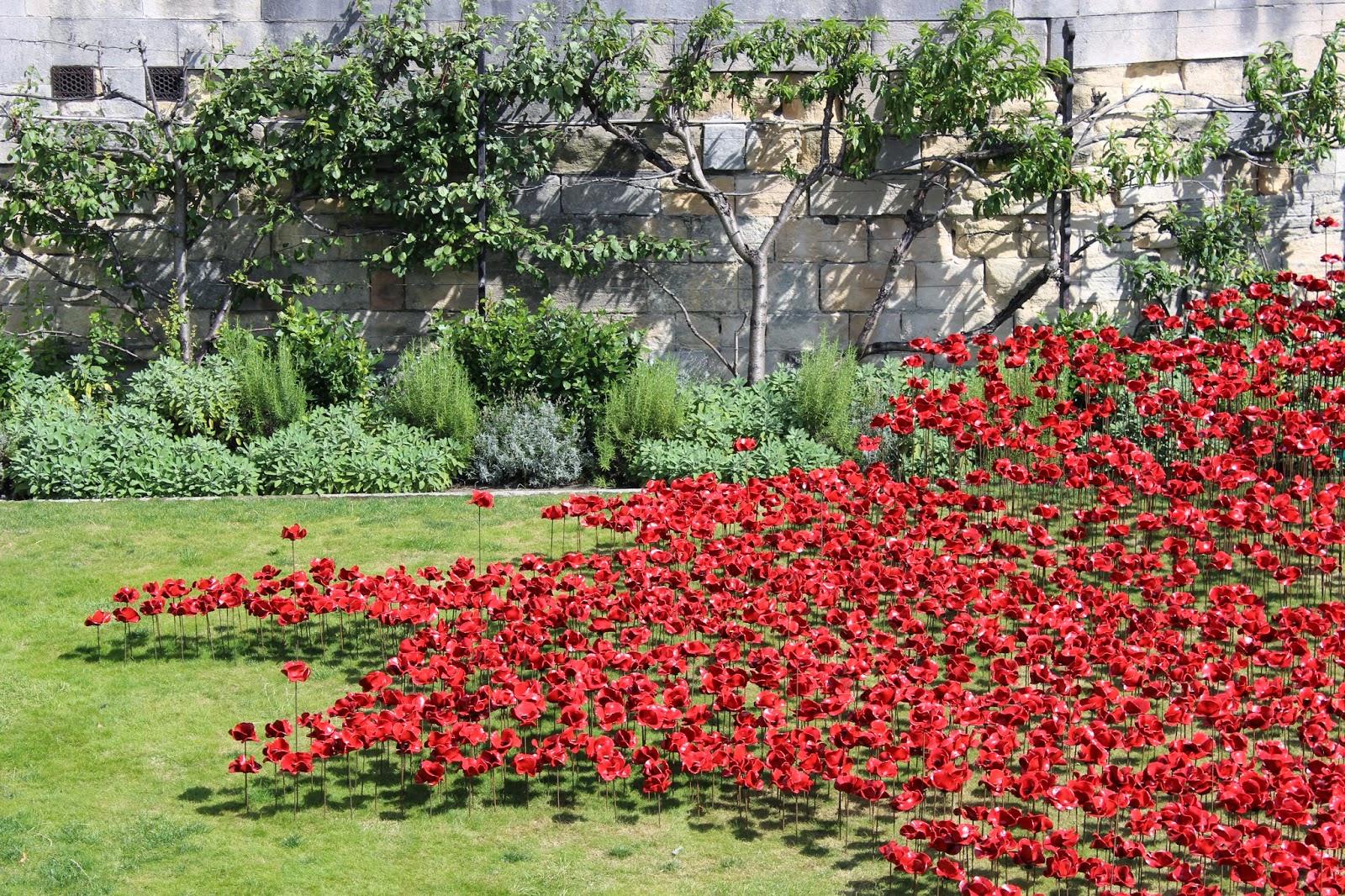
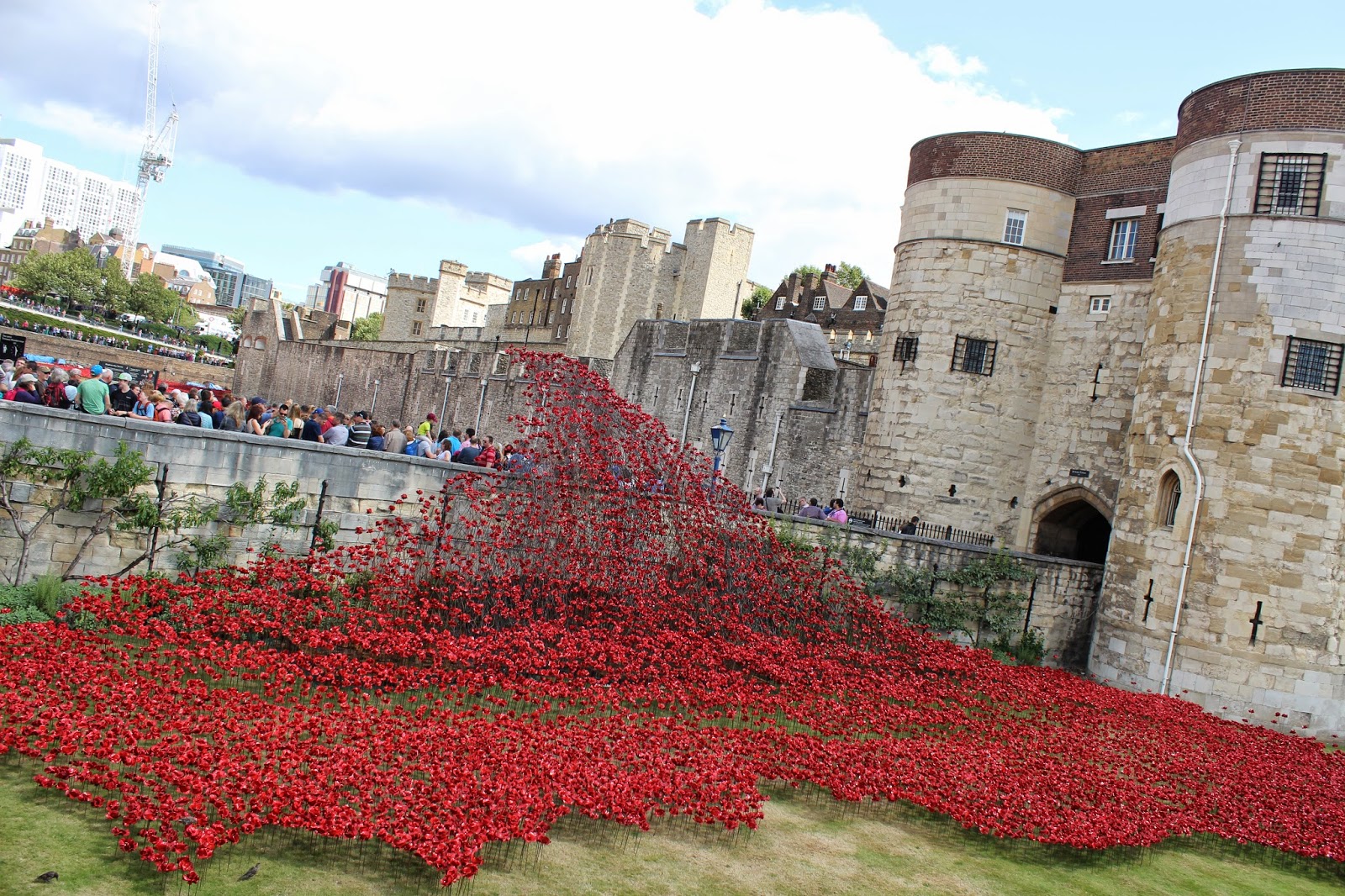
Bloodswept Lands and Seas of Red is the major art installation at the Tower of London, marking one hundred years since the first full day of Britain's involvement in the First World War. Created by ceramic artist Paul Cummins, with setting by stage designer Tom Piper, 888,246 ceramic poppies will progressively fill the Tower's famous moat over the summer. Each poppy represents a British military fatality during the war.

The poppies will encircle the iconic landmark, creating not only a spectacular display visible from all around the Tower but also a location for personal reflection. The scale of the installation intends to reflect the magnitude of such an important centenary creating a powerful visual commemoration.

-------------------------------------------------------------------------------

Pink Floyd - Vera.