Wikio - Top Blogs - Religion and belief
Showing posts with label cottrell. Show all posts

Wednesday, 8 April 2026

Belonging and believing: travelling with those on the journey of faith


Here's the sermon that I shared this morning at St Andrew's Wickford:

I wonder if you attended the Olympic or Paralympic Games in 2012 and were greeted by the cheerful faces of the 70,000 red and purple-clad Games Makers and further 8,000 London Ambassadors who were a key feature of those Games. The majority of Games Makers gave up at least 10 days to volunteer and took on a wide range of activities including welcoming visitors, transporting athletes and working behind the scenes.

As a Church, we can learn from the wonderful welcome given out by the Games Makers. As Archbishop Stephen Cottrell wrote in his book ‘From the abundance of the heart’: "There is a fantasy about evangelism: people hear the gospel, repent, and look around for a church to join. Then there is the reality: people come into contact with the church, or have some inkling of the possibility of God, and enter into a relationship with the church, either through its activities, its worship, or just friendship with its members. In the loving community of these relationships, faith begins to grow. Or to put it more succinctly: belonging comes before believing. Therefore, right at the heart of any effective evangelistic ministry must be a warm and generous attitude to those who are currently outside the church community and a place of welcome and nurture within it."

Archbishop Stephen has also said that in recent years we have re-discovered that for most people becoming a Christian is like a journey. This changes the way we approach evangelism. For the most part it will mean accompanying people on that journey and this is why the story of Jesus on the Emmaus Road (Luke 24. 13 - 49) is instructive for us in thinking about evangelism.

When Jesus encounters the two disciples on the Emmaus Road on the evening of the first Easter Day, he meets them where they are but Luke tells us that "their eyes were kept from recognising him" (Luke 24. 16). He joins their conversation and walks with them while they are going in the wrong direction. He listens to them before he speaks. His first question is one of open vulnerability to their agenda: "What are you discussing with each other while you walk along?"(Luke 24.17). In response to their questions and accounts of what has happened he then breaks open the scriptures, explaining to them "the things about himself "(Luke 14. 27). Arriving at Emmaus he "walks ahead as if he is going on" (Luke 24. 28). But they invite him in, and as he breaks the bread their eyes are opened. They then rush back to Jerusalem. They can’t wait to share with others the good news they have received.

Luke’s account provides us with a rich and challenging story about evangelism which is hugely relevant for the situation we face today because: "our own culture here in Essex … is not so dis-similar to the ones the first apostles encountered outside the comfort zone of the Jewish faith: a smorgasbord of beliefs, a general interest in things spiritual, a lack of confidence in the meta-narratives that had previously been trusted so much. In this sort of world becoming a Christian will be like a journey, and much of our work will be helping people to make the journey; and much of that will be removing obstacles from the path."

God longs for reconciliation with the whole of the creation and with every person on earth; he is therefore an evangelist. His great love for the world and his purposes for the world have been revealed in Jesus Christ, and through his death and resurrection Jesus has already done everything that is necessary for us to enjoy eternal life with God. The ministry of evangelism is our sharing with others the good news of what God has already done in Christ and the transformation it can bring to the world and to our lives here on earth and in eternity. It can involve specific ministries (such as a place of nurture where people can find out about Christian faith), but is also shaped enormously by our witness as individual Christians as we walk with others in their individual daily lives.

"Becoming a Christian is not just learning about the Christian faith: it is about becoming a member of the Christian community, and it is about relationship with a God who is himself a community of persons. Therefore, right at the beginning of the journey, people need to experience what it means to be part of a pilgrim church. Before people can become pilgrims themselves, they need to feel happy to travel with us and be open to experiencing life from a Christian perspective."

"Nurturing a generous attitude of welcome to newcomers is something that needs to be worked at over many years … Welcome is not just what we do when someone comes through the door. It is an attitude which seeks to get inside the shoes of the other person so that they can be welcomed and accompanied at every point of their journey."

Archbishop Stephen likes "to use the term ‘Travellers’ to refer to people who are beginning to explore the Christian faith, because it describes those who are on the way. They may not yet be coming to church, but they are committed to taking the next step. For many people the best next step is a course of enquiry where they can enter into dialogue with the Christian faith in the company of other Christian people."

In April we are going to begin our next Enquirer’s course called Being With Church. Being With is about sharing stories about our lives and hearing the stories of others. These stories are the small things that mean a lot to us and they can also be the most challenging and life changing moments of our lives. There’s a space for every person’s life in this course. The course is based on the belief that to find the meaning of life we need each other. We need to spend time being present and attentive to others who may be different to us and to ourselves and the world around us. As we do this, we can discover a way to be attentive to God and discover that God is present to us.

So, we are talking here about three specific forms of welcome: the welcome someone receives when they first encounter the Church or an individual Christian; the welcome involved in travelling with someone else on their journey to God and beyond; plus, the welcome which can be provided in an enquirer’s course like Being With.

Just like the Olympics and Paralympics, the Church needs welcomers. The traditional role of welcomer to services in the Church of England is that of the sidesperson. We can see from all that we have thought about so far today why that is such an important role. We might not all have a ministry as a sidesperson, but we can all get alongside others on their journey towards God in the way Archbishop Stephen has described and as Jesus did with the two disciples on the Emmaus Road. How, I wonder, can you get inside the shoes of those you know so that they can be welcomed and accompanied at every point of their journey towards God?

Finally, could you encourage people to join our Being With course by making people feel comfortable and safe, putting them at ease so they can bring their questions and feel challenged but not pressured. These are all ways in which we can use our time and talents in God’s service and so be a transforming presence in our homes, community, workplaces and world.

Archbishop Stephen suggests we need to have become a church where evangelism is in our DNA and where we have learned ways of doing evangelism that work in the different and varied and fast changing contexts that make up our diocese. All these involve an intentional desire to welcome others and share with them the good things that we have received from Christ. To do that, like Jesus on the Emmaus Road, we need a warm and generous attitude to those who are currently outside the church community and a place of welcome and nurture within it.

----------------------------------------------------------------------------------------------------------

Malcolm and Alwyn - Fool's Wisdom.

Saturday, 10 May 2025

All Saints Goodmayes: Stations of the Cross


All Saints Goodmayes, which has a set of Stations of the Cross by the artist Henry Shelton, has prepared a booklet of images, reflections and prayers based on these Stations. The reflections and prayers used are those that I wrote for an earlier collaboration with Henry called 'The Passion'.

The Passion: Reflections and Prayers features minimal images with haiku-like poems and prayers that enable us to follow Jesus on his journey to the cross reflecting both on the significance and the pain of that journey as we do so. Henry and I aimed in these reflections to pare down the images and words to their emotional and theological core. The mark making and imagery is minimal but, we hope, in a way that makes maximum impact. Here is an example of one of the reflections and prayers: 

Jesus dies on the cross

The sun is eclipsed, early nightfall,
darkness covers the surface of the deep,
the Spirit grieves over the waters.
On the formless, empty earth, God is dead.

Through the death of all we hold most dear, may we find life. Amen.

The set of Stations now at All Saints Goodmayes have previously been exhibited at York Minister, St stephen Walbrook, and Chelmsford Cathedral. The booklet comes with a Foreword by The Most Revd and Rt Hon. Stephen Cottrell, Archbishop of York:

"At this most holy time, as we follow Jesus on His journey to the cross, Henry Shelton's contemporary images provide an evocative background against which we can place our deepest reflections as we contemplate the Passion of our Lord Jesus Christ, who by his death and resurrection delivered and saved the world." 

Henry Shelton was born and grew up in Stratford, East London. He joined West Ham church as a choir boy where he first became aware of the importance of Christian art.

After leaving school he joined a London studio as an apprentice draughtsman developing his drawing skills in lettering and fine art. After 15 years of service he set up his own studio receiving many commissions to design for such clients as the Science Museum, Borough Councils, private and corporate bodies.

During this time he continued painting Christian art and after meeting Bishop Trevor Huddleston he completed a series of portraits of him which were exhibited in St Dunstan's Church, Stepney, where he was also confirmed by the Bishop.

Henry worked designing in studios across the world, including Hong Kong and the USA. Together, we formed commission4mission, an artist's collective that generated church commissions, exhibitions, events and resources. Henry's commissions include a large oil painting of the Ascension installed as an altarpiece in the Church of the Saviour, Chell Heath; the Millennium clock tower in Goodmayes, memorial etched glass windows in All Saints Goodmayes and All Saint's Hutton, paintings for the Chapel at Queen's Hospital Romford, Stations of the Crown of Thorns at St Paul's Goodmayes, and the Trinity Window at All Saints Goodmayes.

An interview that I undertook with Henry can be read here and here.

--------------------------------------------------------------------------------------------------------

Extreme - Peacemaker Die.

Sunday, 21 July 2024

In Praise of Stop

Here's the sermon that I shared today at St Andrew’s Wickford:

When you use the Lectionary to decide on the Bible reading for a particular service, as we do in this Church, you sometimes wonder what the people who chose the readings were thinking when they made their choices. The Gospel reading for today (Mark 6: 30-34, 53-end) misses out the wonderful stories of Jesus feeding the five thousand and walking on the water which have stimulated thousands of sermons and instead all we get is Jesus travelling around towns, villages and farms meeting large crowds and healing people and, as the preacher, you think; well, how am I going to get a sermon out of that?

One interesting thing about this selection of verses is that we see Jesus attempting to take some time out from ministry together with his disciples and being frustrated in the attempt because the demands of the crowds around them were too great. That continues to be the case in ministry whether we are lay or ordained but the busyness of ministry here in the Wickford and Runwell Team Ministry and in our weekday lives cannot be sustained if it is not fed by regular times of withdrawal for prayer and recuperation.

That was Jesus’ regular practice. We read of him getting up long before daylight, leaving the town and going to a lonely place where he could pray. In order to pray effectively and well he needed to get away from the demands of ministry and away from his disciples too. He needed to be alone with God in order to recharge his batteries for further ministry to come and this is his pattern throughout his ministry; active mission together with others combined with withdrawal for individual prayer and recuperation. It was what he tried to demonstrate to his disciples in today’s Gospel reading and it needs to be our pattern too.

I’m reminded of an exhibition by the artist Micah Purnell which was called In Praise Of Stop . This was an exhibition which reflected on the theme of Sabbath as Resistance by exploring 'the practice of the fourth commandment in a contemporary age.' The exhibition included thought-provoking aphorisms such as ‘Nothing takes practice’, ‘Switch off to connect’, ‘Thou shalt not prepare for tomorrow’ and ‘Everything comes from nothing’. 

In a similar vein is the book written by Stephen Cottrell, the Archbishop of York, which is entitled ‘Do Nothing to Change Your Life: Discovering What Happens When You Stop.’ In this book Cottrell invites us to slow down and stop … and breathe. He asks, ‘When was the last time you had a real day off? Ditched the 'to-do' lists? Switched off the phone? Had a lie-in? Sat in the bath until the water went cold?’ Most of us, he suggests, live at break-neck speed. Busy lives - work, family, friends, endless tasks - leave us with little time to sleep, never mind stopping and reflecting. We urgently need to learn to nurture our inner slob. As Isaiah 30:15 says, ‘In return and rest you shall be saved.’

In a book called 'The city is my monastery', Richard Carter writes that 'Rest is given to us as the culmination of creation’ and that the ‘whole of creation moves towards this time of Sabbath, and our lives have no meaning simply as cycles of survival without this arrival at the place of wonder and rest.’ The rest that is ultimately the culmination of creation is that which we will experience in heaven. Sabbath is our anticipation of that experience in the here and now.

‘Creation is not complete,’ he writes, ‘until God rests on the seventh day and contemplates all creation.’ Therefore, 'God blesses time’ and ‘consecrates it as holy.’ The whole of creation is moving towards this time of Sabbath, ‘and our lives have no meaning simply as cycles of survival without this arrival at the place of wonder and rest.'

‘When we rest, we imitate God - we enter into the rhythm of God's time,' but, more than that, 'if Sabbath is God's time, it does not end in the keeping of the Sabbath - the Sabbath enters into all our time.’ ‘When we keep Sabbath, everything we do can be infused with that sense of God's presence.'

He describes a day on holiday in Kefalonia where he pays attention to every moment of the day – the bread he buys from the bakery, the person who serves him, the wrapping in which it comes, the feel and taste of it. Later in the day, he writes, ‘I sat on the beach and watched people playing in the sea … I swam, ate bread and ripe tomatoes, and these actions were like a prayer.'

So, Richard Carter suggests that Sabbath rest is not simply about stopping but more so about an attitude of the heart which slows us in everyday life to appreciate and enjoy what we encounter in our daily lives.

In lockdown we all experienced an enforced Sabbath. An unattributed poem that was circulated on Facebook at that time suggested that our lockdown experience could be a moment in which we learn how to rest and experience renewal:

For years our land has groaned beneath the grind
Of work, work, work, of pounding feet, of churn;
For years we stopped our ears and would not mind
The gentle voice that urged us all to turn
From endless slog and strain that warps and rends
The sinews of the Spirit, toward rest:
The Sabbath's breathing wisdom God intends
For human flourishing and the land's best.
Now cafes rest, deserted and the shops,
The bank, the bustle, bargain, building, bar,
The tube's hot haggling hustle: it all stops.
Forced into stillness, now we breathe, we are.
Such tragic loss of love, of breath, to prove
How much we need to rest, to breathe, to love.

Our reading today, demonstrates some of the difficulties in regularly finding that time and the attitude Richard Carter described because of the constant demands that ministry makes on us. However, the difficulties involved shouldn’t prevent us from making the attempt to build rest periods and an attitude of slowing down and paying attention into our daily lives. By doing so, we follow in the footsteps of Jesus who specifically carved out times for prayer in the busyness of his ministry years and sought to teach his disciples to do the same. May it be so for each one of us. Amen.

------------------------------------------------------------------------------------------------------

Sunday, 1 October 2023

Paying attention: Consider the lilies

Here's the sermon that I shared at St Mary’s Runwell this morning for their Harvest Festival:

In our reading today we heard Jesus tell us that we should look at the flowers of the field. Stop and notice. In his painting called Consider the Lilies, Stanley Spencer depicts Jesus as mountainous in comparison with the daisies (not lilies) that he contemplates. Archbishop Stephen Cottrell has noted that this Jesus is playful, "huge and humble", godlike. Mark Oakley writes that ‘Whereas lilies call for attention, in church or posh hallways, daisies are overlooked, or considered problematic in our neat lawns. Jesus relishes their beauty, and, at the same time, challenges the sad fact about human beings that "when it comes to the present moment, we're not present".’ 

Cottrell then cleverly refers us to the words of Nadine Stair: ‘If I had my life to live over . . . I'd relax, I would limber up. I would be sillier than I have been. . . I would do more walking and looking. . . I would pick more daisies.’

Simon Small writes that we find it difficult to do this because: ‘Our minds find paying full attention to now very difficult. This is because our minds live in time. Our thoughts are preoccupied with past and future, and the present moment is missed.’ But, he says: ‘To pay profound attention to reality is prayer, because to enter the depths of this moment is to encounter God. There is always only now. It is the only place that God can be found.’

This is very much what Jesus seems to be saying to us through his teaching on worry and anxiety as found in today’s Gospel reading (Matthew 6. 24 -34). When we are preoccupied with what might happen in the future, we are not living fully in the present and may well misunderstand or misinterpret what is actually going on. Jesus encourages us to live fully in the present because, as Simon Small says, that is where we encounter God.

When we genuinely encounter God in the here and now, we know that his love and forgiveness surround us and that his Spirit fills us. As Jesus prayed in John 17, he is in us and we are in him. When we know this in our hearts in the here and now, we can relax because whatever happens to us, we are accepted, forgiven, loved and gifted by the God who created all things and who will bring all things to their rightful end. We are held in the palm of his hands and, therefore, as Julian of Norwich put it, “all shall be well, and all shall be well, and all manner of thing shall be well”.

Jesus says that the more we live in the present and the more we encounter God’s love in the here and now, the less we will be anxious or worried. Prayer is able to help us do both things and therefore helps us to reduce our sense of anxiety or worry. Not because we have listed all our worries to God and believe that he will solve them all for us, but instead because, through prayer, we encounter more of God’s love and, as a result, trust that he will be with us whatever comes our way.

Harvest provides a wonderful opportunity for us to do this in relation to the natural world around us including the birds of the air and the lilies of the field. Harvest provides an ‘opportunity to reflect and give thanks for all the good things in our lives, especially the way in which the earth produces food for us to eat, to give thanks for all those who work to produce food and drink for us to enjoy, to say sorry for the times we are not grateful, that we don’t notice God’s work in the world, that we don’t look after the things God has given us.’ ‘We live in a different time from our ancestors where the harvest and bringing the harvest in would have dominated everyone’s lives’ but today we probably hardly notice it. What we can do, however, is pay attention to what is around us, whether in our gardens and parks or in our homes and town.

Pope Francis has written on the connection between care for our common home and paying attention in his encyclical Laudato Si. There, he wrote: ‘Those who enjoy more and live better each moment are those who have given up dipping here and there, always on the look-out for what they do not have. They experience what it means to appreciate each person and each thing, learning familiarity with the simplest things and how to enjoy them. So they are able to shed their unsatisfied needs, reducing their obsessiveness and weariness. Even living on little they can live a lot, above all when they cultivate other pleasures and find satisfaction in fraternal encounters, in service, in developing their gifts, in music and art, in contact with nature and in prayer.’ (Laudato Si 223)

He continues, saying, ‘No one can cultivate a sober and satisfying life without being at peace with him or herself…. Inner peace is closely related to care for ecology and for the common good because, lived out authentically, it is reflected in a balanced lifestyle together with a capacity for wonder which takes us to a deeper understanding of life. Nature is filled with words of love, but how can we listen to them amid constant noise, interminable and nerve-wracking distractions, or the cult of appearances.’ (Laudato Si 225)

He concludes, drawing on today’s Gospel reading, that: ‘We are speaking of an attitude of heart, one which approaches life with serene attentiveness, which is capable of being fully present to someone…which accepts each moment as a gift from God to be lived to the full. Jesus taught us this attitude when he invited us to contemplate the lilies of the field and the birds of the air…. He was completely present to everyone and to everything and in this way he showed us the way to overcome that unhealthy anxiety which makes us superficial, aggressive and compulsive consumers.’ (Laudato Si 226)

Pope Francis quotes Patriarch Bartholomew as saying that we should look for solutions to the climate emergency in a change of humanity: ‘He asks us to replace consumption with sacrifice, greed with generosity, wastefulness with a spirit of sharing, an asceticism which “entails learning to give, and not simply to give up. It is a way of loving, of moving gradually away from what I want to what God’s world needs. It is liberation from fear, greed and compulsion”. Bartholomew says that, ‘As Christians, we are also called “to accept the world as a sacrament of communion, as a way of sharing with God and our neighbours on a global scale. It is our humble conviction that the divine and the human meet in the slightest detail in the seamless garment of God’s creation, in the last speck of dust of our planet”.’ 

Such an attitude begins with our looking closely, attentively, at the world around us as Jesus encourages us to do in today’s Gospel reading and as Stanley Spencer shows him doing in ‘Consider the Lilies’. This Harvest, may we increasingly do the same.


------------------------------------------------------------------------------------------------------------

Barclay James Harvest - Hymn.

Sunday, 2 July 2023

Welcome, welcome, welcome, welcome, welcome, welcome

Here's the sermon I shared at St Catherine's Wickford this morning:

Hospitality is a bedrock of cultures and countries across the Middle East. Everywhere travellers go in the Middle East, they are overwhelmed by hospitality. This culture derives in part from the experience of nomadic peoples in desert landscapes where one had to travel significant distances to find water. To refuse travellers refreshment in such places would have been to let them die which would have threatened the openhandedness that nomadic peoples must depend on to survive. For Jews, Christians and Muslims, the story of Abraham receiving three travellers who turned out to be divine was key, as he was seen to have entertained angels unawares. This story is then contrasted with the sinful response of the people of Sodom to the same three travellers; instead of offering hospitality, the people of Sodom seek to abuse them.

The rabbis teach that Abraham left off a discussion with God to greet these guests when they arrived at his camp. He ran to greet them during the hottest day on record and served them the best food he could put together. Based on this example, the rabbis say that taking care of guests is greater than receiving the divine presence. The fundamental wickedness of Sodom was their hostility to vulnerable strangers and the violence they enacted on the innocent. The people of Sodom had a moral responsibility to offer protection and hospitality to vulnerable strangers, as all the ancient laws of the East demanded, and they stand in scripture as an example of extreme wickedness because they attacked and abused those they should have protected.

Jesus called his 12 disciples to an itinerant ministry which involved going ahead of him to prepare people for his coming and his message. As a result, they took nothing unnecessary with them, they weren’t distracted by small talk along the way, and they welcomed hospitality when they received it but simply moved on to the next place and the next person whenever they were not made welcome. We’ve been listening to and reflecting on the instructions Jesus gave to his disciples in our Gospel readings for the past couple of weeks (Matthew 10). This passage (Matthew 10.40-42) comes as the conclusion to Jesus’ teaching. His concluding words are all about the importance of welcome and they are, therefore, based on Middle-Eastern understandings of hospitality.

Before the disciples go Jesus warns that those who fail to welcome them are not only turning God’s messengers away from their homes and lives but God himself too. As he says, “Whoever welcomes you welcomes me, and whoever welcomes me welcomes the one who sent me” and earlier, “Whoever listens to you listens to me; whoever rejects you rejects me; and whoever rejects me rejects the one who sent me.” When the disciples return to him, he rejoices at the welcome which they have received and the sense that the Gospel has been received from “the diverse and motley group he has chosen as his associates.”

The emphasis in these passages is on the hospitality provided by others to Jesus’ disciples. We tend to think of ourselves as being called like them to take the good news of Jesus to others, so we naturally identify ourselves with the disciples in the passage and think about the response we receive from others when they know that we are Christians. But to really get the force and challenge of what Jesus is saying in this passage we have to put ourselves in the shoes of those the disciples went to and ask ourselves how well do we receive others? The challenge in this passage is about the quality of the welcome provided to others. The great sin here is to be inhospitable and to be inhospitable is actually to reject the divine in our lives.

So, how do we rate on that basis? We think of ourselves as a friendly, welcoming church but it’s important not rest on our laurels and instead ask ourselves how we can be more welcoming, more hospitable to those who come for the first time and those that we don’t know well. When we are here in church, let us make those people our priority, always seeking to speak first to those we don’t know, don’t know well or haven’t spoken to for some time.

Stephen Cottrell, the Archbishop of York has written: "Nurturing a generous attitude of welcome to newcomers is something that needs to be worked at over many years … Welcome is not just what we do when someone comes through the door. It is an attitude which seeks to get inside the shoes of the other person so that they can be welcomed and accompanied at every point of their journey."

We get six mentions of welcome in the three verses that form today’s short reading which suggests the importance that welcome of others held for Jesus. We see this, too, in his teaching that we should love our enemies and bless those that curse us. We see it in his statement that those who feed the hungry, give drink to the thirsty, clothe the naked and visit those in prison are doing those things to Jesus himself. We see it, too, in his concern to be with those who were excluded from worship and society; those with disabilities, tax collectors, publicans, prostitutes and others. In Jesus, God became one with those who are rejected by others, but the rejected one became the cornerstone of our faith. The experience of Jesus provides a model for ministry. In Jesus, we see that God is most clearly seen among those who are marginalised or rejected (whether by Church or state) and, therefore, those on the edge are the gifts from God which have the most potential to renew us.

Sam Wells, Vicar of St Martin-in-the-Fields says: ‘In his crucifixion [Jesus] was rejected by the builders – yet in his resurrection he became the cornerstone of forgiveness and eternal life. That’s what ministry and mission are all about – not condescendingly making welcome alienated strangers, but seeking out the rejected precisely because they are the energy and the life-force that will transform us all. Every minister, every missionary, every evangelist, every disciple should have these words over their desk, their windscreen, on their screensaver, in the photo section of their wallet, wherever they see it all the time – the stone the builders rejected has become the cornerstone. If you’re looking for where the future church is coming from, look at what the church and society has so blithely rejected. The life of the church is about constantly recognising the sin of how much we have rejected, and celebrating the grace that God gives us back what we once rejected to become the cornerstone of our lives. That’s what prophetic ministry means.’

Whoever welcomes, welcomes Jesus and welcomes God. If we truly want to see and hear God, then all we need to do is to welcome those we encounter as we will see the face of God in them. God calls us not just to be those who follow him but also to be those sent out to prepare the way for him to come into the lives of others and challenges us, too, to be those who are always welcoming, always hospitable towards others.

----------------------------------------------------------------------------------------------------------

Little Richard - Great Gosh A'Mighty.

Sunday, 23 April 2023

An intentional desire to welcome others

Here's the sermon I shared at St Catherine's Wickford this morning:

I wonder if you attended the Olympic or Paralympic Games in 2012 and were greeted by the cheerful faces of the 70,000 red and purple-clad Games Makers and further 8,000 London Ambassadors who were a key feature of those Games. The majority of Games Makers gave up at least 10 days to volunteer and took on a wide range of activities including welcoming visitors, transporting athletes and working behind the scenes.

As a Church, we can learn from the wonderful welcome given out by the Games Makers. As Archbishop Stephen Cottrell wrote in his book ‘From the abundance of the heart’: "There is a fantasy about evangelism: people hear the gospel, repent, and look around for a church to join. Then there is the reality: people come into contact with the church, or have some inkling of the possibility of God, and enter into a relationship with the church, either through its activities, its worship, or just friendship with its members. In the loving community of these relationships, faith begins to grow. Or to put it more succinctly: belonging comes before believing. Therefore, right at the heart of any effective evangelistic ministry must be a warm and generous attitude to those who are currently outside the church community and a place of welcome and nurture within it."

Archbishop Stephen has also said that in recent years we have re-discovered that for most people becoming a Christian is like a journey. This changes the way we approach evangelism. For the most part it will mean accompanying people on that journey and this is why the story of Jesus on the Emmaus Road (Luke 24. 13 - 49) is instructive for us in thinking about evangelism.

When Jesus encounters the two disciples on the Emmaus Road on the evening of the first Easter Day, he meets them where they are but Luke tells us that "their eyes were kept from recognising him" (Luke 24. 16). He joins their conversation and walks with them while they are going in the wrong direction. He listens to them before he speaks. His first question is one of open vulnerability to their agenda: "What are you discussing with each other while you walk along?"(Luke 24.17). In response to their questions and accounts of what has happened he then breaks open the scriptures, explaining to them "the things about himself "(Luke 14. 27). Arriving at Emmaus he "walks ahead as if he is going on" (Luke 24. 28). But they invite him in, and as he breaks the bread their eyes are opened. They then rush back to Jerusalem. They can’t wait to share with others the good news they have received.

Luke’s account provides us with a rich and challenging story about evangelism which is hugely relevant for the situation we face today because: "our own culture here in Essex … is not so dis-similar to the ones the first apostles encountered outside the comfort zone of the Jewish faith: a smorgasbord of beliefs, a general interest in things spiritual, a lack of confidence in the meta-narratives that had previously been trusted so much. In this sort of world becoming a Christian will be like a journey, and much of our work will be helping people to make the journey; and much of that will be removing obstacles from the path."

God longs for reconciliation with the whole of the creation and with every person on earth; he is therefore an evangelist. His great love for the world and his purposes for the world have been revealed in Jesus Christ, and through his death and resurrection Jesus has already done everything that is necessary for us to enjoy eternal life with God. The ministry of evangelism is our sharing with others the good news of what God has already done in Christ and the transformation it can bring to the world and to our lives here on earth and in eternity. It can involve specific ministries (such as a place of nurture where people can find out about Christian faith), but is also shaped enormously by our witness as individual Christians as we walk with others in their individual daily lives.

"Becoming a Christian is not just learning about the Christian faith: it is about becoming a member of the Christian community, and it is about relationship with a God who is himself a community of persons. Therefore, right at the beginning of the journey, people need to experience what it means to be part of a pilgrim church. Before people can become pilgrims themselves, they need to feel happy to travel with us and be open to experiencing life from a Christian perspective."

"Nurturing a generous attitude of welcome to newcomers is something that needs to be worked at over many years … Welcome is not just what we do when someone comes through the door. It is an attitude which seeks to get inside the shoes of the other person so that they can be welcomed and accompanied at every point of their journey."

Archbishop Stephen likes "to use the term ‘Travellers’ to refer to people who are beginning to explore the Christian faith, because it describes those who are on the way. They may not yet be coming to church, but they are committed to taking the next step. For many people the best next step is a course of enquiry where they can enter into dialogue with the Christian faith in the company of other Christian people."

In May we are going to begin a new Enquirer’s course called Being With. Being With is about sharing stories about our lives and hearing the stories of others. These stories are the small things that mean a lot to us and they can also be the most challenging and life changing moments of our lives. There’s a space for every person’s life in this course. The course is based on the belief that to find the meaning of life we need each other. We need to spend time being present and attentive to others who may be different to us and to ourselves and the world around us. As we do this, we can discover a way to be attentive to God and discover that God is present to us.

So, we are talking here about three specific forms of welcome: the welcome someone receives when they first encounter the Church or an individual Christian; the welcome involved in travelling with someone else on their journey to God and beyond; plus the welcome which can be provided in a enquirer’s course like Being With.

Just like the Olympics and Paralympics, the Church needs welcomers. The traditional role of welcomer to services in the Church of England is that of the sidesperson. We can see from all that we have thought about so far today why that is such an important role. We might not all have a ministry as a sidesperson but we can all get alongside others on their journey towards God in the way Archbishop Stephen has described and as Jesus did with the two disciples on the Emmaus Road. How, I wonder, can you get inside the shoes of those you know so that they can be welcomed and accompanied at every point of their journey towards God?

Finally, could you encourage people to join our Being With course by making people feel comfortable and safe, putting them at ease so they can bring their questions and feel challenged but not pressured. These are all ways in which we can use our time and talents in God’s service and so be a transforming presence in our homes, community, workplaces and world.

Archbishop Stephen suggests we need to have become a church where evangelism is in our DNA and where we have learned ways of doing evangelism that work in the different and varied and fast changing contexts that make up our diocese. All these involve an intentional desire to welcome others and share with them the good things that we have received from Christ. To do that, like Jesus on the Emmaus Road, we need a warm and generous attitude to those who are currently outside the church community and a place of welcome and nurture within it.

-----------------------------------------------------------------------------------------------------------

T Bone Burnett, Jay Bellerose, Keefus Ciancia - A Better Day.

Wednesday, 22 February 2023

Lent: A course in Christian meditation

Here's the sermon I have shared at St Andrew's Wickford and St Mary's Runwell today as part of our Ash Wednesday Eucharist's with the Imposition of Ashes:

When Stephen Cottrell, the Archbishop of York, was a parish priest in Huddersfield, a friend of his, who was involved in Adult Education, told him that a course on Zen Buddhist meditation could have been filled three times over and asked why the church was not running a course on Christian meditation.

Archbishop Stephen later moved to a role at the Cathedral in Peterborough and when he told this story there, the Head of Adult Education asked him to run a course on Christian meditation as part of the Adult Education programme. He did, and the course filled up with a mix of those who were already Christians and those who would describe themselves are ‘searchers’.

This experience confirmed his belief that, with the right kind of introduction, many people are open to the riches of Christian spirituality. What better time than Lent for exploring some of that tradition? Lent is a time for going deeper with God; for going deeper into our faith and the riches of its tradition, particularly in terms of prayer.

This Lent we are essentially going to run a course on Christian meditation through our Lent Course ‘Ways to Pray’. Our five-week course explores some different ways of praying: Being Still with God, Prayer Through the Day, Using the Imagination, Multi-sensory prayer, Using Art and Images. The course gives some ideas on aspects of the Church’s tradition and practice that we could explore this Lent, as part of going deeper into God through prayer. Our Quiet Day, here at St Mary’s, on 4 March will also do more of the same. Here are some others ideas and resources too …

The Desert Fathers and Mothers were hermits, monks and nuns who lived mainly in the Scetes desert of Egypt beginning around the third century AD. These informal gatherings of hermit monks and nuns became the model for Christian monasticism. Many of the wise words and teachings of these early desert monks and nuns were collected and are still in print as the ‘Sayings of the Desert Fathers.’

One such saying has a significant overlap with today’s Gospel reading: ‘Stay in your cell. Your cell will teach you everything.’ The idea being that being in conversation with God through prayer will teach us everything we need to know. For this reason, when he was once interviewed by Radio 4 and was asked which wilderness would he go to for Lent if he could be taken anywhere in world, Archbishop Stephen replied that he would stay in his own living room. The location for our prayer is not the main point (although quiet and privacy can help); instead, the point is the quality and depth of our prayer.

Having said that, the Celtic Church has given us a model for the precise opposite; integrating prayer into our daily lives. Celtic Christians had a sense of the heavenly being found in the earthly, particularly in the ordinary tasks of home and work, which can blessed if we see God in our tasks and undertake our tasks as an act of worship to God.

This tradition was particularly strong in Gaelic countries and in the late 19th century Alexander Carmichael collected a number of the prayers and poems together in a book called the ‘Carmina Gadelica’ which ‘abounds with prayers invoking God’s blessing on such routine daily tasks as lighting the fire, milking the cow and preparing for bed.’ In more recent years, equivalent contemporary prayers have been written covering every aspect of daily life from turning on a computer to attending meetings, driving a car, stopping for a lunchbreak, and so on.

Some of the most visionary and passionate prayer in the history of the Church derived from the renewal of the Carmelite Order undertaken by St Teresa of Avila and St John of the Cross. Through quiet prayer, resting in contemplation of God which involved forgetting all earthly things, these attained occasionally prayers of union in which their whole being was absorbed in God.

They frequently described these experiences in terms of the union of lovers in marriage. St John, in particular, described in great poetry the experience of feeling abandoned by God which he described as the dark night of the soul. Their writings can help us understand those times when we feel God is very distant from us as well as those times when we feel an intimate closeness.

St Ignatius of Loyola devised a series of prayer exercises which many have found particularly helpful in the development of their prayer life. The Examen is a daily process for reflecting on the events of the day in order to detect God’s presence and discern his direction for us. The Examen begins with prayer for light then continues through thanksgiving, reviewing our feelings and focus before concluding with future appointments and the Lord’s Prayer.

Ignatius’ Spiritual Exercises are a compilation of meditations, prayers and contemplative practices developed to help people deepen their relationship with God. These are divided into four weeks; not seven-day weeks but stages on our spiritual journey. Week 1 involves reflection on our lives in light of God’s boundless love for us. Week 2 involves imagining ourselves as Christ’s disciples as we reflect on the Gospel stories. Week 3 is meditation on the Last Supper, Christ’s passion and death, while Week 4 is meditation on the resurrection.

These are just some of the resources for prayer which can be found in the Christian tradition (some of which we explore in our Lent Course) and which are available to all of us as we seek to go deeper into God this Lent. These resources can be found in books, through retreats, and by using online meditations. It is possible to travel to centres of prayer or to the world’s deserts and wildernesses in order to learn to pray in some of these ways. But we don’t have to! Like Archbishop Stephen, we could take to heart the teachings of the Desert Fathers to stay in our cell and our cell will teach us everything. Our cell can be our own front room. If we use it for committed, regular prayer this Lent then like the saints, monks and mystics about whom we have thought, we can go deeper into God.

Jesus said: ‘… go to your room, close the door, and pray to your Father, who is unseen. And your Father, who sees what you do in private, will reward you.’

-------------------------------------------------------------------------------------------------------

Iona - Today.

Friday, 7 May 2021

Living God's Future Now - w/c 9 May 2021


Living God’s Future Now’ is our mini online festival of theology, ideas and practice.

We’ve developed this in response to the pandemic and our changing world. The church is changing too, and - as we improvise and experiment - we can learn and support each other.

This is 'Living God’s Future Now’ - talks, workshops and discussion - hosted by HeartEdge. Created to equip, encourage and energise churches - from leaders to volunteers and enquirers - at the heart and on the edge.

The focal event in ‘Living God’s Future Now’ is a monthly conversation where Sam Wells explores what it means to improvise on God’s kingdom with a leading theologian or practitioner.

The online programme includes:

  • Regular weekly workshops: Biblical Studies (Mondays - fortnightly), Sermon Preparation (Tuesdays) and Community of Practitioners (Wednesdays)
  • One-off workshops on topics relevant to lockdown such as ‘Growing online communities’ and ‘Grief, Loss & Remembering’
  • Monthly HeartEdge dialogue featuring Sam Wells in conversation with a noted theologian or practitioner

W/c 9 May 2021

Sunday

Inspired to Follow
Zoom
Sunday 9 May, 14:00 (BST)
Register here.
‘Inspired to Follow: Art and the Bible Story’ helps people explore the Christian faith, using paintings and Biblical story as the starting points. The course uses fine art paintings in the National Gallery’s collection as a springboard for exploring questions of faith. Session 17: The Ascension. Text: Acts 1:1-12. Image: ‘The Incredulity of Saint Thomas’, Giovanni Battista Cima da Conegliano, about.1502-4, NG816.

Monday

God will not be mocked
Zoom
Monday 10 May, 6.00 pm (BST)
Register here.
Next St Brides Liverpool theology lecture in association with HeartEdge with Fergus Butler-Gallie. What being creatures who laugh might mean for our view of God, of the follies of humanity and the particular charisms of the C of E.

Biblical Studies class
Zoom
Monday 10 May,19:30-21:00 (BST)
Register here.
Join Simon Woodman on two Monday evenings each month for a Biblical Studies class: a lecture followed by discussion, with handouts, looking at the Gospels and Acts. Lecture 09: Luke-Acts.

Tuesday

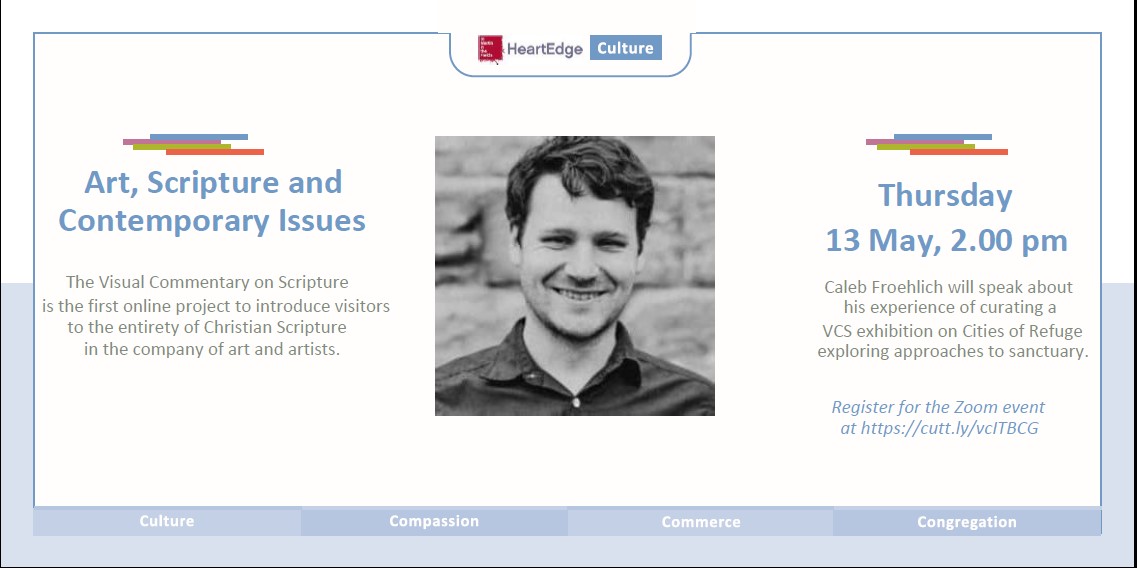
Art, Scripture and Contemporary Issues
Zoom
Tuesday 11 May 14:00 -15:00 (BST)
Register here.
In a short series, curators for the Visual Commentary on Scripture will speak about their experience of curating for VCS. Deborah Lewer will speak about curating an exhibition on Proverbs 11 exploring the righteousness of true and accurate measures.

Sermon Prep Sally Hitchiner and Sam Wells
Livestream
Tuesday 11 May 16:30 -17:30 (BST)
Live streamed on the HeartEdge Facebook page here.
A live preaching workshop focusing on the forthcoming Sunday's lectionary readings in the light of current events and sharing of thoughts on approaches to the passages.

Wednesday

Public Health and Church Engagement post pandemic
Zoom
Wednesday 12 May 10:30-12:00 (BST)
Reg here.
Gillian Straine, CEO of The Guild of Health and St Raphael, explores the potential of the church and people of faith to be agents of healing in our post pandemic world. Workshop 2 develops a theology of healing by exploring the question, 'What is healing?'.

Community of Practitioners workshop
Zoom
Wednesday 12 May 16:00-17:00 (BST)
Email Jonathan Evens here to take part. This is open to all, including ordinands and lay leaders. Church leaders join in community, share and reflect together on their recent experiences in the form of wonderings with one of the HeartEdge team.

Thursday

Art, Scripture and Contemporary Issues
Zoom
Thursday 13 May, 14:00-15:00 (BST)
Reg here.
In a short series, curators for the Visual Commentary on Scripture will speak about their experience of curating for VCS. Caleb Froehlich will speak about curating the Cities of Refuge exhibition which considers the provisions of the biblical cities of refuge from the perspective of sanctuary-seekers.

Living God's Future Now conversation - Stephen Cottrell
Zoom
Thursday 13 May, 18:10 – 19:10( BST)
Register here.
Sam Wells and Stephen Cottrell will be in conversation to discuss how to improvise on the kingdom. The Most Reverend and Right Honourable Stephen Cottrell is the 98th Archbishop of York.

Friday

Shut In, Shut Out, Shut Up Season 4: Ableism, Faith & Church
Zoom
Friday 14 May, 16:30-18:00 ( BST)
Register here.
Ableism is discrimination and social prejudice against disabled people. Like racism and sexism, it classifies entire groups of people as 'less than'. This series explores ableism, faith & church across context, culture and practice. Come and join the conversation with Fiona MacMillan, Ann Memmott and Dr Naomi Lawson Jacobs.

Coming Up

Mission Summer School - 12 – 16 July 2021
Zoom
12-16 July 2021
For more details and to reg click here
An opportunity to engage more deeply with the theology of mission and to explore how it relates to your own practice.Input structured around the four Cs of Commerce, Culture, Congregation and Compassion. A mix of teaching and conversation with leading scholars and practitioners including the Revd Dr Sam Wells, Professor Anthony Reddie, Dr Cathy Ross, and Revd Heather Cracknell, among others. Workshops to engage with the themes and issues presented. Encounters with churches, organisations and projects (HeartEdge and Fresh Expressions) to get a hands-on feel for how it works out in practice.

For more information please have a look at this video of Sam Wells telling us more, here.

---------------------------------------------------------------------------------------------------

Emmylou Harris - All That You Have Is Your Soul.

Sunday, 17 January 2021

Art, theology and preaching

I was asked recently about resources for bringing together art, theology and preaching. 

The request came from someone already using 'Inspired to Follow: Art and the Bible Story' a free resource to help people explore the Christian faith, using paintings and Biblical story as the starting points. It’s been created by St Martin-in-the-Fields in partnership with the National Gallery. The course uses fine art paintings in the National Gallery’s collection, along with a theological reflection and a Biblical text, as a spring board for exploring these two questions:
  • How can I deepen my faith in God?
  • What does it mean to follow Jesus today?
Find out more at https://www.stmartin-in-the-fields.org/life-st-martins/discipleship/inspired-to-follow/. 

Additionally I suggested the following:

The Visual Commentary on Scripture as a great resource for bringing together art, theology and preaching - https://thevcs.org/. The Visual Commentary on Scripture (VCS) is a freely accessible online publication that provides theological commentary on the Bible in dialogue with works of art.

The Visual Meditations at the Artway site (some of which I have written) are always good value - https://www.artway.eu/artway.php?lang=en.

Former Vicar at St Martin's +Nicholas Holtam wrote a book of reflections on paintings in the National Gallery's collection - https://www.nationalgallery.co.uk/products/the-art-of-worship-paintings-prayers-and-readings-for-meditation-hb/p_1032035.


The Art of Worship: Paintings, Prayers, and Readings for Meditation represents a unique collaboration between two famous Trafalgar Square institutions: the National Gallery and the church of St Martin-in-the-Fields. In this beautifully illustrated book, the Reverend Nicholas Holtam – then vicar of St Martin-in-the-Fields – presents his favourite paintings from the National Gallery.

I find Sister Wendy Beckett's books of meditations on art helpful. As you'll be aware there are many of them. The Art of Lent is the one for this season - https://spckpublishing.co.uk/the-art-of-lent - but 'Art and the Sacred' and 'The Gaze of Love' are also great.


Join Sister Wendy on a journey through Lent, and discover the timeless wisdom to be found in some of the world’s greatest paintings. Illustrated in full colour with over forty famous and lesser-known masterpieces of Western art, this beautiful book will lead you into a deeply prayerful response to all that these paintings convey to the discerning eye.

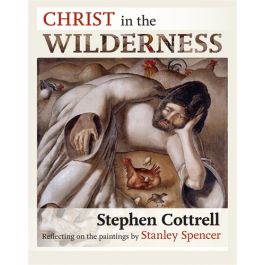
Stephen Cottrell's Christ in the Wilderness is a book in a similar vein - https://spckpublishing.co.uk/christ-in-the-wilderness


The Calvin Institute of Worship has a useful page on Art that Preaches - https://worship.calvin.edu/resources/resource-library/art-that-preaches
Art That Preaches. Call it "the preacher's friend." Certain types of visual art are especially good for helping people worship because they direct attention beyond the artist or artwork to God.

------------------------------------------------------------------------------------------------------

Nickel Creek - He Will Listen To You.

Friday, 15 January 2021

Seeing is Receiving: The art of contemplation (4)

3. Surrender

I began the European leg of my sabbatical art pilgrimage with a mixture of excitement and trepidation. Excitement, because this was the start of a wonderful adventure; trepidation, because I was unsure as to whether my itinerary and the practical arrangements I needed to make as I travelled would work. I had not travelled in this way before and was unsure as to whether the churches I planned to visit would all be open and whether I would find accommodation for my overnight stays. Nevertheless, as this was the beginning of a great adventure, I resolved to surrender myself to the experience come what may.

My journey did not have an auspicious start as, on the approach to Lille, I become part of one of the longest tailbacks it has been my misfortune to encounter with the delay increasing my initial anxieties about the possible difficulties of keeping to my planned itinerary. We did, however, mostly move throughout many kilometres, albeit at a snail’s pace, and eventually reached the cause of the delay – a convoy of tractors filling all the lanes and accompanied by the emergency and highways services. Presumably a protest on behalf of farmers, it served to remind of the rural origins of Hem, which means ‘the dwelling-place’. Originally a hamlet in an agricultural area of northern France, its population grew rapidly after the Second World War with one effect of growth being the consecration in 1958 of the Chapelle Sainte-Thérèse-de-l'Enfant-Jésus et de la Sainte-Face.

An inauspicious and lengthy journey to visit a church that is not included on many tourist sites and which has been described as looking like a barn. As the Chapelle Sainte-Thérèse has external sculptures and a mosaic over its entrance, I reasoned that the journey would not be completely wasted were the church to be locked. It was not and, as I travelled on, it was only when I returned to Calais that I found churches which were not open regularly.

The modest external appearance of the Chapelle Sainte-Thérèse deceives, however, as once within I was in another world, one in in which I was submerged in coloured light. Here there are mosaics and windows by Alfred Manessier, sculptures by Eugène Dodeigne and Jean Roulland, and a tapestry of the Sainte-Face based on a painting by Georges Rouault which was made by the Plasse Le Caisne workshop. The architect was Hermann Bauer and the church has been described as a fine example of art sacré after World War II.

Manessier’s glass sets the tone and creates the spirituality which informs this marvellous space. It does so, not simply through the spirituality of his abstract design and colour harmonies, but also through the concept of stained glass architecture - of a light-filled architectural unit – that I find here. Stained glass here is not windows, but walls. There is no narrative; instead a loose cubist concrete grid holds a great chromatic richness. The play of light and colour created in the space is redolent of the Carmelite spirituality of Thérèse of Lisieux, which was the inspiration for Manessier’s design. Stained glass here creates spiritual space, a sense of prayer and a glimpse of heaven.

When reviewing Manessier’s exhibition at the Venice Biennale in 1962 - for which he was awarded the international prize for painting (to date, the last occasion that a French artist has been awarded this prize) - Jacques Lassaigne wrote of Manessier’s ‘majestic orchestration of vibrant tonalities and pure rhythms.’ Lassaigne also suggested that at various points in Manessier’s very rich career ‘a kind of pause of meditation and inner transformation’ had ‘enabled him to transform the powerful impressions which he had received … into new means of evoking and glorifying secret presences.’[i]

The twentieth century renewal of religious art in Europe, of which this church is a fine example, included a move from storytelling in stained glass by means of narrative figuration to the creation of spiritual space using abstract colour as pioneered by Manessier and Jean Bazaine in France. In the past churches were centres for the drama of the visual - the drama and spectacle of the liturgy combined with the visual narrative of scripture in stained glass. Now people find their visual stimulation elsewhere - through the media primarily – and, as a result, churches have become centres for the opposite of visual stimulation e.g. centres of visual contemplation, where narrative is less essential than ambience and atmosphere.

Slowing down to look on a sustained basis in such a space enables us to surrender ourselves to the work of art in order that we enter the world it creates and immerse ourselves within that place. That was certainly my experience in the Chapelle Sainte-Thérèse-de-l'Enfant-Jésus et de la Sainte-Face. When looking at a painting by Paolo Veronese, John Ruskin wrote of feeling ‘as if I had been plunged into a sea of wine of thought, and must drink to drowning’.[ii] Similarly, the art historian immersed himself in the dimensions and details of Leonardo’s Musician.

James Crockford has described this experience of surrender in relation to Tudeley Parish Church:

‘There’s an overwhelming experience, as you cross the threshold, of having entered a different sort of space. You feel immersed, surrounded, swallowed, which … is a significant part of the effect. The windows have a way of surrounding you and won’t let you go. They weigh heavily on the space. And that’s not simply a weight of colour and design. There’s far more to these windows, as always with Chagall; a density of symbolism and encounter.

What has, for years, spoken to me, and stayed with me, about this scene of Chagall’s, is not the detail of what it all might convey in its parts or its whole, but rather the experience of sitting in that still, small church, immersed in the colour and pain and hope of those windows shining through.’[iii]

As we do the same, we come to appreciate and live within the world to which the artwork introduces us. Joe Moran has described this as being like a swimmer who stops counting the number of pool laps they have done and just enjoys how their body feels and moves in water.[iv]

This is then the point at which we begin enjoying or appreciating an experience for its own sake and not for any other motive. To reach that point is to experience a taste of heaven. The Westminster Shorter Catechism famously says that the chief end of human beings is to glorify God and enjoy God forever. However, if there are instrumental reasons leading to our enjoyment of God that we are not simply enjoying for who God is. Therefore, we pray ‘God of time and eternity, if I love thee for hope of heaven, then deny me heaven; if I love thee for fear of hell, then give me hell; but if I love thee for thyself alone, then give me thyself alone.’

Our experience in heaven will be entirely relational. In heaven there will be nothing to fix, nothing to solve, and therefore no work to be done. In heaven there will be no more death or mourning or crying or pain, for the old order of things will have passed away. In heaven there will be nothing we can do for others, because God will have done everything for us. So, what will there be to do? Heaven is all about our relationships; being with God, with ourselves, with others, and with creation. Heaven is all about enjoying our relationships to the full for what they are. We prepare for life in heaven by anticipating heaven in the here and now; by prioritising relationships which we enjoy simply for who or what the person, creature, artefact or experience is. So, when we surrender to art in the way I experienced in Hem and which I have been describing here, we are experiencing a taste of heaven.

The favourite Christmas story of Stephen Cottrell concerns a two year old called Miriam at a church on the edge of Chichester where he was parish priest. The red brick rectangular church seated about 80 and was full to overflowing for the Christmas Day service. As every space was taken, the crib scene had been placed under the altar. During the service Miriam wandered into the sanctuary and stood for a while observing the nativity scene. It was a large nativity set and so the characters in the scene were about the same size as the two year old. After observing the scene for a while, Miriam carefully climbed in under the altar making her way around the characters to sit in a space within the crib scene where she then remained for the rest of the service.

What she did was essentially an acted parable to the congregation because she immersed herself in the story. That is what we are called to do when we become Christians. It is what is going on when we are baptised. Baptism is our immersion in the Christian story.

When Jesus was baptised he was saying that he would immerse himself in this story and play his special, unique part within it. As he made that commitment, God the Father affirmed him in his identity and purpose by saying, ‘You are my own dear Son. I am pleased with you’ (John 3.17). As we do what Miriam did and immerse ourselves that story, then we are also affirmed by God in just the same way. St Paul writes in Romans 8.14–17 that: ‘Those who are led by God's Spirit are God's children. For the Spirit that God has given you does not make you slaves and cause you to be afraid; instead, the Spirit makes you God's children, and by the Spirit's power we cry out to God, “Father! My Father!” God's Spirit joins himself to our spirits to declare that we are God's children. Since we are his children, we will possess the blessings he keeps for his people, and we will also possess with Christ what God has kept for him; for if we share Christ's suffering, we will also share his glory.’ Paul was saying that, as we enter the story, we are adopted by God as his children and become brothers and sisters of Jesus, co-heirs with him of all he possesses.

How then do we play or pray our part in the story? That all depends on our coming to know the story and what happens within it. We start by looking at what we know of the story to date – the things God has done in and through Israel, Jesus and the Church – and we also look at the hints we have about the way the story will end with the coming in full of the kingdom of God on earth as in heaven. Then we say to ourselves, ‘What is it that people do in this story? How do they act and behave? And then we start to do, say and pray similar things as we have the opportunity. As Christians we are never given a script which has all our lines and actions printed on it. Instead, we have to improvise our part on the basis of what we know of the story so far, on the basis of the example provided by those who have lived in the story before, and on the basis of the opportunities provided in the places where we are and among the people that we know.

Living in the Christian story, therefore, is a challenge – something we should know anyway from looking at the life and death of Jesus – but it comes with the affirmation that we are part of God’s family; his dearly loved children, brothers and sisters of and co-heirs with Jesus himself. When we know this we can relax because whatever happens to us we are accepted, forgiven, loved and gifted by the God who created all things and who will bring all things to their rightful end. When we do that we are like Miriam climbing in under the altar to become part of the crib scene. When we do that we become immersed in God’s story which makes us his children and gives us identity, purpose and meaning.

Explore

All public acts of worship also place or immerse us in the story and therefore enable us to pray the story as we pray the service. As worshippers we are often unaware of that reality, partly because it is often not explained and partly because of our familiarity with liturgies that were curated many years before and which come with warnings that they should not be changed or amended. Those warnings are generally there because we seek to remain in continuity with the great cloud or crowd of witnesses who have gone before and who now cheer us on from their stadium seats in heaven.

However, there is value in being taken out of the familiar and alternative worship curators, having learnt from installation artists, regularly do this to immerse us in new worlds in order that we see the familiar afresh or the new for the first time. Here are two examples of this being done, shared in the hope that you might develop your own initiatives.

Jonny Baker is an alt worship organiser that has adopted the idea of curation - as a role for imagining and overseeing an exhibition or art experience - to use it for different and inventive ways of thinking about how to lead a service or praise event. In this context, rather than simply presiding over liturgy or fronting a band, curation involves negotiating between institutions and artists and making do with what is to hand to create something immersive and brilliant. The hope is that moments of epiphany will be experienced as God is invited to be and breathe in immersive spaces, and people make connections with their own lives and stories.[v]

Baker suggests that ‘worship imagines a world, nothing less’.[vi] He is ‘not content with the world - globally, politically, or indeed the church world or the way worship is played out and imagines the world’, so asks what kind of a world to imagine or make? He suggests this may be ‘the most important question any of us can ask’ and one it will ‘take a lifetime to answer’:

‘Reflecting on alternative worship, which is where the notion of worship curation has come from, I think it has been about imagining new worlds, new relationships, new strategies and tactics, and counter-publics, about saying that other worlds are indeed possible, that business as usual simply will not do.’[vii]

An artwork which enabled people become a part of the installation by viewing themselves in mirrored surfaces featured as an Advent art installation created through churches in the London Borough of Redbridge in 2008. This was comprised of three panels of mirrored perspex mounted on wooden backing panels. The mirrored surfaces were painted to an abstract design using differing textures and densities of paint while leaving unpainted areas forming the shape of a star and the repeated word ‘peace’.

The sombre colours and rectangular voids of this abstract artwork recalled works by Mark Rothko in the Tate collection. Rothko’s later paintings have often been understood as depictions of the absence of God and the darkness of the world; an impression reinforced by Rothko’s suicide on the day that the Tate received those paintings. St Paul wrote that our experience in life is that of seeing in a mirror dimly (1 Corinthians 13.12); we do not see clearly and our understanding of life is clouded, is what he seemed to say. That may also have been the experience of those viewing this installation, where the abstract colour had been applied to mirrored perspex, clouding our ability to see clearly in the mirrored panels of the installation. Yet this may also have depicted the reality of which the poet Martin Wroe has written that God can be seen as ‘the abstract art of paint and poem when our propaganda makes everything clear.’[viii]

In the darkness of the abstract design, viewers could still see reflected, candles, lit within the space where the artwork stood, and, picked out on the panels, forming a star, there were also lines of clear reflection. The light beaming from the star on the right panel was linked by a line to the repeated word ‘Peace’ on the left. Viewers were asked to consider in what ways there might be links between light and peace in the darkness of our world.

What might the blurred and clear mirrored spaces of this installation have shown? Essentially, as in any mirror, we saw ourselves, both blurred and distinct. As a result, we asked ourselves: Are we defined by the darkness or are we one of the many points of light reflected in the darkness of this design? Is the reflection of our light blurred or distinct as we shine in the world? In what ways could we become light bringers and peace makers? After all, we reflected, it is better to light a candle than to curse the darkness.

Those who viewed this work became immersed in it as they saw themselves in its surface. Its reflection enabled their reflection and through reflection something essential was glimpsed. Those who sat in that still, silent space were immersed in the colour and pain and hope of the installation. They entered, experienced and prayed the Advent story.

Wonderings

I wonder if you can recall a time when you were immersed in an activity or environment where you lost all sense of time. I wonder how you felt and what that experience gave to you.

I wonder which stories you have lived by and which you have left behind.

I wonder when was the last time you felt immersed by light, colour or sound.

Prayer

Abundant God, even eternity's too short to extol you. Like a child learning to jump or dive into water, may I no longer teeter on the edge anxious and afraid, but take the step, however faltering, of falling into your arms of love and immersing myself in your abundance. Amen.

Spiritual exercise

Next time it is possible for you to take a shower try to reflect on the experience prayerfully. Think about how it feels to be under (immersed in) the water and of the effect that this immersion has for you. Turn the experience and the effect into prayers.

Art actions

Read the Worship Tricks series at https://jonnybaker.blogs.com/

View A New Jerusalem by Michael Takeo Magruder - http://www.takeo.org/nspace/2014-dta-new-jerusalem/. This is an immersive virtual reality installation that seeks to embody the spirit of the new Jerusalem as described in the Book of Revelation.


[i] J.P. Hodin, Manessier, Praeger Publishers, 1972, p. 78

[ii] J. Evans & J.H. Whitehouse eds., The Diaries of John Ruskin, Oxford, 1956, vol. 2, p. 437

[iii] J. Crockford, ‘Chagall at Tudeley’, Sermon preached at University Church, Oxford, 7th April 2019 - https://www.universitychurch.ox.ac.uk/sermons/chagall-tudeley?fbclid=IwAR3hxj1Lah8A5Uq2yYjggxw1rafwJlxq-4V86olsvwSdpyoLAJ11kKNvKAc

[iv] J. Moran - https://www.theguardian.com/books/2018/sep/14/joe-moran-pleasures-of-slow-reading

[v] J. Baker, Curating Worship, SPCK Publishing, 2010

[vi] https://jonnybaker.blogs.com/jonnybaker/2009/05/worship-curation-2-the-making-of-a-world.html

[vii] https://jonnybaker.blogs.com/jonnybaker/2009/05/worship-curation-2-the-making-of-a-world.html

[viii] http://martinwroe.com/2012/04/dark/

Click here for the other parts of 'Seeing is Receiving'. See also 'And a little child shall lead them' which explores similar themes.

-----------------------------------------------------------------------------------------------------------