Here's the reflection I shared during today's midweek Eucharist for St Andrew's Wickford:
Mary Magdalene by Malcolm Guite.
Today is the Feast of St Mary Magdalene. ‘Mary Magdalene is a woman who has been largely defined by the church fathers… as a repentant sinner, and it was assumed those sins were sexual,’ says former New York Poet Laureate Marie Howe, who was raised Catholic. In her book of poems called Magdalene, Howe seeks to re-envision Mary Magdalene for the modern age. ‘Magdalene imagines the biblical figure of Mary Magdalene as a woman who embodies the spiritual and sensual, alive in a contemporary landscape— hailing a cab, raising a child, listening to the news on the radio. Between facing the traumas of her past and navigating daily life, the narrator of Magdalene yearns for the guidance of her spiritual teacher, a Christ figure, whose death she continues to grieve.'
'Just as many women today sit down to practice meditation or to pray, Mary Magdalene sought meaning and understanding by following Jesus as teacher. “She wanted to find metaphysical meaning,” Howe said.'
In one of the poems she has an encounter that takes her to a third place she’ not yet been.
then I was looking at my old friend John—
suddenly I was in and I saw him,
and he (and this was almost unbearable)
he saw me see him,
and I saw him see me.
He said something like, You’re going to be ok now,
Or, It’s been difficult hasn’t it,
but what he said mattered only a little.
We met -- in our mutual gaze --in between
a third place I’d not yet been.
(The Affliction)
Erotic, spirited, and searching for meaning, she becomes a woman striving to be the subject of her own life, fully human and alive to the sacred in the mortal world.
‘The world that would have gone on without me bargained and cluttered and I walked where I wanted, free of the pretense of family now, belonging to no one, back to the place where he’d bent and written in the dust.’
Jim Friedman notes that it was when the sixth-century Pope Gregory the Great conflated Mary Magdalene with the anonymous woman taken in adultery and the weeping sinner whose tears bathed the feet of her Lord, that Mary Magdalene became a compelling archetype for the forgiven sinner.’ ‘Through the long centuries of male-dominated biblical storytelling, the conflated Magdalene figure was typecast as a fallen women tainted by her erotic past’.
Howe says that by being juxtaposed against Mary the mother of Jesus, ‘Magdalene was set up as the repentant sinner (often a prostitute), creating a split that has affected women for generations. This split between the virgin and the whore, the mother and the single woman, the sacred and the sensual, the body and the spirit – established by the patriarchy – has caused so much suffering in women,’ How can this split begin to be healed? Howe has said, perhaps by talking about it – telling stories – stories such as those in Magdalene.
Andrew Nunn, Dean of Southwark Cathedral says that: ‘More has been said about Mary than is probably true. Her story has been mixed up with other stories – of fallen women, of disturbed women, of faithful women, of passionate women, of accused women, of scandalous women – and all rolled into one story. But Jesus met all those women who challenged convention, who dared to speak, who dared to act and he welcomed them, as he welcomes us, with all our contradictions. But what we do know is that of all the people he could have met in the garden by the tomb in the first dawn of Easter Day, it was Mary, and he asked her to be the apostle of his resurrection.
Jim Friedman notes that these days Mary Magdalene ‘is more accurately understood as an important disciple and primary witness to the Resurrection.’ Malcolm Guite writes: ‘Mary, a woman, despised and condemned by the self righteous, but loved by Jesus was chosen by him to be the first witness of the good news of his resurrection, and in her meeting with the love of Christ a graveyard once more became a garden.’
Easter Dawn by Malcolm Guite.
----------------------------------------------------------------------------------------------------
Malcolm Guite - Easter Dawn.

Showing posts with label apostles. Show all posts
Showing posts with label apostles. Show all posts
Wednesday, 22 July 2026


Saturday, 18 September 2021
ArtWay Visual Meditation - Jan Toorop: Apostles Window
My latest Visual Meditation for ArtWay focuses on the Apostles Window at the Titus Brandsma Memorial Church in Nijmegen and popular reproductions such as Pietà by Jan Toorop:
'For both the Apostles Window and his popular reproductions such as Pietà, Toorop moved beyond the arabesques of his Symbolist works to take his linearity in a more geometric and monumentalized stylistic direction. Kees Veelenturf in writing about the Apostles Window notes the extent to which artists of that time had been searching for a universal grammar of form, emanating from a wish to make genuine ‘Christian’ art...
Both works feature in the exhibition ‘Toorop: Between Faith and Hope’ (until October 24, 2021) at Museum Villa Mondriaan in Winterswijk. A unique feature of the exhibition has been the collecting of stories from the owners of prints by Toorop. These enable us to understand the impact of his work on the faithful. Around 1930 Toorop was one of the most reproduced artists of his time.'
-------------------------------------------------------------------------------------------------------
Both works feature in the exhibition ‘Toorop: Between Faith and Hope’ (until October 24, 2021) at Museum Villa Mondriaan in Winterswijk. A unique feature of the exhibition has been the collecting of stories from the owners of prints by Toorop. These enable us to understand the impact of his work on the faithful. Around 1930 Toorop was one of the most reproduced artists of his time.'
My visual meditations include work by María Inés Aguirre, Giampaolo Babetto, Marian Bohusz-Szyszko, Alexander de Cadenet, Christopher Clack, Marlene Dumas, Terry Ffyffe, Jake Flood, Antoni Gaudi, Nicola Green, Maciej Hoffman, Lakwena Maciver, S. Billie Mandle, Giacomo Manzù, Michael Pendry, Maurice Novarina, Regan O'Callaghan, Ana Maria Pacheco, John Piper, Nicola Ravenscroft, Albert Servaes, Henry Shelton, Anna Sikorska and Edmund de Waal.
My Church of the Month reports include: All Saints Parish Church, Tudeley, Aylesford Priory, Canterbury Cathedral, Chapel of St. Thérèse of the Child Jesus and the Holy Face, Hem, Chelmsford Cathedral, Churches in Little Walsingham, Coventry Cathedral, Église de Saint-Paul à Grange-Canal, Eton College Chapel, Lumen, Metz Cathedral, Notre Dame du Léman, Notre-Dame de Toute Grâce, Plateau d’Assy,Romont, Sint Martinuskerk Latem, St Aidan of Lindisfarne, St Alban Romford, St. Andrew Bobola Polish RC Church, St. Margaret’s Church, Ditchling, and Ditchling Museum of Art + Craft, St Mary the Virgin, Downe, St Michael and All Angels Berwick and St Paul Goodmayes, as well as earlier reports of visits to sites associated with Marian Bohusz-Szyszko, Marc Chagall, Jean Cocteau, Antoni Gaudi and Henri Matisse.
My Church of the Month reports include: All Saints Parish Church, Tudeley, Aylesford Priory, Canterbury Cathedral, Chapel of St. Thérèse of the Child Jesus and the Holy Face, Hem, Chelmsford Cathedral, Churches in Little Walsingham, Coventry Cathedral, Église de Saint-Paul à Grange-Canal, Eton College Chapel, Lumen, Metz Cathedral, Notre Dame du Léman, Notre-Dame de Toute Grâce, Plateau d’Assy,Romont, Sint Martinuskerk Latem, St Aidan of Lindisfarne, St Alban Romford, St. Andrew Bobola Polish RC Church, St. Margaret’s Church, Ditchling, and Ditchling Museum of Art + Craft, St Mary the Virgin, Downe, St Michael and All Angels Berwick and St Paul Goodmayes, as well as earlier reports of visits to sites associated with Marian Bohusz-Szyszko, Marc Chagall, Jean Cocteau, Antoni Gaudi and Henri Matisse.
Blogs for ArtWay include: Congruity and controversy: exploring issues for contemporary commissions;
Photographing Religious Practice; Spirituality and/in Modern Art; and The Spirituality of the Artist-Clown.
Interviews for ArtWay include: Sophie Hacker and Peter Koenig. I also interviewed ArtWay founder Marleen Hengelaar Rookmaaker for Artlyst.
I have reviewed: Art and the Church: A Fractious Embrace, Kempe: The Life, Art and Legacy of Charles Eamer Kempe, and Jazz, Blues, and Spirituals.
Other of my writings for ArtWay can be found here. My pieces for Church Times can be found here. Those for Artlyst are here and those for Art+Christianity are here. See also
Modern religious art: airbrushed from art history?
Photographing Religious Practice; Spirituality and/in Modern Art; and The Spirituality of the Artist-Clown.
Interviews for ArtWay include: Sophie Hacker and Peter Koenig. I also interviewed ArtWay founder Marleen Hengelaar Rookmaaker for Artlyst.
I have reviewed: Art and the Church: A Fractious Embrace, Kempe: The Life, Art and Legacy of Charles Eamer Kempe, and Jazz, Blues, and Spirituals.
Other of my writings for ArtWay can be found here. My pieces for Church Times can be found here. Those for Artlyst are here and those for Art+Christianity are here. See also
Modern religious art: airbrushed from art history?
-------------------------------------------------------------------------------------------------------
Al Green - People Get Ready.
Wednesday, 8 July 2020
Jesus chose ordinary people
Here's the reflection I shared during today's lunchtime Eucharist for St Martin-in-the-Fields:
Contrary to popular belief, we do not have to be perfect to do God's work. We need look no further than the twelve disciples whose many weaknesses are forever preserved throughout the pages of the New Testament. Jesus chose ordinary people - fisherman, tax collectors, political zealots - and turned their weaknesses into strengths.
While Jesus had a large number of followers including women as well as men and those who remained at home to support those who were on the road with Jesus, this passage focuses our attention on the 12 who were amongst the first that were called to follow him, were amongst those closest to him and who became apostles following his Ascension.
Their names, as given here, are: The first, Simon, who is called Peter, and Andrew his brother; and James the son of Zebedee, and John his brother; Philip and Bartholomew (Nathanael); Thomas and Matthew the tax collector; James the son of Alphaeus (James the Less), and Thaddaeus (Judas, son of James); Simon the Zealot, and Judas Iscariot, the one who betrayed Him. (Matthew 10:2-4, emphasis added)
What do we know about them? Peter and Andrew were fishermen in the town of Capernaum working alongside James and John. Peter and Andrew were early followers of John the Baptist. Andrew was the first to follow Jesus and his enthusiasm was evident as his desire to introduce his older brother to Jesus revealed what was already in his heart—a deep love for God. Once Peter was introduced to Jesus they left John and became followers of Jesus. Peter is portrayed as impetuous, always speaking his mind and acting on impulse. He is well known for denying Christ three times after Christ was arrested but became one of the key leaders of the early church after Jesus’ ascension.
James and John were both known for being men of intense passion and fervour. Because of this Jesus nicknamed them the Sons of Thunder. They asked Jesus if they should call down fire from heaven to destroy a village which failed to show them hospitality and also asked if they could sit on either side of Jesus’ throne in heaven. Philip was the one who suggested that Nathanael come and see Jesus and who brought a group of Greek people from Bethsaida to Jesus. Nathanael, also known as Bartholomew, expressed some local prejudice about Nazareth but was recognised by Jesus for the sincerity of his love for God from the beginning of their relationship. Jesus said, “Behold, an Israelite indeed, in whom there is no deceit!” Matthew was a tax collector; tax collectors being the most despised people in all of Israel. They were known for taking extra money from the people of Israel to pay off the Romans and to pad their own pockets. Thomas is best known for his moment of skepticism after the Resurrection which earned him the nickname “Doubting Thomas,” a term for anyone who needs proof before they believe something.
James the Less is the son of Alphaeus. His mother’s name is Mary and he has a brother named Joseph. Except for a few details about his family, there is nothing more mentioned about him in Scripture. Maybe that is why he is referred to as James the Less in Mark 15:40. Simon the Zealot was probably a political activist in his younger years. Some have suggested that the fiery enthusiasm he once had for Israel as a Zealot was now expressed in his devotion to Christ. Judas, son of James, is the eleventh name on the list of disciples. Also known as Jude, Thaddeus, and Lebbaeus, he lived in obscurity as one of the Twelve. He is recorded as asking Jesus the question (in John 14:22), “Lord, why are you going to reveal yourself only to us and not to the world at large?” Judas Iscariot betrayed Jesus for thirty pieces of silver but, by doing so, enabled the events of Christ’s Passion to occur as Jesus knew they would.
So, amongst those that Jesus chose are one who denied him, another who betrayed him; while all of them abandoned him at the last. Some were ambitious and some revengeful. Some had complicated and morally dubious backgrounds. They were primarily ordinary working people; none of whom held influence or power. Some were so obscure, even among the disciples, that we know virtually nothing about them.
They are, therefore, great encouragements to us ‘because they exemplify how common people with typical failings can be used by God in uncommon, remarkable ways.’ John McArthur writes, ‘What we know to be true about Jesus is that He chose [those who were] ordinary and unrefined … They were the commonest of the common. They were from rural areas, farmers, and fisherman. Christ purposely passed over the elite, aristocratic, and influential … and chose mostly … from the dregs of society. That’s how it has always been in God’s economy. He exalts the humble and lays low those who are proud.’
All of them were chosen, trained and used by Jesus. Even those who were in the background as disciples were valuable team members. This was so despite their personal failings and failures. None of those things were barriers to being called by Jesus, trained and used by him. That remains true for each of us.
This week some of us have taken part in formation sessions for the new ‘Being With’ course that is being developed here. The wonderings we used took me back to my teenage experiences and the shyness that impacted my personal development. An experience summed well in The Smiths song ‘Ask’, which begins ‘Shyness is nice / and shyness can stop you from doing all the things in life that you’d like to.’
Realising that God loved me unconditionally and as I was, with my shyness and reserve, was key to finding my way through life and using the mix of gifts, skills and interests I developed. Like Jesus’ disciples I wasn’t an obvious candidate to be called to ministry. But none of us are; that’s the beauty of the way God values each person as a unique creation, calling us to be with him so that, over time, our gifts, skills and interests are all utilised in his company.
Contrary to popular belief, we do not have to be perfect to do God's work. We need look no further than the twelve disciples whose many weaknesses are forever preserved throughout the pages of the New Testament. Jesus chose ordinary people - fisherman, tax collectors, political zealots - and turned their weaknesses into strengths.
While Jesus had a large number of followers including women as well as men and those who remained at home to support those who were on the road with Jesus, this passage focuses our attention on the 12 who were amongst the first that were called to follow him, were amongst those closest to him and who became apostles following his Ascension.
Their names, as given here, are: The first, Simon, who is called Peter, and Andrew his brother; and James the son of Zebedee, and John his brother; Philip and Bartholomew (Nathanael); Thomas and Matthew the tax collector; James the son of Alphaeus (James the Less), and Thaddaeus (Judas, son of James); Simon the Zealot, and Judas Iscariot, the one who betrayed Him. (Matthew 10:2-4, emphasis added)
What do we know about them? Peter and Andrew were fishermen in the town of Capernaum working alongside James and John. Peter and Andrew were early followers of John the Baptist. Andrew was the first to follow Jesus and his enthusiasm was evident as his desire to introduce his older brother to Jesus revealed what was already in his heart—a deep love for God. Once Peter was introduced to Jesus they left John and became followers of Jesus. Peter is portrayed as impetuous, always speaking his mind and acting on impulse. He is well known for denying Christ three times after Christ was arrested but became one of the key leaders of the early church after Jesus’ ascension.
James and John were both known for being men of intense passion and fervour. Because of this Jesus nicknamed them the Sons of Thunder. They asked Jesus if they should call down fire from heaven to destroy a village which failed to show them hospitality and also asked if they could sit on either side of Jesus’ throne in heaven. Philip was the one who suggested that Nathanael come and see Jesus and who brought a group of Greek people from Bethsaida to Jesus. Nathanael, also known as Bartholomew, expressed some local prejudice about Nazareth but was recognised by Jesus for the sincerity of his love for God from the beginning of their relationship. Jesus said, “Behold, an Israelite indeed, in whom there is no deceit!” Matthew was a tax collector; tax collectors being the most despised people in all of Israel. They were known for taking extra money from the people of Israel to pay off the Romans and to pad their own pockets. Thomas is best known for his moment of skepticism after the Resurrection which earned him the nickname “Doubting Thomas,” a term for anyone who needs proof before they believe something.
James the Less is the son of Alphaeus. His mother’s name is Mary and he has a brother named Joseph. Except for a few details about his family, there is nothing more mentioned about him in Scripture. Maybe that is why he is referred to as James the Less in Mark 15:40. Simon the Zealot was probably a political activist in his younger years. Some have suggested that the fiery enthusiasm he once had for Israel as a Zealot was now expressed in his devotion to Christ. Judas, son of James, is the eleventh name on the list of disciples. Also known as Jude, Thaddeus, and Lebbaeus, he lived in obscurity as one of the Twelve. He is recorded as asking Jesus the question (in John 14:22), “Lord, why are you going to reveal yourself only to us and not to the world at large?” Judas Iscariot betrayed Jesus for thirty pieces of silver but, by doing so, enabled the events of Christ’s Passion to occur as Jesus knew they would.
So, amongst those that Jesus chose are one who denied him, another who betrayed him; while all of them abandoned him at the last. Some were ambitious and some revengeful. Some had complicated and morally dubious backgrounds. They were primarily ordinary working people; none of whom held influence or power. Some were so obscure, even among the disciples, that we know virtually nothing about them.
They are, therefore, great encouragements to us ‘because they exemplify how common people with typical failings can be used by God in uncommon, remarkable ways.’ John McArthur writes, ‘What we know to be true about Jesus is that He chose [those who were] ordinary and unrefined … They were the commonest of the common. They were from rural areas, farmers, and fisherman. Christ purposely passed over the elite, aristocratic, and influential … and chose mostly … from the dregs of society. That’s how it has always been in God’s economy. He exalts the humble and lays low those who are proud.’
All of them were chosen, trained and used by Jesus. Even those who were in the background as disciples were valuable team members. This was so despite their personal failings and failures. None of those things were barriers to being called by Jesus, trained and used by him. That remains true for each of us.
This week some of us have taken part in formation sessions for the new ‘Being With’ course that is being developed here. The wonderings we used took me back to my teenage experiences and the shyness that impacted my personal development. An experience summed well in The Smiths song ‘Ask’, which begins ‘Shyness is nice / and shyness can stop you from doing all the things in life that you’d like to.’
Realising that God loved me unconditionally and as I was, with my shyness and reserve, was key to finding my way through life and using the mix of gifts, skills and interests I developed. Like Jesus’ disciples I wasn’t an obvious candidate to be called to ministry. But none of us are; that’s the beauty of the way God values each person as a unique creation, calling us to be with him so that, over time, our gifts, skills and interests are all utilised in his company.
(This reflection draws on material from https://www.crosswalk.com/faith/bible-study/who-were-the-12-disciples-and-what-should-we-know-about-them.html and https://overviewbible.com/12-apostles/)
----------------------------------------------------------------------------------------------------
The Smiths - Ask.
Sunday, 29 March 2015
Speaking in tongues


Art Below's Stations of the Cross exhibition at Marylebone Parish Church may be over but Paul Benney's 'Speaking in Tongues' and ‘St. Jude Thaddeus’ from his 12 Apostle series remain on display through May 2015.
The subjects of 'Speaking in Tongues' are all friends and contemporaries of the artist, and are depicted as the Apostles with Pentecostal flames hovering above them. The reflective surface allows the viewer to appear to be part of the group in an extraordinary and thought-provoking way. Benney's depiction of light emanating from the head as an animation of the spirit has echoes in the imagery of many different religions and is a particular fascination for Benney.
'Speaking in Tongues' follows on thematically from the major exhibition of Benney's widely publicised show Night Paintings at Somerset House, where he is an artist-in-residence. The work brings together Benney's talents as both a contemporary artist and one of the UK's most celebrated portrait painters.
-----------------------------------------------------------------------------------------------
Talking Heads - This Must Be The Place.
Tuesday, 25 November 2014
East London Three Faiths Forum Tour of the Holy Land: Day 6 (2)


'The apostles and the other believers throughout Judea heard that the Gentiles also had received the word of God. 2 When Peter went to Jerusalem, those who were in favor of circumcising Gentiles criticized him, saying, 3 “You were a guest in the home of uncircumcised Gentiles, and you even ate with them!” 4 So Peter gave them a complete account of what had happened from the very beginning:
5 “While I was praying in the city of Joppa, I had a vision. I saw something coming down that looked like a large sheet being lowered by its four corners from heaven, and it stopped next to me. 6 I looked closely inside and saw domesticated and wild animals, reptiles, and wild birds. 7 Then I heard a voice saying to me, ‘Get up, Peter; kill and eat!’8 But I said, ‘Certainly not, Lord! No ritually unclean or defiled food has ever entered my mouth.’ 9 The voice spoke again from heaven, ‘Do not consider anything unclean that God has declared clean.’ 10 This happened three times, and finally the whole thing was drawn back up into heaven. 11 At that very moment three men who had been sent to me from Caesarea arrived at the house where I was staying. 12 The Spirit told me to go with them without hesitation. These six fellow believers from Joppa accompanied me to Caesarea, and we all went into the house of Cornelius. 13 He told us how he had seen an angel standing in his house, who said to him, ‘Send someone to Joppa for a man whose full name is Simon Peter. 14 He will speak words to you by which you and all your family will be saved.’ 15 And when I began to speak, the Holy Spirit came down on them just as on us at the beginning. 16 Then I remembered what the Lord had said: ‘John baptized with water, but you will be baptized with the Holy Spirit.’ 17 It is clear that God gave those Gentiles the same gift that he gave us when we believed in the Lord Jesus Christ; who was I, then, to try to stop God!”
18 When they heard this, they stopped their criticism and praised God, saying, “Then God has given to the Gentiles also the opportunity to repent and live!”'
-------------------------------------------------------------------------------------
Jim White - Diamonds To Coal.
Saturday, 24 November 2012
Treating the Bible like some vast jigsaw puzzle
Tom Wright wrote an article for the Times in the wake on the Synod decision on Women Bishops which was also posted on the Fulcrum website and aimed to nail the lie that 'people who “believe in the Bible” or who “take it literally” will oppose women’s ordination.' He wrote:
Giles Fraser comments in The Guardian today that: 'Conservative religious people are generally locked in a self-referencing worldview where truth is about strict internal coherence rather than any reaching out to reality. That's why they treat the Bible like some vast jigsaw – its truth residing in a complex process of making the pieces fit together and not with the picture it creates.'
So, St Paul sent greetings to friends including an “apostle” called Junia and entrusted that letter to a “deacon” called Phoebe. He clearly accepted women in his ministry teams and among the leadership of the churches with which he worked. Yet on other occasions and in different circumstances and contexts he made statements such as that in 1 Timothy 2. 11-12.
To take the Bible seriously surely means to live with the tension of the different and sometimes contradictory statements and actions found within the Bible, both taken as a whole and in relation to its key protagonists instead of trying to 'treat the Bible like some vast jigsaw – its truth residing in a complex process of making the pieces fit together and not with the picture it creates.' To my mind that also includes taking context, both then and now, into account in seeking to understand what God was saying and doing, both then and now, and not simply insisting that particular statements originally made for particular contexts and times necessarily have literal validity for all times and contexts.
--------------------------------------------------------------------------------------------------
Lone Justice - Don't Toss Us Away.
"All Christian ministry begins with the announcement that Jesus has been raised from the dead. And Jesus entrusted that task, first of all, not to Peter, James, or John, but to Mary Magdalene. Part of the point of the new creation launched at Easter was the transformation of roles and vocations: from Jews-only to worldwide, from monoglot to multilingual (think of Pentecost), and from male-only leadership to male and female together.
Within a few decades, Paul was sending greetings to friends including an “apostle” called Junia (Romans xvi, 7). He entrusted that letter to a “deacon” called Phoebe whose work was taking her to Rome. The letter-bearer would normally be the one to read it out to the recipients and explain its contents. The first expositor of Paul’s greatest letter was an ordained travelling businesswoman.
The resurrection of Jesus is the only Christian guide to the question of where history is going. Unlike the ambiguous “progress” of the Enlightenment, it is full of promise — especially the promise of transformed gender roles."
Among the comments made on the Fulcrum website about Wright's article is this: "The meaning of 1 Timothy 2:11-12 is clear - the only question is whether we choose to obey the instruction of the apostle who was appointed by the Lord Jesus Christ to open the eyes of the nations and turn them from darkness to light (Acts 26: 17-18), a teacher of the nations in faith and truth (he speaks the truth in Christ and lies not) (1 Timothy 2: 7)."
Giles Fraser comments in The Guardian today that: 'Conservative religious people are generally locked in a self-referencing worldview where truth is about strict internal coherence rather than any reaching out to reality. That's why they treat the Bible like some vast jigsaw – its truth residing in a complex process of making the pieces fit together and not with the picture it creates.'
So, St Paul sent greetings to friends including an “apostle” called Junia and entrusted that letter to a “deacon” called Phoebe. He clearly accepted women in his ministry teams and among the leadership of the churches with which he worked. Yet on other occasions and in different circumstances and contexts he made statements such as that in 1 Timothy 2. 11-12.
To take the Bible seriously surely means to live with the tension of the different and sometimes contradictory statements and actions found within the Bible, both taken as a whole and in relation to its key protagonists instead of trying to 'treat the Bible like some vast jigsaw – its truth residing in a complex process of making the pieces fit together and not with the picture it creates.' To my mind that also includes taking context, both then and now, into account in seeking to understand what God was saying and doing, both then and now, and not simply insisting that particular statements originally made for particular contexts and times necessarily have literal validity for all times and contexts.
--------------------------------------------------------------------------------------------------
Lone Justice - Don't Toss Us Away.
Tuesday, 30 August 2011
The Acts of the Apostles

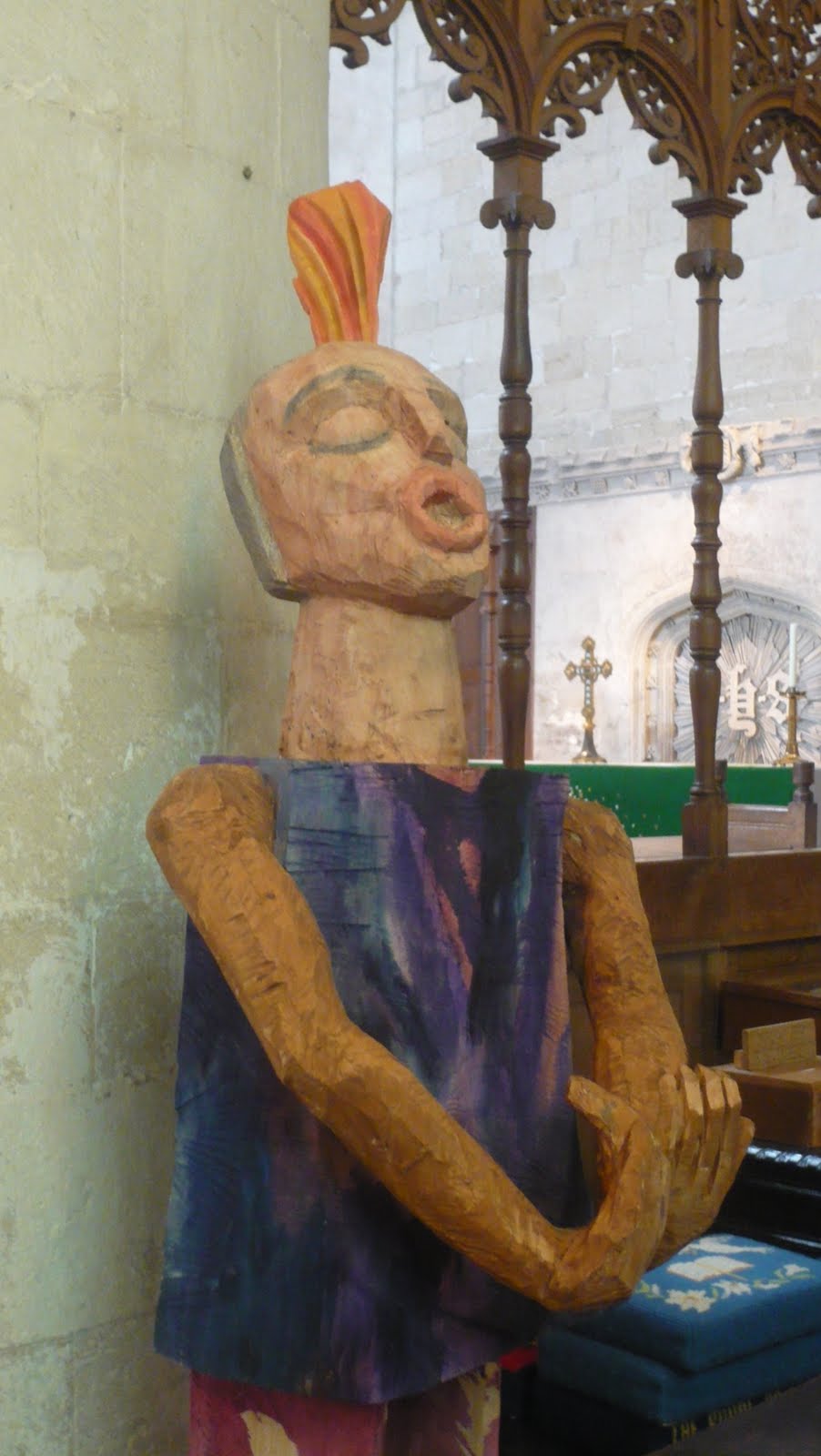


The Acts of the Apostles by Ulrich Lindow is currently at Malmesbury Abbey. Sculptor Ulrich Lindow works in northern Germany near Malmesbury's twin town of Niebüll. His The Acts of the Apostles installation is "a dramatic re-enactment of the events narrated in the New Testament." Lindow has imagined a red glow from the tongues of flame reflected in the colouration of the rough hewn faces of his disciples.
---------------------------------------------------------------------------------------------
Bill Mason Band - Stand Up And Be Counted.
Subscribe to:
Posts (Atom)