Wikio - Top Blogs - Religion and belief
Showing posts with label freedom. Show all posts

Sunday, 19 November 2023

Resources and responsibilities

Here's the sermon that I shared at St Nicholas Laindon this morning: 

How do we respond when the boss is away? That was the scenario for several of the parables that Jesus told, including one of the best known; the Parable of the Talents (Matthew 25. 14 - 30). In this story responsibilities are delegated to three workers, two of whom shoulder their responsibilities and develop the business so that it grows. The third, however, is so paralysed by the responsibility and the possibility of failure that he does nothing with the responsibilities that have been entrusted to him and consequently there is no development and no growth. When the boss returns the first two are rewarded and the third is sacked.

Jesus told this and other parables where the boss is absent, in order to prepare his disciples for his death, resurrection and ascension. He was the one who was going to leave and when he left them, at the point of his Ascension, he was entrusting them with the responsibility of continuing his mission and ministry in his physical absence. It has to be said that this was and is an awesome responsibility and we can readily understand why the third worker was paralysed by fear at the prospect. However, it also shows the value that Jesus saw in his disciples and sees in us. It is amazing but true that God believes in us enough to entrust us with working towards the coming of his kingdom, on earth as in heaven.

Like the third worker in the Parable of the Talents we often shy away from responsibility, although we don’t actually have that choice. Peter Rollins reminds us that ‘the famous philosopher Jean-Paul Sartre once wrote that we are “condemned to freedom”.’ For Sartre, he says, ‘this meant that we are responsible beings. However we are not merely responsible for the decisions we make ... we are also responsible for the decisions we postpone or fail to act on.’

‘This means that we are not only responsible for what we do, but also for what we don’t do. Like a poker player in the middle of a tournament, even doing nothing is an act that will help decide the direction of the game. In this way we are constantly wagering on our existence. Every move, and every failure to move, closes down an infinite range of possible worlds while opening up an entirely new range.’

The choice for Sartre ‘was not between taking responsibility or not, but rather between acknowledging our inherent responsibility or attempting to deny it.’ ‘Instead of the impotent and impossible attempt to flee our freedom Sartre encouraged us to face it, embrace it and make resolute decisions in light of it.’

Jesus’ parables make clear to us the reality of responsibility. The one that we think is in charge and responsible is no longer there which makes us aware of our own responsibility. As Rollins and Sartre suggest we always had that responsibility but our tendency is to avoid or deny it. Our responsibility is huge as the parable suggests that we are responsible for using all that we have for the benefit of the world. If the Boss represents God then his property is the world and we, his workers, are placed in charge of his world and given responsibility for its change and development.

How will we respond to the challenge of Jesus’ parables? In the story, the faithful workers are those that accept this responsibility and act on it. The unfaithful worker is the one who does nothing, who does not act. Are we faithful or unfaithful workers? Are our lives dedicated to working for the benefit of others and our world?

It is important to also note that in the parable we have been given the resources needed for this responsibility. In the parable the Boss gave out resources (the ‘talents’) alongside responsibilities. We have the Holy Spirit which came at Pentecost to empower Jesus’ disciples.

Do we recognise that each of us has much that we can give; that we are all people with talents and possessions however lacking in confidence and means we may sometimes be? We all have something we can offer, so how can we, through our lives and work, benefit and develop the world for which God has given humanity responsibility? What resources - in terms of abilities, job, income and possessions - has God given to us in order to fulfil our responsibility to benefit and develop the world?

Through his Parables, Jesus challenges us as to whether we will be faithful or unfaithful servants? How will we respond? If we accept the responsibility we have been given, we should then pray for quiet courage to match this hour. We did not choose to be born or to live in such an age; but we ask that its problems challenge us, its discoveries exhilarate us, its injustices anger us, its possibilities inspire us and its vigour renew us for the sake of Christ’s kingdom come, on earth as in his heaven. Amen.


----------------------------------------------------------------------------------------------------------------

The Alpha Band - Spark In the Dark (On the Moody Existentialist).

Sunday, 10 September 2023

Forgiveness - the only way to experience healing and peace

Here the sermon I shared at St Mary's Runwell this morning:

The rock band Good Charlotte have a song called The Story of My Old Man. It begins like this:

‘I don’t know too much, too much of my old man.
I know he walked right out the door and we never saw him again.
Last I heard he was at the bar doing himself in.
I know I got that same disease, I guess I got that from him.

This is the story of my old man,
just like his father before him.
I’m telling you do anything you can,
so you don't end up just like them.’

In today’s Gospel reading (Matthew 18: 15-20), Jesus says the church is like a family and he is realistic and recognises that, in a family, brothers (and sisters and parents will fall out). The song was about a real family and in the song, it is the Dad who has broken up the family. In all these situations there is real hurt and when people are in these sorts of situation, they react with anger saying “don’t end up just like them” or treat them “as though they were pagans or tax collectors.” In other words, don’t have anything to do with them because of the hurt they have caused.

Good Charlotte have a second song on this same theme which is called Emotionless:

'Hey Dad, I'm writing to you
not to tell you, that I still hate you
just to ask you how you feel
and how we fell apart, how this fell apart …

I remember the days, you were a hero in my eyes
but those were just a long lost memory of mine
I spent so many years learning how to survive
Now, I'm writing just to let you know that I'm still alive
And sometimes I forgive.
Yeah, this time I’ll admit that I miss you.
I miss you. Hey Dad.'

You see the difference between the two songs? They’re both about the singer’s Old Man. In both he’s been hurt by the things that his Old Man has done. But in the second song, he’s writing to try to restore the relationship, even, at the end, to say that he forgives and misses his Dad. It’s clearly not easy because of the hurt but it’s also very much what he needs to do.

And it’s a similar story in our Gospel reading. Jesus is not giving the disciples these instructions so that they can reject those brothers and sisters in the Church who do something wrong. He is giving these instructions so that these brothers and sisters can be won back; so that the relationship can be restored. When Jesus says treat people like pagans and tax collectors, he doesn’t mean reject them. Matthew was a tax collector. He knew from personal experience how Jesus treated tax collectors and outcasts. He went to their homes, ate meals with them and said that he had not come to call respectable people, but outcasts. He did all he could to restore the relationship and heal the wounds.

And that is also what we see in the parables before and after these instructions. In the parable of the lost sheep, the point is that we do everything possible to find those who are lost and the parable of the unforgiving servant was told to illustrate the point that we should not put limits on forgiveness but forgive again and again, just as God forgives us.

This is not easy. Another songwriter, Leonard Cohen, has said that, “Of all the people who left their names behind, I don’t think there’s a figure of Christ’s moral stature. A man who declared himself to stand among the thieves, the prostitutes, the homeless. His position cannot be comprehended. It is an inhuman generosity … (which) would overthrow the world if it was embraced.”

There is a divine generosity in Jesus which we are called to emulate. We will find it hard to forgive, just as the person in the two Good Charlotte songs found it hard to forgive his Dad. But that is where Jesus wants us to do and that is the point of these instructions that he gave to the disciples. They are about restoring relationships not about rejecting those we think are in the wrong. When we struggle to forgive, struggle to restore, struggle to reconcile then we are coming together in the name of Jesus and he is right there with us.

So, forgiveness takes practice, honesty, open-mindedness and a willingness (even if it is a weary willingness) to try. It isn't easy. Perhaps you have already tried to forgive someone and just couldn't do it. Perhaps you have forgiven and the person did not show remorse or change his or her behaviour or own up to his or her offences – and you find yourself unforgiving all over again. It is perfectly normal to want to hurt back when you have been hurt. But hurting back rarely satisfies. We think it will, but it doesn't. If I slap you after you slap me, it does not lessen the sting I feel on my own face, nor does it diminish my sadness over the fact that you have struck me. Retaliation gives, at best, only momentary respite from our pain. The only way to experience healing and peace is to forgive.

Until we can forgive, we remain locked in our pain and locked out of the possibility of experiencing healing and freedom, locked out of the possibility of being at peace. So, to forgive is not just to be altruistic. It is the best form of self-interest. It is also a process that does not exclude hatred and anger. These emotions are all part of being human. You should never hate yourself for hating others who do terrible things: the depth of your love is shown by the extent of your anger.

When I talk of forgiveness, what I mean is the belief that you can come out the other side a better person. A better person than the one being consumed by anger and hatred. Remaining in that state locks you in a state of victimhood, making you almost dependent on the perpetrator. If you can find it in yourself to forgive then you are no longer chained to the perpetrator. You can move on, and you can even help the perpetrator to become a better person too.

The simple truth is, we all make mistakes, and we all need forgiveness. There is no magic wand we can wave to go back in time and change what has happened or undo the harm that has been done, but we can do everything in our power to set right what has been made wrong. We can endeavour to make sure the harm never happens again.

There are times when all of us have been thoughtless, selfish or cruel. But no act is unforgivable; no person is beyond redemption. Yet, it is not easy to admit one's wrongdoing and ask for forgiveness. "I am sorry" are perhaps the three hardest words to say. We can come up with all manner of justifications to excuse what we have done. When we are willing to let down our defences and look honestly at our actions, we find there is a great freedom in asking for forgiveness and great strength in admitting the wrong. It is how we free ourselves from our past errors. It is how we are able to move forward into our future, unfettered by the mistakes we have made. 

--------------------------------------------------------------------------------------------------------------

Good Charlotte - We Believe.

Sunday, 25 September 2022

Free from lies and enslavements

Here's the reflection I shared this evening at Evensong in St Catherine's Wickford:

In this passage (John 8.31-38,48-59) we are given two definitions of what it means to be free. Jesus gives these two definitions to people who were living under Roman rule and where, therefore, a conquered and oppressed people.

The first definition is about living a life in which we are free from entanglements of lies because we know the truth. An article in ‘Psychology Today’ states that “when it comes to the core challenges of adult life—career, money, sexual identity and marriage—fooling yourself can have devastating consequences.”

The article continues: “In each of these domains—think of them as the four horsemen of self-deception—we face situations that require us to make difficult decisions in the face of doubt and uncertainty. The result is anxiety and a strong temptation to hide from the truth. “People keep secrets from themselves because to acknowledge the information would be extremely anxiety-producing,” says New York City psychiatrist and psychoanalyst Gail Saltz. Self-deception and worry reinforce each other, making it harder and harder to face the facts.”

The way out of this situation is to know and accept the truth about ourselves – “accepting our flaws alongside our strengths” as that “provides a bulwark against excessive self-deception” as also “does coming to peace with our own internal contradictions and learning to withstand difficult feelings, such as doubt and fear.” Acknowledging the truth about ourselves sets us free from anxiety, free to leave in peace with ourselves.

Jesus spoke this truth to people who were living a lie. The people say to him: “We are descendants of Abraham and have never been slaves to anyone. What do you mean by saying, ‘You will be made free’?” Yet, they are people living under the rule of an invading power – the Roman Empire - so are not free. Jesus’ challenge to know the truth about themselves and be set free through that knowledge is, therefore, particularly pertinent to them. In what ways are we also hiding from the truth about ourselves?

The second definition is to do with sin. Jesus identifies sin here with enslavement; in other words, some other power or force that controls us. Such a power could be external, as with the occupying Roman Empire, or it could be internal, as with the kind of lies about ourselves we have been considering which come to define who we are and how we act. The Bible speaks about love of money and various kinds of addictions in those terms and uses the idea of idolatry to describe such forces or powers that come to control us and compromising the freedom that we find in God.

Jesus says that our primary identity, within which we are free from the control of others, is that of being a child of God. When other forces or powers control us, then our identity as God’s child is compromised and we experience separation from both God and the freedom that we find in God’s presence. In what ways do we experience enslavement in our lives? What are the factors or forces that control our behaviours and actions? 

Jesus is saying that when we know and affirm and make central to life our identity as a child of God, then self-deception and other internal or external controls fall away and we are free to become the people we were created by God to be. Fully realising that freedom involves a lifelong journey which reaches its culmination in heaven when we are finally and fully free to be the people we are in God’s presence and to enjoy others for who they are. In the challenges he poses to us through today’s Gospel reading, we are called to begin that process of self-discovery that is also God-discovery by seeking to free ourselves from lies and enslavements by inhabiting our true identity as children of God.

---------------------------------------------------------------------------------------------------------

Friday, 4 March 2022

Beginning tomorrow: Fields of Vision - A Human Atlas Projection


5, 6, 7 March (18:00 – 20:00)

Fields of Vision is an immersive exterior projection created by Marcus Lyon in collaboration with St Martin-in-the-Fields. The work, covering the whole church façade, explores concepts of freedom, service and community in our modern world through oral histories, large scale portraits and ancestral DNA mapping, with music by Brian Eno. The piece weaves together the narratives of 28 extraordinary individuals from across the globe, chosen by their own communities, to tell a deeper story of our interdependence and the extraordinary power of collaboration.

Marcus Lyon says: 'We create our Human Atlas projects to inspire new generations to see the power of social change – each large-scale portrait, inspirational oral history and DNA map allows the audience to witness the extraordinary vision of those who answer the call to serve our communities across the globe.'

30-minute shows from 18:00 – 20:00 in the St Martin-in-the-Fields Courtyard. Start times 18:00, 18:40 and 19:20. Admission Free.

Sacred Space and Fields of Vision

On Sunday 6 March, Sacred Space will be held in the courtyard from 7.10pm and will incorporate the 30 minute Fields of Vision projection installation by Marcus Lyon. There will be a liturgy created to top and tail the viewing of the projection.


See my preview piece on Fields of Vision for Artlyst and my Artlyst interview with Marcus Lyon which can be viewed here. See also my survey of art at St Martin-in-the-Fields here.

----------------------------------------------------------------------------------------------------------

Brian Eno - Prophecy Theme.

Wednesday, 22 July 2020

Freedom in our time

Tonight I led the Bread for the World service for St Martin-in-the-Fields with young people from St Mary's Cathedral, Johannesburg. This week's theme was 'Freedom in our time'. View the service at https://www.facebook.com/stmartininthefields/videos/280675573241382.

We had planned to host a Youth Pilgrimage in Holy Week and Easter this year, with young people coming from the Cathedral of St Mary the Virgin in Johannesburg. The Pilgrimage has had to be postponed but the young people remain in contact with us contributing to our service on Pentecost Sunday and now to tonight’s Bread for the World.

The young people of St Mary’s Cathedral chose tonight’s theme of "Freedom in our time". They brought us our Bible reading, reflections, a poem, some of our music, and the wonderings for our Listening Groups after the service.

Plans for the Youth Pilgrimage represent a significant development in our partnership with the Cathedral presenting an opportunity to support the development of future leaders of the Cathedral’s community. The Pilgrimage will, we hope and pray, have a significant impact on the personal and spiritual development of the young people and, through them, on the mission and ministry of the Cathedral. We hope our plans can go ahead next year, possibly in Holy Week and at Easter.

In the meantime we have the opportunity to learn from the young people at the Cathedral as they share their thoughts and reflections on freedom in our time. Their longing to see justice, freedom and love in their society and their generation is truly inspiring.

Reports of my visit to Johannesburg to meet the young people can be found here.

---------------------------------------------------------------------------------------------------------

The Soweto Gospel Choir - Ingoma.

Sunday, 7 July 2019

Maciej Hoffman: Be Free For Art


Maciej Hoffman was born in Wroclaw, Poland. In his third year at the Theological Academy in Wroclaw, his craving for philosophy was no longer as powerful as the vocation to become an artist. In 1988 Hoffman enrolled in the Academy of Fine Arts, having graduated with a dual diploma in sculpture and painting. Hoffman went on to pursue a career in advertising and marketing. In 2003 he began exploring web art and became passionate for it. 

Today Hoffman has returned to exhibiting his artwork. His existential and expressionist work is concerned with the trauma of all individuals and peoples who have suffered - and continue to suffer - worldwide. Hoffman ‘views his art as both a means of self-expression and a way of engaging in public discourse, depicting contrasts, emotions and powerful human experiences.’ He has said that the subjects which interest him are those ‘issues that puzzle us throughout the years, forming our way of looking at the world, changing us.’ Maciej is a Polish Jew. He has frequently organised and contributed to inter-faith exhibitions/events. For more, see www.maciej-hoffman.com.

He says:

'Our creativity, instead of being used to create more freedom, is used to build a more perfect and "magnificent" system of control and manipulation.

The space for what is irrational, imperfect or disordered becomes increasingly narrow. The room for trials and mistakes, for searching and for research, for listening to others and observing what happens around is gone.

Being inquisitive, asking questions is no longer valued in the world of simple and ready-to-go manifestations. Freedom is leaving us, step by step.

What is free of supervision, beyond statistics and classification, is the only real margin of freedom we can exercise – that is creation, that is art.'

Maciej Hoffman paints huge expressionist canvases depicting scenes of trauma. His paintings depict the distress caused through conflict and he seeks to use his art to generate discussion among people of all faiths and none about the causes of conflict. Hoffman has said that the subjects which interest him are those "issues that puzzle us throughout the years, forming our way of looking at the world, changing us."

There is great freedom and improvisation in his gestural brushstrokes overlaid with flecks and drips of paint creating the sensation that the artist has almost physically attacked the canvas, yet concept and composition also clearly underpin his expressionism. The images which emerge from this maelstrom of paint, although often founded in the darkness of existential angst, also exhibit a dynamism and energy which moves towards freedom. 

Be Free for Art: Maciej Hoffman, 9th - 27th July 2019, Willesden Gallery.

-----------------------------------------------------------------------------------------------

Leonard Cohen - Amen.

Saturday, 24 June 2017

Les Colombes artist Michael Pendry in Artlyst interview


Les Colombes: The White Doves, an Art for Peace Project by Michael Pendry is at St Martin-in-the-Fields until Monday 3 July.

Michael is a multimedia artist, who was born in Stuttgart in 1974, draws on his experience as a stage designer in the theatrical installations he regularly creates for cultural institutions. Having created installations for an increasing number of churches and having stated that he is driven by a desire to get through to those people for whom visiting cultural facilities is rather unusual, I took the opportunity provided by the installation of his ‘Les Colombes – The White Doves’ at St Martin-in-the-Fields, to explore these motivations more fully with the artist in an interview which has been published by Artlyst.

In the interview I note that ‘Les Colombes’ has become an installation which is touring the world – installed in Munich and Jerusalem prior to London and travelling on to San Francisco and Berlin. Michael thinks ‘Les Colombes’ “is easy to understand, has a simple and, most of all, a very emotional message which is so relevant in our times... the doves in their unity stand for such a fundamental human right. The time has come to announce and to stand up for this – for the right to peace and freedom! May the flock of doves grow, from place to place, from country to country, and across all borders.”'

-------------------------------------------------------------------------------------------

PLastic Ono Band - Give Peace A Chance.

Monday, 19 October 2015

Freedom of expression and freedom of religion

The Theos Annual Lecture 2015 was given tonight by Baroness O’Neill of Bengarve at The Honourable Society of the Inner Temple.

Entitled freedom of expression and freedom of religion, Baroness O'Neill explored the reasons we can give for taking our rights to rights to freedom of expression and to freedom of religion and belief seriously, for interpreting them in specific ways but not in other ways; for institutionalising them in some ways but not in other ways.

Along the way, she noted evidence that they are not respected as being 'all too plain in the persistence of intolerance and intimidation, of outright censorship and religious persecution of those of other faiths, and in the criminalisation of apostasy in some states.'

The lecture can be read by clicking here.

---------------------------------------------------------------------------------------------------

Wham - Freedom.

Saturday, 18 April 2015

ArtWay meditation: 'Word' by Maciej Hoffman

In my latest meditation for ArtWay I reflect on 'Word' by Maciej Hoffman where 'we can see many connections between breath, inspiration and words':

'Inspiration is free just as breathing is free. Such freedom is vital as, when breathing becomes constrained, death quickly follows. Hoffman believes deeply in artistic creation as the one real margin of freedom we can use.'

My other ArtWay meditations include work by Marian Bohusz-Szyszko, Christopher Clack, Marlene Dumas, Antoni Gaudi, Maurice Novarina, John Piper, and Henry Shelton.

--------------------------------------------------------------------------------------------------

Sufjan Stevens - The Only Thing.

Thursday, 2 April 2015

Metaphysical symbol of purity and spiritual transformation

ArtMoorHouse is a creative space in a Norman Foster building at the heart of the City of London which provides the setting for a successful synergy between Art and Business.

Their current show is by Maria Ines Aguirre and is entitled The Element of Freedom. The element in question is water which is described as follows:

'Water is the carrier of nature, the pulse of life. Water changes itself info as many natures as the different places throng which it runs. Water does not resist, it flows, always going to where it wants to, so, in the end, nothing can resist it.

Metaphysical symbol of purity and spiritual transformation, water is the allegory of a new founded freedom; a freedom which is gained independently through the the ability to adapt to changing of the circumstances, whilst always remaining true to ourselves.'

Aguirre's work stands out for its colour, energy and spontaneity. Her fascination with the connections between music and colour led her to become the first visual artist in residence at Steinway & Sons, London, where she transformed a Steinway Model D concert grand piano into 'Dancing Soul'.

Pierre Restany wrote the following about Aguirre's work: 'We have become too intellectual in our ways of perceiving things. The dominance of rational thought over activities based on feeling prevents us from understanding the fullest dimension of any concept... For Mia, emotion is colour and colour is the virtual expression of emotions.'

-------------------------------------------------------------------------------------------

Joni Mitchell - Hejira.

Monday, 29 December 2014

Maciej Hoffman: be free for art


Maciej Hoffman's exhibition for the Limmud Conference 2014 is at the Mead Gallery Warwick until Thursday 1st January 2015.

Maciej writes that 'some achievements of mankind are simultaneously defeats of humanism: sophisticated life-penetrating systems, which can reduce us to be just filled forms in some mysterious registers; special tests and scales for measurement and classification of our intellect and emotions. Our creativity is being used for construction of more perfect and “magnificent” systems of control. The space for what is irrational, imperfect or disordered becomes increasingly narrow.

Freedom leaves us step by step.

What is free of supervision, what is beyond of statistics and classifications, what is the only one real margin of freedom we can use – that’s the creation, that is art.'

------------------------------------------------------------------------------------

Ritchie Havens - Freedom.

Sunday, 16 February 2014

The love we give away is the love we keep

“God so loved the world that he gave his one and only Son, that whoever believes in him shall not perish but have eternal life.” (John 3. 16)

“God so loved that he gave ...”

There is a saying that: “Love grows by giving. The love we give away is the only love we keep. The only way to retain love is to give it away.” (Elbert Hubbard)

“God so loved that he gave his one and only Son ....”

There is another saying that, “If you love someone, set them free. If they come back they’re yours; if they don’t they never were.”

In terms of romantic, parental and community love, this is saying that love isn’t owned and cannot be taken - it can only be given. So if we love someone, we have to give that person the freedom to choose for his or herself. That means letting go of our control over them. At times, this means that those we love leave us and ultimately, of course, it means we have to let those we love go into death.

We see love involving letting go and setting free most obviously in parents giving their children space and time in which to grow and make their own decisions. It is a risky business; parents don’t know how the choices their children make will turn out in the long run and so they have to battle against the tendency to control, in order that they can genuinely love their children by letting them go and grow into independence.

Sacrificial love is deeper still. God gave his one and only Son - not in order that his Son would benefit personally from this act of giving but that, through the loving sacrifice of his Son’s life, all peoples everywhere can be saved. This is the ultimate in giving love away.

Yet, through this sacrificial giving away by God the Father, all things are returned to him. Jesus’ death brings all people back to God and his resurrection returns Jesus himself to God. The Christian story therefore promises that, “The love we give away is the love we keep.”

-------------------------------------------------------------------------------

Bob Dylan - Is Your Love In Vain?

Sunday, 27 October 2013

The Year of Jubilee

When we have a General or Local Election I wonder whether you read the manifesto’s of the candidates that you are able to vote for. I guess that most of us don’t. Often they are quite wordy and many people don’t believe a word that is written in them.

The political parties know this, as is demonstrated by this quote from a post entitled Why manifestos still matter (even if nobody reads them) from Labour List:

“Given the amount of time and effort that goes into producing election manifestos, the number of people who actually read them is frighteningly small. Every campaign, parties make determined efforts to get them onto shelves but their sales hardly threaten JK Rowling or even the authors of well-known political diaries (still available in all good book shops) ….

But for the millions of voters who decide the election outcome … well for the overwhelming majority, life’s too short.”

The passage that Jesus read in the synagogue at Nazareth (Luke 4. 16 - 24) was the manifesto for his ministry and for the kingdom of God. We would do well not to ignore this manifesto because what Jesus spoke about here he actually did in the course of his ministry. He did exactly what it says on the tin, as the advert goes. 

Jesus’ manifesto was taken from Isaiah 61 and is all about release. Release from poverty, imprisonment, blindness and oppression. What Jesus is proclaiming would have been recognised by his hearers as the announcement of the Year of Jubilee – “the time when the Lord shall come to save his people.”

The word ‘jubilee’ stems from the Hebrew word ‘Yobel’, which refers to the ram or ram’s horn with which jubilee years were proclaimed. In Leviticus it states that such a horn or trumpet is to be blown on the tenth day of the seventh month after the lapse of ‘seven Sabbaths of years’ (49 years) as a proclamation of liberty throughout the land of the tribes of Israel. The year of jubilee was a consecrated year of ‘Sabbath-rest’ and liberty. During this year all debts were cancelled, lands were restored to their original owners and family members were restored to one another.

The people listening to Jesus knew about Jubilee but had never heard anything like his statement before. What Jesus was saying and how he was saying it was astonishing. They had heard teachers talk of the law before but this was something so amazing that they were in awe. Jesus was in another league because he claimed to be the fulfilment of Isaiah’s prophecy in Isaiah 61:1–2.

Jesus stated that he had come to ‘proclaim freedom for the prisoners and recovery of sight to the blind, to set the oppressed free, to proclaim the year of the Lord’s favour’ (Luke 4:18–19). That is the year of jubilee and so Jesus proclaimed his coming and the coming of God’s kingdom as the time of Jubilee – a time of release for all people from those things that enslave us and trap us.

Each one of us is a slave to sin and blind to the truth about God because we have chosen to live selfish lives turning our backs on God and the way of life that he had created for human beings to live. In turning away from God’s ways we do not do away with gods altogether instead our desires run riot and we become slaves to them worshipping other gods; whether they come in the form of money, sex, celebrity or whatever.

Jesus comes to free us from all of these enslavements and to open our eyes to the way in which God created human beings to live; loving God with all our being and loving our neighbours as ourselves.

This isn’t something that is just for us as individuals however. It is also something which can impact all of society. After all, the Old Testament Jubilee was intended for the nation of Israel, not simply individuals within it. A contemporary example of this happening in practice is the Jubilee Debt Campaign, which is part of a global movement demanding freedom from the slavery of unjust debts and a new financial system that puts people first. Inspired by the ancient concept of ‘jubilee’, the Jubilee Debt Campaign works for a world where debt is no longer used as a form of power by which the rich exploit the poor. Freedom from debt slavery is a necessary step towards a world in which our common resources are used to realise equality, justice and human dignity. It is particularly important that we think about such things at the end of One World Week where people from diverse backgrounds have been coming together to learn about global justice, to spread that learning and to use it to take action for justice locally and globally.

We can see from all this that, in order to understand what our release means, we need to be people who know and understand the Bible. Chapter 4 of Luke’s gospel shows us clearly that Jesus was immersed in the Hebrew scriptures and saw them as speaking about himself. When he was tempted by the Devil at the beginning of Chapter 4 he defended himself by quoting from the Bible. In that passage he used the Bible to tell the Devil what he will not be like and here, in the synagogue, he used the Bible to tell everyone what he will be like. We can do the same if we read and understand what God is saying to us in the Bible both about those things from which our lives need to be freed and those things to which we need to dedicate our lives, talents and time.     

The people who heard Jesus were, initially, impressed by what he said but as they realised that Jesus intended this Jubilee to be for all people they rejected him and tried to kill him. What will our response to Jesus’ manifesto be? Will it be the rejection that he experienced from the people of Nazareth? Will it be the apathy and disbelief that we accord to most political manifestos? Will it be the cynicism or distrust that some feel towards events like One World Week? Or will it be acceptance of the release from slavery to sin that Jesus offers to us and involvement in his work of releasing others from sin and from debt?

------------------------------------------------------------------------------------------------------
 
U2 - Beautiful Day. 

Wednesday, 24 April 2013

Fear, fallibility and faith in Mumford and Sons

I’ve been reading ‘The Incredible Rise of Mumford & Sons’ by Chloé Govan which is interesting primarily because of the perspective from which she writes about the influence of Christian faith and upbringing on the band.
I’ve posted before about the way in which Biblical references in song lyrics are often either overlooked or misinterpreted because of misunderstandings about Christianity itself (see, for example, here and here). Govan does not fall into the first trap in that she correctly identifies many of the Biblical/Christian references in the songs of Mumford & Sons but she does use commonly held misconceptions of the Christian faith which then affect her interpretations of the faith as it explored or expressed in these songs.
In addition, she also makes the commonly held but naive assumption that first person lyrics are directly autobiographical and confessional. It was this assumption that rightly annoyed Bob Dylan when journalists wrote as though they knew him by means of his songs and I can easily imagine Marcus Mumford, if he had read this biography (which he probably has not), feeling similar annoyance at someone presuming to know his personal spiritual journey through her interpretation of his lyrics.
The key misconception of Christianity as explored and expressed in these songs which Govan holds is that following God involves the surrender of free will and individuality while true freedom involves the full expression of personal choice. She therefore equates belief with submission and non-belief with freedom and, as a result, interprets all references to freedom within these lyrics in terms of this framework. Religion is a set of rules providing a comfort blanket for the immature, while maturity is seen in the assertion of an independent self.
Govan’s use of this equation is particularly evident in her analysis of ‘Roll Away Your Stone’ which she reads as a dialogue between Mumford and God in which Marcus expresses his frustration at God’s control over him. While clearly structured as a conversation, ‘Roll Away Your Stone’ does not actually identify who is being addressed as ‘you’ within the song, so Govan’s suggestion that the ‘you’ being addressed is God is an assumption rather than a statement. The song begins with the protagonist suggesting that both he and his conversation partner lift the lid on their souls, although the protagonist is wary of doing so fearing the demons within. The conversation develops by means of the response that grace is not about the efforts we make but the welcome we receive when we turn to God. On this basis, the protagonist then says that he will give up his desires and mark this moment at which his soul has become passionate for God. Having arrived at this confident assertion of faith backed by the intensity of the musical arrangement, the song then ends on a note of ambiguous prevarication.
There certainly are tensions explored in these songs in relation to the demands and challenges of faith but the polarity around which these revolve is not submission versus freedom so much as fear versus faith. The protagonist in ‘Roll Away Your Stone’ is afraid firstly of the demons within and secondly of the demands which faith may bring. This is the debate that the protagonist seems that have within himself in ‘Little Lion Man’ i.e. the extent to which he does or does not have the courage of his convictions.
All this is set out in the title track and opening song of the first album, which thereby sets both the ground that the album explores and the tone in which it does so. ‘Sigh No More’ begins with confident assertions of faith then moves into acknowledgement of human fallibility and prevarication summed up in the phrase that “Man is giddy thing” before asserting that love (i.e. God’s love) does not enslave but is freeing, enabling those who know it to become the people they were meant to be. The song ends with a prayer to see the beauty which will come when the protagonist’s heart is truly aligned with God’s love. Throughout the album the overriding concern is that personal fallibilities and fears – the darkness within – will prevent grace from having its full effect and the beauty of alignment with love from being fully realised.

Govan's discussion of the Christian faith of Mumford's parents is primarily drawn from press cuttings and her understanding of their story and beliefs is undercut by factual inaccuracies which include Sandy Millar as a female minister and the muddling of the Exodus with Herod's killing of the firstborn at Bethlehem, so that Moses is described as leading people out of the grip of evil people like Herod into glory. 

Among the undeniable flaws of the evangelical sect to which Mumford's parents belong (i.e. the Vineyard Churches) which Govan cites are the response of the Roman Catholic Church to Galileo in the 1600s and Archbishop Ussher's 17th century chronology of the history of the world. While the Vineyard Churches can, no doubt, be criticised on all kinds of levels they had nothing to do with either of these episodes in Church history which have been brought into the picture because they are supposedly conclusive proof that Christianity as a whole is opposed to science. 

Govan's discussion is, therefore, typical of the misunderstandings and misconceptions which plague contemporary discussion of Christianity and which lead many to dismiss the faith without ever actually engaging with its beliefs and practices. Govan's discussion of Christianity has significance as it flags up the size of the task (in part, self-induced) which faces the Church today, while those looking for an accessible and more nuanced review of the actual historical record in relation to the historical incidents cited by Govan could perhaps read 6 Modern Myths about Christianity & Western Civilisation by Philip Sampson.

------------------------------------------------------------------------------

Mumford & Sons - Sigh No More.

Saturday, 2 March 2013

Ross Ashmore: Cataloguing the mundane


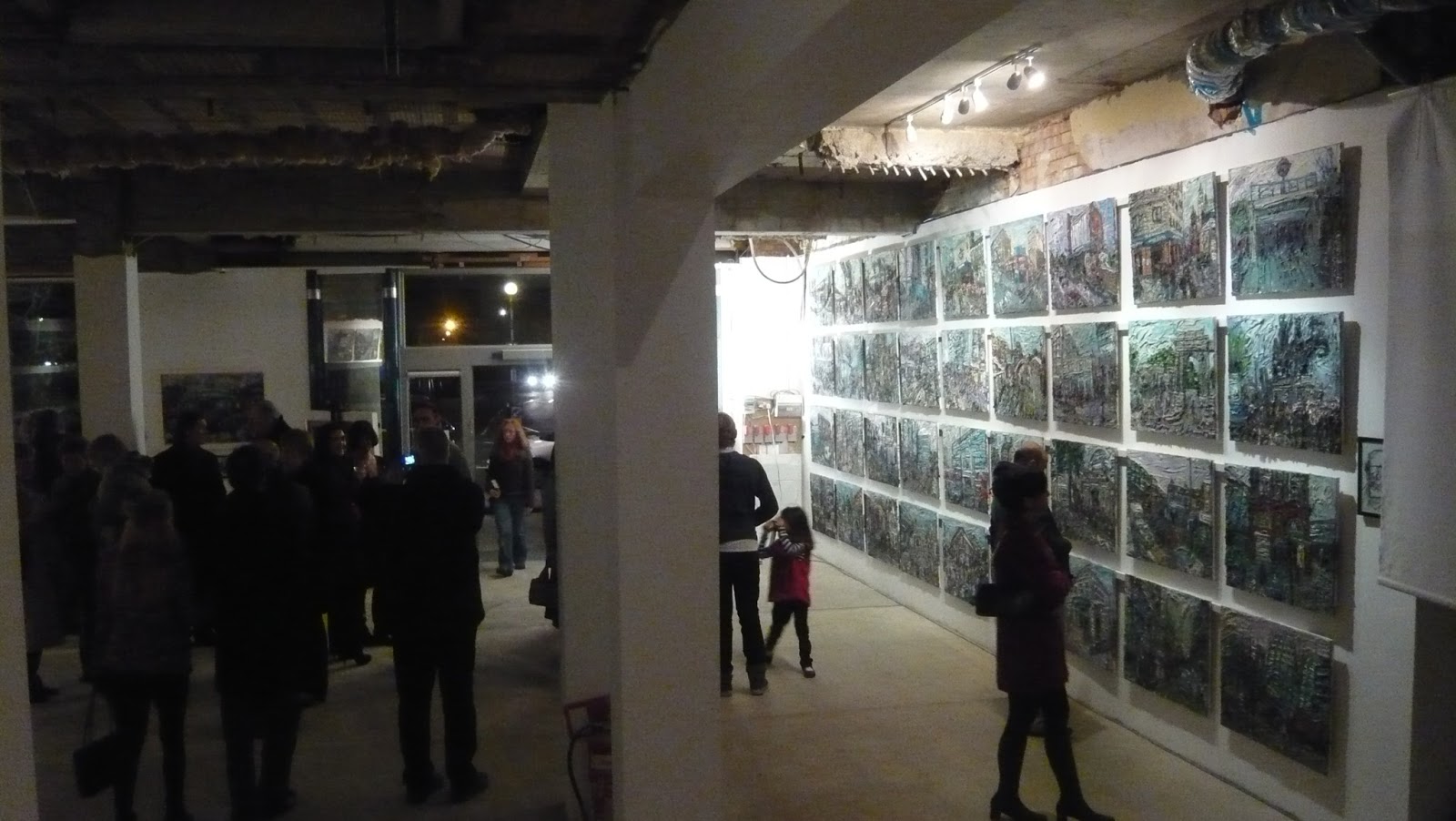
Ross Ashmore has embarked on an ambitious task of painting all the London Transport Underground Stations- of which there are 267. “I realise for me this has to do with my commercial past. I was always under pressure to deliver on time, except this time I had created my own brief and deadline.” To coincide with this year's 150th Anniversary of London Underground, he will finally complete all the paintings, of all the stations, this summer. “I love the Underground. I love the concept of going below ground and resurfacing somewhere else."

“I believe that art is a powerful form of expression. That an artist should be honest, passionate and have conviction about his work – much at odds with the commercial world I had come from and today's obsession with perfection. I didn't want to be chocolate box. The gesture of painting, the process, is just as important to me as the image. Every painting is an action – making the mark in paint creates energy and conveys emotion – it creates the mood – it begins to take on a life of it's own. I love the physicality of painting. Many artists today are so obsessed with perfection and technique they don't look like paintings at all.”

“The mass produced commercial world is so concerned with perfection – 'everything was airbrushed out!' In contrast I began to appreciate being different, embracing individuality – freedom of expression. This view is what drives and inspires me today. It's the ordinary things in life, the mundane that I want to catalogue in my work. With all the relentless change, very soon, we may forget the way things were.”

Ross Ashmore: Going Underground is at SPACE art gallery (141 High St, Southgate N14 6BP) until 5 April. Open: Mon-Fri 17:30-19:30, Sat and Sun 12:00-16:00.

-------------------------------------------------------------------------------------


Thursday, 21 February 2013

A quest for spiritual freedom


My latest exhibition review will be in tomorrow's Church Times:

"Our arts coverage features a Polish painter, Maciej Hoffman, engaged in a quest for spiritual freedom, having experienced the ups and downs of communism and capitalism and found them wanting."

--------------------------------------------------------------------------------

Lloyd Cole and the Commotions - Are You Ready To Be Heartbroken?

Sunday, 20 May 2012

Manifesto for release

When we have a General or Local Election I wonder whether you read the manifesto’s of the candidates that you are able to vote for. I guess that most of us don’t. Often they are quite wordy and many people don’t believe a word that is written in them.

The passage that Jesus read in the synagogue at Nazareth was his manifesto for his ministry and for the kingdom of God (Luke 4. 14 - 21). We would do well not to ignore this manifesto because what Jesus spoke about here he actually did in the course of his ministry. He did exactly what it says on the tin, as the advert goes.

Jesus’ manifesto is all about release. Release from poverty, imprisonment, blindness and oppression. What Jesus is proclaiming would have been recognised by his hearers as the announcement of the Year of Jubilee – “the time when the Lord shall come to save his people.”

In the Old Testament Law the year of Jubilee came every 50 years and in this year property reverted to its original owners, debts were remitted, and Hebrews who had been enslaved for debt were released. Jesus is proclaiming his coming and the coming of God’s kingdom as the time of Jubilee – a time of release for all people from those things that enslave us and trap us.

Each one of us is a slave to sin and blind to the truth about God because we have chosen to live selfish lives turning our backs on God and the way of life that he had created for human beings to live. In turning away from God’s ways we do not do away with gods altogether instead our desires run riot and we become slaves to them worshipping other gods; whether they come in the form of money, sex, celebrity or whatever.

Jesus comes to free us from all of these enslavements and to open our eyes to the way in which God created human beings to live; loving God with all our being and loving our neighbours as ourselves.

In order to understand what our release means we need to be people who know and understand the Bible. Chapter 4 of Luke’s gospel shows us clearly that Jesus was immersed in the Hebrew scriptures and saw them as speaking about himself. When he was tempted by the Devil at the beginning of Chapter 4 he defends himself by quoting from the Bible. In that passage he is using the Bible to tell the Devil what he will not be like and here, in the synagogue, he uses the Bible to tell everyone what he will be like. We can do the same if we read and understand what God is saying to us in the Bible both about those things from which our lives need to be freed and those things to which we need to dedicate our lives, talents and time.     

The people who heard Jesus were, initially, impressed by what he said but as they realised that Jesus intended this Jubilee to be for all people they rejected him and tried to kill him. What will our response to Jesus’ manifesto be? Will it be the rejection that he experienced from the people of Nazareth? Will it be the apathy and disbelief that we accord to most political manifestos? Or will it be acceptance of the release from slavery to sin that Jesus offers to us?

-------------------------------------------------------------------------------------------------

T. Bone Burnett - The Murder Weapon.

Saturday, 26 November 2011

Free us, Lord, from our addictions

This was my assembly on addiction, given yesterday as chaplain of Venus College at St Edward's Church of England School and Sixth Form College:

Think of something that you really like and that makes you feel good. It can be anything you like; something you do, something you watch or listen to, something you eat, someone you like to be with.

Now think about the feeling that you get and how it makes you feel.

Imagine not simply enjoying that feeling but beginning to crave it; so that, rather than being something great when you happen to experience it, you start to want to have that same feeling more and more frequently.

Imagine now that you begin wake up craving that feeling so that you have to satisfy your craving that day.

Imagine that the craving is so strong that you will lie, steal, cheat, hurt, and maybe even kill to ensure you get that feeling that day.

What began as something good has become something ugly. What began as something you were free to enjoy has become something which controls everything about you. What began as something that enhanced your life has begun to destroy it.

That is how addiction works. We are most familiar with talk of addiction in terms of alcohol, drugs or smoking but we can actually become addicted to all sorts of things and addiction has taken hold when we can no longer cope without the thing to which we have become addicted. 

Earlier in the week I watched an interview with the shock rocker Alice Cooper; someone who has had a well-publicized battle with addiction, often consuming an entire bottle of whiskey each day. He has said, “Nobody ever sees the alcoholism coming. It’s one of those things that broadsides you. There’s never a place where the drug or the alcohol says, oh, by the way, it’s time to stop now. It just keeps going until your body tells you, ‘If you don’t stop you’re going to die.’ I never met anybody who was an alcoholic or a drug addict that ever walked out of it going, ‘Yeah, what a good idea that was.’ For me it was never a great idea.’”


Cooper has said that divine intervention is what broke his drinking habit in the mid-1980s. "I honestly think I was simply and completely healed. I guess you can call it a miracle. It's the only way I can explain it. It was absolutely eliminated from my life." He once told the Sunday Times, "Drinking beer is easy. Trashing your hotel room is easy. But being a Christian, that's a tough call."


So how can Christianity help when it comes to addiction. First, the Bible commends moderation to us. “Moderation is better than muscle, self-control better than political power.” (Proverbs 16. 32) We need to be clear that the Bible doesn’t try to ban the good things in life, but does say don’t allow those things to control by becoming addictions. The way to do that is to enjoy things in moderation. The second thing it encourages us to do is to put God first. “Do not get drunk with wine, which will only ruin you; instead, be filled with the Spirit.” (Ephesians 5. 18) If we put God at the centre of our lives then everything else will find its proper place and won’t be addictive or controlling.


So, with those thoughts in mind, let us pray:


Lord Jesus, You said, "I have come to set the captives free." We are captive and need Your healing touch. Free us, Lord, from our addictions, so that we will be:
... free from the cares and worries that stifle our happiness;
... free from sins that cling to us, and to which we cling;
... free from all compulsive behaviour that prevents us from becoming what You, Lord, have planned for us.

Bring us, loving Saviour, to the experience of abundant life which You promised. Amen.


---------------------------------------------------------------------------------

Alice Cooper - Poison.

Thursday, 25 August 2011

Radical Compassion


This autumn the Educational Programme series at St Martin-in-the-Fields looks particularly interesting both because of the topic and speakers chosen.

Radical Compassion: The Gospel and Social Justice seeks to examine the radical implications of Christ’s life and transforming compassion in relation to issues of social justice. What is Christ saying to the poor, marginalised, and the struggles of our time? Can we rediscover a theology of liberation for today?

The lectures will take place in St Martin-in-the-Fields Church from 7.00pm – 8.30pm. They are free and no booking is required. There will be a retiring collection to cover some of the costs of the programme.

Monday 19 September: The Revd Professor Nicholas Sagovsky: Compassion and Justice - Professor Nicholas Sagovsky’s experiences in advocacy and justice for refugees and asylum seekers as a member of both the Independent Asylum Commission and the Churches Refugee Network provide the basis for his discussion of the Gospel in relation to issues of social justice.

Monday 3 October: Revd Clare Herbert: Compassion and Protest - As an ‘out’ lesbian priest and active campaigner on behalf of gay and lesbian Christians, Revd Clare Herbert has plenty of experience in fighting for what she believes in.  This lecture will explore the ways she has come to terms with needing to express both protest and compassion.

Monday 17 October: Neil MacGregor: Compassion and Art - In this lecture the Director of the British Museum uses images to help us enter more profoundly into our understanding of the radical compassion of Christ captured in some of our greatest art treasures, whilst asking the question: Can these works of art speak to our present and deepen our own compassion and humanity?

Monday 31 October: Nicola Slee: Compassion and Empowerment - As a poet and theologian who has looked extensively into the relationship between women and spirituality, Nicola’s lecture will address how the radical compassion shown throughout the gospel can lead to female empowerment.
  
Wednesday 16 November: Terry Eagleton: Compassion and Power - Widely regarded as Britain’s most influential literary theorist, Terry Eagleton will consider the contemporary relevance of the Gospel’s critique of power and the use of violence, drawing on themes discussed in his 2010 Richard Price Memorial Lecture ‘The New Atheism and the War on Terror’.

Monday 20 February: Dr Robert Beckford: Compassion and Freedom - Dr Robert Beckford is one of the most prolific black documentary presenters in Britain and will use his knowledge of racial tension to discuss Christ’s radical compassion in relation to freedom.
-------------------------------------------------------------------------------

Marvin Gaye - Save The Children.

Tuesday, 30 June 2009

God's Hazard

God’s Hazard, Nicholas Mosley, Dalkey Archive Press, 2009 (ISBN 978-1-56478-540-4)

A writer named Adam is writing a reinterpretation of the Genesis creation stories but his tale becomes intertwined with the story of his daughter and her friends leaving school and travelling to the conflict zones of the contemporary world. Myth becomes combined with history in the making and the reader is challenged to resolve questions of creation, responsibility and parenting.

Adam writes of God’s hazard being in setting his children free but then faces a hazard of his own as his daughter makes her way in the world. But who is actually hazarding what and who is telling whose story? Adam seems to write God’s story and that of his daughter Sophie but his own story is also being told and who is doing the telling? What choices, freedom and responsibility do each actually have?

Mosley’s novel places us, as readers, in the centre of these questions and gives us the responsibility for mediating between “God’s efforts to care for humans while leaving them free” and “humans’ rediscovery of their true need for God through darkness and disaster.” It may seem as though Mosley is seeking to tie us up in knots but it may also be that what he has written is a love-knot that “both binds and leaves you free.”

Accordingly and rightly, earlier reviewers have noted that everything in Mosley’s realm is double-edged and multidimensional and that his novels are both abstract and realistic. In a similar vein Mark C. Taylor has written of the way in which “some of the most creative contemporary painters and architects are seeking a third way that falls between abstraction and figuration.” In their work, “torn figures mark the trace of something else, something other that almost emerges in the crack of faulty images.” This other, he writes, “is neither being nor nonbeing, fullness nor void, immanent nor transcendent.” Taylor calls this “genealogy of otherness and difference based on the principle of creative juxtaposition”, altarity.

Nicholas Mosley is therefore the novelist, par excellence, of altarity and God’s Hazard, his latest effort at the truth of a Christian faith in free will.

--------------------------------------------------------------------------------------

Switchfoot - Dare You To Move.