Wikio - Top Blogs - Religion and belief
Showing posts with label ateliers d'arte sacre. Show all posts

Saturday, 13 February 2021

Sabbatical Art Pilgrimage: Denis Chapel, Saint-Germain-en-Laye


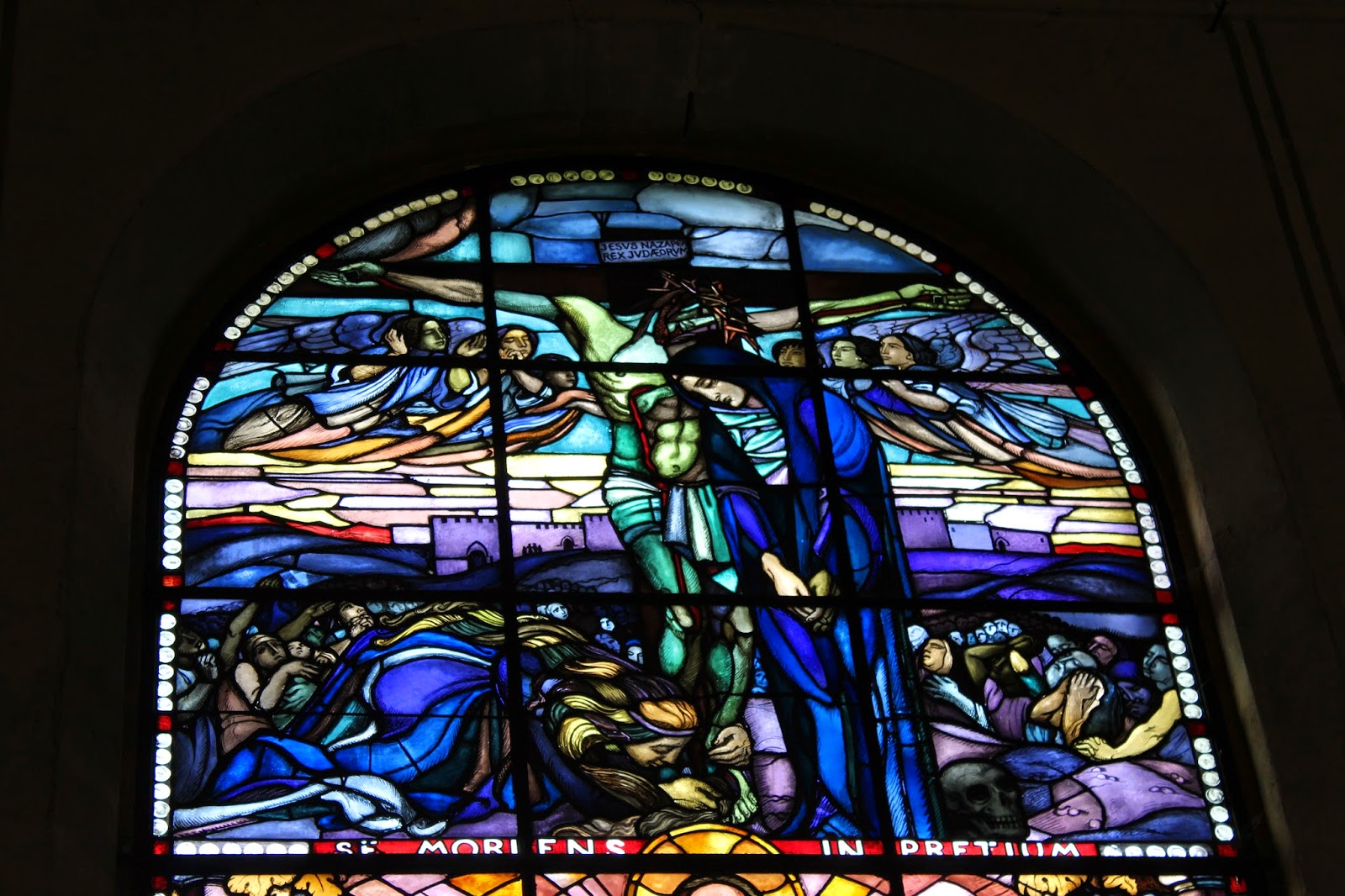
The Musee Maurice Denis is a museum dedicated to the work of Denis, the Symbolists and Nabis artists and their time. Once the home of the painter, the museum was opened to the public in 1980. Since then the collection has been further enriched and helps to form an understanding of the origins of modern art. Denis restored and decorated a chapel in the building which can also be seen and which represents a bringing together of his work with the Ateliers d'Arte Sacre.

-----------------------------------------------------------------------------------------------------------

Florence and the Machine - Cosmic Love.

Saturday, 11 October 2014

Sabbatical art pilgrimage: Report - Part 2


Commissions can be categorized as follows:

·         single commissions;
·         series of commissions over a different time-frame;
·         series of commissions in the same time-frame; and
·         programme of temporary commissions.

Issues to be addressed within such commissions include:

(i)                  Harmonisation versus dialogue/dissonance

This relates to commissions in settings where there is existing artwork/architecture and concerns the extent to which the new commission is integrated with whatever is already there or by being dissonant raises questions about what is already there. Artworks integrated within the life and architecture of a church are not viewed in the same way as works within the white cube of a gallery space and this needs to be understood and handled with sensitivity during the commissioning process. The result can be a sense of overall integrity and harmony within a space which holds great variety and diversity. Where this occurs the whole and its constituent parts image something of the Trinitarian belief – the one and the many - which is at the heart of Christianity.

Harmonisation is used most frequently with single commissions or a series of commissions over a different time-frame. At St Alban Romford Fr. Roderick Hingley has created links of colour, shape, texture and symbol that have led to the integration of commissions into a re-ordered space which enhances worship and is also aesthetically pleasing. At Chelmsford Cathedral former Dean, Peter Judd, used this approach when he commissioned Cazalet’s engraved St Cedd window in St Cedd’s Chapel as a counter-balance to John Hutton’s engraved St Peter window in St Peter’s Chapel. St Paul’s Goodmayes provides another example of this approach.

In other situations churches such as Metz Cathedral or Sint Aldegondis Deurle seem to have commissioned work without an overall scheme or plan for harmonization, yet do not appear to have become incoherent spaces. In many Belgian churches contemporary art is integrated with the artwork of the past in a melange of different styles which, while not specifically harmonised, nevertheless possesses integrity. It must be a great encouragement to contemporary artists to see churches, already rich in heritage, wishing to continue to develop and add to that tradition from the work of their own day and time.

Expressionist images of the crucifixion introduced a sense of dialogue or dissonance by challenging sentimental images of Christ and deliberately introducing ugliness into beautiful buildings. Dissonance most often occurs in relation to temporary commissions, such as that at St Paul’s Cathedral. The interventions there fulfil the key requirement of installation art; “a friction with its context that resists organisational pressure and instead exerts its own terms of engagement.”

(ii)                Curatorial vision versus artistic vision

Artworks commissioned for churches by necessity function as an element within a broader architectural, aesthetic and liturgical scheme and, for some artists, this sense that the art and the artist's vision is subordinate to a bigger, broader vision can be a part of the reason why church commissions are unattractive and unpursued.

At St Mary & All Angels Little Walsingham a note from the Director of Art in Churches says that the artworks commissioned there have been carefully placed to distinguish them from liturgical artefacts also in the church. He wants them to be seen as ‘works of art’ in a way that differs from the liturgical artefacts and enriches the areas of our spiritual being which extend beyond 'the confines of the spiritual liturgical.' This note illustrates a strand of thinking which sees art and artists as independent of though complementary to the Church, as opposed to the thinking in the Liturgical Movement, where art is the handmaid of the liturgy. Both have value, while both also raise issues for debate and discussion. Justine Grace, in The Spirit of Collaboration, writes of church commissions being perceived in modernism as being ‘ruled by the dogmatic prescriptions of the church rather than the artistic imagination’. At the same time, the example provided at Notre-Dame de Toute Grâce du Plateau d'Assy, where contemporary ‘masters’ were explicitly commissioned by Pére Marie-Alain Couturier, is, as noted by William S. Rubin, in some instances, of artists unfamiliar with the liturgy translating the subjects chosen into ‘purely personal philosophies’ (Modern Sacred Art and the Church of Assy, Columbia University Press, New York & London, 1961).

Notre-Dame de Toute Grâce on the Plateau d’Assy was planned as showcase for the value of contemporary church commissions. Couturier took on the primary role of curator but, as most of the commissions included were on the basis of his friendships with the artists involved, his decisions he made or did not make illustrate the tricky balance required to succeed in commissioning.

Too much work was commissioned for Assy from too many artists making the resulting iconographic scheme muddled and esoteric. There are inappropriate clashes of style (e.g. the Jacques Lipchitz sculpture dominating the Rouault windows or different styles in each of the nave windows), inappropriate positioning of some works (e.g. stained glass by Bazaine and reliefs by Chagall which can barely be seen), commissions which do not work in the space (e.g. the intimiste style of Bonnard is not suited to being viewed from a distance) and central commissions with esoteric symbolism (e.g. the Lurçat tapestry).

Couturier, presumably to sustain his friendships with the artists involved, seems not to have exercised sufficient control regarding the overall scheme which therefore means that the whole is not greater than the sum of its parts. By contrast, Sutherland had to fight for aspects of his vision for the tapestry at Coventry Cathedral and needed the support of Spence in order to do so in the face of requests for change from Cathedral staff.

The architecture and artworks at a church like the Church of the Annunciation Little Walsingham illustrates what can be achieved when using artists who are either involved with the ‘alternative’ world of church decoration or who are not generally reckoned to be contemporary ‘masters’

(iii)              Treasure casket versus integrated design

Spence described Coventry Cathedral as a plain jewel casket filled with many jewels. In other words the building is architecturally plain - essentially a white rectangle - with the aim that this simplicity and minimalism will show off the artworks to best effect and that the significance and impact of these works will bring the building to life as a place of worship.

Spence was “the co-ordinator of the whole operation of commissioning artists and craftsmen with the skills to create a variety of elements, including glass, congenially juxtaposed and working together as a whole.” “Spence believed that the architect, as leader of the team, should collaborate at the earliest possible stage with his engineers and artists. With the art in progress there was also a reduced risk of it being lost in any subsequent budget cut. He was therefore careful to commission work from the outset. Artists were sought to suit each project and the artist’s freedom was maintained.”

The desire to preserve is at its strongest, however, when a church is built as a complete, integrated artistic and architectural unit in a particular style, whether Neo-Gothic/Pre-Raphaelite, as at St Michael & All Angels Waterford, or Modernist, as with Le Corbusier’s churches at Ronchamp and La Tourette. With such churches the desire to preserve is at its greatest, meaning, in the most extreme circumstances, that no development or new commissions are permissible because to do so would detract from the original designs. For many of the art sacré Churches which I visited in France this also means that they are designated as historic monuments. This guarantees their preservation while, possibly, denying their development.

The need for input/oversight from some kind of wider preservation body (e.g. the Diocesan Advisory Committee in Anglican settings) is demonstrated by the issues raised at St Peter’s Gorleston-on-Sea where for some time individuals were able to make significant changes to Gill’s original design based primarily on personal taste or preference.

The rejection of Harry Clarke’s design for St Michael and All Angels, on the grounds that the design was out of keeping with the Pre-Raphaelite windows already in the church, provides an interesting example of the complexity of issues and pressures found in such settings which has the potential for turning down work that could add considerably to the setting. The debate which preceded the work by Renzo Piano on the site of Ronchamp may well be another example of this syndrome; one which had a positive resolution. One possible solution to these dilemmas, which has been used at La Tourette, is that of commissioning temporary works that then relate in some way to the original design of the church or its artworks.

(iv)               Team versus individual stars

Couturier criticized the Ateliers d'Art Sacre as a 'world closed in on itself, where reciprocal indulgence, or else mutual admiration, quickly becomes the ransom paid to work as a team and maintain friendship.' Yet Couturier's scheme of work at Assy suffers from the opposite problem, as work by individual masters produced in isolation from each other, with work assigned on the basis of what they could with integrity contribute, results in a decorative scheme with no cohesiveness or focus.

Couturier, here, fails to be sufficiently decisive as a curator. As William S. Rubin states, 'the subject was almost as often picked for the man as the man for the subject.' It is the difference between a cohesive team of mediocre talents versus a team of individual stars. It is anyone's guess as to which will win. The ideal is usually part-way between the two and a mixed economy (of artists with significant mainstream reputations receiving occasional commissions plus artists with less significant mainstream reputations receiving commissions which form a significant part of their practice) is what we find throughout this period and into the present day.

Artists in the latter group have often worked together on commissions or to obtain commissions i.e. using broker/support organisations such as: ASP, Ateliers d'Arte Sacré, Christian Artists, commission4mission, Guild of Catholic Artists and Craftsmen, Guild of St Joseph & St Dominic, Societie de Saint Luc et St Maurice, and Society of Catholic Artists.

Commissioning several works from the same artists and positioning these at different locations within a church indicates an awareness of the differing ways in which visitors and worshippers use and respond to the space. Artworks integrated within the life and architecture of a church are not viewed in the same way as works within the white cube of a gallery space and this needs to be understood and handled with sensitivity during the commissioning process. The number and variety of commissions which feature within Chelmsford Cathedral, for example, mean that even in a packed service when each worshipper will only see from their specific place within the space a very small proportion of the artworks within the building, they will, nevertheless, be able to view something of significance and depth to enhance their experience of worship.

(v)                 Current masters versus national, regional or local artists

Couturier and Pie-Raymond Régamey argued that "each generation must appeal to the masters of living art, and today those masters come first from secular art." Hussey wrote that it had been the great enthusiasm of his life and work” to commission the very best artist’s he could.

In Contemporary Art in British Churches Paul Bayley sets up a dichotomy (as did Couturier and Régamey) between the significant contemporary artists participating in the upsurge of commissioning from the church (initiated by Hussey) and "self-styled 'Christian art' that though sincere and well-intentioned" is "often formulaic or decorative" and (tellingly) has "little or no standing within the art world." Alan Green gives a theological underpinning to this approach by pointing out that "Jesus was not afraid to associate with, and be looked after by, those who were not seen as good Jews ... Those who approached Jesus and seem to have got the best responses from him were not the religious elite, but those with no particular religious standing who nevertheless recognised something special in him and presented themselves honestly."

However the mainstream art movements of the day will not necessarily share a natural affinity with the Church (particularly when the Church is seen as a part of what is to be subverted) and, if the focus of the Church is on engaging key mainstream artists, then less attention may be paid to supporting emerging artists with a Christian faith able to engage effectively with the mainstream art world.

In addition, fashions and reputations in the art world (as elsewhere) change considerably with time. In their own day and time Pablo Picasso and Matisse were considered unassailable as the giants of twentieth century art while now, in terms of continuing influence on contemporary artists, Marcel Duchamp is generally considered to be the most influential twentieth century artist. Lurçat’s tapestry provides the central focus for the Church at Assy, where those artists commissioned were considered current masters, but his reputation has not been sustained into the current day.

The reputations of many of those who were commissioned by the Church in the twentieth century (e.g. Bazaine, Denis, Albert Gleizes, Lurcat, Manessier, Sutherland, Piper, Rouault, Severini) have declined following their deaths. The same is likely to be so for those receiving contemporary commissions (i.e. Clarke, Cox, Emin, Le Brun, Wisniewski). The pace with which modern art moved from one movement to next in the twentieth century quickly and, often unfairly, condemned as passé what had previously been avant garde.

The Church cannot, and probably should not, seek to keep up with the fickle nature of fashion and instead should value both artists with significant mainstream reputations wishing to receive occasional commissions plus artists with less significant mainstream reputations who receive commissions which form a more significant part of their practice. In my view, therefore, debates about artists with significant mainstream reputations versus those without and between secular artists and artists who are Christians represent false division and unnecessary debate. The reality is that both have happened simultaneously in the story of modern church commissions and both have resulted in successes and failures. As I shall attempt to outline in discussing the quality of commissions, the key is to pay sustained and prayerful attention to each and every artwork in order to discern what is good and of God in and through it. 

(vi)               Permanent vs temporary

Artists may, consciously or unconsciously, value permanent commissions (with churches providing one significant public context for such commissions) once they have established their reputation with a view to sustaining that reputation into an uncertain future. Permanent church commissions offer a means to escape the vagaries of the art market. However as Christianity is not currently viewed as trendy or fashionable in the West, it is seen as rarely benefitting an emerging artist to secure a church commission.

Permanent commissions raise issues of maintenance such the effect on its stained glass of building subsidence at Canterbury Cathedral or the ongoing maintenance programme for Kossowski’s ceramics at Aylesford Priory. Their cost can therefore be more than the purchase price.

The development of the idea and practice of installation art from the 1960s onwards has meant that it is no longer necessary to think of church commissions solely in terms of permanent commissions. This change in thinking has meant that St Paul’s Cathedral, rather than attempting the tricky negotiations which would be entailed by seeking to add to its existing permanent array of art (from the delicate carvings of Grinling Gibbons in the quire to Sir James Thornhill's dome murals, as well as the Victorian mosaics and Henry Moore's Mother and Child: Hood), can instead explore the encounter between art and faith through a series of temporary interventions by artists, which have included Rebecca Horn, Yoko Ono, Antony Gormley and Bill Viola.

These interventions enrich both the daily pattern of worship in the Cathedral and the experience of the thousands who visit daily. Their temporary nature offers something new even for those that are regular worshippers at St Pauls, while the contrast that they provide with the existing art and permanent architecture of the Cathedral means that they also fulfil the key requirement of installation art; “a friction with its context that resists organisational pressure and instead exerts its own terms of engagement.”

----------------------------------------------------------------------------------------

Saturday, 16 August 2014

Sabbatical art pilgrimage: Notre-Dame de Toute Grâce du Plateau d'Assy


William S. Rubin writes in ‘Modern Sacred Art and the Church of Assy’ (Columbia University Press, New York & London, 1961) that, 'In August 1950, the Dominican-inspired church of Notre-Damede Toute Grâce at Assy was consecrated amid great jubilation and even greater hope that it represented the commencement of a "Renaissance" of sacred art. The appearance there of religious works which, in power and purity, recalled those of the great ages of faith, certainly seemed symptomatic of a genuine religious revival.’

Yet, as my sabbatical art pilgrimage has been demonstrating, a renaissance of sacred art had been underway from the beginning of the century. The decoration of St. Paul Grange-Canal in Geneva by Maurice Denis, Alexandre Cingria and others in 1913 – 1915 had served as a manifesto for this renaissance and led on to the founding in 1919 of the Ateliers d’Art Sacré by Denis and Georges Desvallières as well the Group of St Luke and St Maurice by François Baud, Cingria, Marcel Feuillat, Marcel Poncet and Georges de Traz. Both groups produced significant work for a significant number of churches in subsequent years.

In 1935 the Group of St Luke secured the decoration of the new church of Notre-Dame-des-Alpes Le Fayet in the French Alps by means a tender process assessed by a panel which included the philosopher Jacques Maritain, the Catholic art critic Maurice Brillant and the director of the Ecole des Beaux Arts in Geneva Adrien Bovy. The process and the resulting work was therefore set up to be a showcase for the renaissance of sacred art in France and Switzerland during the first half of the twentieth century in which Denis, Maritain and Cingria had played key roles. It was this stage of the revival that was challenged by the commissions for Notre-Dame-de-Toute-Grâce.

Rubin continues, ‘For the first time in centuries, great artists had directed their efforts towards church art. Bonnard, Chagall, Léger, Lipchitz, Lurçat, Matisse, and Rouault had all contributed significantly.’ The Dominican Friars Marie-Alain Couturier and Pie-Raymond Régamey had argued in the journal ‘L’Art sacré’ that they edited that ‘each generation must appeal to the masters of living art, and today those masters come first from secular art.’ Couturier worked with the parish priest at Assy, Canon Jean Devémy, to commission those modern masters who contributed work to the church of Assy.

Interestingly, Couturier himself and the commissions at Assy had begun within the earlier phase of the renaissance of sacred art. On the basis of his work at Le Fayet, Devémy selected Maurice Novarina as architect. Novarina used his regional style at Assy with a chalet-style pitched roof and locally sourced materials. The chalet style is intimate and warm while the wooden carved beams suggest a Nordic hall. The interior is dark, as a result, but this tends to sets off the work well. While appropriate to Alpine setting in terms of aesthetics and practicalities, Novarina was not, at this stage of his career, working in the modernist style first exemplified by Alberto Sartoris’ design for the church at Lourtier and subsequently further developed by Le Corbusier at Ronchamp, La Tourette and Firminiy. Couturier had trained at the Ateliers d’Art Sacré and had worked on schemes of stained glass with artists at the Atelier and others, such as the L’Arche artists. Several of these artists, included Couturier himself, received commissions for the nave windows. Rubin comments that this was Couturier allocating some commissions to the ‘family’ of artists ‘active in modernist circles of Church decoration before the war’ before he then moved on to ‘the more radical aspect of the decorative plan for Assy.’

This ‘radical aspect’ of Couturier’s plan was to prove deeply controversial as commissioning modern ‘masters … from secular art’ meant that ‘Side by side with works of the pious Catholic Rouault one saw those of Jews, atheists, and even Communists - a revolutionary situation that struck the keynote of a new evangelical spirit ...’ As a result: ‘Even before its dedication in 1950, the church had become the center of an increasingly bitter dispute which was to cause a marked rupture between the liberal and conservative wings of the clergy and laity during the following years. The violent polemics on both sides involved not only the French Church, but also the Vatican, usually through the voice of the Congregation of the Holy Office. As its destiny was linked to the fortunes of the entire liberal religious movement in France, the Church at Assy and its decorations were vehemently attacked and defended by an army of critics, most of whom had seen only a few photographs of the works in question.'

The polemic against the Assy commissions was centered on the crucifix created by Germaine Richier but this was used as a focus for a wide-ranging attack by traditionalists on the desire of French Dominicans for a Christianity that was engaged with the secular world. As a result, they argued that priests should not live in ‘Christian ghettos’ but should join with the citizenry ‘to establish a new, spiritually inspired system of social justice’ - the worker-priest movement – and, with artists, to preach a ‘new gospel of sacred art’ that could help these artists come to ‘Christian awareness.’ These initiatives were representative of ‘a new evangelical spirit’ which was concerned with contextualized mission.

Richier’s bronze crucifix resembles ‘craggy and weathered wood’ in its surface and the undefined figure has a cruciform shape, the combination conveying a ‘tortured and sacrificial appearance.’ It is a stunning image of the effect which suffering has on human beings by reducing a person to mere flesh and bone. Couturier related the image to the ‘root out of dry ground’ of Isaiah 53. Richier’s crucifix therefore connects with the strand in modern sacred art, exemplified by Albert Servaes and Graham Sutherland, which viewed Christ’s sacrifice as emblematic of human suffering in conflict and persecution. Works in this vein were often controversial as they challenged sentimental images of Christ and deliberately introduced ugliness into beautiful buildings. The crucifix was described by those who opposed its inclusion in the church as a caricature of a crucifix in which it was no longer possible to ‘recognise the adorable humanity of Christ’ making it ‘an insult to the majesty of God’ and ‘a scandal for the piety of the faithful.’

Servaes and Richier were both affected by decrees from the holy office and saw their artworks removed from the churches for which they had been commissioned. The instruction on sacred art issued by the Sacred Congregation of the Holy Office in 1952 was the beginning of two year iniatiatve by the Vatican which severely constrained the modernizing programme of the French Dominicans and represented a victory for the traditionalists within the Church.

Richier’s crucifix has, though, subsequently been returned to its place in the sanctuary at Assy and the church, like many other art sacré churches, is classed by the French Government as a national monument becoming a significant tourist location – the secular state recognizing the value of sacred commissions. As a similar level of acceptance and understanding has also evolved in relation to other controversial commissions, including those by Servaes and Sutherland, it would seem that scandals of modern church commissions, whether the reception of the works themselves or that of their challenging content, are, with time, resolved as congregations and communities live with the works and learn to value the challenge of what initially seemed to be scandalous.

Notre-Dame de Toute Grâce was planned as a showcase for the value of contemporary church commissions with Couturier taking on the primary role of curator but, as most of the commissions included were on the basis of his friendships with the artists involved, the decisions he made or did not make illustrate the tricky balance required to succeed in commissioning. Couturier criticized the Ateliers d'Art Sacré for being a 'world closed in on itself, where reciprocal indulgence, or else mutual admiration, quickly becomes the ransom paid to work as a team and maintain friendship.' Yet Couturier's scheme of work at Assy suffers from the opposite problem, as work by individual masters produced in isolation from each other, with work assigned on the basis of what they could with integrity contribute, results in a decorative scheme with no cohesiveness or focus. Couturier, here, fails to be sufficiently decisive as a curator. As Rubin states, 'the subject was almost as often picked for the man as the man for the subject.'

Too much work was commissioned for Assy from too many artists making the resulting iconographic scheme muddled and esoteric. There are inappropriate clashes of style (e.g. the Lipchitz sculpture dominating the Rouault windows or the different styles used in each of the nave windows), inappropriate positioning of some works (e.g. stained glass by Bazaine and reliefs by Chagall which can barely be seen), commissions which do not work in the space (e.g. the intimiste style of Bonnard is not suited to being viewed from a distance) and central commissions with esoteric symbolism (e.g. the Lurçat tapestry). Couturier, presumably to sustain his friendships with the artists involved, seems not to have exercised sufficient control regarding the overall scheme which therefore means that the whole is not greater than the sum of its parts.

The overall lesson of Assy would seem to be that simplicity is of the essence. The most effective works are those which are simplest, clearest and most pared back i.e. the work by Léger, Matisse, Richier and Rouault. The Rouault windows, in particular, are luminous, effective translations of his paintings into stained glass combining beauty and sorrow. The floral windows seem a strange choice initially but function as memento mori. Chagall created a wonderful 'Exodus' mural on ceramic tiles which was an inspired choice for the baptistery. He depicts a crucifixion in the top right hand corner; the act of Exodus for Christians which is symbolised by baptism. Although he was uncertain about undertaking this first commission for a church, his work here shows clearly the suitability of his vision and practice for churches and led to many subsequent commissions.

The Lurçat tapestry, by contrast, seems particularly ineffective both in itself and as a central focus. Its imagery is undeniably personal and esoteric. It provides visual focus through its size but, although intended as an apocalyptic evocation of the conflict between good and evil, fails to convey menace or threat. The beast seems funny and friendly in a way which could suit it to a walk on part in Teletubbies or In the Night Garden, while the female figure that opposes it is a non-entity as a realized, dynamic creation. The work of Adam Kossowski at St Benet Mile End and St Mary Leyland provide much stronger examples of apocalyptic imagery put to devotional rather than esoteric use. That said, Lurçat’s work is by no means fundamentally unsuited to an ecclesiastical context as his vibrant ‘Creation’ tapestry for the Chapel at Bishop Otter College ably demonstrates.

The artists Couturier commissioned were his friends but the work of his friends was not always suited to this particular sacred environment and scheme as some were clearly working outside their comfort zones and were not able to solve the inherent issues either of engaging with the space i.e. Bonnard’s intimiste style lost in the space and Lurçat’s esoteric apocalyptic imagery.

As noted earlier, Couturier and Régamey argued that "each generation must appeal to the masters of living art, and today those masters come first from secular art." However fashions and reputations in the art world (as elsewhere) change considerably with time. In their own day and time Pablo Picasso and Matisse were considered unassailable as the giants of twentieth century art while now, in terms of continuing influence on contemporary artists, Marcel Duchamp is generally considered to be the most influential twentieth century artist. Lurçat’s tapestry provides the central focus for the Church at Assy, where those artists commissioned were considered current masters, but his reputation has not been sustained into the current day, and the same is also true of Lipchitz.

The reputations of many of those who were commissioned by the Church in the twentieth century (e.g. Bazaine, Denis, Gleizes, Lurcat, Manessier, Sutherland, Piper, Rouault, Severini) have declined following their deaths. The same is likely to be so for those receiving contemporary commissions (i.e. Clarke, Cox, Emin, Le Brun, Wisniewski). The pace with which modern art moved from one movement to next in the twentieth century quickly and, often unfairly, condemned as passé what had previously been avant garde.

The Church cannot, and probably should not, seek to keep up with the fickle nature of fashion and instead should value both those artists with significant mainstream reputations wishing to receive occasional commissions and artists with less significant mainstream reputations who receive commissions which form a more significant part of their practice. In practice, that combination is what we find at Assy and it also there in the contrast between the commissioning practices at Assy and Le Fayet.

As a result, in my view, setting up dichotomies between artists with significant mainstream reputations versus those without and between secular artists and artists who are Christians represents an unnecessary division often advocated on the basis of subjective quality criteria. The reality is that both have happened simultaneously in the story of modern and contemporary church commissions and both have resulted in successes and failures. What is warranted and rewarded is sustained and prayerful attention to each and every artwork in order to discern what is good and of God in and through it.

----------------------------------------------------------------------------

Young Disciples - As We Come To Be.

Monday, 4 August 2014

Sabbatical art pilgrimage: Notre-Dame du Bon Conseil Lourtier


A chapel set on a mountainous site, ‘with a campanile that is slim, tall,rounded in plan and rendered, distinct from the main body of the church’; it has been suggested that this could be a description of Notre Dame du Haut in Ronchamp, the chapel famously built by Le Corbusier in 1954. Instead, this is a description of Notre-Dame du Bon Conseil at Lourtier in Switzerland built by the Italian architect Alberto Sartoris in 1932.

Dennis Sharp writes: ‘Born in Turin, Sartoris trained as an architect in Switzerland and became one of the leading theorists and writers of the Modern Movement. Sartoris was the man who put the word “functionalist” into the architectural vocabulary …

"Our” movement in this context means the modern tendency started by the group of architects under Le Corbusier. The Functionalist Group was officially founded at La Sarraz in 1928 and called CIAM (Congrés Internationaux d’Architecture Moderne) …

Alberto Sartoris was Le Corbusier’s choice as the Italian representative to CIAM.’


Prior to Maurice Novarina’s Church of Notre-Dame de Toute Grâce du Plateau d'Assy and more radical in design, this was the first modern church in an Alpine setting. As a young architect, Sartoris agreed to rebuild, for a modest sum, the original church which had been destroyed by fire. He had the support of the villagers and the clergy but, once consecrated, his design was attacked in the Gazette de Lausanne under the title of ‘The scandal Lourtier’.

This attack on Sartoris’ design would have been because of the factors which Thomas Muirhead has identified as characterizing his work: ‘Sartoris believed that modernist architecture must be based on a renunciation of useless and superfluous elements, a respect for true tradition, an harmonious distribution of line and colour, a rhythmical mastery of contrast and assonance, and the investigation of a specific style.’ Accordingly Sartoris’ design for Notre-Dame du Bon Conseil is clean, spare and minimalist. Internally, the church is a simple white rectangle with a sleek arched wooden roof. Both the ceiling’s planks and the grey-painted wooden pews draw the eye to the sanctuary wall containing two large stained glass windows by Albert Gaeng.

The Futurist painter Fillia wrote that Sartoris’ plans for a Cathedral in Fribourg showed the direction that modern sacred architecture should take. His description of these plans as ‘a play of volumes that define an absolutely original rhythm and achieve a result of constructive severity that is of the greatest significance’ could equally apply to Sartoris’ achievement at Lourtier. Fillia and Sartoris collaborated on publications to do with futurism and architecture. In one such article, published in November 1932, Fillia gave notice that Sartoris had selected one of his ‘religious works to decorate a new Rationalist church he has constructed’. This was a mural based on Fillia’s painting Nativity-Mystical-Motherhood of 1932 which was originally in the sanctuary recess between Gaeng’s two windows. The mural has since been painted over and replaced by a small sculpture.

Between 1928 and 1930 the futurist artist Fillia spent time in Paris with Gino Severini. During this time he also saw Severini's work in the Swiss churches of Semsales and La Roche. The end of 1930 then saw a decisive reorientation of Fillia's work towards sacred art which culminated in 1931 with the publication of the 'Manifesto of Futurist Sacred Art' on the occasion of the International Exhibition of Modern Christian Sacred Art in Padua, which had a Futurist section of twenty two works by thirteen artists.
 
By these means the anti-clerical art of the Futurists inspired a flowering of religious painting that constitutes one of the most unexpected episodes in the history of that movement. Futurism eulogised the beauty of speed and the energies and machines that produced it. Futurists saw themselves as “immersed in the chaos of an old, crumbling era” but “partaking of the vibrations of a new epoch in the process of formation.” They embraced continual progress and viewed Catholic priests as fatally associated with old order hating “the fleeting, the momentary, speed, energy and passion.” Not fertile ground for a flowering of religious art, one would have thought.

Yet Marinetti, the great theorist of Futurism, maintained a significant distinction between Christ and the Catholic Church that led to the explosion of Futurist religious art which appeared in the 1930s. The “precious essence of Christ’s morals,” he argued, “accorded every right, every pardon and every sympathy to the impassioned fervour, to the fickle flame of the heart.”

Marinetti’s ‘Manifesto of Futurist Sacred Art’ appeared in 1931 and further exacerbated the movement’s conflict with the Catholic Church by stating that “only Futurist artists … are able to express clearly … the simultaneous dogmas of the Catholic faith, such as the Holy Trinity, the Immaculate Conception and Christ’s Calvary.” Pope Pius XI responded in a speech of 1932 by saying that ”Our hope, Our ardent wish, Our will can only be … that such art will never be admitted into our churches …”

Marinetti had argued that only Futurists could express the simultaneous dogmas of the Catholic faith because only they had “addressed the complex matter of simultaneity” in their art. 

Accordingly, a key feature of Futurist sacred art is the bringing together within the same picture frame of key events from the life of Christ. The convoluted titles of many of these works, such as Fillia’s 'Madonna and Child / Nativity / Nativity-Death-Eternity', indicate clearly the telescoping of events that can be found in these works. This work sets an semi-abstract/cubist Madonna and Child in front of a sky-filled cross in front of a mountain in front of a rock in front of a globe ringed by the outlines of churches as seen through the ages. Marinetti described this work as “an impressive amalgamation of the concrete and the abstract; a synthesis of the long development of Catholicism through the centuries.”

It is, when set alongside other works by Fillia, an example of a set of identikit symbols – saint, cross, globe, mountain, churches – that several Futurists juggle in works that sit uncomfortably between the later cubism of Gleizes and the surrealism of Giorgio de Chirico. Not all Futurist sacred art is of the poster book style and imagery of Fillia however. Giuseppe Preziosi, for example, also used simultaneity in his Annunciation-Nativity-Death but here the subtler harmonies of his colours combine with the interpenetrating planes of his subjects to integrate Christ’s birth and death within the work.

Gerardo Dottori, known as the ‘mystic’ Futurist, made use of similar techniques to create in his 'Crucifixion' of 1928 one of the genuine masterpieces of Futurist sacred art. His crucified Christ is picked out in a heavenly spotlight which also surrounds the two Mary’s grieving at his feet. Light also emanates from the upper half of Christ’s body and outstretched arms illuminating the darkened sky that has thrown the landscape of Calvary into turmoil. Dottori’s stylistic use of light symbolises both Christ’s obedience to God’s will and the light of salvation that his death brings into a world darkened by sin.

Dottori also makes use of a second key theme in Futurist sacred art; that of flight as a symbol of transcendence. His Annunciation in an Aerial Temple sees Mary literally caught up in her spirit by the news that Gabriel brings (an anticipation of her own Assumption, perhaps) and gives us an angelic perspective on the event. Aeropainting was a major strand of Futurist art and this interest in flight became a symbol firstly of physical liberation from the earth and then of spiritual ascent. The Trinity, the Madonna, as well as the expected Angels, all appear winged and in flight within these works.

One of the most striking of all the flight images is Nino Vatali’s Ascension where Christ ascends on the cross in stop-frame images that build a Jacob’s ladder ascending to the heavens. Whether the imagery of the cross as a ladder from earth to heaven was consciously in Vitali’s mind as he painted or whether he was simply transposing a Futurist technique with a sacred theme, the image and imagery remain powerful.

Only Futurist aeropainters, Marinetti argued, “are able to express in plastic terms the abyssal charm and heavenly transparencies of infinity.” Again, his rhetoric tends to exceed the resulting works but, for all that, their Futurist sacred art forms a fascinating subject that extends our understanding of the influence of sacred themes and imagery in early twentieth century European art even where artists and the Church were conflicted.

Gaeng, by contrast with these artists, was part of the St Luc Group which had been founded by Alexandre Cingria. Sartoris knew Cingria but said in one interview that, when he saw Cingria’s work at St-Martin de Lutry-Paudex, he felt no religious feeling, making the choice of Gaeng, for Lourtier, a surprising one. After completing at the Ecole des Beaux Arts in Geneva he went to Paris to study at the Atelier de l’Art Sacré set up by Maurice Denis and Georges Desvalliéres. After meeting Antoine Bourdelle and Gino Severini, he assisted Severini with the decoration of St Nicholas Semsales. The St Luc Group also contributed to the decoration of Semsales. From 1926 to 1936 Gaeng was almost entirely devoted to the decoration of churches (stained glass, mosaics and frescos) in the cantons of Vaud, Valais, Fribourg and Jura.

Gaeng’s sanctuary windows, which depict St George on the left and St John the Evangelist before the Porta Latina on the right, are dark, dramatic and dense in detail. Coloured lines of force and movement cross rectangles constructed without significant use of lead lines. His later windows from 1956 which depict the Litany of the Blessed Virgin Mary are, by contrast, lighter, brighter and with a futurist energy and aspect. Gaeng then supplements the figurative windows with purely abstract designs that draw on the coloured grids of Mondrian.

Lourtier is to be found among the imposing alpine architecture of snow-capped peaks in the Val de Bagnes, one of Switzerland's largest nature reserves. Opposite Notre-Dame du Bon Conseil is a viewing area with panoramic views looking down the valley, the river falling steeply away under the bridge connecting two halves of the village. Erratic roofs straddle narrow switchback roads surrounded by kush terraced pastures; old traditions and untamed nature living side by side.

I arrived at the end of the afternoon to find the mountain sunshine flooding the empty church; then drove further on and further up to find a hotel so I could return for Mass on Sunday morning. Here, the simplicity of the Mass which impressed itself on me. The liturgy spoke for itself; no incense, no choir, just a priest speaking conversationally to his people and responses from the 70 strong congregation. There is no scandal of Lourtier; instead the triumph of Lourtier is an influential design coupled with a dramatically beautiful building that is well suited to the liturgy and well used by its people.

----------------------------------------------------------------------------------------------

Bill Fay - This World.