Wikio - Top Blogs - Religion and belief
Showing posts with label foster. Show all posts

Wednesday, 29 June 2022

St Martin of Tours, Basildon

St. Martin's of Tours Church in Basildon Town Centre was officially opened on 10th November, 1962 in a consecration service conducted by the Bishop of Chelmsford; Rt. Rev. John Gerhard Tiarks. Its design was the work of local architect Trena M. Cotton. 

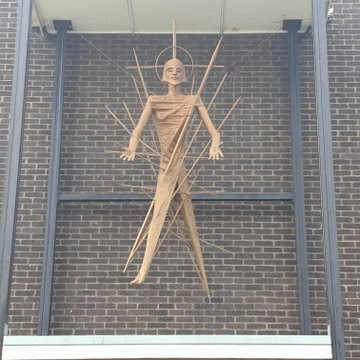
The Church received a royal visitor on October 9th, 1968 when Her Royal Highness The Duchess of Kent (Katharine Windsor) dedicated the new south porch and Christ sculpture. The 10-foot high Christ figure was designed by the artist Thomas Bayliss Huxley-Jones and completed in fibreglass at his studio in Broomfield near Chelmsford, Essex. It was to be his last completed work as a short time later he was admitted to St. John's Hospital in Chelmsford where he died on 10th December 1968. The fibreglass figure is of our Lord pierced by shafts of light with his hands outstretched towards the town in service of the people. It is an invitation of welcome to all to enter.

Huxley-Jones, F.R.B.S., was a Fellow of the Royal Society of British Sculptors and studied at the Wolverhampton School of Art (1924-1929) and from 1929-1933 at the Royal School of Art, South Kensington. For many years he was principal of the school of sculpture at Grays Art School, Aberdeen, Scotland. He was famed for his statue of Helios at BBC Television Centre and the Joy of Life Fountain in Hyde Park. He was married in 1934 to the artist and sculptress (Rose) Gwynneth Cobden Holt and they lived from around 1949 at High House, Broomfield in Essex. His grave, and that of his wife is in St. Mary churchyard at Broomfield.

The work of Huxley-Jones also features elsewhere within the Diocese. His Woman of Samaria is a fibreglass figure at St Peter's Aldborough Hatch, while at Chelmsford Cathedral, Huxley-Jones' work includes a Christus in St Cedd's Chapel, a carving of St Peter on the south-east corner of the South Transept and 16 stone carvings representing the history and concerns of Essex, Chelmsford, and the Church.

A Garden of Remembrance adjacent to the church opened on November 3rd, 1973, in a dedication service conducted by Rev. Peter Grimwood. Standing within the garden is a statue depicting St. Martin sharing his cloak with a beggar, which was created by notable sculptor and artist Peter Foster.

In 1989 the plain exterior glass was replaced with stained glass designed and made by Joseph Nuttgens. The North side windows from West to East tell the story of St Martin begining with the Cathedral of Tours then the River Loire and finally the Caves of Marmoutier and a Cross referring to St Martin's suffering. The South side windows East to West depict the Cross and Resurrection, colours and various designs to be found in the town centre and the flood barriers from the nearby river Thames. Finally a triangle an ancient representation of the Holy Trinity, the circle and rays depict an outburst of energy from God, which is love. His presence, open to all, flows as a river down through the Thames Barrier into the hustle and bustle of this modern town.

The magnificent stained glass window in the Lady Chapel by Nuttgens depicts in symbols the Blessed Virgin Mary in heaven. Within the window can be seen the signs of the universe, clouds, sky, stars, the sun and the moon.

Educated by Dominicans and brought up within a milieu of idealistic Catholicism, Nuttgens left to study at the Central School of Art and the Royal College of Art, completing his studies in 1964. He then worked experimentally, firstly with expanded plastics and metal sheet, exhibiting at the Camden Arts Centre, London in 1970; then making ‘light’ sculptures, incorporating steel sheet and coloured glass, transmitting colour from hidden light sources, which were exhibited at the Cochrane Gallery, London, and with AIM, at the CBX, in Milton Keynes, throughout the seventies. During this period he also taught at schools and art colleges and, for nine years, taught prisoners in Wormwood Scrubs Prison. Encouraged by Patrick Reyntiens, he returned to stained glass in 1978, becoming his assistant, working mainly on John Piper’s windows. On the death of his father in 1982 he re-established this studio and, since then, has designed and made stained glass windows for cathedrals, churches and many other venues. Throughout this time he has maintained an output of painting (complimentary and vital to his commissioned work) and, in recent years, has set up a relief print shop within his studio, producing woodcuts and linocuts. 

A freestanding Bell Tower designed by Douglas Galloway RIBO and built in 1999 was opened by Her Majesty the Queen and dedicated by The Rt. Revd. John Perry The Lord Bishop of Chelmsford on Friday 12th March 1999. This special service marked the official opening of the Belltower and the first 50 years of Basildon new town.



--------------------------------------------------------------------------------------------------------------

Robert Levon Been - Mercy Of Man.

Thursday, 9 November 2017

Bloomberg London and St Francis at The Engine Room

Today I've visited two new buildings, both of which make art prominent features of their design. 

Image result for bloomberg london art

Located in the heart of the City of London, Bloomberg's new European headquarters is the first wholly owned and designed Bloomberg building in the world. Designed to facilitate collaboration and fuel innovation, it will bring Bloomberg’s 4,000 London-based employees under one roof for the first time.

The 3.2 acre Bloomberg site encompasses three public plazas, providing new civic space in the heart of the City. Bloomberg Arcade divides the site and returns a lost portion of Watling Street – an important Roman road – back to the city grid. The covered dining arcade features a variety of independent restaurants and serves as a new pedestrian thoroughfare. At each end, it is defined by a major new public artwork by Cristina Iglesias that creates a place of repose among the City’s dense fabric of streets. Art plays a central role in the project, with eight major contemporary commissions in and around the building. Monumental works by Olafur Eliasson, Pae White, and leading British artists also feature in a building designed by Norman Foster.

Designed to complement historic neighbouring structures and to age gracefully with time, the Bloomberg building is the biggest stone project in the City of London for a century. It features 9,600 tonnes of Derbyshire sandstone and blends locally sourced, natural materials with the best of international craftsmanship.

Bloomberg’s new European headquarters is located on one of the UK’s most significant archaeological sites, home to the ancient Temple of Mithras and at the heart of what was Roman London’s commercial centre. London Mithraeum Bloomberg SPACE restores the Temple of Mithras to the site of its discovery. Open to the public and free to enter, Bloomberg SPACE will host a series of contemporary art commissions reflecting broadly on the history of the site, as well as a huge vitrine displaying more than 600 remarkable Roman artefacts found during recent excavations at Bloomberg. The immersive temple reconstruction uses carefully directed lights, haze and sound to bring the temple’s remains to life, and to evoke the rituals and activities that took place within its cave-like walls.


St Francis at the Engine Room is a community centre and the first new Anglican Church to be erected in London in almost 40 years. Spearheaded by the Diocese of London working in partnership with Lee Valley Estates, Newlon Housing Trust and London City Mission. It has been created to put a community resource and place of worship at the heart of the new housing development in the Hale Village. 

The opening of the Engine Room community centre in 2013 was a key step towards creating a dynamic community space for adults, children and families in Hale Village. The vision is to become a catalyst for building community at the heart of the Hale Village by putting a community centre and church at the heart of this new housing development. Everything done through their workers, volunteers and partnerships with other community groups is about investing in local lives. They want to give every resident of the Hale Village daily opportunities to make new friends, to learn from each other, to grow spiritually and to share their lives. Their community workers, Andrew and Martina Kwapong and local volunteers are using their knowledge and expertise to draw people in, make them feel they belong and unlock their potential for giving back to others. In September 2014, they were joined by The Revd. Andrew Williams, an experienced parish priest who is leading St Francis church. Last year, hundreds of local residents benefited from a wide range of fun and creative activities run by the Engine Room and St Francis church.

Graeme Mortimer Evelyn has created a permanent contemporary altarpiece (Reredos) The Eternal Engine for St Francis at The Engine Room. This hand carved, painted relief sculpture is approximately 5 metres x 3 metres in scale and is be one of the largest permanent contemporary sculpture works ever installed within a sacred space in the UK. It also represents the second Church of England altarpiece commission the artist has received, following the unveiling in 2011 of the Reconciliation Reredos for the historic St Stephens Church in Bristol. Evelyn's Stations of the Cross can also be seen currently in St Francis at The Engine Room. These began as a journey of bridge building between an understanding of his Buddhist faith and Christian upbringing, leading to a universal message of human struggle and hope.

-----------------------------------------------------------------------------------------------

Beyonce - At Last.

Tuesday, 21 February 2017

HeartEdge launches on 8 February 2017 at St Stephen Walbrook


HeartEdge is a network of initiated by St Martin-in-the-Fields for churches working at the heart of culture, community and commerce with those at the margins and on the edge. HeartEdge aims to build association, learning, development and resource.

February 8 saw the launch of HeartEdge with a day exploring mission by sharing ideas, uncovering solutions and finding support held at St Stephen Walbrook, London and hosted by Revd Dr Sam Wells. 80+ attendees heard a wide range of contributions from Jonathan Evens (Priest for Partnership Development, St Martin-in-the-Fields and St Stephen Walbrook), Jessica Foster (Curate, St Peter's Hall Green Birmingham), Ruth Gouldbornne (Minister at Bloomsbury Central Baptist Church), James Hutchings (Team Rector, Holy Trinity Exmouth), Ali Lyon (Consultant and member of St Martin-in-the-Fields), Rosemarie Mallett (Rector of St John’s Angell Town, Brixton), Sally Muggeridge (Curate, St Stephen Walbrook), Andy Turner (Project Co-ordinator, HeartEdge), Dan Tyndall (Vicar of St Mary Redcliffe, Bristol), Tim Vreugdenhil (Pastor of CityKirk Amsterdam), and Lucy Winkett (Rector, St James’s Church, Piccadilly).

Following the event Sam Wells said, 'I was so delighted to see so many energised and engaged faces at the HeartEdge launch as we spoke about structures, configurations, approaches, insights – but most of all of renewal of vocation, vision and common exploration. That left me full of hope for the emergence of HeartEdge – a movement as yet of many different words but one purposeful spirit. I hope you will sign up and encourage others to do so.'

HeartEdge supports churches in blending their mission around four key areas:
  • Congregation – Inclusive approaches to liturgy, worship and day-to-day communal life
  • Community – models of outreach serving local need and addressing social justice
  • Culture – art, music and ideas to re-imagine the Christian narrative for the present moment
  • Commerce – Commercial activities that generate finance, creatively extending and enhancing mission and ministry through social enterprise
HeartEdge works with its members in finding their stories, sharing resources and connecting effectively with others developing their church and community. We create spaces where members give from their experience and take from others – an exchange that’s often inspiring, always compelling, and mutually useful for all participants. We want HeartEdge to be an essential resource and a valuable community, as members develop their church and neighbourhood.

When churches join HeartEdge they receive:
  • Connections: Access to all kinds of useful contacts and connections to help their church develop cultural, commercial and community activity
  • Information: Grow knowledge and insight to help in their work via the lived experience of others
  • Visits: Opportunity to meet those most relevant to them in situ, gaining understanding of their work and experience
  • Mentors: Via phone calls and meetings, appropriate learning and support from others
  • Events: Programmed with bespoke content useful for their context
  • Publications: An emerging range of resources based on approaches to ministry used by HeartEdge members
  • Projects: Support and resources to begin specific social justice initiatives
  • Emails and Online: a monthly email with links to useful resources
HeartEdge is fuelled by its members. Members are people and churches who are makers and takers – people and churches that both give to the network and take from it.

For more information contact Revd Jonathan Evens, Associate Vicar for Partnerships on 020 7766 1127 or jonathan.evens@smitf.org or visit www.smitf.org/church/worship/partnerships/.

--------------------------------------------------------------------------------------------------

Arvo Pärt - The Woman with the Alabaster Box.

Wednesday, 8 February 2017

Launch of HeartEdge


Programme:

10.00: Registration and refreshments
10.30: Welcome: Jonathan Evens
10.35: At the heart and on the edge Sam Wells
11.15: Coffee, tea and pastry
11.35: What Works For Us? Ali Lyon and Sam Wells
  1. Jessica Foster Curate St Peters Hall Green Birmingham 
  2. Lucy Winkett Rector St James’s Church, Piccadilly 
  3. Dan Tyndall Vicar of St Mary Redcliffe, Bristol 
  4. James Hutchings Team Rector Holy Trinity Exmouth 
12.45: Lunch: by Unity Kitchen - Part of the Camden Society
1.35: What Works For Me? Andy Turner
What does your church bring to HeartEdge? What are you looking for? What are your stories, tactics, tips, assets, and asks?
2.20: What Works For Us? Ali Lyon and Andy Turner
  1. Rosemarie Mallett Youth Wardens 
  2. Sally Muggeridge Start:Stop 
  3. Ruth Gouldbornne Welcome and hospitality 
  4. Tim Vreugdenhil ‘Ask The Pastor’ and Stand-up Theology
3.00: What Works Together? Jonathan Evens
3.15: Concluding thoughts Sam Wells
3.30 End

In my welcome I said:

Welcome to St Stephen Walbrook for the launch of HeartEdge. St Stephen Walbrook is a Wren masterpiece which became the launchpad for Samaritans. That compassionate project led to a greater sense of the congregation as community, which in turn resulted in the reordering of the building around this circular altar by Henry Moore. As a result, the visual arts, as well as music, have central to our cultural offer here. For the past three years we have worked in partnership with St Martin-in-the-Fields in order to use their focus on congregation, compassion, culture and commerce to grow our mission in the City of London and improve our financial sustainability. Our partnership is an example of how sharing in mission together can benefit all churches involved and has then helped to shape the process by which HeartEdge has come into being. In launching HeartEdge here we want to make a clear statement that HeartEdge, while initiated by St Martin-in-the-Fields, is a network for and of its member churches.

In a moment Sam Wells, the Vicar of St Martin's, will give a contextual and theological grounding to HeartEdge and then we will hear from a range of churches interested in HeartEdge whose stories of ministry and whose models of mission gives examples of what can be shared, learnt and grown through HeartEdge. In between the two panel sessions, where we will hear from those churches, there will be the opportunity for all of us to share something of our context and what we could contribute to and take from the network. We hope this programme will provide a real taste of what being a member of HeartEdge will be like.

Before we hear from Sam let us pray ... God of hope, in Jesus you made heaven visible to earth and earth visible to heaven: make your Church, and each church represented here today, a community at the heart of your kingdom alongside those on the edge of society, that each day we may seek your glory, and embody your grace; through Christ our Lord. Amen.

Then in outlining the HeartEdge offer I said:

As curate and then incumbent in two of the East London boroughs which are part of the Diocese of Chelmsford I used the 4C’s in mission and ministry without being aware of that neat way of categorizing what it was I was doing. In my curacy in Barking we increased our halls income with a compassionate project that delivered ESOL classes primarily to those of other faiths through a partnership with the local FE College, whilst also involving the church congregation in the local authority’s programme of public art. Then as an incumbent in Seven Kings, we again used halls income as our commercial activity while bringing local artists into the building for exhibitions and concerts and commissioning some to create work for a community garden. Our compassionate activities involved campaigning work with resident’s associations and the formation of a social enterprise start-up service. All of these provided ways of involving our diverse congregation in service to their community as well as drawing new people into the congregation.

It was only when I took on this role that I realised that those things could be categorised and understood using the 4C’s and that realisation is, for me, a key part of my motivation in HeartEdge as I realised that the 4C’s make sense not just in a City Centre location like St Martin’s but also in the very different challenges faced when ministering in East London. On that basis I think it is true to say that adapted to your context they have relevance wherever your church is located and I hope that the range of contributors to today’s event has also served to demonstrate the same point.

Our intent for HeartEdge is that the network brings together a large number of very different churches – churches which differ in size, context, tradition, denomination and locations – but which can have shared conversations because they use, or have the aspiration to use, the 4C’s in mission and ministry. We hope that today has provided an experience of what it is like to take part in this kind of shared conversation and that it has suggested to you already some of the benefits that accrue from having these conversations.

We envisage four primary elements to those conversations within HeartEdge. First, a series of regional events with similarities to today’s launch but to which other elements and partners could also be added. As today, these would be opportunities to bring a range of churches together to:
  • begin conversations that could expand the network into other parts of the country; 
  • begin linking up churches in ways which provide support, advice and encouragement on the basis of similar approaches to mission and ministry regardless of geographical location; and 
  • celebrate the benefits of partnership working and the network that is HeartEdge. 
We also plan to use what we are calling in the Membership Pack, the snapshot – a series of questions about your church and its context that we ask each HeartEdge member to complete – to match churches with particular forms of experience to other churches in need of just that kind of experience. In essence, a form of peer-to-peer mentoring.

We plan to offer consultancy days to individual churches. For these we would gather a small hand-picked team of people from member churches to visit your church for a day and spend the morning seeing and hearing about your ministry, your buildings and your context, before using the afternoon to share stories of relevant experience and thoughtshower ideas and approaches which may be of use within your context. During the consultation period that we have used to shape HeartEdge, our friends at St Mary’s Hitchin offered us the opportunity to trial this approach with a team from Bloomsbury Baptist, CityKerk Amsterdam and St Martin’s. The exercise proved mutually beneficial for all involved.

Additionally, we anticipate that many HeartEdge members will have developed their own models for specific aspects of mission and ministry which can be shared, adapted and replicated in other churches. As examples, we’ve heard today about Youth Wardens, Start:Stop, International Groups, Ask the Pastor and Stand-Up Theology. We envisage that these and many other models can be disseminated within HeartEdge through workshops and/or resource materials.

We hope this brief overview of the main activities envisaged for HeartEdge in its initial phase highlights the real benefits available to churches which join the network. Yet to get the most benefit from what HeartEdge offers, involvement has to involve giving as well as taking. We note in the Membership Pack that generosity is central to HeartEdge and central to the network becoming a really useful resource. That is because there is no limit to what a real community of hope can do when one member’s generosity enables other members to generate new stories across their communities. In HeartEdge we believe that by focussing on and beginning with one another’s assets, not our deficits, we can go on to do unbelievable things together.

Should you wish to become part of a new growth movement for the broad church there are two contributions to make initially. The first is to complete and return the tear off slip at the back of the Membership Pack. Doing so involves deciding how much you wish to or can afford to give to HeartEdge as an annual membership donation. We have suggested a range of donation from £50 to £500 per annum but trust you to decide on the appropriate amount for your church. We have reached this point with a combination of allocated time and seedcorn funding from St Martins which has enabled Andy Turner and I to undertake the consultation, plan the launch and, with the Development Trust at St Martin’s, begin fundraising to support the next phase in the development of HeartEdge, but we also need your membership donations in order to build the core team able to deliver the range of initiatives I have just outlined. Once you return your membership application form with your annual donation, you are then a HeartEdge member.

The second contribution we ask you to make initially is the information about your church and context contained in the Snapshot section of the Membership Pack. The snapshot summarises:

1. Work you’re doing
2. Your experience developing cultural, community or commercial activity
3. The assets you’ve identified
4. The obstacles and challenges you face
5. The resources you need
6. Your hopes and fears

The snapshot is a way for you and HeartEdge to understand the journey your church is on and the directions in which you want to head. By joining the network you’ll meet others who share your interests, opportunities, hopes and fears. The snapshot will help you find the support, resources and solutions that you need. The more information you can provide – the more we can put you in touch with the best people and resources.

We ask you to complete this and send it to us within three months of joining. The earlier the better though, as this is the information that will increasingly enable us to match one church with another in order that peer-to-peer mentoring can begin. Once we have this information we can also begin having discussions with you in relation to the value for you of consultancy days, workshops and other related resources.

Joining HeartEdge is a simple as completing the tear-off slip and returning it to us but for HeartEdge to really come alive and genuinely become a new growth movement for the broad church it must become a movement actively fuelled by its members – actively fuelled by people like you - people and churches that both take from the network and give back to it. By doing so, we will find our way to becoming abundant communities that open space for generosity and cooperation. We very much hope that that is a vision to inspire, and one of which you will want to be a part.

------------------------------------------------------------------------------------------------

Karl Jenkins - I'll Make Music.

Friday, 1 May 2015

Sophia Hub Seven Kings update

Ros Southern writes:

'Hi there, here's the news of interest this week to start-ups, businesses and Timebank members,

Looking forward to hearing from Meenakshi Sharma at enterprise club on Tuesday 5th about all things freelance, seeking out the work and contracts you love, no social media.. an experienced business woman. Info click here

There's loads of business support available locally and in London this month, click here for info. I'm going to the First Thursday event.

Take a look at what Jenny Coverdale, our trusty volunteer, has been doing to take her environmental passion forwards

We are delighted to have set the date for the next Timebank skills swap (Saturday 6 June)- please see what's on offer and get involved. This is a clear way to help start-ups- Click here

We have Lynette on record as saying she is going to organise a cooking and eating Timebank event - sounds good! I am hoping this youtube link works http://youtu.be/EQY2PtVC0cM. :)

And finally, thanks so much to Wendy Foster of the City Business Library for coming to the enterprise club this week. EVERY start up and business needs to join up - incredible resources! Click here for report I'm signing up Wednesday afternoon.

Please like our Facebook page https://www.facebook.com/SophiaHubs7K and pass it on.

Have a nice bank holiday weekend,

Best wishes,

Ros Southern, Coordinator, Sophia Hubs Seven Kings

M: 07707 460309 T: 0208 590 2568
ros.southern@sophiahubs.com
T: @sophiahubs7k FB: Sophia Hubs Seven Kings blog: https://sophiahubs7k.wordpress.com/
c/o St Johns Church, St Johns Road, Seven Kings, IG2 7BB'

---------------------------------------------------------------------------------------------------

John Prine - Everything Is Cool.

Sunday, 3 August 2014

Sabbatical art pilgrimage: St Peter Gorleston-on-Sea


St Peter Gorleston is, the words of Andrew Anderson writing in 1960 for the Eastern Daily Press, 'a simple church' with 'plain red brick walls and gables, steep curly tiled roofs with the neatest flashings, sturdy well-made buttresses, leaden downpipes and large wooden box gutters with sparrows chirping about.' The tower is 'capped by slanting gables, cross on top and with a steeply pointed three part window in each face of the tower.'

Bill Howell, long-time church member and author of the church guide, explained to me that that is precisely how its designer Eric Gill planned it should be; 'a plain building done by bricklayers and carpenters' without recourse to 'mechanical town methods.' All very much in line with Gill's lifelong belief that workers should be the owners of their own production and not slaves to the profits of others.

Gill's minimalism extended inside his design as well with his intent being 'no ornaments except perhaps a figure of St Peter on the outside and a large crucifix hanging over the altar';. 'the choir and the organ, the vestments and the stained glass windows, the paintings and the statues, all are so much frippery compared with the altar and the service of the altar' ('Mass for the Masses'). Accordingly, his design began with a centrally located altar and worked outwards from there using a cruciform plan. In his essay 'Plain Architecture' he stated that 'a church is there first and chiefly as a canopy over an altar.' Here the altar was 'placed centrally beneath the tower, which was supported on crossing arches; arches are used throughout the church, with little or no lintels spanning doors or windows.' 'Arcades and porch too are arches springing directly from the sub-floor, not supported on piers as is usual in churches' (Church Guide).

What arches they are too! 'Striding about the place,' as Anderson evocatively puts it, intersecting centrally in pleasing geometric interlacings to create the 'roomy space' needed for the altar and to bear on their shoulder the light well that is the tower. Rightly all in white, they remind the viewer of Antoni Gaudi's use of parabolic and catenary arches, particularly at the School of the Teresianas. Gill, despite his own architectural training in the office of W.D. Caröe from 1899 - 1903 and the support of High Wycombe architect Edmund Farrell, must have had concerns regarding the viability of these arches. During one visit he asked the builders to leave the wooden arch supports in place for longer to ensure they had set. When Gill left, the supports were immediately removed without any ill effect.

Gill was asked to undertake the design by his friend Fr. Thomas Walker, who he had got to know in High Wycombe. Gill had moved to Piggotts, near High Wycombe, in 1928: ‘Here he aimed to create a ‘cell of good living’ – a community centred on home and chapel, workshops, farm and a little school on the top of a Chiltern hill. Here he attracted followers: his apprentices, included David Kindersley, sculptor and engraver (and father of Peter Kindersley, co-founder of Dorling-Kindersley, the publishers); the Cribbs and Anthony Foster. Visiting friends included G.K. Chesterton, Stanley Spencer, David Jones and Peter Kapista. Amongst the best known work Gill produced at Piggotts are the figures of Prospero and Ariel on the front façade of the BBC in London (1932); the vast ‘Creation of Adam’ sculpture at the League of Nations building in Geneva (1938); and the large-scale East Wind sculpture that hovers over St James's Underground station’.

Walker had become parish priest to a congregation at Gorleston which had outgrown their original building, a converted malthouse. For Gill this was an opportunity to put his practical and theological ideas about church, which were ahead of their time, into bricks and mortar. Prior to Vatican II, St Peter's was only the second Roman Catholic Church in the country to have a central altar. We can imagine Gill’s excitement at the opportunity as he wrote to his friend George Carey, 'no sooner was the essay ('Mass for the Masses') published then I got a real job, to build a real church with a central altar and all.'

The radical minimalism and focus of Gill's design has been too much for the parish as a whole and some subsequent priests to manage. As he showed me around Bill sadly recounted a litany of changes made over the years to Gill's original design (some thankfully rectified) including the turning of the altar, raising of the crucifix, over painting of the tower mural, introduction of stained glass, hanging of a baldachin, and more. Some of the changes have been done sensitively and by using colleagues of Gill such as Denis Tegetmeier and Joseph Edward Nuttgens, while others were, as Howells makes scathingly clear in the Church Guide, simply crass. The church is now Grade II listed and, while Bill complains about the levels of bureaucracy this involves, the building is protected against the vagaries of individuals exercising their own personal and subjective 'good' taste.

Gill designed the rood, piscina, font, altars and holy water stoups. These were all made in his workshop. The foundation stone and altar inscription are good examples of Gill's lettering. Gill also designed the Entry into Jerusalem mural for the spandrel of the east arch and the low relief carving of St Peter casting his net for the porch. His son in law Tegetmeier painted the mural, while Anthony Foster carved St Peter. Tegetmeier also contributed a set of excellent and original 'Stations of the Cross' in 1962. The stained glass window designed by Nuttgens and representing Christ the King was installed in 1963. While a strong piece of work in its own right, its placement in this building goes counter to Gill's plain design with the window literally obscured by the focus on the central altar and its low slung crucifix.


Malcolm Yorke writes in 'Man of Flesh and Spirit' that today this church seems less remarkable then it once did but that, he concludes, 'is probably a tribute to Gill whose ideas on liturgy and plain architecture have come into their own.' Bill Howells notes several statements to do with more contemporary churches of which Gill would probably have approved. Cardinal Heenan writing about the Metropolitan Cathedral of Christ the King in Liverpool suggested that the 'attention of all who enter should be arrested and held by the altar.' That was because Sir Frederick Gibberd, the architect, realised the brief he was given, 'not to draw attention to the cathedral's own beauty; it was there to shelter the High Altar, which was to be the main focus.' 

Gill, sadly, did not live to see these ideas take hold; he died of cancer two after the completion of St Peter's. He would have been rather less enamoured of the difficulties that the parish currently face in maintaining this splendid and significant sacred space.

-------------------------------------------------------------------------------------------------

Moby - Hymn.