Wikio - Top Blogs - Religion and belief
Showing posts with label dance. Show all posts

Saturday, 18 July 2026

friday mailing: Churches and cultural programming

The most recent friday mailing from Nick Shepherd features a case study in which I briefly review the cultural programmes set up in each of the Parishes in which I have ministered, including several with smaller congregations and available resources, and draw out key learning from each initiative.

The friday mailing is compiled by Nick Shepherd and seeks to inform and inspire the community of practitioners leading learning in the church (with a particular slant towards the Church of England). It serves a diverse constituency of educators, leadership practitioners, discipleship enablers, jobbing ministers and fancy titled coach/facilitators working across the church.

The purpose of fm is to signpost articles, resources, events and research that stimulate reflection on the breadth of learning the church engages in; within worshiping communities, pioneering & mission contexts and the public square. This includes the continuing ministerial education and formation work in dioceses, courses and colleges. fm is compiled by staff in the Archbishops’ Council’s Ministry and Evangelism & Discipleship teams, but relies on community members to send us the appropriate news and views.

Check out the archive and sign up if you’re interested at https://mailchi.mp/churchofengland/fm

------------------------------------------------------------------------------------------------------------

Tuesday, 14 July 2026

Edward Lucie-Smith R.I.P.


Edward Lucie-Smith, the Jamaican-born British art critic, poet and author whose output across more than six decades shaped how several generations understood modern and contemporary Art, has died aged 93. 

Artlyst write: 'It is with great sadness that we announce the death of the distinguished art critic, writer and poet Edward Lucie-Smith (1933–2026). For the last fifteen years, Edward served as Artlyst’s Chief Reviewer, bringing unrivalled knowledge, sharp critical insight and an unmistakable literary voice to our publication. His reviews challenged convention, celebrated artistic achievement and never shied away from difficult questions. A towering figure in post-war art criticism, Edward leaves behind an extraordinary body of work that shaped generations of artists, writers and readers. His absence will be felt by everyone at Artlyst and throughout the international art community.' See the Artlyst obituary here.

I first encountered Lucie-Smith through his poems in Penguin Modern Poets 6 (with Jack Clemo and George MacBeth) but met him early on in my time as Priest-in-charge at St Stephen Walbrook. Together, we organised exhibitions by Kim Poor, Joe Machine, Terry Ffyffe, Alexander de Cadenet, and Jamaican Spiritual artists. These also included concerts by Italian pianist Claudio Crismani, Riyad Nicolas and Katya DJ, Niklas Oldemeier and Shir Victoria Levy, poetry from Steven O'Brien, Joe Machine, and Lucie-Smith, and dance from Fernando Montaño and Kirill Burlov. 

During the poetry evening at St Stephen Walbrook organised with The London Magazine, Lucie-Smith read his powerfully intense series of poems about the Srebrenica massacre which took place in Bosnia in 1995. Lucie-Smith and I lectured on Francis Bacon at St Stephen Walbrook and also spoke at the PV for Terry Ffyffe's 'Painting the Light' exhibition. At a conference entitled 'Art Awakening Humanity', organised with Alexander de Cadenet, Lucie-Smith gave his agnostic’s view of art and spirituality. Knowledgable about art and spirituality, his books included 'The face of Jesus', a collection of paintings and images of Jesus throughout the centuries depicting his life, from birth to his crucifixion to his resurrection. 

As Chief Reviewer for Artlyst, he introduced me to Artlyst's Editor, Paul Robinson, and thereby enabled the invitation I received to begin writing for Artlyst. I owe him a debt of gratitude for that introduction and for the exhibitions we were able to organise together in my time at Walbrook.

Lucie-Smith was an enthusiast who, even though he had seen so much work over the course of his career, was still open to surprise as he wrote of Ffyffe's final series of work: "Every now and then even a hardened old lag in the art business - yes folks, I mean me - gets a nice surprise … Terry Ffyffe-asked me to come and look at a new series of paintings … and my reaction was 'Wow!' … These were whirling, dynamic abstract designs - a total break with anything major of his that I had encountered previously.” He was also a loyal supporter of artists like Ffyffe, even when their work was not generally considered as fashionable as that of others among their peers. Lucie-Smith was strong in his enthusiasms, insights and opinions and was happy to hold contrary views to those of other critics - see, for example, his twelve defining Artlyst reviews.  

---------------------------------------------------------------------------------------------------------

Claudio Crismani - Friss-Lassan.

Wednesday, 25 March 2026

Case Study: Churches and cultural programming


The connections nurtured between contemporary art, spirituality and faith by churches are often of a one-off or temporary nature – an exhibition, an installation, a residency – rather than a sustained programme integrated into other aspects of that church’s mission and ministry. Where such programmes do exist, they tend to be in larger churches or cathedrals, where greater resources can be found, than in local parish churches.

In over 20 years of ordained ministry in the Church of England, I have sought to build longer-term programmes in each of the four parishes where I have ministered. In each parish, I have used a different combination of cultural programming in each Parish because of the different contexts and the range of resource available to me. Along the way, I also encountered and used the 4 Cs model of mission (culture, compassion, commerce, congregation) that provides an effective means to review and create integrated approaches to mission and ministry which include cultural programmes.

In this case study, I briefly review the programmes set up in each Parish, including several with smaller congregations and available resources, and draw out key learning from each initiative.

Regeneration initiatives

My curacy was served at St Margaret’s church in Barking, East London, which was set alongside the ruins of Barking Abbey at the cultural end of the town in a deprived multicultural borough undergoing regeneration. The key initiative here was to engage with the public arts programme of the local authority which was accompanying the wider regeneration initiatives within the borough.

Three different projects included: an art workshop for young people creating designs for vitreous enamels by Dale Devereux Barker located in Barking Town Centre (Making Barking Brilliant); interviews of older church members for a film (RE:Generation) by Michael Cousin that was premiered at the church alongside an exhibition of archive and contemporary photographs showing change and continuity in the area; and film of the church environment and congregation members that was projected onto its clear glass windows by visual jockeys SDNA (Abbey Happy), as part of a wider projection installation (Love and Light) which highlighted the key heritage buildings in the town.

These engagements were made possible because the local authority needed community groups able to provide access to hard-to-reach communities in the area. Churches in the UK are often a key gathering place for a diverse range of the local community, both for worship and because facilities are hired out to other community groups. As a result, we were able to offer the local authority access to a diverse range of people in the local community, including those they found harder to engage in the Arts. The benefits for our congregation included involvement in an interesting range of Arts activities which drew specifically on the diversity of our congregation and the sustainability over time of our ministry.

Other cultural initiatives which also connected to the diversity and heritage of our church included: commission - a painting by Alan Stewart of a black Christ offering breakfast to a multicultural group of disciples (Early in the Morning) to counter-balance the images of white Biblical figures and saints found elsewhere within the building; concerts – utilising the talents of those in the congregation and community including South African concert pianist Manuel Villet, Nigerian juju singer Jide Chord, and Nigerian oboist Althea Ifeka; exhibition – loans to ‘George Jack (1855 - 1931) Architect & Designer-Craftsman’, an exhibition at the William Morris Gallery; gifts - an art book made by George Emmerson, a local artist, depicting the church and its environs and an icon of ‘Christ blessing the children’ by Kjellaug Nordsjö, a Scandinavian iconographer, from our Swedish partner church for our Youth Chapel; and Workshops – workshops for young people in Fashion and Graffiti art, as part of the SOULINTHECITY mission, included creation of a mural by graffiti artist AKS that included the words ‘one’, ‘heart’, ‘soul’, ‘unity’, ‘community’ and ‘together’.

These initiatives drew people from outside our congregations to the church while encouraging people of all ages within our congregation to see themselves as affirmed and valued through the imagery and activities of the church.

Art trails and festivals

My first incumbency was at St John’s Church in Seven Kings, East London, in a multicultural suburban residential area. The key initiative here was to connect artists and churches to maximise the impact of existing and new art.

Churches locally, and more widely in the Episcopal Area, had interesting examples of art which had been previously commissioned but which were not publicised or viewed to any great extent. St John’s had a recently installed East Window by Derek Hunt, as well as other stained glass by the Kempe and Whitefriars Studios. To create wider awareness, encourage visits, and organise additional activities (such as art workshops, exhibitions, guided tours, open days, and sponsored walks), art trails were created firstly for the local churches and then for the Episcopal Area. Leaflets and website pages for the trails described the artworks able to be viewed at each church on the trail, together with contact/opening information and maps showing locations. We drew on a combination of paid and volunteer researchers to find the artworks that were included and to write about them and the artists who made them.

The basis for the Art trails was that people would be unlikely to travel to view one or two artworks in one church but would be more likely to travel if they could see a range of interesting artworks in different churches in the course of a day’s or half day’s visit. This proved to be the case with people attended the organised activities linked to the trails or visiting on an individual basis and, over time, visiting all the churches on the trails.

I was also involved in linking churches together to create Art Festivals that opened church buildings for a range of Arts events and drew people from outside church congregations to those events. The fundamental insight for this initiative was that, if each church in a defined locality organised one or two Arts initiatives in a defined time period, an Arts Festival would be created without any one church having to do a large amount of organisation. If those events could also be organised within the time period of an annual locally run Arts Festival, so much the better in terms of marketing, publicity, and community awareness.

At this time, I was also involved in setting up and running an artist’s collective called commission4mission, the members of which were artists interested in undertaking commissions for churches. Their work was publicised through newsletters, exhibitions, and art talks. 13 commissions were undertaken over an 11-year period and exhibitions held at locations including Chelmsford Cathedral, Coventry Cathedral, Norwich Cathedral, St Martin-in-the-Fields, and Methodist Central Hall Westminster.

Asset-based community development commends looking for resources in the local area and this is particularly important and effective for smaller churches with more limited resources. Identifying how churches can work together and who and what is available outside the church congregation in the wider community can be key to setting up effective and wide-ranging cultural programmes. My experience in Seven Kings clearly demonstrated the value of these approaches.

Participatory initiatives and the 4 C’s

St Martin-in-the-Fields is a large, significant church located at the heart of the UK’s capital city, with a history of innovation in regard to the 4 Cs of culture, compassion, commerce, and congregation. I joined the clergy team at St Martin’s in order to develop their wider partnerships with other churches by setting up and running a network of churches called HeartEdge, which sought to share the 4 Cs as an encouragement to churches to be at the heart of their local communities while being with those on the edge and facing marginalisation. Within the St Martin’s congregation, I also had a role in working with artists and craftspeople.

St Martin’s has a reputation as a church that has effectively and creatively commissioned contemporary artists, such as Shirazeh Houshiary (East Window), to create new work for the church building and its environs. However, through meeting many artists in the congregation after my arrival, it became apparent that the major programme of aspirational commissioning of artists from outside the congregation had left artists in the congregation feeling under-valued. What was needed, as a balance, was a participatory programme led by the congregation’s artists. Following consultation with artists and craftspeople themselves, a programme including a monthly drawing group, seasonal contemplative art workshops, a monthly display of work by the artists on a rota basis, and an annual exhibition was introduced and generated significant energy and involvement from artists and craftspeople whilst adding significantly to the contemplative and educative offerings available to the congregation as a whole.

A community art initiative led by the artist Anna Sikorska provides an excellent example of participatory art that helped the congregation and community at St Martin-in-the-Fields reflect on themes of light seen through fallibility and flaws as inspired by 2 Corinthians 4.6-12. Sikorska’s installation was set in the Light Well of St Martin’s during November and December 2017 and was the culmination of a community art project in which individuals from across St Martin’s – church congregation, Chinese community, clergy, staff and members of the International Group – gathered together over time and tables of clay to carefully form the porcelain lanterns which filled the Light Well for the installation. Each of these porcelain lanterns was filled with light from a simple string of light bulbs.

These cracked translucent lanterns lit from within were a visible realisation of St Paul’s image of light in clay jars. By linking the lanterns together, this installation also showed that it is as we come together, linked, like the lanterns, by the light of Christ that we become the Body of Christ. This installation and community art project enabled reflection on the understanding that there are fractures and flaws running through each of our lives and these imperfections actually enable the light of Christ within to be seen more clearly. Our vulnerabilities are, therefore, the most precious aspect of our lives; of more significance than a confident pride in ourselves that will not acknowledge weakness.

Having observed such initiatives in practice and the ways in which they brought energy to the congregation, Revd Dr Sam Wells, Vicar of St Martin-in-the-Fields suggested the following threefold approach to use of the Arts by churches:

‘A congregation may encourage art on three levels. One is the participatory: a local church may host an artists’ and craftspeoples’ group; it may take participants of all abilities; there’s no reason why it can’t host members of all faiths and none; perhaps each month a member of the group may be invited to exhibit their work in a valued and visible place, and be given the opportunity to write or speak about it. Another is the aspirational: a competition might be held for an artefact to be placed permanently in the church building, tenders invited, donors sought, publicity encouraged, visitors attracted. Similar approaches might apply for temporary art installations. A third level is the commercial. A church building might be a suitable venue for a display and sale of artworks; yet another host of new faces drawn in, conversations triggered, relationships made; and the church perhaps taking a 20% cut of all piece sold. In a short time a secluded, secretive space may be opened out to become a centre of community activity, energy, and creativity.’[i]

In these ways, the participatory initiatives at St Martin’s brought new energy to congregational life while also providing an example of the 4 Cs in practice and enabled the identification of new models within the culture strand.

A cultural and heritage centre

My current Parish is that of Wickford and Runwell within the Diocese of Chelmsford and in the southern part of the county of Essex. Wickford is an expanding market town in rural Essex and Runwell is a village on the northern edge of the town which development is now incorporating into the town itself. The rapid growth of Wickford means that it has not fully embraced its new identity and does not have all of the facilities in its town centre that would be expected in a town of its current size.

Through use of the 4 Cs model of mission to review missional activity within the Parish and opportunities latent within the community, we identified that Wickford did not have a cultural and heritage in the town centre, that the only public buildings which could house such a centre were the churches, and that St Andrew’s Church was of a sufficient size and suitability to be developed as a cultural and heritage centre, while also remaining as a church.

We began exploring this possibility by sharing the idea with creatives locally and then by setting up an initial programme of culture and heritage. This involves regular art exhibitions and heritage displays combined with a fortnightly arts and performance evening that has included art talks, concerts, dance performances, exhibition viewings, heritage talks, open mic nights, and readings of poetry and prose. We have also organised concerts and workshops outside of this basic programme, including working with schools to hold art workshops for pupils based on our exhibitions.

We have worked with local artists and groups, while also bringing in creatives from further afield. In this way, we are seeking to be both aspirational and participatory in our practice. Our programming has supported local creatives in developing their careers and practice whilst also bringing people into our building who would not have attended our services.

More recently we obtained government funding for a feasibility study to explore how best to scale up the development of St Andrew’s as a cultural and heritage centre. The feasibility study involved considerable community consultation combined with assessment of government arts funding and options for the structuring of the project’s governance. Following the recommendations of this study we are setting up an Advisory Group formed of local creatives, expanding our partnerships including working with the local Business Improvement District on a community cinema initiative, and formulating plans for a grassroots music venue initiative.

This supports our wider vision of connecting effectively with the wider community by increasing the range of entry points to the building and congregation while improving the sustainability of both through commercial hire of our spaces.

Learning lessons

My engagement with congregations and the wider community through the Arts in the context of faith has involved community engagement, partnership working, creation of inclusive images, explorations of current social issues, attractional events, and pilgrimage style trails. These have drawn new groups to churches and have enabled other agencies to engage with diverse congregations. Art trails, in particular, have provided a marvellous way to encourage visitors to engage with the diversity of art found in many churches, and open to all the spirituality inherent in such art.

Cultural programming needs to be organised with the input and ideas of creatives. It needs to engage with the wider ministry initiatives and topics of the church whilst also being open to what God is doing amongst the community of creatives more widely. Identifying how churches can work together and who and what is available outside the church congregation in the wider community is key to setting up effective and wide-ranging cultural programmes. In this respect, partnership working with others such as other churches, the local authority, national and local Trusts or grant funders, Arts groups, and others, is vital.

As each context is different, time must be spent initially in community/congregational consultation and through use of frameworks such as the 4 Cs to identify the opportunities that exist within the Parish. Such consultation will also often identify several creatives willing to become involved in the development of new initiatives. In his writing on culture, Sam Wells has used the metaphor of churches as estuary space; a metaphor that derives from the artist Makoto Fujimura and which describes ‘a transitional place where cross-fertilisation can take place and creativity can thrive amid diverse conversation partners’.[ii] This, even more than the bringing to church of new people who might not otherwise attend, is where the true missional activity stimulated by culture takes place. The Arts open up conversations about fundamental aspects of life and belief.

A visitor to an exhibition I organised noted that the exhibition was extraordinarily broad-minded, human and thought-provoking and that churches are extraordinary places for such exhibitions to be held. It is the thought-provoking nature of these interactions which open the already religious to the wonder of art and the non-religious to the possibility of faith.

As such, while each of the examples included in this case study is different due to the differing contexts of each Parish, taken together they demonstrate the value of including culture within a balanced approach to mission as advocated by the 4 Cs model of mission.


Further information:
Books:

S. Wells, ‘A Future That's Bigger Than The Past: Towards the renewal of the Church’, Canterbury Press, 2019

S. Wells ed., ‘Finding Abundance in Scarcity: Steps Towards Church Transformation A HeartEdge Handbook’, Canterbury Press, 2021

References:

[i] S. Wells, ‘A Future That's Bigger Than The Past: Towards the renewal of the Church’, Canterbury Press, 2019, pp.66-67.

[ii] Ibid, p.66.

Images:
  • Graffiti artist AKS with the SOULINTHECITY mural in Barking
  • 'Early in the Morning' by Alan Stewart in the Youth Chapel at St Margaret's Barking
  • Cover of Art Trail leaflet for the Barking Episcopal Area
  • Installation view of Anna Sikorska's 'Light the Well' project at St Martin-in-the-Fields
  • Installation view of Anna Sikorska's 'Light the Well' project at St Martin-in-the-Fields
  • Concert by Rev Simpkins & the Phantom Notes at St Andrew's Wickford
  • Performance by Infusion Physical Theatre at St Andrew's Wickford. Exhibition by Runwell Art Club
  • Exhibition viewing evening at St Andrew's Wickford for 'Adventures in Joy' by Max Blake
--------------------------------------------------------------------------------------------------------

Rev Simpkins - John Henry's Prayer.

Saturday, 13 December 2025

ArtWay - The things we carry – A collaborative exhibition by Neil Tye

In my latest interview for ArtWay I talk with artist Neil Tye and his collaborators Randall Flinn and Bill Wade:

'For the last 25 years Neil Tye has been working as a physical visual theatre performer, instructor, teacher, and installation artist, and has taken his performances and teaching skills around the world ...

Tye has worked with Ad Deum, a professional modern/contemporary dance company based in Houston, Texas, directed by its founder Randall Flinn, who established the company in January 2000. The mission of Ad Deum is to create and perform excellent and vital works of dance that serve to wash over the heart and soul of humanity with relevant meaning and redemptive hope.

At Flinn’s invitation Bill Wade also became involved in a collaborative dance performance at the opening of Tye’s exhibition in Houston. Wade founded Inlet Dance Theatre in 2001 and the company embodies his belief that dance viewing, training and performing experiences may serve as tools to bring about personal growth and development. Inlet’s ensemble-based culture intentionally focuses on craftsmanship and mastery while employing a collaborative creative process in the development of new work. All of Inlet’s repertory speaks creatively about human life issues and does so in a life-giving manner. The company presents a wide aesthetic range of works that speak to what could be, rather than only what is.

I spoke to all three about their collaboration and Tye’s work.'

For more on Neil Tye click here.

My other writing for ArtWay can be found at https://www.artway.eu/authors/jonathan-evens. This includes church reports, interviews, reviews and visual meditations.

ArtWay.eu has been hailed "a jewel in the crown of work in Christianity and the arts," and having come under the custodianship of the Kirby Laing Centre, the much-loved publication has entered an exciting new chapter in its story following the launch of a new website in September 2024.

Since its founding, ArtWay has published a rich library of materials and resources for scholars, artists, art enthusiasts and congregations concerned about linking art and faith. Founded by Marleen Hengelaar-Rookmaaker in 2009, ArtWay's significance is reflected in its designation as UNESCO digital heritage material in the Netherlands.

In 2018, I interviewed ArtWay founder Marleen Hengelaar-Rookmaaker for Artlyst on the legacy of ArtWay itself.


In the video above, the ArtWay team recounts the history of this much-loved resource and looks ahead
  to an exciting future for ArtWay.

-----------------------------------------------------------------------------------------------------------

Ad Deum Dance Company - Be Still My Soul.

Thursday, 26 June 2025

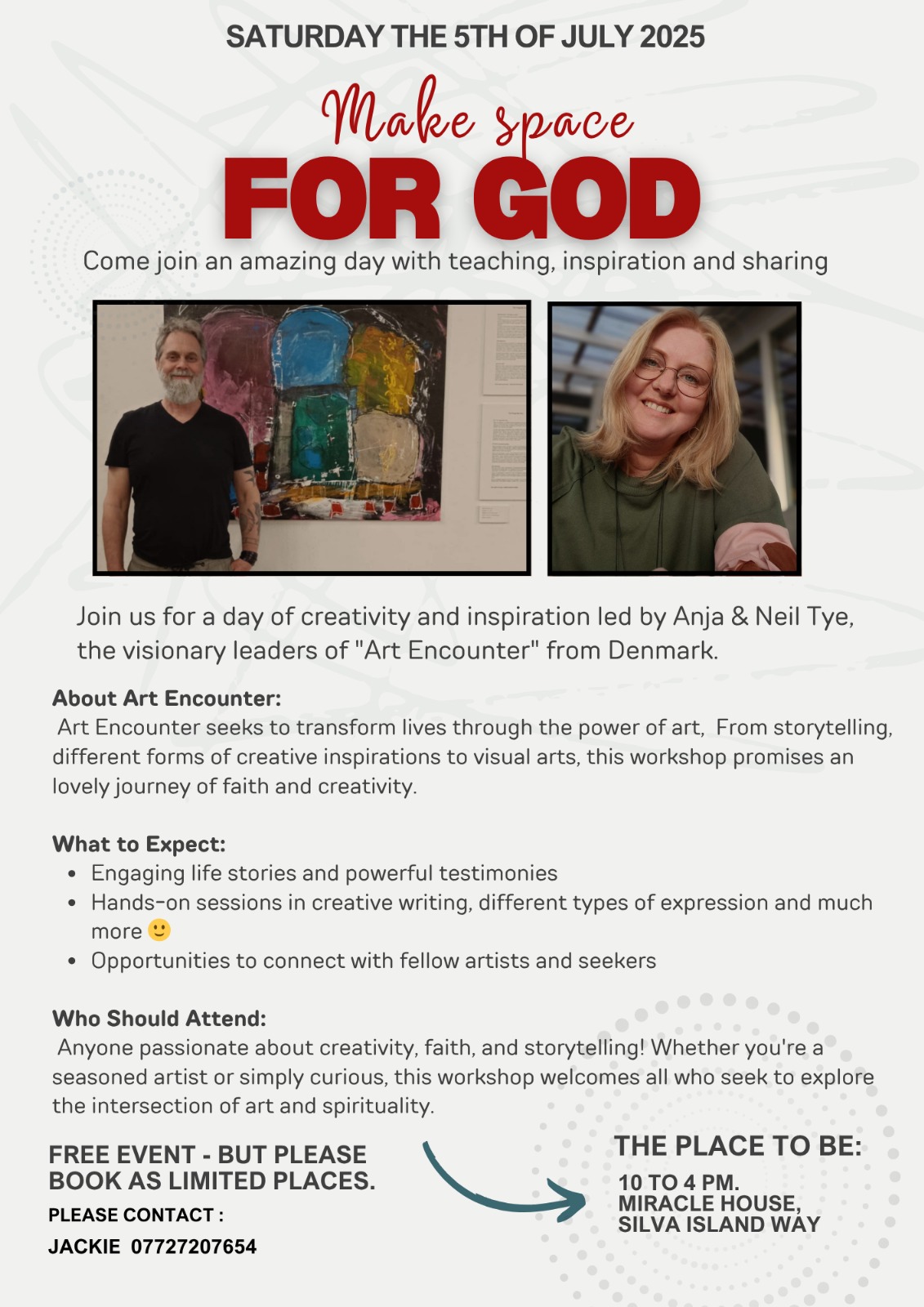
An evening with Neil Tye and Make Space for God


An evening with Neil Tye
Friday 4 July, 7.00 pm
St Andrew’s Church, 11 London Road, Wickford SS12 0AN


For the last 25 years Neil Tye has been working professionally, as a physical visual theatre performer, instructor, teacher, and installation artist, and has taken his performances, and teaching skills around the world. Hear stories about his music, performance, and painting.

Part of ‘Unveiled’, the Friday night arts and performance event at St Andrew’s Church

Artist Statement

Neil’s artistic practice is grounded in an intuitive and process-driven approach, wherein the act of painting itself dictates the final composition. Rather than adhering to predetermined concepts, he engages with the canvas through spontaneous mark-making and gestural forms, allowing the work to evolve organically. While his initial engagement with a piece may be sparked by a particular colour or shape, it is the dynamic interplay of movement, texture, and form that ultimately guides its development.

By embracing spontaneity and fluidity, his work exists at the intersection of abstraction and interpretation, inviting viewers to engage with the imagery in a way that is both personal and open-ended. Through this interplay between process and meaning-making, Neil`s paintings function as both intuitive expressions and conceptual explorations of movement, memory, and transformation.

About the artist

Neil Tye (b. 1963, London UK) is a Denmark-based artist with a background in both visual arts and physical theatre. Initially working as a performer and educator in physical theatre, he transitioned into visual expression 15 years ago. He holds an MA in Professional Practice from Middlesex University, London, and has exhibited, performed, and taught extensively across Europe and beyond. His exhibitions include venues such as the arts and culture centre Spinderihallerne (Denmark), the arts centre Banco de Nordeste (Brazil), and The Post Houston TX (USA), among others. Drawing from his multidisciplinary background, Neil’s work explores movement, form, and storytelling through visual mediums. He continues to create from his studio M10 in the Art zone area here in Spinderihallerene.

'The things we carry'

Following its initial display at Spinderihallerene in April, Neil's latest exhibition 'The things we carry' will be shown at Redbud Arts Center, Houston, from 7 - 28 June. This is a collection of mixed media works that centre around the nature of human connection. To mark the opening, Redbud Arts Center will host a special one-night performance by the internationally acclaimed Ad Deum Dance Company. The performance, inspired by themes from Tye's exhibition, will weave movement, storytelling, and live interaction with the artwork, offering audiences a multidisciplinary experience that bridges visual art and contemporary dance.

Neil says of the exhibition: "The title of this exhibition was inspired by reflections I had while creating my recent body of work. The first thought centres on the fundamental nature of human connection—we are not meant to navigate life alone. We rely on one another for support, understanding, and encouragement, whether through conversation, shared experiences, or emotional upliftment. The second thought arose from one particular painting, which evoked the image of an overloaded truck. This visual metaphor led me to consider how, in life, we accumulate and carry various burdens—emotions, worries, frustrations, memories, secrets, hopes, and dreams. These intangible yet weighty elements can become overwhelming, making it evident that we cannot bear them alone. At times, we must find ways to release or share these burdens, but this raises important questions: Where do we turn for relief? To whom do we entrust our heaviest thoughts? And how can we cultivate a sense of communal support to help lighten the loads we all inevitably carry?"


Make Space for God

Saturday 5 July, 10.00 am - 4.00 pm 

Miracle House, Silva Island Way, Wickford

A day of creativity and inspiration led by Anja and Neil Tye, the visionary leaders of "Art Encounter" from Denmark.

Art Encounter is an international arts ministry under Rescue Team which is run by married couple Neil and Anja Tye who are based in Denmark.

Neil and Anja are trained artists, and have been using their artistic skills as artist missionaries for many years. They have worked with different Christian organisations and churches from around the world such as Creative Mission in Sweden, Creative Arts Europe in Belgium, YWAM Costa Rica, Circus Victory Brazil, Ad Deum Dance Company USA, Iris Ministries Brazil, Acts Academy International Bible College, to Euroclass youth Mission boarding school in Denmark.

Art Encounter communicates the Gospel by using the arts, from dance, theatre, creative writing, and the visual arts and painting in various settings both in Denmark and around the world.

-----------------------------------------------------------------------------------------------------

Glen Hansard - Down On Our Knees.

Saturday, 2 November 2024

Unveiled - To date and upcoming


We've been enjoying a great Unveiled programme at St Andrew's Wickford this Autumn and have more exciting events still to come. 

Our first event was an exhibition viewing evening for the 'Trials & Tribulations: Modern Interpretations of Iconography' exhibition at which artist John Paul Barrett spoke about his work. He spoke about his career to date, how he became an artist, the spirituality that informs his work and his interest in Eastern European iconography. His work has a sculptured and textured look and he told us about the technique he uses to achieve that look. He also spoke about some of the artists that have inspired his expressionist style and why they are important to him. He ended by telling us about some the other themes and topics he addresses.

To view the exhibition, St Andrew’s is usually open: Sat 9am-12.30pm; Sun 9.30am-12 noon; Mon 2-3.45pm; Tue 1-4.30pm; Wed 10am-12 noon; Fri 10am-1pm. See https://wickfordandrunwellparish.org.uk/whats-on.html for more information.

The next event saw Dave Crawford in concert with friends. Popular local musician, Dave Crawford writes engaging/melodic songs in Americana/ Alt-Rock/Indie-Folk. He has performed at the Leigh Folk Festival, Pin Drop Sessions, & Music for Mind together with Kev Butler. We have also enjoyed his powerful vocals & guitar at our Open Mic Nights. This was Dave’s second concert at Unveiled. He was ably supported by Ben (on bongo's), Jimmy Sharp and Mr Shed.

Robson and Tony Coke gave a fascinating presentation about the Napoleonic Wars and historical re-enacts. Robson (2nd 95th Rifles & Drum Major of the Band of 1st Foot Guards 1815, Napoleonic Association) talked about the Napoleonic Wars, explained how re-enactments are organised and showed uniforms and equipment used in reenactments.

In her concert Eva Romanakova performed a wide genre of music - Musical Theatre, Arias, Pop, Jazz, Movie Songs and also Folk - in her concert. She also sang music from various countries and different times. She performed with accomplished pianist Andrew Palmer.

Our upcoming events are:
  • 8 November (7.30 pm) – Open Mic Night. Everybody is welcome to come along & play, read, sing or just spectate. See you there for a great evening of live performance!
  • 22 November (7.00 pm) – An evening with Steven Turner. Hear about the career of local dancer Steven Turner, who has trained in a variety of dance styles, including contemporary, street, mime & moving with props. Steven founded his own organisation, Next Step Creative, to promote collaboration between dance & other creative arts. He also regularly choreographs & teaches for Dance 21 (a dance company for children & young adults with Down’s syndrome). He has performed across the UK and Europe including Switzerland, Netherlands, Denmark, Germany, & France.
  • 6 December (7.00 pm) – Broomfield artists in the Basildon Deanery. Find out about artworks in Basildon & Nevendon by Thomas Bayliss Huxley-Jones & Rosemary Rutherford. An illustrated talk by Jonathan Evens.
These events do not require tickets (just turn up on the night). There will be a retiring collection to cover artist and church costs. See http://wickfordandrunwellparish.org.uk/whats-on.html for fuller information.

I will be talking about Unveiled in a HeartEdge EdgeExchange - Art in and for churches together with Laura Moffat on Tuesday November 26th at 2pm. Register in advance for this meeting: https://us06web.zoom.us/meeting/register/tZ0rcOihqTMvHtRJy25xYAAnEVMlCyYCcOt0. After registering, you will receive a confirmation email containing information about joining the meeting.

-----------------------------------------------------------------------------------------------------

Dave Crawford - My Last Lullaby.

Friday, 28 June 2024

Infusion Physical Theatre and Dance 21: Soothe


Infusion Physical Theatre shared the stage with Dance 21, an accessibility-focused dance group based in Chelmsford, at St Andrew's Wickford this evening. In partnership with the Arts Council England and Next Step Creative, Infusion delivered a series of workshops with Dance 21, giving them a chance to create their own short dance works based on the Threat, Drive, Soothe model. Dance 21 performed as a wonderful curtain raiser to Infusion’s full performance of 'Soothe' tonight.

'Soothe' is an off-balance, fun, emotive dance exploration of the three modes of emotional regulation: threat, drive, soothe. In a multimedia dance show for all ages, award-winning Infusion Physical Theatre brings to life the movement of mental wellbeing in a thoughtful and rambunctious examination of hormones that push, pull and drag us through life. Combining contemporary dance and multimedia, Infusion weaves together non-traditional partnering and original music to follow the cravings of a post-lockdown society eager for recovery. Psychologist Dr Lisa Harrow called it, “An emotive interplay between art and science!”

Founded in 2013 by Cambridge-based artists Daniel and Melanie Cossette, Infusion has performed site-specific work for the National Trust’s Winter Lights, performed in Project Dance (London and Paris), in Edinburgh Festival Fringe (Scotland), Sprung (Queens College, Cambridge), as well as appearing in Wandsworth Arts Fringe, The Library Presents rural touring scheme, local and international theatres. Infusion Physical Theatre combines contemporary dance, non-traditional partnering, mime, puppetry and circus with soulful touches of humour, longing and the human spirit in bodily form.

Also at tonight's performance was Christ John Otto of Belonging House.

Tonight's performance was part of Unveiled, our fortnightly arts and performance evenings at St Andrew's Wickford. Our final Unveiled evening before the summer break will be 'Depeche Mode: Songs of Faith & Devotion', Friday 12 July, 7.00 pm, when I will talk about Christian influences in the music of Basildon band, Depeche Mode.

-----------------------------------------------------------------------------------------------------

Infusion Physical Theatre - Soothe.

Seen and Unseen: Art makes life worth living

 My latest article for Seen & Unseen is entitled 'Art makes life worth living' and explores why society, and churches, need the Arts:

'Churches feature within these arguments because they often host or organise cultural events, exhibitions, installations and performances which contribute towards the economic, social, wellbeing and tourism impacts achieved by the arts and culture. The Arts are actually central to church life because, as well as being places to enjoy cultural programmes such as concerts and exhibitions and also being places to see art and architecture, many of the activities of churches take place within beautiful buildings while services combine drama, literature, music, poetry and visuals.'

My first article for Seen and Unseen was 'Life is more important than art' which reviews the themes of recent art exhibitions that tackle life’s big questions and the roles creators take.

My second article 'Corinne Bailey Rae’s energised and anguished creative journey' explores inspirations in Detroit, Leeds and Ethiopia for Corinne Bailey Rae’s latest album, Black Rainbows, which is an atlas of capacious faith.

My third article was an interview with musician and priest Rev Simpkins in which we discussed how music is an expression of humanity and his faith.

My fourth article was a guide to the Christmas season’s art, past and present. Traditionally at this time of year “great art comes tumbling through your letterbox” so, in this article, I explore the historic and contemporary art of Christmas.

My fifth article was 'Finding the human amid the wreckage of migration'. In this article I interviewed Shezad Dawood about his multimedia Leviathan exhibition at Salisbury Cathedral where personal objects recovered from ocean depths tell a story of modern and ancient migrations.

My sixth article was 'The visionary artists finding heaven down here' in which I explored a tradition of visionary artists whose works shed light on the material and spiritual worlds.

My seventh article was 'How the incomer’s eye sees identity' in which I explain how curating an exhibition for Ben Uri Online gave me the chance to highlight synergies between ancient texts and current issues.

My eighth article was 'Infernal rebellion and the questions it asks' in which I interview the author Nicholas Papadopulos about his book The Infernal Word: Notes from a Rebel Angel.

My ninth article was 'A day, night and dawn with Nick Cave’s lyrics' in which I review Adam Steiner’s Darker With The Dawn — Nick Cave’s Songs Of Love And Death and explore whether Steiner's rappel into Cave’s art helps us understand its purpose.

My 10th article was 'Theresa Lola's poetical hope' about the death-haunted yet lyrical, joyful and moving poet for a new generation.

My 11th article was 'How to look at our world: Aaron Rosen interview', exploring themes from Rosen's book 'What Would Jesus See: Ways of Looking at a Disorienting World'.

My 12th article was 'Blake, imagination and the insight of God', exploring a new exhibition - 'William Blake's Universe at the Fitzwilliam Museum - which focuses on seekers of spiritual regeneration and national revival.

My 13th article 'Matthew Krishanu: painting childhood' was an interview with Matthew Krishanu on his exhibition 'The Bough Breaks' at Camden Art Centre.

---------------------------------------------------------------------------------------------------

Mavis Staples - High Note.