Wikio - Top Blogs - Religion and belief
Showing posts with label adams. Show all posts

Friday, 29 August 2025

Visual Commentary on Scripture - 'Before the Deluge'

The fourth exhibition I have curated for the Visual Commentary on Scripture (VCS) is now live on the VCS website. 'Before the Deluge' is a series of climate-focused commentaries on Genesis 6 looking at 'The Flood' by Norman Adams, 'Noah in the Ark and a Church' by Albert Herbert, and 'Noah's Ark' by Sadao Watanabe.

My first exhibition for the VCS was 'Back from the Brink' on Daniel 4: 'Immediately the word was fulfilled upon Nebuchadnezzar. He was driven from among men, and ate grass like an ox, and his body was wet with the dew of heaven till his hair grew as long as eagles’ feathers, and his nails were like birds’ claws.' (Daniel 4:33). In the exhibition I explore this chapter with William Blake's 'Nebuchadnezzar', 1795–c.1805, Arthur Boyd's 'Nebuchadnezzar's Dream of the Tree', 1969, and Peter Howson's 'The Third Step', 2001.

My second exhibition was 'A Question of Faith' and explored Hebrews 11 through the paintings of New Zealand artist Colin McCahon. McCahon is widely recognised as New Zealand’s foremost painter. Over 45 years, his work encompassed many themes, subjects and styles, from landscape to figuration to abstraction and an innovative use of painted text. His adaption of aspects of modernist painting to a specific local situation and his intense engagement with spiritual matters, mark him out as a distinctive figure in twentieth-century art.

My third exhibition was 'Fishers of People'. This exhibition uses Damien Hirst's 'Isolated Elements Swimming in the Same Direction for the Purpose of Understanding (Left) and (Right)', John Bellany's 'Kinlochbervie', and Paul Thek's 'Fishman in Excelsis Table' to discuss Matthew 4:12-22 and Mark 1:14-20. These artworks give us what is essentially a collage of the kingdom whereby we are invited to imagine the kingdom of God as a body of water in which Christians are immersed and through which they are raised.

The VCS is a freely accessible online publication that provides theological commentary on the Bible in dialogue with works of art. It helps its users to (re)discover the Bible in new ways through the illuminating interaction of artworks, scriptural texts, and commissioned commentaries. The virtual exhibitions of the VCS aim to facilitate new possibilities of seeing and reading so that the biblical text and the selected works of art come alive in new and vivid ways.

Each section of the VCS is a virtual exhibition comprising a biblical passage, three art works, and their associated commentaries. The curators of each exhibition select artworks that they consider will open up the biblical texts for interpretation, and/or offer new perspectives on themes the texts address. The commentaries explain and interpret the relationships between the works of art and the scriptural text.

Find out more about the VCS, its exhibitions and other resources through a short series of HeartEdge workshops introducing the VCS as a whole and exploring particular exhibitions with their curators. These workshops can be viewed here, here, here and here.

-------------------------------------------------------------------------------------------------------

The Fire Theft - Sinatra.

Friday, 12 February 2021

Seeing is Receiving: The art of contemplation (8)

7. Sparking

A tale of two churches is central to the story that I sought to tell through my sabbatical art pilgrimage. The two churches are Notre-Dame des Alpes in Le Fayet and Notre-Dame de Toute Grâce on the Plateau d'Assy. Both are only kilometres apart in the French Alps and were built by same architect in a similar style yet they represent different stages in the sparking of inspiration from the Holy Spirit that led to the twentieth century’s revival of sacred art.

My sabbatical art pilgrimage involved visits to significant sites connected with the renewal of religious art in Europe during the twentieth century. In Europe I visited sites connected with the artists surrounding Maurice Denis, Jacques Maritain, Albert Gleizes and Marie-Alain Couturier, while, in the UK, I primarily visited sites which highlighted the influence of the innovatory commissions undertaken by George Bell and Walter Hussey. These were they that were primarily responsible for the sparking of inspiration in church commissions in this period of time.

At the beginning of the twentieth century modern art looked, sounded and felt very different from the art that had traditionally been made for the Church. This meant that the Church tended to avoid using modern art while many modern artists were excitedly exploring new ways of creating art and often couldn’t see any connection between what they were doing and the styles of art which the Church continued to use.

As a result, a whole segment of society – artists and art lovers – was not being impacted by Christianity. Denis, Maritain, Gleizes, Couturier, Bell and Hussey made it their life’s work to reconnect the Church with modern art. The key debate that they had, through their actions and writings, was whether the sparking of inspiration was best done by artists who were Christians and who primarily focused their work on church decoration or by artists who were reckoned to be contemporary masters, regardless of whether or not they practised the faith.

It was that debate which was played out through the commissions for the churches at Le Fayet and Assy. The decoration of St. Paul Grange-Canal in Geneva by Denis, Alexandre Cingria and others in 1913 – 1915 served as a manifesto for the renaissance in modern sacred art that they and others facilitated. This led to the founding in 1919 of the Ateliers d’Art Sacré in Paris by Denis and Georges Desvallières as well the Group of St Luke and St Maurice in Switzerland by François Baud, Cingria, Marcel Feuillat, Marcel Poncet and Georges de Traz. Both groups produced significant work for many churches in subsequent years.

In 1935 the Group of St Luke secured the decoration of the new church of Notre-Dame-des-Alpes by means of a tender process assessed by Maritain, the Catholic art critic Maurice Brillant and the director of the Ecole des Beaux Arts in Geneva, Adrien Bovy.[i] The process and the resulting work was a showcase for the renaissance of sacred art in which Denis, Maritain and Cingria had played key roles. It was this stage of the revival that was later challenged by the commissions selected for Notre-Dame-de-Toute-Grâce.

Although he trained at the Ateliers d’Art Sacré and worked on schemes of stained glass with its artists, together with his fellow Dominican Friar Pie-Raymond Régamey, Couturier argued in ‘L’Art sacré’, the journal which they jointly edited, that ‘each generation must appeal to the masters of living art, and today those masters come first from secular art.’[ii] Couturier worked with the parish priest at Assy, Canon Jean Devémy, on commissions for the church at Assy.

Initially their commissions were within the earlier phase of the renaissance of sacred art as sparked by the Holy Spirit. On the basis of his work at Le Fayet, Devémy selected Maurice Novarina as architect for Assy. As at Le Fayet, Novarina used his regional style with a chalet-style pitched roof and locally sourced materials. Initial commissions for the nave windows went to artists who had been active in modernist Church decoration before the war but Couturier then moved on to commission Pierre Bonnard, Marc Chagall, Fernand Léger, Jacques Lipchitz, Jean Lurçat, Henri Matisse, Germaine Richier and Georges Rouault.

William S. Rubin noted that this ‘radical aspect’ of Couturier’s plan proved deeply controversial as commissioning modern ‘masters … from secular art’ meant that ‘Side by side with works of the pious Catholic Rouault one saw those of Jews, atheists, and even Communists - a revolutionary situation that struck the keynote of a new evangelical spirit ...’ As a result, ‘Even before its dedication in 1950, the church had become the center of an increasingly bitter dispute which was to cause a marked rupture between the liberal and conservative wings of the clergy and laity during the following years.’[iii]

Despite the controversy caused Couturier’s approach to commissioning sparking inspiration for others and has become part of the commissioning landscape for churches. In England, Bishop Bell sought ‘ways and means for a reconciliation of the Artist and the Church’ while Hussey made it the great enthusiasm of his life and work ‘to commission for the Church the very best artists.’ Both experienced opposition and criticism but at St Matthew’s Northampton, St Michael and All Angels Berwick and Chichester Cathedral enabled commissions by a range of contemporary masters.

My visits to these and other churches confirmed for me the continuing value of commissions made at both stages of the twentieth century renaissance in sacred art. Both churches, Le Fayet and Assy, contain artworks which speak powerfully and movingly of the Christian faith and therefore also inform the spirituality of those who see them. Significant work was done throughout the twentieth century both by artists who were Christians and who primarily focused their work on church decoration and also by artists who were reckoned to be contemporary masters, regardless of whether or not they practised the faith. This continues to be the case in contemporary church commissions and, as a result, one of the lessons we can learn from the twentieth century revival of sacred art and its sparking of inspiration is that debate which sets ‘Christian’ artists against secular masters is unnecessary.

Churches need encouragement and validation to commission challenging and innovative work from either group of artists because the sparking of inspiration by the Holy Spirit derives not from our alignment with statements of belief but from the sharing of our contemplative seeing. As we have been reflecting through this book, this is based on slowing down in order to sustain silent looking by immersing ourselves in the world created by the work combined with reflection on sources. It is this that enables a positive cycle of creativity by sparking inspiration from the Holy Spirit.

Jesus’ disciples spent three years not understanding what he was saying and doing before running away, deserting and denying him at the crucifixion. Then the Day of Pentecost happened and the coming of the Holy Spirit was the moment when it all came together for them, when they finally understood and both knew their part in God’s plan and could begin to play it.

When the Spirit came they could speak in languages they had never learned and were understood, they could explain the scriptures although they were uneducated and their explanations made sense. They could proclaim Jesus as Lord and Christ and people responded to their challenge, and they knew how to structure and organise the new community that grew around them in response to their message. All that Jesus had said to them and done with them suddenly made sense and was useful to them because the Spirit had come and brought clarity and revelation. That is what Jesus had promised them would happen. That is the work which the Holy Spirit comes to do in our lives. Jesus told the disciples that when the Spirit came he would lead them into all truth. In other words, they would have that experience of inspiration being sparked; of revelation, of clarity, of things making sense, coming together and connecting.

This is an experience that is common to artists. Written In My Soul is a series of interviews with some of the most well-known singer-songwriters from the 1950s onward. Many of these great artists – Bob Dylan, Neil Young, Van Morrison and others - felt that their songs were given to them in moments of revelation, that their songs were already written and ‘came through them as though radio receivers – without much conscious effort or direction.’[iv]

That is an experience of the Spirit coming, although often not recognised as such. It has also been my experience, both in creating and preaching. I will often reflect or meditate on an experience, a song, an image, a Bible passage, by putting it in my mind, carrying it around in my mind over several days or weeks, reminding myself of it from time to time and just generally living with it for a period of time. When I do so, then I find that, at some unexpected moment, a new thought or idea or image will come to me that makes sense or takes forward the experience or song or image or passage on which I had been reflecting.

This is not just something for artists or even for preachers, it is something that can happen for us all; not just in major life-changing moments of revelation but also in a series of minor everyday epiphanies. Corita Kent writes that there is ‘an energy in the creative process that belongs in the league of those energies which can uplift, unify, and harmonize all of us.’ This energy or spark or inspiration, ‘which we call “making,” is the relating of parts to make a new whole.’[v]

If done well, this sparking of creativity gives rise to a sparking of response: ‘… the work of art gives us an experience of wholeness called ecstasy – a moment of rising above our feelings of separateness, competition, divisiveness “to a state of exalted delight in which normal understanding is felt to be surpassed” (Webster’s).’ This is as we should expect, as the ‘very word imagination implies that you are into territory no one has ever been to before.’ As a result, ‘a rigid discipline that demands one “right” way is confining and limiting.’[vi]

There is a third spark that precedes those describes thus far. Kent says that new ideas ‘are bursting all around and all this comes into you and is changed by you.’[vii] We are all each other’s sources and anything that comes our way, including the work of artists, ‘is a place for starting’.[viii] Contemplative prayer or reflection enables us to see and grasp these inspirations as they burst around us. Sparks of inspiration and creativity come to us in this way because, as Anaïs Nin notes, there are ‘very few human beings who receive the truth, complete and staggering, by instant illumination.’ Instead, we ‘acquire it fragment by fragment on a small scale, successive developments, cellularly, like a laborious mosaic.’[ix]g

The acquiring of fragments and creative linking of these to form a mosaic as commended by Kent and Jan Steward via Nin may remind us of Betty Spackman’s approach with ‘A Creature Chronicle’. Another artist inspired to create in this way, as a means of mirroring or depicting the contemplative creative process itself, was Marc Chagall. Chagall’s art is one that connects and reconciles disparate images of Bible, experience, history, memory and myth on the canvas through colour and composition. In his work Chagall links up different, unusual and unlikely images in a way that makes visual and emotional sense; in a way that communicates his love of his home, his world, his people, its sights, sounds and smells. He succeeds in ‘achieving a pictorial unity through the yoking of motifs taken from different realms of given reality.’[x] He reconciles emotions, thoughts, and reminiscences with lines, colours and shapes to create harmonious, meaningful paintings. Walther and Metzger have suggested that ‘no other twentieth century artist had Chagall's gift for harmonising what were thought to be irreconcilable opposites.’[xi] That was actually far from being the case, yet the fact that this might seem so is to recognise the lack of awareness and understanding shown to the art of contemplation in modern and contemporary art by critics and the Church alike. This has been to the wider detriment of society and has meant that some artists using the approaches described in this book have been under-appreciated in regard to recognition and, in other respects, as to intent.

The approaches to creative and Spirit-inspired sparking of these artists have synergies with the approaches of David Jones in The Anathemata and T. S. Eliot in The Waste Land. What these poets did in constructing a whole from fragmentary materials is also essentially similar to the form and construction of the Bible itself. Writer and minister, Mike Riddell has described the Bible as 'a collection of bits' assembled to form God’s home page while the Anglican priest Mark Oakley used a more poetic image when he wrote that the Bible is 'the best example of a collage of God that we have.' Riddell continued by saying that, 'what holds all these bits together is the fact that they somehow represent the continued involvement of God with the world in general and humanity in particular.'[xii] Oakley suggested that 'held together, they form a colourful and intriguing picture that draws us into its own landscape' and enables Christians to 'glimpse something of the divine being and his life in the world' and find 'a vocabulary for the Christian life.'[xiii]

What also holds them together is the Spirit-inspired sparking of creativity in creating and linking fragments of meaning that we have been exploring through the work of Chagall, Eliot, Jones, Kent and Spackman. It may be that it is this form of inspiration to which the Bible itself wants to point us when, in 2 Timothy 3.16, we read that ‘All scripture is inspired by God.’ Sparks of the Spirit – the inspiration of God – come not in one fully realised and systematised creation but fragment by fragment, to be creatively linked and held together in a collage of revelation.

This place of renewed inspiration, creativity and revelation is reached by means of learning to see as opposed to merely looking. The ways of learning to see that we have explored enable us to genuinely pay attention by slowing down, sustained looking, surrendering ourselves to art by immersing ourselves within it, staying with the silence inherent in much art, study of sources, the sharing of experiences, and an openness to inspiration, the sparking of the Spirit. In learning to use these ways of paying attention we are opening the gift the artist offers of sharing with us the mindful and prayerful act of seeing; to spend time noticing, looking intently and making careful observation in order to make material from their thoughts and ideas. With these ways of seeing in place, we can now see that there is beauty in all art and life as seen through the concept of sacrament, of heaven in the ordinary, including the artefacts of art. It is this that we contemplate. It is this to which we pay attention. It is this that is prayer.

Explore

Chagall's unitive vision finds echoes in the work of some of his peers and has been taken up, responded to and developed by other later artists.

Cecil Collins, in painting fools and angels found a means of depicting divine and human action and response. Collins viewed art as ‘an interpenetration between worlds, as a marriage of the known with the unknown’. In art, he said, the ‘imagination searches out and prefigures the mysterious unity of all life’. As a result of this metaphysical purpose and exploration ‘a picture lives on many different levels at once, it is an interpenetration of planes of reality, it cannot be analyzed or anatomised into single levels because one level can only be understood in the light of others. The reality or interior life of the picture can only be realised as a total experience.’[xiv] That total experience in Collins' work is unitive experience; whether this is the attempt at reconstituting the world that is Images in Praise of Love or the complex combination of symbol and structure that hymns the marriage union and reconciles masculine and feminine qualities in The Artist and His Wife.

Collins was also preoccupied by our expulsion from the Garden of Eden and our longing to return; in itself a reconciliation. This is a theme that was also taken up by Norman Adams. Adams' produced a questioning, probing work based on the expulsion and inspired by Paul Gauguin's Where do we come from? Who are we? Where are we going? An everyman figure is on a sloping pathway which he could be ascending or descending. Above him is a mass of blooming flowers, below a confused, muddy zone of swirls and scraping. His predicament poses the question to us as viewer, are we returning to Eden reconciled to God or descending into confused self-interest? The religious subject matter of Norman Adams' paintings provides him with geometry, a structure of lines and circles that allows his complex colours, his masterly and distinctive use of watercolour, to work their magic.’[xv] For Sister Wendy Beckett this ability of Adams' suggests that a mystical sense of oneness is making itself visible in his work.[xvi]

John Reilly was as strong and explicit as Collins in setting out his intentions: ‘My paintings are not concerned with the surface appearance of people or things but try to express something of the fundamental spiritual reality behind this surface appearance. I try to express in visible form the oneness and unity of this invisible power, binding all things into one whole.’[xvii] Using lessons learnt from Orphism and Rayonism he constructed a pattern of rippling rays emanating from a central source of light. Within this structure he set objects and figures composed of abstract shapes and colours that are indicative of their spiritual qualities. A painting like No Parting includes natural formations, animals, human figures and plants held together, underpinned, in eternal circulation by the central point, which some may see as a pictorial device structuring a work of beauty and others as symbolic of God. In Universal Power - The Fourth Day of Creation we are shown a snapshot of creation, of the first reconciliation of shape and form. As Reilly's abstract shapes spiral out from the central point they coalesce into those same fundamental, elemental shapes of bird, plant and human life.

For David Jones reconciliation comes through the tangle of associations and allusions triggered by words and images. Caroline Collier has noted his ‘fondness for entwinings, for complications, interrelationships, layers and correspondences.’[xviii] We see this most clearly in his use of line but, as Nicolette Gray notes in her comments on Curtained Outlook, the level of unity achieved throughout his work is much greater than simply this alone:

‘The artist has woven a complex of components into a new unity. The verticals of the window-frame, the windows and balustrade of the house outside, and of the jug on the table, are counterbalanced by the horizontal of the sill and the balcony, and by the outward-moving diagonals of the table, the toothbrush and box lid, and the downward-moving lines of the house. Movement runs throughout the composition - there is not a single straight line, not a flat wash of colour. The sudden accents of colour/tone/drawing pick up the movement of the composition. The drawing itself is part soft pencil, part brush drawing in colour, here sketchy, there emphatic. All the elements are worked together: form and content have been reconciled, unity combined with movement.’[xix]

Giles Auty, in writing of Norman Adams, noted that he belongs ‘to a relatively small tradition of painters whose outlook is positive’: ‘An affirmative vision such as his is especially rare in the modern art of the West, artists preferring to shelter more frequently behind masks of disillusionment and cynicism. Indeed, such negative views of life have the additional bonus of being perennially in fashion, the large black-humoured painting sharing something of the timeless chic of the little black dress.’[xx] The tradition of affirmative, unitive, figurative art may be small yet it remains significant, if undervalued.

Wonderings

I wonder if you can recall a moment when something new was sparked in you.

I wonder if you can remember what led to that sparking and how it felt.

I wonder what you did with that new something.

Prayer

Creating God, for whom creation is your prayer, may I see creativity as noticing and naming, letting all things be by attending to them for your sake and to see your goodness; that all may be well and all manner of thing be well. Amen.

Spiritual exercise

Take the phrase ‘Through the veil’ and ruminate on it in your heart and mind. Create a list in whatever way you wish of all that this phrase brings to mind for you. Use your list to begin a creative project of whatever kind you wish entitled ‘Through the veil’.

Art actions

View John Reilly’s work at http://thejohnreillygallery.co.uk/index.htm.

Watch the documentary ‘Bill Viola: The Road to St Paul’s’ which follows the world’s most influential video artist Bill Viola and his wife and close collaborator Kira Perov over a twelve-year period as they undertake and complete the installation of their two permanent video works, Mary and Martyrs, in St. Paul’s Cathedral.
 

Click here for the other parts of 'Seeing is Receiving'. See also 'And a little child shall lead them' which explores similar themes.


[i] L. Mamedova, ‘L’église Notre-Dame des Alpes à Saint-Gervais-le Fayet : une collaboration entre un architecte savoyard et un artiste genevois’, Publié dans L. el-Wakil et P. Vaisse, Genève-Lyon-Paris. Relations artistiques, réseaux, influences, voyages, Genève, Georg, 2004 - http://www.okam-design.com/lada/files/Fayet-article.pdf

[ii] M-A Couturier, ‘What Assy Teaches Us’ in Sacred Art, University of Texas Press, 1989, p.52

[iii] W.S. Rubin, Modern Sacred Art and the Church of Assy, Columbia University Press, New York & London, 1961

[iv] B. Flanagan, Written In My Soul, Omnibus Press, 1990, p. xii

[v] C. Kent & J. Steward, Learning by Heart, Allworth Press, 2008, p.5

[vi] C. Kent & J. Steward, Learning by Heart, Allworth Press, 2008, pps.90-91

[vii] C. Kent & J. Steward, Learning by Heart, Allworth Press, 2008, p.50

[viii] C. Kent & J. Steward, Learning by Heart, Allworth Press, 2008, p.48

[ix] Cited in C. Kent & J. Steward, Learning by Heart, Allworth Press, 2008, p.94

[x] Ingo F. Walther and Rainer Metzger, Marc Chagall 1887 – 1985: Painting as Poetry, Taschen, 2000, p. 20

[xi] Ingo F. Walther and Rainer Metzger, Marc Chagall 1887 – 1985: Painting as Poetry, Taschen, 2000, p. 89

[xii] M. Riddell, God’s home page (Oxford: The Bible Reading Fellowship, 1998), pps.24 & 25

[xiii] M. Oakley, The Collage of God (London: Darton, Longman and Todd Ltd, 2001), p.21

[xiv] Writings and statements by the Artist, Cecil Collins A Retrospective Exhibition, Judith Collins, Tate Gallery, 1989

[xv] M. Walters in ‘Images of Christ’, Modern Painters VI/2

[xvi] Sister W. Beckett, ‘Norman Adams’ in Modern Painters IV/1

[xvii] J. Reilly, ‘Introduction’ in The Painted Word: Paintings by John Reilly, Cross Publishing, 2008

[xviii] Caroline Collier, ‘Under the Form of Paint ...’ in David Jones: Paintings. Drawings. Inscriptions. Prints., The South Bank Centre, 1989

[xix] N. Gray, The Paintings of David Jones, Lund Humphries Publishers Ltd, 1989

[xx] G. Auty, ‘An Affirmative View’ in Norman Adams, R.A., Christopher Hull Gallery, 1991


----------------------------------------------------------------------------------------------

Bob Dylan - Every Grain Of Sand.

Thursday, 27 December 2018

Sister Wendy Beckett RIP

My latest piece for Artlyst is an appreciation of the life and writing of Sister Wendy Beckett who has died aged 88:

'I first encountered Sister Wendy Beckett in the pages of ‘Modern Painters’, the art magazine founded by the art critic Peter Fuller which ‘celebrated the critical imagination; stood up for aesthetic values and had a particular focus on British art.’

An early piece would have been a review of an exhibition by Norman Adams in which she suggested that a mystical sense of oneness was making itself visible in his work. In ‘The Way of the Cross and the Paradise Garden’ she noted a radiance of joy conveyed by ‘angels somersaulting through a dazzle of colour bars, crosses of light, that proclaims the marvellous oneness of the Death of Christ and His Rising.’

My other Artlyst articles and interviews are:
----------------------------------------------------------------------------------------------------

The Civil Wars - I Heard the Bells on Christmas Day.

Friday, 27 November 2015

Stevens, de Waal, Stofer, Baldwin, Britton, Rena & Adams


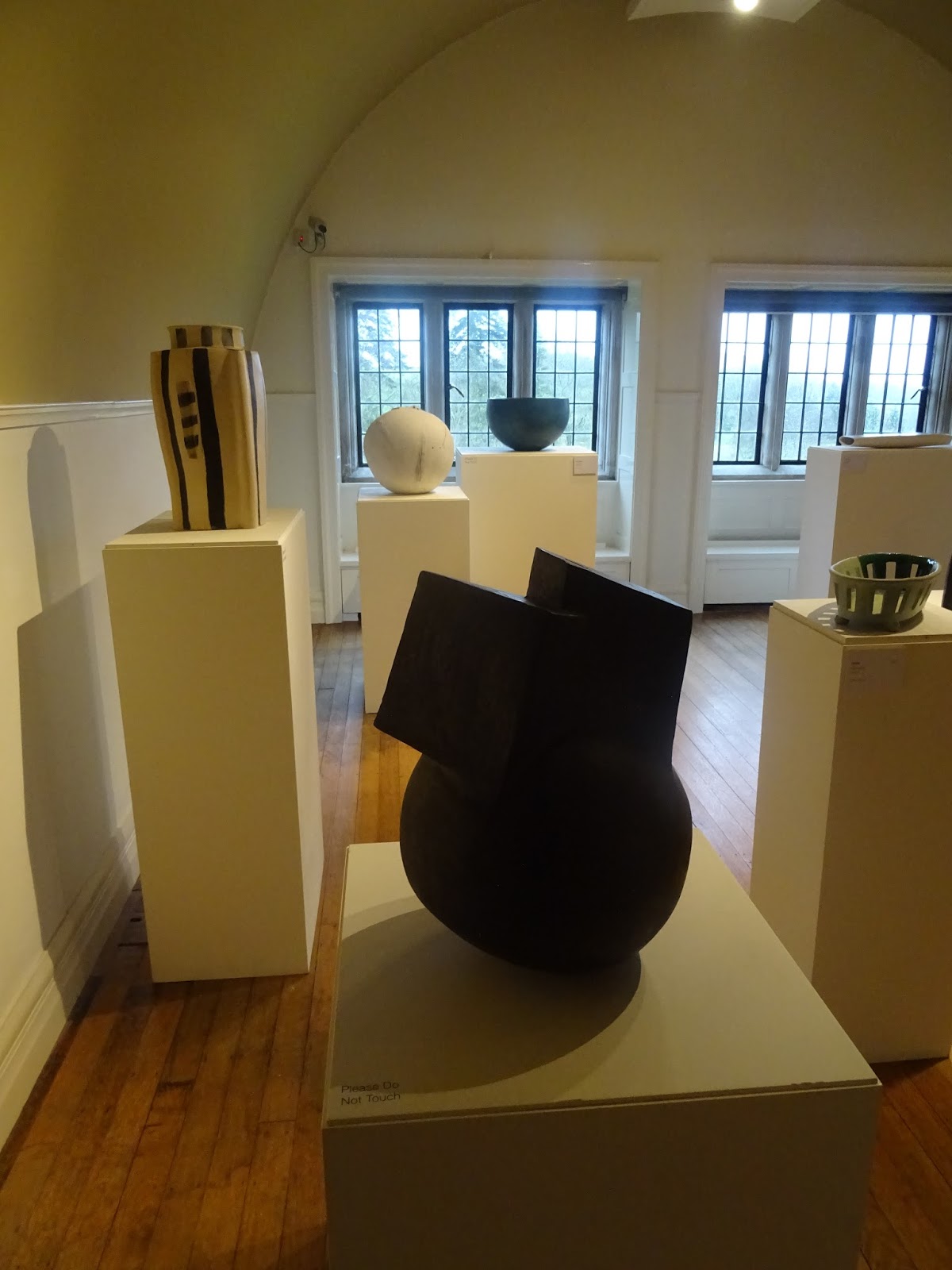
Blackwell, the Arts & Crafts House, currently has two under-stated but wonderful exhibitions of ceramics. Ideas of Order takes a poem by Wallace Stevens’ poem as its starting point in order to juxtapose ‘ideas of order’ in ceramic works by Edmund de Waal and Hans Stofer, while Gordon Baldwin, Alison Britton and Nicholas Rena grapple with ideas of form and function in Traditions of Use:

"‘I placed a jar in Tennessee,
And round it was, upon a hill.
It made the slovenly wilderness
Surround that hill.’

American poet Wallace Stevens’ Anecdote of the Jar begins with an act of deliberate placement which creates new order. ‘Placed’ and out-of-place in the wilderness, the jar of the title domesticates wilderness into a surrounding. Taking Stevens’ poem as its starting point, this display juxtaposes ‘ideas of order’ in ceramic works by makers Edmund de Waal and Hans Stofer.

English novelist AS Byatt recognised affinities between Stevens and Edmund de Waal: ‘The pots give me the same joy Stevens gives me, of recognising the human making of Balzac’s “things”, what Stevens also calls a “blessed rage for order”’. De Waal’s delicate groups of vessels and the cultivated disorder of Stofer’s bowls evoke and question ideas of aesthetic, domestic and social order - and the hierarchies of value that underpin them. The conversation between pieces is shadowed by Blackwell’s history as a house where domestic order and routine labour were inextricable."

Traditions of Use "showcases the work of three leading British ceramic artists who all grapple with ideas of form and function within the wider debate of where contemporary craft stands in today’s art world.

Breaking with the tradition that in ceramics form is all that matters, Gordon Baldwin creates what he terms ‘vessels’ which challenge the concepts of ‘fine art’ and ‘craft.’ So too does renowned ceramicist, writer and critic, Alison Britton, who looks at the connections and disjunctions with ceramic history, painting and sculpture. Nicholas Rena’s sculptural ceramics engage with ideas of containment and emptiness while alluding ‘to traditions of use that are almost lost.’"

The Lakeland Arts Trust also shows work at Blackwell, including earthenware by sculptor and poet Anna Adams, wife of the painter Norman Adams. Lakeland Arts is one of the most significant arts and heritage organisations in the North of England with a national and international reputation for the quality of its historic buildings, museum and gallery collections and programming. It has a diverse portfolio of attractions: Blackwell, Abbot Hall Art Gallery and the Museum of Lakeland Life & Industry in Kendal and the new Windermere Jetty in Bowness.

---------------------------------------------------------------------------------------------

Wallace Stevens - The Idea Of Order.

Sunday, 16 October 2011

Beyond 'Airbrushed from Art History' (6)

Lord Harries' begins a series of lectures this week on Christian Faith and Modern Art at the Museum of London.

The last century has seen changes in artistic style that have been both rapid and radical. This has presented a particular problem to artists who have wished to express Christian themes. These illustrated lectures will look at how different artists have responded to this challenge whilst retaining their artistic integrity.

The Explosion of Modernism. Wednesday, 19 October 2011 - 1:00pm: The period before World War 1 saw an extraordinary burst of creativity in all the arts which has decisively effected all subsequent developments. This lecture will look at the emergence of expressionism and amongst other artists will consider in detail the work of Nolde, Jacob Epstein and Rouault.

Distinctive Individual Visions. Wednesday, 16 November 2011 - 1:00pm: As at the end of the 18th century William Blake developed a highly individual style that did not fit easily into the categories of the age, so in our time artists like Marc Chagall, Stanley Spencer and Cecil Collins, in their very different ways, have sought to express an intense, highly personal religious vision of the world.

Catholic Elegance and Joy. Wednesday, 14 December 2011 - 1:00pm: In the period under consideration a fair number of the artists considered have been Roman Catholics, but at one time there was a particular symbiosis between two of them, Eric Gill and David Jones, who will be discussed along with others who shared their faith.

Post World War II Optimism. Wednesday, 18 January 2012 - 1:00pm: After World War II, without forgetting the terrible suffering earlier in the century, there was a new confidence expressed in the artistic commissions of the time. Older artists who had been active before World War I such as Epstein and Matisse received commissions as well as younger artists such as Graham Sutherland, known especially for his work in Coventry Cathedral, Ceri Richards and Henry Moore.

Searching for New Ways. Wednesday, 22 February 2012 - 1:00pm: From the 1960s to our own time artists who have wished to express Christian themes have explored a number of very different artistic ways of doing so. Amongst those considered in this lecture are Albert Herbert, Norman Adams, John Reilly and Craigie Aitchison.

Contemporary Christian Art. Wednesday, 21 March 2012 - 1:00pm: Contrary to much opinion, the current scene of faith-related art is very much alive. There are new commissions for churches and cathedrals, a number of artists pursue their work on the basis of a deeply convinced faith, and other artists often resonate with traditional Christian themes, albeit in a highly untraditional way. The challenge for the artist, stated in the introduction to the course of lectures above, is still very much there: how to retain artistic integrity whilst doing justice to received themes.

--------------------------------------------------------------------------------------------

King's X - Faith, Hope, Love.

Saturday, 24 July 2010

Exhibiting spirituality


It has been interesting to see the number of exhibitions recently which have explored some aspect of spirituality. Both the numbers and differing styles of exhibition would seem to indicate a renewed engagement within the art world with the force and mystery of spirituality.
Blood Tears Faith Doubt was an exhibition at the Courtauld Gallery curated by students which "confronted historic Christian art with contemporary art that continues to address the same visual tradition." The contemporary works selected allude to or depict religious imagery or practices but are ambiguous or ironic in their response therefore providing a strong contrast with works of devotion from a earlier age.
A similar questioning of received traditions can be found in Newspeak: British Art Now at the Saatchi Gallery and particularly in the stunning work of Ged Quinn. Quinn reproduces with great technical virtuosity works from the golden ages of classical, romantic and genre paintings but inserts within these compositions jarring contemporary images which undercut the arcadian images. Cake in the Wilderness depicts a cherry cake cut into a crucifix which is also the shape of the infamous Spandau prison while True Peace Will Prevail Under The Rule juxtaposes Claude Lorrain's depiction of Jacob, Rachel and Leah at the well with Mount Carmel, home of David Koresh's dissident religious community. By these means Quinn questions idealist images of faith and tradition in a way that challenges the honesty and veracity of religious image making.
Mark Wallinger's recent show at the Anthony Reynolds Gallery also questioned the substance of religion with the second of two sculptures meditating on the nature of selfhood. Richard Dorment described I Am Innocent as consisting:
"of two bigger-than-life-size reproductions of Velázquez’s portrait of Pope Innocent X shown back-to-back and revolving slowly from a cable attached to a motor in the ceiling. On one side, we see the portrait as Velázquez painted it, with the Pope on the left hand side; on the other, the portrait is reversed, so that he sits on the right."

Here we see, Dorment suggests, "a human being whose “I” is subsumed in the trappings of power."
However, despite the prevalence of ironic juxtaposition in a exhibition such as Newspeak, there have also been more positive responses to spirituality on show. The photographs of Leah Gordon at Riflemaker have much in common with those of Markéta Luskačová in Blood Tears Faith Doubt, in that both depict the poignant integrity with which those they photograph practice their faith and, through this, capture a sense of the sacred in the everyday.

Gordon writes that: "Photography has rarely been embraced as a form of representation by religions. It is as if photography with it's indelible relationship to the material could only serve to disprove the divine. Although when one reflects on its alchemical past it seems rooted in magical process." The work of both suggests that such attitudes should change.
Gordon's exhibition is called The Invisibles, a title which tallies with several of the abstract works on show in this year's Royal Academy Summer Exhibition such as The Unseen by Emma Biggs and Matthew Collings. In the same room is Jane Harris’s Divine which combines a golden comb-like oval framing a white void. The still harmonious parallels of this composition hide an infinite variety of brushstrokes when seen close-up; suggestive of the permanence and change contained within the divine.
Finally, the Summer Exhibition includes a commemorative display by the late Craigie Aitchison including several of his luminous Crucifixions while the Kings Place Gallery has a wonderful selection of landscape and religious works by the late Norman Adams (see above). With this latter exhibition, for once, a gallery's exhibition description seems entirely accurate:
"When Norman Adams died in March 2005, Britain lost one of the most significant artists to have emerged over the last half century. Spanning a career of almost sixty years, Adams’ art was essentially ecstatic and life affirming in its approach to nature and man’s place within it.
Drawn from the artist’s estate, the paintings and watercolours in this exhibition explore five decades of prolific output during the course of which Adams evolved an intensely original and personal style in which the poetical and Romantic landscape traditions of Blake and Turner are infused with the broader currents of European Modernism – Van Gogh and Ensor, Nolde and Picasso among others - to create one of the most deeply felt and emotionally intense expressions of the Northern Expressionist sensibility in late 20th Century British art."

--------------------------------------------------------------------------------
King Crimson - Starless And Bible Black.

Wednesday, 7 April 2010

Norman Adams @ Marle Place Gardens & Gallery


In Brenchley, near Tonbridge in Kent, Marle Place is a peaceful, privately owned Wealden garden, ten acres of formal planting and many more acres of woodland and orchard. It is a plantman and artist's garden, featuring a Victorian gazebo, Edwardian rockery and walled fragrant garden. A restored 19th century greenhouse with orchid collection, a mosaic terrace and ornamental ponds. The 17th century house with a massive chimney is of architectural interest, but not open.

The Gallery houses varied exhibitions throughout the season by contemporary painters, sculptors, potters and makers, on show and for sale. The current exhibition is Norman Adams RA: Spirit in the Garden. The exhibition consists of nine large watercolours all painted in the last 15 years of Adams' life. The exhibition examines the symbolism of Adams' abstract works and the origin of these forms in the emotional intensity of these religious and spiritual paintings. Adams' vast watercolours are alive, saturated, even baptised, with colour and passion.

This exhibition is part of a larger group of exhibitions called Cross Purposes and instigated by Mascalls Gallery, which includes Santiago Bell, Susan Shaw, Maggie Hambling and Craigie Aitchison. Centering on Chagall's drawings for the windows of nearby Tudeley which are coming to the UK for the first time, this exhibition explores the uses of the crucifixion by a broad range of artists featuring the work of many artists including Stanley Spencer, Graham Sutherland, and Eric Gill. The exhibition addresses both meditative religious works as well as more horrific secular works. The exhibition tours to Ben Uri Gallery, London's Jewish Museum of Art. To listen to a review of this on Radio 3's Night Waves click here to go to http://www.bbc.co.uk/iplayer/episode/b00rpwkh/Night_Waves_Ideas_Election_Maggi_Hambling/

----------------------------------------------------------------------------------
Brian Kennedy - Hollow.

Friday, 26 February 2010

Cross Purposes

The Cross Purposes exhibition at Mascalls Gallery in Kent and then in June at Ben Uri examines how and why artists of different religions, or of none, use the crucifixion as a central motif in modern and contemporary practice.

Only five miles away from Mascalls Gallery is one of the UK’s finest examples of religious art and a moving example of the crucifixion as a 'conduit' for a very personal tragedy. The church in Tudeley is renowned internationally as the only church to have all its windows decorated by Marc Chagall which fulfilled a long term ambition of the artist. The windows were commissioned by the family of Sarah d'Avigdor-Goldsmid as a commemoration of her tragic and untimely death. Chagall’s drawings for Tudeley Church are being seen for the first time in Britain at Mascalls Gallery courtesy of Centre Pompidou. Chagall’s previously unpublished and haunting ‘Apocalypse en Lilas, Capriccio’, will also be shown at both Mascalls and Ben Uri.

The 20th century has seen some of the most important and interesting depictions of the crucifixion interestingly in a time when the church’s influence waned measurably. One of the best known religious artists of our time was Graham Sutherland. Images from the concentration camps proved to be a catalyst for some of the most powerful depictions of the crucifixion. This exhibition shows a bloody and haggard Christ whose body bears witness to the “continuing beastliness and cruelty of mankind.”

The two world wars are represented in a number of works within the exhibition as artists look towards one of the few symbols that could contain the potency of their emotions. The 20 artists represented in the exhibition create narratives both of the artistic traditions of the time from Eric Gill to Maggie Hambling, Norman Adams and Tracey Emin and by doing so navigate a way through the major events of the century. The works show the crucifixion as both a symbol of shock and also as an object of contemplation: from the hollowed out scarecrow figure of Christ on the battlefield of Europe by Scottish artist R Hamilton Blyth to a rarely seen, life-size drawing of Duncan Grant’s crucifixion for Berwick Church in East Sussex.

The exhibition is curated by Nathaniel Hepburn. 5 March to 29 May 2010 at Mascalls Gallery, Maidstone Road, Paddock Wood, Kent. 15 June to 19 September at Ben Uri Gallery, The London Jewish Museum of Art. Other related exhibitions include: Easter Images: Maggi Hambling & Craigie Aitchison, 27 March - 6 April, The Kentish Barn, International Study Centre, Canterbury Cathedral; 1st April to 29th May, Norman Adams RA: Spirit in the Garden at Marle Place Gardens and Gallery; Susan Shaw - Dispersal, 5 March - 25 May, St Thomas a Becket, Capel, Tonbridge, Kent, TN12 6SX; Santiago Bell: Chilean woodcarver in exile, 5 March - 29 May, St Andrews Paddock Wood; From the Darkness ... light in contemporary art at St Peter's Church, Preston Park, Brighton, 1 May – 23 May.

--------------------------------------------------------------------------------

Sam Phillips - Where the Colours Don't Go.

Monday, 4 January 2010

Airbrushed from Art History (15)

An animal and a green faced man gaze lovingly into each others eyes as the man offers the animal a glowing branch that scatters light. Above them the green, yellow, blue and red houses of a Russian village turn onto their roofs while a man and woman move up the main street, the man upright, the woman upside down.

The painting is called I and the Village and can be viewed as laying out the key parameter's for what I call the art of reconciliation. Things and people are turned upside down, everything is in the foreground, and is alive, dramatic, moving. The artist, Marc Chagall, is linking up different, unusual and unlikely images in a way that makes visual and emotional sense; in a way that communicates his love of his home, his world, his people, its sights, sounds and smells. He has succeeded, as Walther and Metzger write in Marc Chagall, in "achieving a pictorial unity through the yoking of motifs taken from different realms of given reality". He has reconciled emotions, thoughts, reminiscences with lines, colours and shapes to create a harmonious, meaningful painting.

Walther and Metzger have suggested that "no other twentieth century artist had Chagall's gift for harmonising what were thought to be irreconcilable opposites". That is not so. Cecil Collins, in Images in Praise of Love, produces a work that brings together the life forms of the universe - astrological, biological, cellular, human and angelic - in a rhythmic, harmonious whole. His key character, the Fool, sums up the reconciling artist:

"The Saint, the Artist, the Poet, and the Fool are one. They are the eternal virginity of spirit, which in the dark winter of the world, continually proclaims the existence of a new life, gives faithful promise of the spring of an invisible Kingdom, and the coming of light."

David Jones drew and painted through a tangle of words and images all laden, for him, with other associations that he aimed to draw into his picture so that the work and the scene became layered with meaning. For him, everything was upfront, part of the foreground. He was a man who did not want to see the wood for the trees. His struggle was, as Nicolette Gray has written, "to put down without loss of meaning or loss of art-form all that he needed to adjust into a unity."


In artists such as these we find an alternative and unremarked strain of modern art. A style of painting that we could term the art of reconciliation. It is a form of painting that begins with Chagall and which reveals the lie that he was just a follower rather than an originator among the principal artists of the 1920's. The art of Chagall is one which seeks reconciliation in all aspects of his painting.

In 'I and the Village' this can be seen firstly, as Werner Haftmann has written, in the pictures' geometrical construction:

"Along the central perpendicular ... a large circle can be seen which seems to hang in the crosslines of the diagonals. ... In contrast to the concentrical calm of the circle, in which the diagonals are refracted as in a glass ball, the leaping, playful, diagonal offshoots bring in many richly contrasted movements. This geometrical net binds the whole construction firmly inside the picture rectangle so that, although in many places the edges of the picture cut through objective details, these do not point outside the picture margins but remain structural elements of the internal design. Nothing projects outside of the self-contained unity of the ornamental surface."

The construction of the painting clearly has no representational function instead its use is to harmonise or reconcile the various elements that Chagall wishes to introduce.

Reconciliation is, then, also seen in Chagall's choice of colour. Haftmann comments that "since the colours are in tone groupings ... colour loses its material quality and becomes the bearer of an independent, immaterial colour-light. ... it is a pure inner picture light, created out of the light values of the individual colours and their interaction. It is split into facets in the spatial and ornamental network of the picture surface, and shines unorientated out of the entire surface of the painting. The colour alone is the source of all light." Chagall's use of colour then also binds together, unifies, the whole composition.

What Chagall is doing corresponds to standard guidance which saw unity as one of the four qualities that should co-exist in a good painting. Unity could then be discussed in terms of unity of colour, unity of pattern and so on. However, in his use of construction and colour Chagall is also uniting some of the great artistic movements of his day. In his composition he makes use of the discoveries of cubism, in his colours the freedoms of fauvism and expressionism and, in his imagery he anticipates aspects of surrealism. His originality and innovations lie in the fact that, when all around him artists were dismantling the jigsaw of art in order to explore to their limits single aspects such as perspective, structure and colour, he was intent on fitting the pieces of the puzzle back together in new and imaginative configurations.

However, his urge to reconcile does not stop here. He takes us further by his unity of content. Throughout his work he brought together disparate images to reconcile them within the frame of his painting. In this picture the images are ones which spring from his childhood memories. This gives them a loose but wholly personal unity. However, the more important unities are in the way that they fit within the geometrical and colour harmonies of the painting and, in the symbolic and emotional links that he establishes between his otherwise disconnected memories.

Colour and pattern emphasise the link between the large human face and the animal face. The eyes are linked by a line that cuts across the other diagonals. The tender green filling the human face highlights the loving gaze directed at the animal. Together they emphasise the emotional unity underlying the picture, that all these objects and images are loved by the painter.

The images can be seen as bringing together four sections of creation; the human, the animal, plant life (the twig, bottom centre) and civilisation (the village). They bring together the strange (topsy turvey houses and people) with the ordinary (a man walking the village street, a woman milking a cow). They connect a person with a community, the 'I' of the title with the people and animals who populate the village.

These, together, may also hint at other unities; those of family where the animal may be symbolic of a mother figure, and the village, and all within it, caught up in a parent-child relationship. Or where the tender love expressed towards all these disparate objects is speaking of a spiritual unity with God expressed in every aspect of His creation and all linked and made worthy of love as a result. Whatever, Chagall has created a unity at every level within his painting so that both the medium and the content proclaim the possibility of reconciliation not solely within the confines of a frame but out there in the real world. If a human can reconcile within art, the painting seems to suggest, then reconciliation is possible within life as well.

This, then, is Chagall's art of reconciliation. His origination, the development of which has produced much that is valuable, although under recognised, in modern art. However, because Chagall has never been recognised as an initiator he has never been viewed as having followers. Despite this for a number of practising artists he is viewed as a key figure.

John Lane has written in The Living Tree of how Chagall "set out to give embodiment to a unitive vision as comprehensive, though more personal, as that of the Middle Ages." Ken Kiff said in 1991 that the great paintings which had been on show in London in the recent past - and he included Chagall's Time is a River Without Banks as one of two examples - may be "more forward looking than perhaps any of this recent work." He felt that the new century may value and see the revolutionary aspect of things that some attitudes in the present century tend to suppress. Chagall, himself, expressed similar sentiments when he said in 1943:

"Mankind is looking for something new. It is looking for its own original power of expression, like that of the primitives, of the people who opened their mouths for the first time to utter their unique truths. Will the former vision be replaced by a new vision, by an entirely new way of looking at the world?"

Chagall's unitive vision finds echoes in the work of some of his peers and has been taken up, responded to and developed by other later artists.

Stanley Spencer, by locating biblical stories within his home village linked the divine and the earthly. In doing so he was aiming at a transfiguration of the ordinary, including himself. He spoke of having "noted in all my various desires that they have a relationship to each other and that they or many of them, come together to suggest some clue as to what their final form will be. This final something, the thing that ecstasy is about, God alone can give the order and reveal the design." By this he was suggesting that if, he linked a present emotion to a place that recalled a similar past emotion (this provided the setting for his painting) and to a similar biblical event (this provided the content of his painting), then the final work of art created would be both a release of that emotion in himself and a transfiguration of the emotion. Both would bring a sense of peace and ecstasy through an at-oneness with God and His world.

Cecil Collins, in painting fools and angels found another means of depicting divine and human action and response. Collins viewed art as "an interpenetration between worlds, as a marriage of the known with the unknown". In art, he said, the "imagination searches out and prefigures the mysterious unity of all life." As a result of this metaphysical purpose and exploration "a picture lives on many different levels at once, it is an interpenetration of planes of reality, it cannot be analyzed or anatomised into single levels because one level can only be understood in the light of others. The reality or interior life of the picture can only be realised as a total experience."

That total experience in Collins' work is unitive experience. Whether this is the attempt at reconstituting the world that is Images in Praise of Love or the complex combination of symbol and structure that hymns the marriage union and reconciles masculine and feminine qualities in The Artist and His Wife.

Collins was also preoccupied by our expulsion from the garden of Eden and our longing to return, in itself a reconciliation. This is a theme that was also taken up by Norman Adams. Adams' produced a questioning, probing work, inspired by Gauguin's Where do we come from, Who are we, Where are we going and based on the expulsion. An everyman figure is on a sloping pathway which he could be ascending or descending. Above him is a mass of blooming flowers, below a confused, muddy zone of swirls and scraping. His predicament poses the question to us as viewer, are we returning to Eden reconciled to God or descending into confused self interest.

Margaret Walters has noted how the religious subject matter of Norman Adams' paintings provide him with "a geometry, a structure of lines and circles that allows his complex colours, his masterly and distinctive use of watercolour, to work their magic." For Sister Wendy Beckett this ability of Adams' suggests that a mystical sense of oneness is making itself visible in his work. In The Way of the Cross and the Paradise Garden it is the radiance of joy conveyed by "angels somersaulting through a dazzle of colour bars, crosses of light, that proclaims the marvellous oneness of the Death of Christ and His Rising", the revelation that the two are different sides of the same love.

Adams indicates, in his notes on A New Heaven and Earth the way in which the structure and the disparate content of his work are combined to form a unified work:

"The lower panel depicts The Slough of Despond in which human beings and beasts struggle through the bog. The central panel depicts the great mass of people, displaced like refugees, some of them sheltering in improvised tent-like structures: and in one a nativity is taking place. This painting was partially inspired by recent political happenings, beginning with the plight of the Iraqui Kurds. At the top of this panel, the heavens are seen to be opening, with a glimpse of better things to come. The great display of colourful Angels leads into the upper panel, which is all Angels (rather insect-like and developing from butterflies). The 'open-envelope' shape of the work provides an upward thrust to heaven: the two side panels (depicting the Birth of Adam and Eve, and the Angel of the Resurrection), hold the painting together like two embracing arms."

John Reilly is a contemporary artist who has been as strong and explicit as Collins in setting out his intentions:

"My paintings are not concerned with the surface appearance of people or things but try to express something of the fundamental spiritual reality behind this surface appearance. I try to express in visible form the oneness and unity of this invisible power, binding all things into one whole."

Using lessons learnt from Orphism and Rayonism he constructs a pattern of rippling rays emanating from a central source of light. Within this structure he sets objects and figures composed of abstract shapes and colours that are indicative of their spiritual qualities. A painting like No Parting includes natural formations, animals, human figures and plants held together, underpinned, in eternal circulation by the central point, which some may see as a pictorial device structuring a work of beauty and others as symbolic of God. In Universal Power - The Fourth Day of Creation we are shown a snapshot of creation, of the first reconciliation of shape and form. As Reilly's abstract shapes spiral out from the central point they coalesce into those same fundamental, elemental shapes of bird, plant and human life.

For David Jones reconciliation comes through the tangle of associations and allusions triggered by words and images. Caroline Collier, in Under the form of paint, has noted his "fondness for entwinings, for complications, interrelationships, layers and correspondences." We see this most clearly in his use of line but, as Nicolette Gray notes in her comments on Curtained Outlook, the level of unity achieved throughout his work is much greater than simply this alone:

"The artist has woven a complex of components into a new unity. The verticals of the window-frame, the windows and balustrade of the house outside, and of the jug on the table, are counterbalanced by the horizontal of the sill and the balcony, and by the outward-moving diagonals of the table, the toothbrush and box lid, and the downward-moving lines of the house. Movement runs throughout the composition - there is not a single straight line, not a flat wash of colour. The sudden accents of colour/tone/drawing pick up the movement of the composition. The drawing itself is part soft pencil, part brush drawing in colour, here sketchy, there emphatic. All the elements are worked together: form and content have been reconciled, unity combined with movement."

Finally, Albert Herbert was another artist driven by a number of (artistically) unfashionable desires. He had a drive to make images and tell stories, to make accessible art, "paintings that are more public and easier to understand." Coupled with these drives was a concern with revealing the inner world, the 'marvellous', feelings, and through these, the collective mind.

His reconciliation of these disparate drives involved learning to see and paint as children do. "I learned to draw again as if from the beginning, drawing what I felt and knew rather than what it looked like." He also restricted himself to depictions of Biblical events and stories. These he treated as "symbols, metaphors, revealing the 'marvellous'". Religion he saw as revealing not just the inner world but also the collective mind.

His method of creating added a further level of reconciliation to his work. He explained that a painting usually started with some idea that could be put into words but that when he began to paint he became fully involved in "the struggle to harmonise shapes, colours and textures". This could go on for several months with the original idea becoming lost in the paint only to re-emerge as something quite different. In this way he both drew his images from his subconscious and integrated them into the wholeness of the painting.

His approach tallied with that of another of his peers, Ken Kiff. Kiff, too, argued that his subconscious images only achieved meaning through the process of shaping and forming the painting. The painting, as a whole, had to be discovered, by the artist, bit by bit. This had to happen in order "for the thing to really grow together and be significantly all part of the same growing thing". In this growth there could be a sense of peace, completeness and wholeness despite the presence, at times, of disturbing imagery.


Cecil Collins, too, came to use a similar approach to a united development of image and form. He called this process the Matrix. Collins' use of the Matrix involved the following; he would choose two complementary colours, then, with his eyes shut he would paint a number of brush strokes. He would then open his eyes and consider the marks on the paper or canvas. As he looked images would suggest themselves and he would select and paint the one that he wished to impose as the predominate image. The point of the Matrix was to "penetrate deeper into the creative imagination so that it is that which speaks to the artist and not the shallower levels of the mind ... The Matrix ... stands for all the hidden desires of the soul".

As a result of this approach the work of these artists can be understood at a variety of different levels. Herbert has explained this by saying that "when people ask what my paintings mean I find I reply according to who they are. If a christian asks about them I reply using christian words. If I sense they won't understand that, I can speak about the story in psychological terms, Jungian. Or I can speak as if it is an abstract painting."

There is an immediacy about his work that accords with the desire to be accessible and is the result of the combination of recognisable, childlike imagery with a vibrancy and thrusting to the use of colour and construction. Initial reactions draw the viewer into a more complex and creative relationship with the painting where we may read in meanings that make sense to us. Herbert felt that paintings are like mirrors, "they reflect something of what is already in the viewers' mind". In this way we return to the collective mind, universal experiences of the divine to which all people can relate.

These universal experiences, Herbert believed, cannot be better expressed than through Biblical imagery:

"The painting of Moses climbing the mountain and speaking to God in a cloud, is about the incomprehensible; God is beyond understanding, it is the revelation coming from outside the tangible world of the senses. It cannot be put better than in this Biblical image of something hidden from you by a cloud; and you going upwards with great difficulty, away from the ordinary world, and looking for something hidden from you."

His last exhibitions introduced a new motif for this experience, that of going through a curtain or veil towards something unseen. Herbert saw human beings as being outside of the temple, outside of the presence of God, but able to perceive and move toward this presence. He increased his depictions of the intersections between ourselves and God. These came through our common origins (Eve gives birth to us all), and the person of Jesus (Baptism) together with his regular imagery of the burning bush, Jonah and the Whale, Elijah and the Raven, and the Nativity. This increase in connections was accompanied by a lightening and brightening of his colour which culminated in the somersault of joy that forms Happiness.

For Herbert, to arrive at this fusion of ideas and form took over thirty years, including years when he resisted his impulses and took his painting in other directions altogether. His fascination with Jonah may have been because he felt he too resisted his calling. If his earlier exhibitions centred on the struggles of obedience then the latter exhibitions celebrated the fruits.

Giles Auty, in writing of Norman Adams, noted that he belongs "to a relatively small tradition of painters whose outlook is positive. An affirmative vision such as his is especially rare in the modern art of the West, artists preferring to shelter more frequently behind masks of disillusionment and cynicism. Indeed, such negative views of life have the additional bonus of being perennially in fashion, the large black-humoured painting sharing something of the timeless chic of the little black dress." The tradition may be small yet it remains significant, if undervalued.

-------------------------------------------------------------------------------------


Pierce Pettis - That Kind Of Love.