Wikio - Top Blogs - Religion and belief
Showing posts with label feibusch. Show all posts

Thursday, 16 September 2021

Artlyst: Ilona Bossanyi interview

My latest interview for Artlyst is with Ilona Bossanyi, granddaughter of the Hungarian émigré artist Ervin Bossanyi:

'Earlier this year I wrote an article about the extent to which artworks in the UK by émigré artists are- under threat, with some requiring urgent restoration and others in buildings that have been closed. Ilona Bossanyi, granddaughter of the Hungarian stained glass artist Ervin Bossanyi, contacted me after reading that article, in which her grandfather was mentioned, as she was concerned about the fate of the stained-glass window that her grandfather had created for the Tate Gallery...

The difficulties émigré artists such as Bossanyi have faced over the years, including the difficulty of receiving appropriate recognition posthumously, is demonstrated by the many strains seen in the story of how An Angel Blessing the Washerwomen of Chartres first came to the Tate and of its subsequent reception...

Yet, as with work by many other émigré artists, a lack of recognition, both of their work and stories, continues into the present even, at times, on the part of institutions that hold such works in trust for future generations.'

The Church Times article that attracted Ilona Bossanyi's interest was based on a conference held at St John's Waterloo to raise awareness about the threat to works by Hans Feibusch and other emigre artists. That article can be found at - https://www.churchtimes.co.uk/articles/2021/11-june/features/features/debt-owed-to-jewish-refugee-art.

See also my Artlyst articles on Refugee Artists: Learning from The Lives Of Others and
Polish Art In Britain: Centenary Marked At London’s Ben Uri Gallery.

My other pieces for Artlyst are:

Interviews -
Articles -
----------------------------------------------------------------------------------------------------------

Keith Green - Stained Glass.

Friday, 11 June 2021

Church Times: Debt owed to Jewish refugee art

My latest article for Church Times is about influential works by émigré Jewish artists, now under threat, and our debt owed to Jewish refugee art:

'St John’s, Waterloo, is home to two murals by the émigré artist Hans Feibusch. Its Vicar, Canon Giles Goddard, understands more than most the significance of this period, and the issues raised: “Our Feibusch murals have graced St John’s and focused our thoughts for almost 70 years.

“But it is only now that we, and other churches blessed with works of this period, are beginning to see the bigger picture. What did Feibusch and his fellow non-Christian artists bring to our faith and to our understanding of the post-war world? How can we save their legacy, so significant and yet so much at risk? And how can we respond to the art of refugees in Britain today?”

Nick Braithwaite, great-nephew of George Mayer-Marton, is campaigning to save his great-uncle’s vast 1955 Crucifixion mural — a rare combination of fresco and mosaic — at the Roman Catholic Church of the Holy Rosary, Oldham. He says that these artists brought an “infusion of Continental modernist energy into a conservative art scene in the UK”.'

The article is based on a conference to be held at St John's Waterloo on 16 June - https://www.eventbrite.co.uk/e/a-jewish-jesus-art-and-faith-in-the-shadow-of-world-war-ii-registration-128521672783

Other of my articles about the art of refugees can be found at:

------------------------------------------------------------------------------------------------------

Leonard Cohen - Born In Chains.

Friday, 30 April 2021

Thought for the Week: Respair

I’ve written the Thought for the Week at St Martin-in-the-Fields this week:

Our HeartEdge friends at St John’s Waterloo have their annual Arts Festival in May and June before closing for a major restoration, their first since 1951. The Waterloo Festival celebrates the 70th anniversary of the Festival of Britain, a “return of hope”, for which St John’s, badly damaged by a war-time bomb, was restored and made the official Festival Church. Now, as then, out of a period of crisis and loss comes a fresh determination to make the world a better place.

The Festival is called Respair, the return of hope after a period of despair, a word that fell out of use many centuries ago but one they are reviving as we celebrate the brighter future that vaccines will bring and the rebirth of real-life creativity and shared experience.

Among the stories of hope being shared is that of Jewish émigré artists who used Christian iconography, worked for the Church and contributed to cultural life in post-war Britain. Hans Feibusch, for one, arrived in the UK in the 1930’s and received church commissions which enabled him to survive and thrive. He painted two magnificent murals at St John’s and came to be responsible for more murals in Church of England churches than any other artist in its entire history.

This is a story of effective interfaith dialogue and enjoyment of others' creativity. It is a story where the Church is at the heart of welcome and hospitality combined with awareness of the immense contribution that refugees make to the culture and economy of the countries to which they travel. If it becomes a story we can reinhabit as a nation, then we will know respair.

-------------------------------------------------------------------------------------------------------------

Leonard Cohen - It Seemed The Better Way.

Saturday, 6 May 2017

Sabbatical Art Pilgrimage: Latest ArtWay Report

My latest Church of the Month report for ArtWay focuses on Chichester Cathedral:

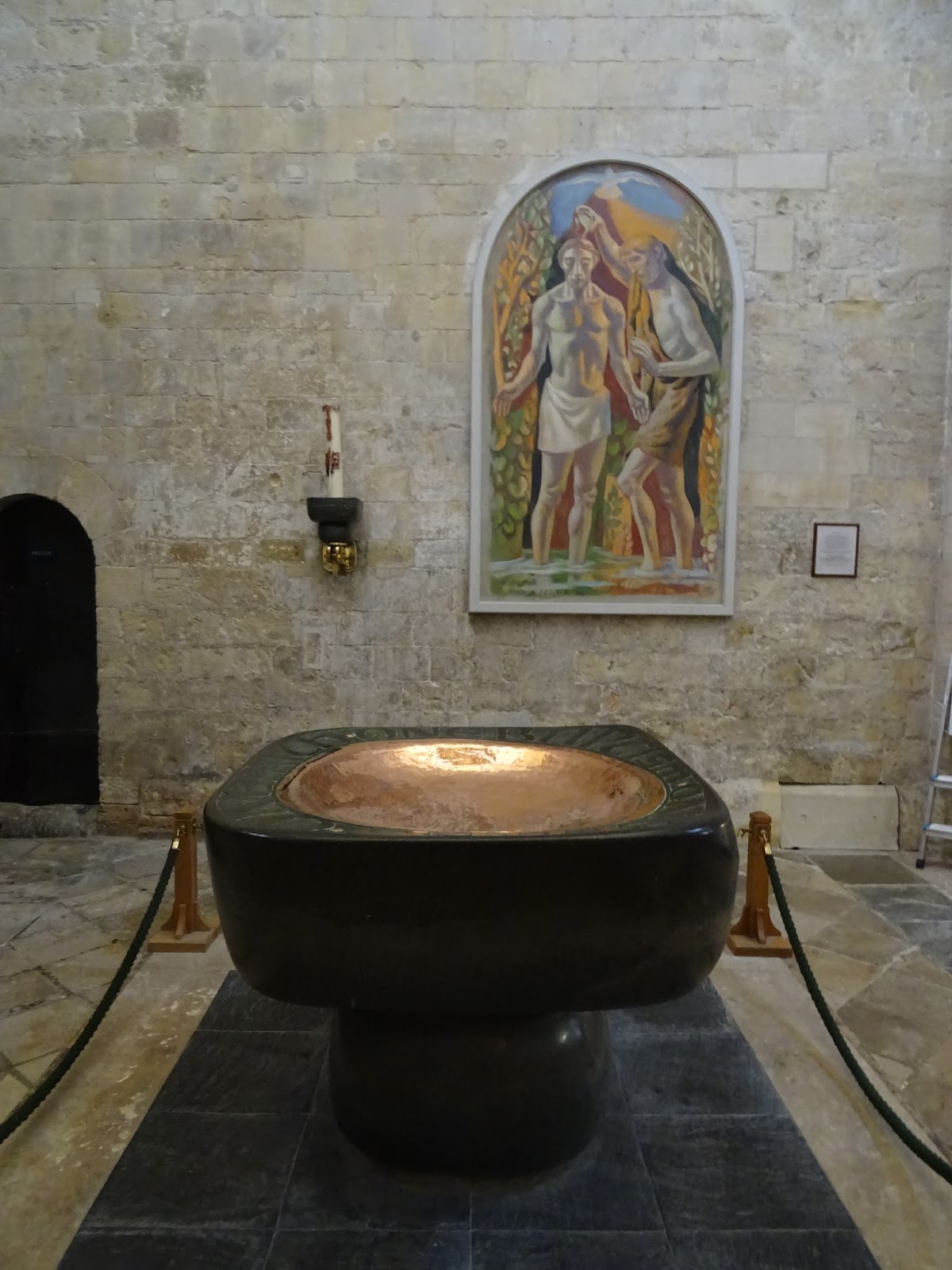
'... the mix of commissions at Chichester Cathedral—from the “riot of colour and symbol” in the Piper tapestry to the glow of Hans Feibusch’s tender Baptism, the harmonious whole that is the Icon of the Divine Light by Cecil Collins to the fractured energies of Ursula Benker-Schirmer’s tapestry for the Shrine of St. Richard—genuinely invigorate and beautify the cathedral while introducing variety and intrigue into the experience of visiting and worshipping here. Tourists are encouraged to do both during their visit by prayers on the hour and use of the leaflet “A Spiritual Tour of Chichester Cathedral,” which has been designed to help people pray as they walk around the space.'

This Church of the Month report follows on from others about Aylesford Priory, Canterbury Cathedral, Chapel of St. Thérèse of the Child Jesus and the Holy Face, Hem, Chelmsford Cathedral, Coventry Cathedral, Église de Saint-Paul à Grange-Canal, LumenMetz CathedralNotre Dame du Léman, Notre-Dame de Toute Grâce, Plateau d’Assy,Romont, Sint Martinuskerk Latem, St Aidan of Lindisfarne, St Alban Romford, St. Andrew Bobola Polish RC Church, St Margaret's Ditchling and St Mary the Virgin, Downe, and St Paul Goodmayes, as well as earlier reports of visits to sites associated with Marian Bohusz-Szyszko, Marc Chagall, Jean Cocteau, Antoni Gaudi and Henri Matisse.

----------------------------------------------------------------------------------------------

Karl Jenkins - The Armed Man.

Saturday, 22 August 2015

Chichester Cathedral: a reconciliation of the Artist and the Church


One of the distinguishing features of Chichester Cathedral, is the use of modern works of art to invigorate and beautify the cathedral. This idea, initiated by Bishop George Bell in the early 1950s, was largely put into effect by Walter Hussey during his deanship between 1955-77.

On 27th June 1929, the day he became Bishop of Chichester, George Bell famously expressed, in his enthronement address, his commitment to a much closer relationship between the Anglican Church and the arts:

‘Whether it be music or painting or drama, sculpture or architecture or any other form of art, there is an instinctive sympathy between all of these and the worship of God. Nor should the church be afraid to thank the artists for their help, or to offer its blessing to the works so pure and lovely in which they seek to express the Eternal Spirit. Therefore I earnestly hope that in this diocese (and in others) we may seek ways and means for a reconciliation of the Artist and the Church—learning from him as well as giving to him and considering with his help our conception alike of the character of Christian worship and of the forms in which the Christian teaching may be proclaimed.’

The concluding sentence of the rationale that Canon Walter Hussey, Dean of Chichester Cathedral, provided for Marc Chagall as a brief for his stained glass window at the Cathedral based on Psalm 150 read as follows:

‘… it has been the great enthusiasm of my life and work to commission for the Church the very best artists I could, in painting, in sculpture, in music and in literature.’

Between these two statements, both in terms of concept and commission, lie many of the works still to be seen in the cathedral. These include:
Paintings:
Tapestries:
Stained glass:
  • a window by Marc Chagall, based on the theme of Psalm 150 '...let everything that hath breath praise the Lord' (1978). 
Embroideries:
  • a panel behind the bishop's throne designed by Joan Freeman (1993), and hassocks in the Presbytery designed by Sylvia Green (1995), were all were worked by members of the cathedral's Seffrid Guild
Cast aluminium:
  • All by Geoffrey Clarke - candlesticks and communion rails in St Mary Magdelane's Chapel (1960-62); Pulpit (1966); Lectern (1972).
Stone:
  • Font - polished polyphant stone and beaten copper by John Skelton (1983) 
  • Altars - in the retro-choir, St Mary Magdalene's chapel and the high altar by Robert Potter. 
Sculptures:
  • 'Virgin and Child' by John Skelton (1988)
  • 'Christ in Judgement' by Philip Jackson (1998). 
  • 'The Refugee' by Diana Brandenburger has been loaned to the Cathedral in memory of George Bell, as he was a "Champion of the oppressed."
  • Outside the cathedral, a magnificent statue of St Richard by Philip Jackson, a gift from the Friends of the cathedral to mark the Jubilee. 
---------------------------------------------------------------------------------------------

Leonard Bernstein - Chichester Psalms.

Saturday, 26 July 2014

Sabbatical art pilgrimage: Chichester Cathedral


‘… it has been the great enthusiasm of my life and work to commission for the Church the very best artists I could, in painting, in sculpture, in music and in literature.’

This was the concluding sentence of the rationale that Canon Walter Hussey, Dean of Chichester Cathedral, provided for Marc Chagall as a brief for his stained glass window at the Cathedral based on Psalm 150. This window was the conclusion to the remarkable series of commissions by Hussey; firstly at St Matthews Northampton and then at Chichester Cathedral.

Bishop George Bell strongly supported the appointment of Walter Hussey as Dean of Chichester Cathedral to take forward the commissioning programme he had initiated there as part of his wider programme to reinvigorate the Church’s patronage of the Arts. Other Anglican clergy such as Vincent McKenna, Moelwyn Merchant and Bernard Walke played their part in this work of reinvigoration but it is Hussey’s commissions of William Albright, W.H. Auden, Leonard Bernstein, Benjamin Britten, Chagall, Cecil Collins, Gerald Finzi, Henry Moore, Norman Nicholson, John Piper, Ceri Richards, John Skelton, Graham Sutherland, Michael Tippett and William Walton which stand out, in the fields of literature, music and the visual arts, as truly significant in their own right and for the reinvigoration of the Church’s patronage of the Arts. For his commissions at St Matthews and Chichester Cathedral, Kenneth Clark memorably described him as 'the last great patron of art in the Church of England.'

Peter Webster notes that while ‘the period from the mid-1960s onwards’ in fact saw an ‘upsurge in commissioning activity’ and that, ‘emboldened by the examples of Chichester, and Coventry Cathedral, authorities in cathedrals and in newly built parish churches began to commission new works of art for those buildings,’ ‘it was also the case that the high-water mark of the Church’s engagement with the leaders in British art had in fact already been reached:’

‘Never again in the twentieth century was the Church to achieve the same contact with artists of the stature of Henry Moore and Graham Sutherland, and indeed Hussey’s commissions as he neared retirement were of his own generation or older. The art world became more and more fragmented, with a bewildering variety of styles, each developing according to its own particular internal logic. The church continued to commission contemporary art, but now of certain styles amongst the many. Generally, commissions were confined to figurative art, since the task of interpreting abstract work in a Christian way presented considerable challenges. It had been the vision of men like Bell and Hussey that the church should position itself in the mainstream of the nation’s life, including its art. There had now ceased to be a clearly visible mainstream in which the church could position itself.’

This more difficult terrain to negotiate is, perhaps, indicated by the repeated refusal of permission from the Cathedrals Fabric Commission for England (CFCE) for the application made by the Chapter of Chichester Cathedral to commission Jaume Plensa's Together for installation in the Cathedral as the Hussey Memorial Commission. The grounds for rejection in this case are to do with the perception of significant change in the character of the space above the Arundel Bell Screen as a result of the installation.

New commissions in settings where there is existing artwork/architecture have to take into account issues of harmonisation or dissonance i.e. to what extent will the new commission be integrated with whatever is already there or by being dissonant raise questions about what is already there. Artworks integrated within the life and architecture of a church are not viewed in the same way as works within the white cube of a gallery space and this needs to be understood and handled with sensitivity during the commissioning process. The result can be a sense of overall integrity and harmony within a space which holds great variety and diversity and where this occurs the whole and its constituent parts image something of the Trinitarian belief – the one and the many - which is at the very heart of Christianity.

In my view the commissioning process at Chichester and the artist himself have fully taken these issues into account in their proposal and the CFCE’s decision is deeply disappointing for all involved with this commission. The impasse demonstrates that commissions for churches continue to have significant potential for controversy. Having visited on my sabbatical art pilgrimage several churches associated with commissions perceived to be controversial at the time of their installation, such as Albert Servaes’ Stations of the Cross, Henry Moore’s Madonna and Child and Germaine Richier’s Crucifix, it seems to me that controversies of modern art, whether the reception of the works themselves or that of their challenging content, are, with time, resolved as congregations live with the works and learn to value the challenge of what initially seemed to be scandalous.

Certainly, the mix of commissions here - from the ‘riot of colour and symbol’ in the Piper tapestry to the glow of Hans Feibusch’s tender Baptism or from the harmonious whole that is the Icon of Divine Light by Cecil Collins to the fractured energies of Ursula Benker-Schirmer’s tapestry for the Shrine of St Richard – genuinely ‘invigorate and beautify the cathedral’ while introducing variety and intrigue into the experience of visiting and worshipping here. Tourists are encouraged to do both during their visit by prayers on the hour and use of the leaflet ‘A Spiritual Tour of Chichester Cathedral’ which has been designed to help people pray as they walk around the Cathedral.

Hussey believed that ‘True artists of all sorts, as creators of some of the most worthwhile of man’s work, are well adapted to express man’s worship of God.’ When this is done consciously, he suggested, ‘the beauty and strength of their work can draw others to share to some extent their vision.’ This thought underpinned his brief to Chagall for the window based on Psalm 150 and titled The Arts to the Glory of God which takes as its theme ‘O praise God in his holiness … Let everything that has breath praise the Lord.’

Charles Marq, Chagall’s collaborator on his windows, wrote: ‘The triumphal quality of this chant is expressed by the dominance in the composition of the colour red (red on white, on green, on yellow), broken by a certain number of green, blue and yellow blobs. This is the first time that Marc Chagall has conceived a subject composed entirely of small figures; it is the people in festive mood glorifying the Lord, exalting his greatness and his creation.’ The work, he suggests, communicates a ‘message of glory and praise.’ (Chagall Glass at Chichester and Tudeley, Ed. By Paul Foster, Otter Memorial Paper No. 14)

Hussey, who had shown an interest in the arts, music, drama, painting and sculpture from his school and university years and who in his entry in Who's Who gave his sole recreation as ‘enjoying the arts,’  ‘acquired animportant and varied collection of his own’ which, on retirement, he offered to leave ‘to the city which he had done so much to promote as a centre of the arts:’

‘Like many others he was concerned about the neglect into which Pallant House, a fine example of eighteenth-century domestic architecture, had fallen and, as Dr KME Murray wrote 'his generous offer...was made deliberately as a means of securing the restoration of the house and its opening to the public'. In 1982 Hussey was present at the official opening of the house and saw his paintings and other works of art displayed in the same informal domestic setting as they had been at the deanery where he had taken so much pleasure in showing them to friends and strangers alike.’

Pallant House, which has been described as ‘a jewel of a gallery’ and as ‘one of the most important galleries for British modern art in the country,’ is now home to a Collection of British Modern art frequently described as one of the best in the UK. with important works by Gino Severini , Ivon Hitchens, Henry Moore, John Piper, Graham Sutherland, Patrick Caulfield, Michael Andrews, Peter Blake and Richard Hamilton.

Bell and Hussey also supported the development of a nationally significant collection of mid-20th century British art by the Otter Gallery which forms an integral and vital part of the University of Chichester. This gallery is home to an extensive collection of art that includes works across all disciplines. It offers a welcoming and accessible space for art to both its immediate community of staff and students and diverse audiences beyond. Core to the gallery's mission is its original intention to place art at the heart of people's lives. By 2020 the Gallery intends to be a stimulus for research and learning, exploring new perspectives and insights through practice, display interpretation and engagement.

The collection was started in 1947 when Eleanor Hipwell, head of art for the Bishop Otter College, acquired three paintings from an exhibition held at the Victoria and Albert Museum in order to display them in the University. Shortly afterwards, Miss K E Murray was appointed as a new Principal. Along with Eleanor Hipwell's successor, Sheila McCririck, Miss Murray pursued a determination to develop a collection of contemporary art that would inspire and inform the students of the University. The acquisition of quality work with inadequate monetary resources was a demonstration of Miss Murray's persuasive persistence. The support of Bell, who was Chairman of the Bishop Otter College Council, and Hussey was vital in helping to promote acceptance of an acquisitions policy that included controversial and challenging pieces such as Patrick Heron's Black and White.

I visited while a selection of the permanent collection was on display. Connected Collections enables visitors to explore and contemplate the various aesthetic, historical, stylistic and social juxtapositions between diverse yet inter-linked artworks and their makers, inviting further connections and new discoveries of their own. Among the ceramics on display, comparisons can be made between makers such as Alison Britton, Michael Cardew, Ewen Henderson, Bernard Leach, Eric James Mellon and Lucie Rie, while oil paintings, watercolours and prints by artists including Elizabeth Blackadder, Sandra Blow, Mary Fedden, Terry Frost, Graham Sutherland and Alfred Wallis serve to highlight just some of the connecting themes between two and three dimensional works.

On visiting I was surprised to discover that the collection also includes Jean Lurçat’s altarpiece tapestry The Creation in the College’s Chapel and Geoffrey Clarke’s aluminium sculpture of The Crucifixion above the Chapel’s entrance. Lurçat’s altarpiece here is a vast improvement on that at Notre-Dame de Toute Grâce du Plateau d'Assy which is entirely lacking in the menace required for a tapestry focused on apocalyptic imagery. This tapestry has been temporarily replaced by screenprint produced by students and inspired by the tapestry. In this work the accent is on beauty and wonder in a towering conception where seeds and birds soar in heightened colours.

Clarke’s sculpture, attached to the gable of the chapel immediately over the entrance door, ‘incorporates the figures of the two thieves who were crucified alongside Christ.’ The sculpture also ‘holds a nugget of glass, a symbol of the eye of God.’ Clarke has used words such as ‘illumination; inspiration; light; kindling of mind and spirit; vision’ to describe the work and was commissioned to create this piece after completing commissions for the Cathedral.

Also alongside the Chapel is John Skelton tau cross entitled Axis Mundi. Skelton created this work while in residence at Bishop Otter College. The vertical block represents life and the horizontal represents the after-life. Both sculptures feature on a sculpture trail around Chichester - http://www.publicsculpturesofsussex.co.uk/files/Chichester-Sculpture-trail.pdf.

While it is true that, Peter Webster notes, Hussey’s mode of patronage, which ‘depended on a discerning patron, authoritative critic and notable artist working in tandem, disseminating new art downwards to a grateful if uncomprehending public’ was a way of working which was, by the time of his retirement, ‘no longer fit for purpose,’ it had nevertheless accomplished significant achievements across a wider field than church commissions alone and had made a major contribution to reinvigorating the Church’s patronage of the Arts.


---------------------------------------------------------------------------------

Leonard Bernstein - Chichester Psalms.

Friday, 25 July 2014

Sabbatical art pilgrimage: St Michael and All Angels Berwick


‘Whether it be music or painting or drama, sculpture or architecture or any other form of art, there is an instinctive sympathy between all of these and the worship of God. Nor should the church be afraid to thank the artists for their help, or to offer its blessing to the works so pure and lovely in which they seek to express the Eternal Spirit. Therefore I earnestly hope that in this diocese (and in others) we may seek ways and means for a reconciliation of the Artist and the Church—learning from him as well as giving to him and considering with his help our conception alike of the character of Christian worship and of the forms in which the Christian teaching may be proclaimed.’
On 27th June 1929, the day he became Bishop of Chichester, George Bell famously expressed, in his enthronement address, his commitment to a much closer relationship between the Anglican Church and the arts.
Bell had been intent on re-establishing the link between the Church and the arts from his early days as Dean of Canterbury (1924-9) where he had begun with religious drama, commissioning in 1928 a new play for the cathedral from John Masefield; an event which in large part led to the establishing of a series of Canterbury plays, including Murder in the Cathedral by T.S. Eliot. He went on to commission drama, music and visual art, put structures in place (e.g. the Sussex Churches Art Council and its ‘Pictures in Churches Loan Scheme’) to support a wider commissioning of artists, placed his trust in the vision of artists when they encountered opposition and he was called on to adjudicate on commissions and strongly supported the appointment of Walter Hussey as Dean of Chichester Cathedral to take forward the commissioning programme he had initiated there.
Bell viewed his drive to re-associate the Church and the Arts as being “an effective protection against barbarism, whether the barbarism was Nazism, materialism or any other threat to civilization.” Murals commissioned from Duncan Grant, Vanessa Bell and Quentin Bell in 1941 for the Sussex Church of St Michael & All Angels Berwick represented a fulfilment of his vision be a catalyst for promoting the relationship between the Arts and the Church. As Sir Kenneth Clarke wrote in 1941: “...with a little judicious publicity it might have the effect of encouraging other dioceses to do the same. If once such a movement got under way, it would have incalculable influence for the good on English Art.”
The commission for the murals came about in the following way:
‘Sir Kenneth Clark announced in a letter to the Times (1939) the formation of the Central Institute of Art and Design (CIAD) whose purpose was to respond to the plight of artists in wartime … It was a cause that Bell passionately identified with and almost immediately he took up the challenge of stimulating Church patronage of the Arts within his own diocese. He received enthusiastic support from Sir Kenneth Clark at the CIAD and within his diocese from Professor Charles Reilly who had a home near Brighton. The CIAD introduced Bell to the Society of Mural Painters whose membership included both Hans Feibusch, who offered to undertake commissions in the Diocese for no fee, and Duncan Grant who was also a committee member of the CIAD …
Feibusch was the first to complete murals in the Diocese and Prof. Reilly heralded his work at St Wilfrid's, Brighton in 1940 as the first ‘modern’ murals in any English church. By ‘modern’ he meant: a painting belonging to the present generation and based in its forms and colour on the revolution in the graphic arts brought about by the researches and experiments of Cezanne and Picasso.
Prof. Reilly was credited by Bishop Bell with the idea of taking the project to a new level by proposing Duncan Grant undertake a scheme at Berwick. For the first time a modern artist of national standing would undertake a complete decorative scheme for an historic rural church. If the project was successful, they believed it would stimulate demand for commissions in churches all over the country to alleviate the plight of many artists.’
‘Duncan Grant (1885-1978) was the lead artist for the murals and put forward the initial proposals. He moved with Vanessa Bell (1879 – 1961) and her husband, Clive, to Charleston Farmhouse at the foot of the Downs, three miles to the west of Berwick Church, in 1916. Vanessa was sister of Virginia Woolf.
Quentin Bell (1910-1996) was the son of Vanessa and Clive Bell and undertook all the paintings within the Chancel as well as ‘The Supper at Emmaus’ at the end of the north aisle.’
They ‘had in view a ‘decorative scheme’ which, rather than simply being a series of individual paintings within frames, would create an environment with its own particular feeling and aesthetic.’ ‘The six larger works are Christ in Glory and a crucifixion scene, The Victory of Calvary, by Duncan Grant; The Supper at Emmaus and The Wise and Foolish Virgins by Quentin Bell; and The Annunciation and The Nativity by Vanessa Bell.’ 
Grant’s work was ‘influenced by his travels in Italy where, as an art student, he had seen the mosaics at Ravenna and copied the frescoes of Piero della Francesca (1420-1492) at Arezzo. Then in Paris he had copied works by Chardin (1699-1779) portraying scenes from everyday life, ordinary people in work or recreation. At the same time he studied the work of the Impressionists and was later greatly influenced by the Post-Impressionists such as Cezanne, Seurat, and others …
The murals at Berwick exhibit influences from all these traditions, but also something of the artists’ focus on the intimacy of the home and personal relationships and their love of the beauty and simplicity of the Downland landscape.’
Berwick Church was unusual in that ‘the plain leaded lights in its nave did not have figures or colour to clash with the paintings around them, and this was even more pronounced after bomb damage caused them to be replaced with completely plain glass. This gives beautiful views of the surrounding Sussex countryside, which seem to complement rather than compete with the paintings, many of which have the same countryside as their background.’
‘The Berwick commission required the agreement of both the local Parochial Church Council and also the Chancellor of the Diocese. He was himself advised by the Diocesan Advisory Committee (DAC) …
However, just before the Chancellor could give his authorisation, one member of the parish lodged a formal petition objecting to the murals. This triggered a 'Consistory Court' hearing at which evidence was heard from both those in favour and those opposed to the scheme. Bishop Bell along with members of the CIAD felt that much of the future of Church Patronage of the arts might rest upon this commission.
In the small flint schoolhouse, just down the lane from the church on 1st October 1941, the court heard evidence from Sir Kenneth Clark, Bertram Nicholls and Frederick Etchells in support of the scheme. The sincerity of the artists was emphasised along with their generosity in asking for only a fraction of what the work would normally cost. Despite the objections, the Chancellor authorised the commission to go ahead.’
It is difficult to measure the impact that Bishop Bell, and the Berwick murals in particular, have had on Church patronage of ‘modern art’. Grant was only to receive one other church commission – frescoes painted in 1959 for Lincoln Cathedral’s Russell Chantry - and the catalytic effect for which Bell had hoped did not materialise in any dramatic way. However, much commissioning did take place in the post-war years particularly where reconstruction to damaged churches was needed. The murals themselves looked back in terms of style to the grand ‘tradition of ecclesiastical art’ while their content was nostalgic for a past picture of rural England which was rapidly being lost. Both factors meant that the scheme at Berwick could not serve as a model for Church patronage of modern art as Bell had hoped. To visit Berwick today in the context of my wider sabbatical art pilgrimage makes clear that it is no more than a beautiful siding or cul-de-sac in the history of the revival of sacred art in the twentieth century.
The artists at Berwick were considered ‘avant garde’ in their day but they actually produced a scheme for the church which drew heavily on the ‘tradition of ecclesiastical art.’ They paid ‘homage to the high points of the artistic heritage of a European Civilization’ which was, at that time, in turmoil. Though they were modern artists they expressed ‘a respect for both the history and tradition of art and the simplicity of the setting and community for whom they were painting.’
The murals are, like those of Stanley Spencer in the Sandham Memorial Chapel at Burghclere, ‘a unique example of war art:’
‘They record the landscape, the people, and the way of life that was under threat. Christ in Glory depicting, amongst the three servicemen shown, Douglas Hemming who was killed at Caen, takes on a war memorial role. Their religious content reflects the belief of their patron that Christianity was the central pillar of a European civilization that was under threat from the despotic forces of evil.’
As with Spencer’s murals, the artist’s love for and use of ‘local people and the local landscape showed how the divine was a part of the everyday’ enabling them to ‘sense the closeness of God to their own lives.’  As Bell put it in his dedication sermon: ‘The pictures will bring home to you the real truth of the Bible story ... help the pages of the New Testament to speak to you - not as sacred personages living in a far-off land and time, but as human beings ... with the same kind of human troubles, and faults, and goodness, and dangers, that we know in Sussex today.’
-----------------------------------------------------------------------------------------------------
Extreme - Ghost.

Saturday, 10 May 2014

Sabbatical art pilgrimage: St Alban the Martyr Holborn


St Alban the Martyr Holborn is reached via an alleyway from Chancery Lane and is entered via a short passageway and courtyard leading to the south transept where the entrance to the church and a small chapel dedicated to Father Mackonochie (the first incumbent of St. Alban's and a pioneer in bringing Anglo-Catholicism to the slum dwellers of Victorian London) can be found.
 
The original building by William Butterfield and dating from 1859 was burnt out in 1941 as a result of firebombs before being restored 1959-61 by Adrian Gilbert Scott. The building has therefore experienced its own death and resurrection and the resurrected Christ is encountered both at its entrance in the form of Hans Feibusch’s sculpture Resurrected Christ and on its East Wall where Feibusch’s immense mural of The Trinity in Glory features the resurrected Christ at its centre.

The mural from 1965-6 which fills the east wall with colour and vitality measures 29 ft. by 50 ft. (8.8 m by 15.2 m) and contains more than fifty principal figures but was executed by Feibusch, with assistance from Phyllis Bray, in only three months. Among those fifty principal figures, Fr. Mackonochie, is shown wearing green vestments, together with other clergy who have worked in St. Alban's, including the Vicar at the time of the painting, Father Peter Priest. In 1969-70 Feibusch then painted fourteen Stations of the Cross which were marouflaged to the north and south walls of the Church.


As a German Jewish émigré who became a refugee from the Nazis, Feibusch would no doubt have profoundly understood a ministry like that of Fr. Mackonochie which was described by a non-Christian contemporary as bringing “light into the dark places, and beauty and orderliness and peace before weary eyes and harassed minds, and sweet and ennobling music to ears accustomed to discordant curses, and screams of anger, and cries of pain.” Enthusiasm for humanity in whom the divinity of Christ could be seen was the essence of Fr. Mackonochie’s faith and actions.


Feibusch captures this essence in the most expressive set of Stations with bold yet bleached, non-naturalistic pastel colours painted in oils specially mixed for him by Winsor and Newton. Greens, yellows, pinks, mauves and blues are utilised to convey pathos in every panel. The sorrowing sadness of his selfless sacrifice is fully realised in paintings which image passion without straining for effect.


These same colours then explode in a vision of glory which both ascends in diagonals of green, yellow and blue while also circling the risen Christ with images of liberation and devotion. Freedom from imprisonment, healing from handicap, filling with the Spirit; all lead to adoration of the Trinity which then results in ministry to those requiring release. In the words of the artist, “a continuous upward-flowing stream of anonymous worshippers.” The Trinity in Glory is a celebration of liberation; a depiction of Christ’s Isaianic manifesto which fuelled and fuels the ministry of this church.  


My mid-morning visit comes too soon for the daily lunch‑time mass in Fr. Mackonochie’s chapel which ministers to office workers in the area as well as to St Alban's regulars;  Fr Mackonochie's emphasis on the Mass remains as the heart of worship here. As I sit in the silence of echoes which is the soundspace of empty churches, echoes of footsteps reverberate in the silence from the passageway to courtyard to church. A black-suited, shaven-headed man enters, approaches the sanctuary, kneels for an instant before The Trinity in Glory rises and exits, crossing himself on the forehead with holy water as he leaves. What brought him and what touched him? Light in dark places, beauty and orderliness and peace before weary eyes and harassed minds, sweet and ennobling music to ears accustomed to discordant curses, and screams of anger, and cries of pain?

---------------------------------------------------------------------------------------------------

Woven Hand - The Good Shepherd.