Wikio - Top Blogs - Religion and belief
Showing posts with label commemoration of the departed. Show all posts

Sunday, 2 November 2025

Home at last


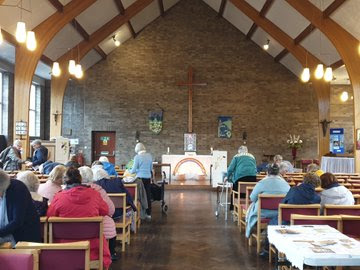
Here's the sermon I shared this evening in our Commemoration of the Departed Service at St Andrew’s Wickford:

‘In 2019, Natalie Bergman was poised to step on to the stage at New York’s Radio City Music Hall with her brother Elliot and their band Wild Belle. It should’ve been a glorious night for the siblings, but before they could play even a single note, they received earth-shattering news: their father and stepmother had been killed by a drunk driver.

Bergman was especially close to her father, considering him her mentor and biggest fan, and his sudden death left her isolated and adrift. “We ended the tour immediately. It also seemed to kind of end my musical ambitions all at once,” she told NPR’s Simon Scott. “I felt as though I lost my identity with his death. I just didn’t really understand who I was.”

After months of grieving, Bergman decided to embrace her sense of isolation even more fully and visited a monastery in the remote California wilderness. During that time of silence, prayer, and reflection spent observing the monastery’s rituals and listening to the monks’ chants, music slowly began easing its way back into her life. Thus were sown the seeds for what would become Bergman’s first solo album, titled simply Mercy’, from which we have just heard the song ‘Home At Last’.

Natalie has explained simply and clearly how it happened: “When I began writing, I had already lost the greatest love I’ve ever had, so I had nothing else to lose. I went for it. I sang from the depths of my sorrow and I witnessed a little light while doing so.”

On the album, she finds different sources of hope and help. ‘Talk To The Lord’ quotes Psalm 23 – ‘Though I walk in shadows, I won't be afraid / I will fear no evil / For You walk with me’ – in order to state that:

‘When you are scared, reach out your hand
Talk to the Lord, talk to the Lord
If you are sad, He'll dry your tears
Talk to the Lord, talk to the Lord’

In ‘I Will Praise You’, she says ‘When I'm broken, I will sing Your name’, while ‘Shine Your Light On Me’ also quotes Psalm 23 in a prayer for light as she cries like a ‘mourning dove’ for her ‘greatest love’. ‘Paint The Rain’ documents difficult days but discovers that:

‘In this pain, you make me sing
When I am blue, you take me in
My little ways, they feel strange
You give me a little bit, and you take it away
You paint the rain’

In these ways, she has been enabled to live again and to find joy particularly in family life. These can all be significant helps for us in our journeys through grief as well. There is one more specific help that Natalie Bergman received from her time at the Chama Valley Monastery:

‘one of the most important answers that I got from the heavenly father is that heaven is a realm that exists and we have no idea what it is. I did a lot of reading there, and one of the scriptures I read was that, “Everything the eye has seen, and the mouth has tasted, and the heart has felt, that is not what heaven is.” Heaven is such a different realm than anything we’re even capable of experiencing, and it’s this great mystery, which is why it’s so hard and challenging to have such a strong faith because no one is promised this. I really needed to know that it existed because I need my father to be there and I need my mother to be there, whether it’s a physical place or a spiritual one. Whatever this place is, I learned that it indeed exists and that was the greatest comfort to me. That was the biggest thing I took from the monastery.’

It is this understanding that she explores in ‘Home At Last’. The song begins:

‘I come to You to answer my prayer
I long to know about Heaven
After the body dies
Where does the soul begin?
Where have all the good people gone?
The people that I love
Have they gone to the Garden
Where the tree of life grows tall
And the weeping is no more?’

In the song she asks specifically of her father, ‘Is he home at last?’, and ends the song with the repeated assurance that ‘Yes’, ‘He is home at last’.

This is the assurance that Jesus gave to his disciples in the teaching he gave them at the Last Supper before his own death on the cross (John 14.1-7). He said then that he was going from them into death to prepare a place for them among the many dwelling places in his Father’s house and that if he was going away from them for that task, he will come again and will take them and us to himself, so that where he is, there we may be also.

This is the promise that Natalie Bergman came to realise was true for her father, as it is also for us and for those we have lost. This is why at the end of every funeral I take I pray these words: ‘Lead us to a place of peace and refreshment; guide us to springs of life-giving water; wipe away the tears from our eyes and bring us to heaven where there is no more death, no more grief or crying or pain in your presence, Father, Son and Holy Spirit.’ Heaven is the place where ‘Where the tree of life grows tall / And the weeping is no more’.

Jesus describes being with God in homely terms that we can all understand. He says it is like being in God’s house with a special room already prepared for us. Our homes are usually where we feel most secure – we feel “at home” there – and our rooms tend to reflect our unique personalities as we fill them with things that we like and which interest us. So, Jesus is talking here about the way in which God knows each of us, knows what we need and is actively preparing for when we go to be with him.

So, God is prepared to welcome us but have we prepared ourselves to meet with God? Often, we are like Thomas in this reading and like Natalie Bergman before the death of her father, we don’t know where we are going or who we will meet when we get there and so we can be afraid of death and of dying.

God has given us a way of getting to know him before we die and that is by coming to know Jesus Christ for ourselves. As Jesus says in his reading, he is the way we can come to know God for ourselves because he is God himself. He is the truth about God because when we look at Jesus, we see what God is actually like, someone who is prepared to sacrifice everything in order to show his love for us. And he is the life of God, the one who can take us by the hand and lead us into everlasting life together with God.

So, as Natalie Bergman discovered and as she sings in ‘Talk To The Lord’:

‘When you are scared, reach out your hand
Talk to the Lord, talk to the Lord
If you are sad, He'll dry your tears
Talk to the Lord, talk to the Lord’


See also my review for Seen and Unseen of Natalie Bergman's recent gig at Union Chapel 

-----------------------------------------------------------------------------------------------------------

Natalie Bergman - Home At Last.

Thursday, 2 November 2023

The mother heart of God


Here's the reflection that I shared in today's Mothers' Union Eucharist for All Souls Day at St Andrew's Wickford:

“Jerusalem, Jerusalem ... how many times I wanted to put my arms around all your people, just as a hen gathers her chicks under her wings, but you would not let me!” (Luke 13. 31 – end)

In this statement of his love for the people of Jerusalem, Jesus speaks of his concern and love for Jerusalem being typified by a mother hen gathering together all her chicks under her wing for safety and warmth. Lovingly, Jesus is saying he wants to be like the mother hen gathering God’s people to him where they will then experience safety and love. At the same time that he makes this specific statement to the people of Jerusalem, he is also paying a wonderful tribute to motherhood itself by equating the love which God shows towards us to the love that mothers show towards their offspring.

We tend to think most readily of God as a father but there are several places in scripture where God’s love is described as being like that of mother for her children.

Hannah Whitall Smith wrote “My children have been the joy of my life. I cannot imagine more exquisite bliss than comes to one sometimes in the possession and companionship of a child. To me there have been moments, when my arms have been around my children, that have seemed more like what the bliss of heaven must be than any other thing I can conceive of; and I think this feeling has taught me more of what God’s feelings towards his children are than anything else in the universe. If I, a human being with limited capacity, can find such joy in my children, what must God, with his infinite heart of love, feel towards his; In fact most of my ideas of the love and goodness of God have come from my own experience as a mother, because I could not conceive that God would create me with a greater capacity for unselfishness and self-sacrifice than He possessed Himself; and since this discovery of the mother heart of God I have always been able to answer every doubt that may have arisen in my mind, as to the extent and quality of the love of God, by simply looking at my own feelings as a mother.”

Hannah Whitall Smith lived in the United States in the 1850’s. She was born into a Quaker family but later became a Wesleyan preacher and was one of the inspirations behind the Keswick Convention. She wrote those words about the mother heart of God after reading Isaiah 66. 12 – 13, another passage of scripture in which God’s love for all people is described as being like a mother’s love for her children: "The Lord says, “You will be like a child that is nursed by its mother, carried in her arms, and treated with love. I will comfort you in Jerusalem, as a mother comforts her child.”

Jesus’ focus was on the safety that mothers’ seek to provide for their children out of love. Here, the focus is on the sense of comfort that the child receives from the love of its mother, particularly as it is nursed and fed. Isaiah also used motherly imagery in reference to God in Chapter 49. 15 where the focus is on the faithfulness of a mother’s love:

“The Lord answers,

“Can a woman forget her own baby
and not love the child she bore?
Even if a mother should forget her child,
I will never forget you.”

Nancy Hicks picks up on imagery around nursing the child when she writes about Psalm 131:

“Nursing was one of the most intimate acts I have ever been allowed to participate in, and what joy to be utterly depended upon! But a nursing baby is a demanding baby, “Pick me up NOW! Feed me NOW!” And when she fell asleep in my arms I felt needed, but not really appreciated for anything other than my capacity to satisfy hunger.

Then she was weaned. Now, when she crawled into my lap it was for relationship and comfort and intimacy. I understood God’s delight at the psalmist’s words, “Surely I have composed and quieted my soul; like a weaned child rests against his mother, my soul is like a weaned child within me.” 

In Psalm 131, the Psalmist pictures himself having the kind of intimacy with God that a weaned child has as it cuddles up on its mother’s lap. That intimacy comes after the child has been fed and has moved on from milk to solid food.

So, the picture that we gain from all these descriptions is of God’s love as the love of a mother for her child is that of God wanting to bring us into a place where we feel safe alongside her, where we know the comfort of being fed and therefore grow from the basics of the faith (the milk) to the depths of the faith (the solid food).

Do you experience the love of God in these ways? Have you thought, like Hannah Whitall Smith, that if we can find deep joy in our children, what must God, with his infinite heart of love, feel towards us? God loves you like a mother loves her child. As we reflect together on All Souls Day and pray for the souls of those we have loved and lost, God wants to take us into a deeper relationship with him and at the heart of that relationship is his infinite heart of love beating with the kind of love which mother’s commonly show towards their children. May we open up our lives and hearts to receive that love and enter in to that depth of relationship today! Amen.

There are two final points it is worth us noting. As we have already said, we commonly speak about God as male and yet the scriptures do use, as we have seen, female imagery of God. Interestingly, not just in terms of the mother heart of God, but wisdom and Spirit in particular are often feminine terms. This is of real significance in understanding that women and men are valued equally by God and were created by God to be equal.

Secondly, all talk about God as male and female, Father or Mother, is ultimately only descriptive language. God is always more than any label or image we use to help us understand him. Ultimately, God is Spirit and neither exclusively male or female. It is great to think of God as a loving Father or a loving Mother because those images help us understand and grasp something of the reality and significance of his love but God’s love is always greater and deeper than the love that we have experienced even from the most loving of parents.

Our Service for the Commemoration of the Departed is at 6.30 pm on Sunday at St Andrew's Wickford. All are most welcome.

-------------------------------------------------------------------------------------------------------------

Hildegard von Bingen - Voices of Angels - Voices of Ascension.