Wikio - Top Blogs - Religion and belief
Showing posts with label four essex trios. Show all posts

Saturday, 11 January 2025

Five Trios

'Five Trios' is a series of poems on thin places and sacred spaces in the Diocese of Chelmsford. The five poems in the series are:
The poems have been published by Amethyst Review and International Times.

The series draws inspiration from T.S. Eliot's 'Four Quartets' and, in common, with the 'Thin Places and Sacred Spaces' anthology reflects on the experience of feeling the touch of eternity in art, nature, silence, or sacred architecture. The ‘thin place’ is a Celtic term, originally indicating a specific geographical location where the veil between heaven and earth seems exceptionally thin or lifted altogether. Barking, Bradwell, Broomfield, Pleshey and Runwell are all places in the Diocese of Chelmsford where I have had that experience and where heaven and earth, past, present and future seem to be intermingled.

'Barking' is about St Margaret’s Barking and Barking Abbey and draws on my time as a curate at St Margaret's. My other posts about St Margaret's Barking can be found here, here, here, and here. See also here and here.

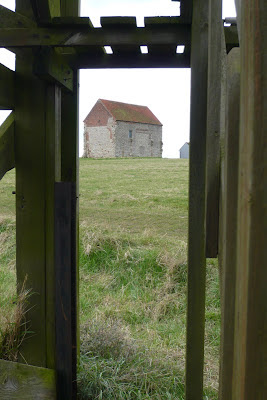
'Bradwell' is a celebration of the history of the Chapel of St Peter-on-the-Wall, the Othona Community, and of pilgrimage to those places. My previous posts about Bradwell and the Othona Community can be found here and here.

Broomfield in Essex became a village of artists following the arrival of Revd John Rutherford in 1930. His daughter, the artist Rosemary Rutherford, also moved with them and made the vicarage a base for her artwork including paintings and stained glass. Then, Gwynneth Holt and Thomas Bayliss Huxley-Jones moved to Broomfield in 1949 where they shared a large studio in their garden and both achieved high personal success. 'Broomfield' reviews their stories, work, legacy and motivations. For more on the artists of Broomfield, all of whom are commemorated there with blue plaques, see here, here, here, here and here.

'Pleshey' celebrates the Diocesan Retreat House at Pleshey in Essex and the legacy of Evelyn Underhill as a retreat director. My posts about Pleshey can be found here and my posts about Evelyn Underhill here. My poem can also be found on the Diocesan Retreat House website here.

'Runwell' takes the reader on a visit to St Mary's Runwell, while also reflecting on the spirituality of the space plus its history and legends. This poem has also been included in the Amethyst Press anthology, 'Thin Places and Sacred Spaces',

I am giving a reading of the five poems accompanied by photographs at St Andrew's Wickford on Friday 31 January at 7.00 pm and am also giving a talk at St Mary with St Leonard Broomfield about two of the Broomfield artists on Saturday 8 February at 2.00 pm.


----------------------------------------------------------------------------------------------------------

International Times: Barking

My latest poem to be published by International Times is entitled 'Barking' and is about St Margaret’s Barking and Barking Abbey. 

It has come to be written because one of the responses to my 'Four Essex Trios' series of poems was a suggestion from the Bishop of Chelmsford that I also write a poem for the Barking Episcopal Area of the Diocese of Chelmsford. This is that poem and it expands the series to become 'Five Trios'.

'Four Essex Trios' is a series of poems on thin places and sacred spaces in Essex. The four poems in the series are:
The poems have been published by Amethyst Review and International Times.

'Bradwell' is a celebration of the history of the Chapel of St Peter-on-the-Wall, the Othona Community, and of pilgrimage to those places. My previous posts about Bradwell and the Othona Community can be found here and here.

Broomfield in Essex became a village of artists following the arrival of Revd John Rutherford in 1930. His daughter, the artist Rosemary Rutherford, also moved with them and made the vicarage a base for her artwork including paintings and stained glass. Then, Gwynneth Holt and Thomas Bayliss Huxley-Jones moved to Broomfield in 1949 where they shared a large studio in their garden and both achieved high personal success. 'Broomfield' reviews their stories, work, legacy and motivations. For more on the artists of Broomfield, all of whom are commemorated there with blue plaques, see here, here, here, here and here.

'Pleshey' celebrates the Diocesan Retreat House at Pleshey in Essex and the legacy of Evelyn Underhill as a retreat director. My posts about Pleshey can be found here and my posts about Evelyn Underhill here. My poem can also be found on the Diocesan Retreat House website here.

'Runwell' takes the reader on a visit to St Mary's Runwell, while also reflecting on the spirituality of the space plus its history and legends. This poem has been included in the Amethyst Press anthology, 'Thin Places and Sacred Spaces',

My other posts about St Margaret's Barking can be found here, here, here, and here. See also here and here.

The series draws inspiration from T.S. Eliot's 'Four Quartets' and, in common, with the 'Thin Places and Sacred Spaces' anthology reflects on the experience of feeling the touch of eternity in art, nature, silence, or sacred architecture. The ‘thin place’ is a Celtic term, originally indicating a specific geographical location where the veil between heaven and earth seems exceptionally thin or lifted altogether. Bradwell, Broomfield, Pleshey and Runwell are all places in Essex where I have had that experience and where heaven and earth, past, present and future seem to be intermingled.

My earlier pieces for IT are an interview with the poet Chris Emery, an interview with Jago Cooper, Director of the the Sainsbury Centre for Visual Arts, plus reviews of: albums by Joy Oladokun and Michael Kiwanaku; Nolan's Africa by Andrew Turley; Mavis Staples in concert at Union Chapel; T Bone Burnett's 'The Other Side' and Peter Case live in Leytonstone; Helaine Blumenfeld's Together exhibition, What Is and Might Be and then Otherwise by David Miller; 'Giacometti in Paris' by Michael Peppiatt, the first Pissabed Prophet album - 'Zany in parts, moving in others, you’ll be hard pressed to find a more unusual, inspired & profound album this year. ‘Pissabed Prophet’ will thrill, intrigue, amuse & inspire' - and 'Religion and Contemporary Art: A Curious Accord', a book which derives from a 2017 symposium organised by the Association of Scholars of Christianity in the History of Art.

Several of my short stories have been published by IT including three about Nicola Ravenscroft's EarthAngel sculptures (then called mudcubs), which we exhibited at St Andrew's Wickford in 2022. The first story in the series is 'The Mudcubs and the O Zone holes'. The second is 'The Mudcubs and the Clean-Up King', and the third is 'The mudcubs and the Wall'. My other short stories to have been published by International Times are 'The Black Rain', a story about the impact of violence in our media, 'The New Dark Ages', a story about principles and understandings that are gradually fading away from our modern societies, and 'The curious glasses', a story based on the butterfly effect.

IT have also published a poem, The ABC of creativity, which covers attention, beginning and creation, 'Broomfield'.

-------------------------------------------------------------------------------------------------------

Tom Yates - Love Comes Well Armed.

Sunday, 15 December 2024

All Saints Stock Harvard: Gwynneth Holt


As part of preparation for my 'People and Stone' talk on 'Broomfield Artists: Thomas Huxley-Jones and Gwynneth Holt' (8 February, 2.00 pm, Broomfield Parish Church), I visited All Saints Stock Harvard briefly this morning to photograph their rood figures carved by Holt.

These are now on the north wall at the west end of the North Aisle. Before 1986 this area housed the Sacristry and was cleared with the building of the new Vestries on the North side of the church. The Rood Figures of Our Lord, Our Lady and St. John were designed in 1955 by Holt and are carved in lime wood. As part of the post war restoration these figures were originally position in the Chancel Arch on a Rood Beam. The figures were incorporated in a hanging rood, still in the Chancel Arch, as part of the 1981 re-ordering but were moved to their present position in about 1990 to open up the view of the East Window.

The Parish Magazine of Stock Harvard (May 1955) contains the following comment about the figure of Christ on the rood beam at All Saints Church: "The figure speaks to us of eternal wisdom combined with eternal youth, and there is about the whole figure and its expression a strength and calmness which communicates itself to people who look at it long enough with a really open mind ... The figure has that strange factor of timelessness which some of the medieval artists secured."

The blue plaque information from Chelmsford City Council records that “In 1952, Holt was elected as a fellow of the Royal Society of British Sculptors. She also produced works in the United States when she visited the Hopkins Centre at Dartmouth College in New Hampshire in both 1963 and 1968. Holt was also known to be one of the Royal Society of Sculptors earliest female members, where she expressed frustration at the sculpture profession being dominated by men. Following her death, Holt’s work has been showcased in many places by both the Royal Society of Sculptors and Chelmsford Museum.” 

In expressing her frustration with the male-dominated nature of her profession, she said: “Women are just as intelligent as men, and their contribution to art is just as valuable: They are not given a chance to take art up seriously. What with looking after the house, there is not much time left for concentrating on art."

Joan Weedon writes that from the time Holt married Thomas Bayliss Huxley-Jones (also a sculptor) “both exhibited at the London, Scottish and West of England academies, the Society of Portrait Sculptors and the Paris Salon. Among the awards Gwynneth won were the Feodora Gleichen award (for 'outstanding work by a woman sculptor') for her 'Mother and Child' exhibited at the Royal Academy, and two at the Paris Salon for 'Arts Decoratif and for sculpture. A set of her wartime figurines of a semi-humorous character [‘Our Gang’], which were cast by the Bovey Tracey pottery, is now in the Imperial War Museum. While living in Aberdeen she also exhibited work in ivories, woods, copper, terracotta and bronze in London and Edinburgh.

[They] moved to Broomfield, Chelmsford, in 1949 where they shared a large studio in their garden [at High House] and both achieved high personal success. Huxley-Jones's brilliant, imaginative figures gained him wide recognition, and he undoubtedly influenced Gwynneth's own style, although her life studies at that time may be perceived as more naturalistic than the style of her husband's large symbolic works.”

“Holt completed many works with a religious theme, or for ecclesiastical buildings, such as His Holiness Pope John XXIII, Hands, The Resurrection and Mother and Child. She completed commissions for the pulpit of St. Andrew’s Church in Hornchurch, Essex; the chapel of the East Mission in Stepney and the limewood The Immaculate Conception for the Church of the Immaculate Conception in Chelmsford.”

“It was for her work in ivory, however, that Holt was most celebrated as a sculptor, and her ivory sculpture Annunciation (1946) received particular praise for her carving skills. Annunciation depicts the Virgin Mary, her palms raised to God, with Gabriel depicted beneath her feet. In the 1972 book Modern Ivory Carving, Holt was described as ‘Britain’s foremost ivory carver’.”

Weedon also notes that: “The demonstrable piety of many of Gwynneth's exhibits created a demand for interpretations of Christian figures and symbols. Eight churches in and around Essex contain her important representations of such figures, and there are other such works traceable to her 'Chelmsford phase'. 

Examples of her work may be seen in the Church of the Immaculate Conception, Chelmsford; Stock Harvard Parish Church, Essex; Balsham Parish Church, Cambs; St Andrew's, Hornchurch, Essex: Downham Church, Essex; Methodist East End Mission, London; Navestock Church, Essex; Buxhall Church, Suffolk; St Leonard's Parish Church, Eynsham.”

Broomfield Parish Church has a prayer desk of light oak decorated on the plain apron front with an applied carved head by Gwynneth Holt. The head of the Virgin Mary is in 20th C style, her bare head emerging from a cowl.

The grave of Holt and Huxley-Jones is to be found in the churchyard St Mary with St Leonard in Broomfield.

My poem 'Broomfield' reviews their stories, work, legacy and motivations together with that of Rosemary Rutherford. For more on the artists of Broomfield, all of whom are commemorated there with blue plaques, see here, here, here, here and here.

--------------------------------------------------------------------------------------------------

Saturday, 7 December 2024

International Times: Emotive Beats

My latest review to be published by International Times is on albums by Michael Kiwanuka and Joy Oladokun:

'Whether you are struggling or content, seeking peace or living the questions, both these artists have much to share that is compelling and challenging because both are vulnerably open about where they are, what they experience and what they believe. Both mesh that honesty to music that is hook-laden and stirring in its quality whether mellow or anguished in the emotive beat of its heart.'

My earlier pieces for IT are an interview with the poet Chris Emery, an interview with Jago Cooper, Director of the the Sainsbury Centre for Visual Arts, plus reviews of: Nolan's Africa by Andrew Turley; Mavis Staples in concert at Union Chapel; T Bone Burnett's 'The Other Side' and Peter Case live in Leytonstone; Helaine Blumenfeld's Together exhibition, What Is and Might Be and then Otherwise by David Miller; 'Giacometti in Paris' by Michael Peppiatt, the first Pissabed Prophet album - 'Zany in parts, moving in others, you’ll be hard pressed to find a more unusual, inspired & profound album this year. ‘Pissabed Prophet’ will thrill, intrigue, amuse & inspire' - and 'Religion and Contemporary Art: A Curious Accord', a book which derives from a 2017 symposium organised by the Association of Scholars of Christianity in the History of Art.

Several of my short stories have been published by IT including three about Nicola Ravenscroft's EarthAngel sculptures (then called mudcubs), which we exhibited at St Andrew's Wickford in 2022. The first story in the series is 'The Mudcubs and the O Zone holes'. The second is 'The Mudcubs and the Clean-Up King', and the third is 'The mudcubs and the Wall'. My other short stories to have been published by International Times are 'The Black Rain', a story about the impact of violence in our media, 'The New Dark Ages', a story about principles and understandings that are gradually fading away from our modern societies, and 'The curious glasses', a story based on the butterfly effect.

IT have also published a poem, The ABC of creativity, which covers attention, beginning and creation, 'Broomfield' and 'Bradwell', which are part of a series of poems on thin places and sacred spaces in Essex called 'Four Essex Trios'.

------------------------------------------------------------------------------------------------------

Friday, 29 November 2024

Thin Places and Sacred Spaces: October online launch


View the recording of the October online launch for Thin Places and Sacred Spaces here. Join editor Sarah Law of Amethyst Press on Friday for an evening hour of poetry readings and discussions on what makes the concept of a thin place so compatible with poetry. To see the September Launch, which includes my reading of 'Runwell', click here.


In this important and wide-ranging new anthology from Amethyst Press, with contributions by over 150 contemporary poets, readers are invited to reflect on and experience the poetry of ‘thin places’. The ‘thin place’ is a Celtic term, originally indicating a specific geographical location where the veil between heaven and earth seems exceptionally thin or lifted altogether. The anthology embraces and expands the concept of thin places and sacred spaces, including:

  • Sacred Locations
  • Sacred Nature
  • Sacred Architecture
  • Sacred Times & Holy Hours
  • The Thin Veil Between Life & Death
  • The Holy Unexpected
  • Thin Places in Art, Poetry & Language
If you have ever felt the touch of eternity in nature or sacred architecture; at specific times of the day or year; in stillness, movement, art, silence or surprise – this collection is for you.

'Runwell' is part of a series of poems on thin places and sacred spaces in Essex called 'Four Essex Trios' and was the first poem in the sequence to be written and published. The poem takes the reader on a visit to St Mary's Runwell, while also reflecting on the spirituality of the space plus its history and legends.

The second poem in the sequence to be published is at International Times and is entitled 'Broomfield' Broomfield in Essex became a village of artists following the arrival of Revd John Rutherford in 1930. His daughter, the artist Rosemary Rutherford, also moved with them and made the vicarage a base for her artwork including paintings and stained glass. Then, Gwynneth Holt and Thomas Bayliss Huxley-Jones moved to Broomfield in 1949 where they shared a large studio in their garden and both achieved high personal success. My poem reviews their stories, work, legacy and motivations. For more on the artists of Broomfield, all of whom are commemorated there with blue plaques, see here, here, here, here and here. I will be giving a talk on 'Broomfield Artists in the Basildon Deanery' at St Andrew's Wickford in December (see below).

The third poem in the series to be published is entitled 'Pleshey' and celebrates the Diocesan Retreat House at Pleshey in Essex and the legacy of Evelyn Underhill as a retreat director. My poem can also be found on the Diocesan Retreat House website here.

'Bradwell', the final poem in the series to have been published, is a celebration of the history of the Chapel of St Peter-on-the-Wall, the Othona Community, and of pilgrimage to those places. My previous posts about Bradwell and the Othona Community can be found here and here.

I also had a poem included in All Shall Be Well: Poems for Julian of Norwich, the first Amethyst Press anthology of new poems. 'All Shall Be Well' is an anthology of new poems for Mother Julian, medieval mystic, anchoress, and the first woman to write a book in English. Lyrical, prayerful, vivid and insightful, these poems offer a poetic testament to Julian's enduring legacy of prayer and confidence in a merciful God who assured her that 'All Shall Be Well, and All Shall Be Well, and All Manner of Thing Shall Be Well.' The anthology has been edited by and comes with an introduction by Sarah Law, editor of Amethyst Review.

My poem for that anthology is based on a large painting 'The Revelations of Julian of Norwich' by Australian artist Alan Oldfield which is to be found at the Belsey Bridge Conference Centre in Ditchingham, Norfolk.

Amethyst Review is a publication for readers and writers who are interested in creative exploration of spirituality and the sacred. Readers and writers of all religions and none are most welcome. All work published engages in some way with spirituality or the sacred in a spirit of thoughtful and respectful inquiry, rather than proselytizing.

The Editor-in-chief is Sarah Law – poet (mainly), tutor, occasional critic, sometime fiction writer. She has published five poetry collections, the latest of which is 'Thérèse: Poems'. Her novel, Sketches from a Sunlit Heaven is a 2023 Illumination Book Award silver medal winner. She set up Amethyst Review feeling the lack of a UK-based platform for the sharing and readership of new literary writing that engages in some way with spirituality and the sacred.

Five of my poems have appeared in Amethyst Review. They are:'Pleshey', 'Runwell', 'Are/Are Not', 'Attend, attend' and 'Maritain, Green, Beckett and Anderson in conversation down through the ages'. To read my poems published by Stride, click here, here, here, here, and here. My poems published by International Times are 'Broomfield' and 'The ABC of creativity'. The latter covers attention, beginning and creation and can be read here.


----------------------------------------------------------------------------------------------------

Launch of Thin Places & Sacred Spaces: an anthology of new poetry

Saturday, 2 November 2024

Four Essex Trios

'Four Essex Trios' is a series of poems on thin places and sacred spaces in Essex. The four poems in the series are:
The poems have been published by Amethyst Review and International Times. 

'Bradwell' is a celebration of the history of the Chapel of St Peter-on-the-Wall, the Othona Community, and of pilgrimage to those places. My previous posts about Bradwell and the Othona Community can be found here and here.

Broomfield in Essex became a village of artists following the arrival of Revd John Rutherford in 1930. His daughter, the artist Rosemary Rutherford, also moved with them and made the vicarage a base for her artwork including paintings and stained glass. Then, Gwynneth Holt and Thomas Bayliss Huxley-Jones moved to Broomfield in 1949 where they shared a large studio in their garden and both achieved high personal success. 'Broomfield' reviews their stories, work, legacy and motivations. For more on the artists of Broomfield, all of whom are commemorated there with blue plaques, see here, here, here, here and here. 

'Pleshey' celebrates the Diocesan Retreat House at Pleshey in Essex and the legacy of Evelyn Underhill as a retreat director. My posts about Pleshey can be found here and my posts about Evelyn Underhill here. My poem can also be found on the Diocesan Retreat House website here.
 
'Runwell' takes the reader on a visit to St Mary's Runwell, while also reflecting on the spirituality of the space plus its history and legends. This poem has been included in the Amethyst Press anthology, 'Thin Places and Sacred Spaces', 

The series draws inspiration from T.S. Eliot's 'Four Quartets' and, in common, with the 'Thin Places and Sacred Spaces' anthology reflects on the experience of feeling the touch of eternity in art, nature, silence, or sacred architecture. The ‘thin place’ is a Celtic term, originally indicating a specific geographical location where the veil between heaven and earth seems exceptionally thin or lifted altogether. Bradwell, Broomfield, Pleshey and Runwell are all places in Essex where I have had that experience and where heaven and earth, past, present and future seem to be intermingled.

----------------------------------------------------------------------------------------------------------

Rev Simpkins - Gathering Grounds.

International Times: Bradwell


The fourth poem in my series of poems on thin places and sacred spaces in Essex called 'Four Essex Trios' has been published today by International Times. 'Bradwell' is a celebration of the history of the Chapel of St Peter-on-the-Wall, the Othona Community, and of pilgrimage to those places. My previous posts about Bradwell and the Othona Community can be found here and here. 

The first poem in the sequence to be written - 'Runwell' - was also published by Amethyst Review and has recently been included in the Amethyst Press anthology, Thin Places and Sacred Spaces, This poem takes the reader on a visit to St Mary's Runwell, while also reflecting on the spirituality of the space plus its history and legends.

The second poem in the sequence to be published is at International Times and is entitled 'Broomfield' Broomfield in Essex became a village of artists following the arrival of Revd John Rutherford in 1930. His daughter, the artist Rosemary Rutherford, also moved with them and made the vicarage a base for her artwork including paintings and stained glass. Then, Gwynneth Holt and Thomas Bayliss Huxley-Jones moved to Broomfield in 1949 where they shared a large studio in their garden and both achieved high personal success. My poem reviews their stories, work, legacy and motivations. For more on the artists of Broomfield, all of whom are commemorated there with blue plaques, see here, here, here, here and here. I will be giving a talk on 'Rosemary Rutherford's Religious Art' at St Mary with St Leonard Broomfield today, together with Kathy Rouse (see below). This talk will be followed, in December, by a talk on the Broomfield artists at St Andrew's Wickford (see below).

The third poem in the sequence to be published was 'Pleshey', which was published by Amethyst Review. This poem celebrates the Diocesan Retreat House at Pleshey in Essex and the legacy of Evelyn Underhill as a retreat director.  My posts about Pleshey can be found here and my posts about Evelyn Underhill here.


----------------------------------------------------------------------------------------------------------

Rev Simpkins - In The Marsh A Desert.

Wednesday, 23 October 2024

October online launch for 'Thin Places and Sacred Spaces'


The October online launch for Thin Places and Sacred Spaces is this Friday, October 25th, 7-8PM BST. All are welcome to attend. Join editor Sarah Law of Amethyst Press on Friday for an evening hour of poetry readings and discussions on what makes the concept of a thin place so compatible with poetry/

The eventbrite link to register for Friday's event is: https://www.eventbrite.co.uk/e/thin-places-sacred-spaces-october-online-launch-tickets-1026964326947?aff=oddtdtcreator

To see the September Launch, which includes my reading of 'Runwell', click here.

In this important and wide-ranging new anthology from Amethyst Press, with contributions by over 150 contemporary poets, readers are invited to reflect on and experience the poetry of ‘thin places’. The ‘thin place’ is a Celtic term, originally indicating a specific geographical location where the veil between heaven and earth seems exceptionally thin or lifted altogether. The anthology embraces and expands the concept of thin places and sacred spaces, including:
  • Sacred Locations
  • Sacred Nature
  • Sacred Architecture
  • Sacred Times & Holy Hours
  • The Thin Veil Between Life & Death
  • The Holy Unexpected
  • Thin Places in Art, Poetry & Language
If you have ever felt the touch of eternity in nature or sacred architecture; at specific times of the day or year; in stillness, movement, art, silence or surprise – this collection is for you.

'Runwell' is part of a series of poems on thin places and sacred spaces in Essex called 'Four Essex Trios' and was the first poem in the sequence to be written and published. The poem takes the reader on a visit to St Mary's Runwell, while also reflecting on the spirituality of the space plus its history and legends.

The second poem in the sequence to be published is at International Times and is entitled 'Broomfield' Broomfield in Essex became a village of artists following the arrival of Revd John Rutherford in 1930. His daughter, the artist Rosemary Rutherford, also moved with them and made the vicarage a base for her artwork including paintings and stained glass. Then, Gwynneth Holt and Thomas Bayliss Huxley-Jones moved to Broomfield in 1949 where they shared a large studio in their garden and both achieved high personal success. My poem reviews their stories, work, legacy and motivations. For more on the artists of Broomfield, all of whom are commemorated there with blue plaques, see here, here, here, here and here. I will be giving a talk on 'Rosemary Rutherford's Religious Art' at St Mary with St Leonard Broomfield in November, together with Kathy Rouse (see below).

The latest poem in the series to be published is entitled 'Pleshey' and celebrates the Diocesan Retreat House at Pleshey in Essex and the legacy of Evelyn Underhill as a retreat director. The final poem in this sequence - 'Bradwell' - will be published shortly.

I also had a poem included in All Shall Be Well: Poems for Julian of Norwich, the first Amethyst Press anthology of new poems. 'All Shall Be Well' is an anthology of new poems for Mother Julian, medieval mystic, anchoress, and the first woman to write a book in English. Lyrical, prayerful, vivid and insightful, these poems offer a poetic testament to Julian's enduring legacy of prayer and confidence in a merciful God who assured her that 'All Shall Be Well, and All Shall Be Well, and All Manner of Thing Shall Be Well.' The anthology has been edited by and comes with an introduction by Sarah Law, editor of Amethyst Review.

My poem for that anthology is based on a large painting 'The Revelations of Julian of Norwich' by Australian artist Alan Oldfield which is to be found at the Belsey Bridge Conference Centre in Ditchingham, Norfolk.

Amethyst Review is a publication for readers and writers who are interested in creative exploration of spirituality and the sacred. Readers and writers of all religions and none are most welcome. All work published engages in some way with spirituality or the sacred in a spirit of thoughtful and respectful inquiry, rather than proselytizing.

The Editor-in-chief is Sarah Law – poet (mainly), tutor, occasional critic, sometime fiction writer. She has published five poetry collections, the latest of which is 'Thérèse: Poems'. Her novel, Sketches from a Sunlit Heaven is a 2023 Illumination Book Award silver medal winner. She set up Amethyst Review feeling the lack of a UK-based platform for the sharing and readership of new literary writing that engages in some way with spirituality and the sacred.

Five of my poems have appeared in Amethyst Review. They are:'Pleshey', 'Runwell', 'Are/Are Not', 'Attend, attend' and 'Maritain, Green, Beckett and Anderson in conversation down through the ages'. To read my poems published by Stride, click here, here, here, here, and here. My poems published by International Times are 'Broomfield' and 'The ABC of creativity'. The latter covers attention, beginning and creation and can be read here.

----------------------------------------------------------------------------------------------------

Launch of Thin Places & Sacred Spaces: an anthology of new poetry