Wikio - Top Blogs - Religion and belief
Showing posts with label cumbria. Show all posts

Friday, 11 August 2017

Norman Nicholson: Interweaving faith and geography into a theology of place

Vising the Lake District has reminded me of another great Cumbrian poet, Norman Nicholson, who was born on 8 January 1914 in a Victorian terraced house in Millom, where he was to live for most of his life. His writing career stretched from 1940 up until the time of his death. He was awarded the Queen's Gold Medal for Poetry in 1977, and the OBE in 1981.

His poetry is noted for its local flavour, its straightforwardness of language and the use of elements of common speech.Norman Nicholson died on 30 May 1987, leaving behind a rich legacy as the greatest modern day Lake's poet. In St George's Church in Millom, you will find a specially commissioned stained glass window designed and made by Christine Boyce. It is inspired by Norman's poetry and has sections of some of his poems worked into the design.

Martyn Halsall says that with Norman Nicholson we "have a writer whose intense localism proved actually to be liberation, enabling him to interweave faith and geography into a theology of place that stretched beyond global warfare into humanity's war against our fragile globe; a prophetic prophecy with which we need continually to engage."

A post at Vulpes Libris notes that Nicholson "was a man of firm Christian beliefs, and that permeates much of his work – not least the title poem of Sea to the West, which vividly describes the Irish Sea at sunset." "The closing lines of that same poem provided his epitaph – carved on the headstone of his grave at St George’s Church in Millom:

"Let my eyes at the last be blinded
Not by the dark
But by dazzle."

As a result of my visit to the Lakes I'll shortly be reading two anthologies compiled by Nicholson; Anthology of Religious Verse and The Lake District: An Anthology. The latter including Nicholson's wonderful poem about dry-stone walls which is simply entitled 'Wall'.

Kathleen Jones writes in the Introduction to Norman Nicholson: The Whispering Poet that:

"Norman Nicholson detested the ‘cult of the picturesque’. His chosen space was in the edgelands between the Lake District and the sea. He is the celebrant, not of the emotions aroused by landscape, but of man’s relationship with the land, above and below ground, documenting man’s capacity to produce industrial holocausts, exploring geology and its consequences. Norman had great admiration for the poet William Cowper. He wrote a biography of Cowper and praised him for ‘showing the English country scene more as it really was and less as it was imagined to be’. Cowper’s was not a landscape ‘of mountains, torrents and romantic wildness’ but of a more commonplace reality. Cowper ‘celebrated the usual, the everyday, the humdrum’, and this is where Norman chose to place himself, turning his back on the mountains and torrents that formed the north eastern horizon, to focus on everyday life in Millom."

-----------------------------------------------------------------------------------------------

Norman Nicholson - September On The Mosses.

Tuesday, 8 August 2017

Josefina de Vasconcellos: Kendal Parish Church & Cartmel Priory

Josefina de Vasconcellos was active as a sculptor from the early 1920s. As an artist she followed her own individual path, always believing that sculpture had a role to play as an inspirational force in society. In her extraordinary life she faced many challenges and disappointments, yet, sustained by her sincere Christian beliefs, managed to continue working into great old age. Versions of her best-known work Reconciliation now stand outside Coventry Cathedral, in the Hiroshima Peace Park, at the site of the Berlin Wall and in the grounds of Stormont Castle, Belfast. Many of her other works are in churches, cathedrals and private homes throughout the UK and overseas. More information about her extraordinary life and art can be found in Josefina de Vasconcellos, Her Life and Art.

De Vasconcellos had a lengthy association with Cumbria following her marriage to the artist Delmar Banner. They adopted two boys, and the family settled in a farmhouse at The Bield in Little Langdale at the heart of the Lakes.She carved in an outhouse at the farm while Delmar painted dramatic landscapes from the summits of the Lakeland fells. 

Banner was also an Anglican lay priest, and he led her to be baptised into the Anglican church, a faith that has run through much of her artistic work. Among her works outside Cumbria are ‘Reconciliation’ at Coventry Cathedral and Bradford University, ‘Holy Family’ at Liverpool Cathedral and Gloucester Cathedral, ‘Mary and Child’ at St Paul’s Cathedral, London, ‘Nativity’ (at Christmas) at St Martin-in-the-Fields Church in Trafalgar Square, London (now destroyed), and many more.

In Cumbria she received commissions for 13 different locations, many of which were churches. I have recently seen sculptures by de Vasconcellos at Kendal Parish Church and Cartmel Priory. 


The Family of Man is in the South Aisle at Kendal Parish Church. The setting for this sculpture is a contemporary Refugee Camp in the Middle East. Huddled together, under an old blanket are Mary, Jesus and three children representing the African, European and Oriental peoples of the world. Although it has the appearance of stone the sculpture, like much of de Vasconcellos' work, is made of fibreglass. As a result, it is sometimes moved elsewhere in the church.

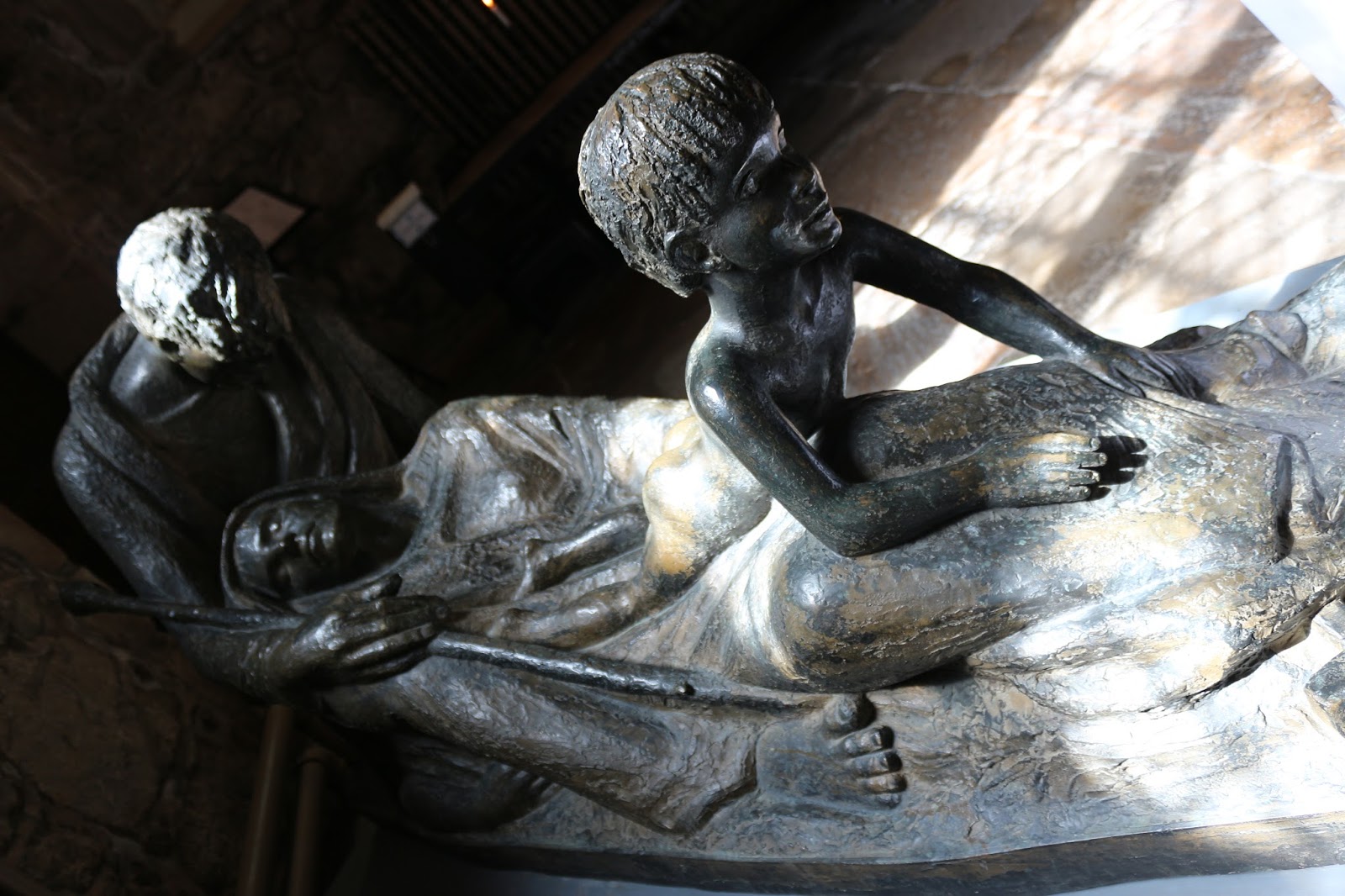
At Cartmel Priory, on entering the charming little chapel known as the town choir, de Vasconcellos' sculpture of St Michael the Archangel battling his way through the jaws of the dragon is powerfully evident. In the sedilla in the wall opposite is 'The True Vine' depicting the Virgin Mary and the baby Jesus. 'The Young Martyr' in the North Transept commemorates the four canons and ten laymen executed in 1537 for resisting the closure of Cartmel Priory during the dissolution of the monasteries, and for all martyrs who have died for their faith. On one of the sides the names of the Martyrs of Cartmel from 1537 are carved into the stone. Within the base of a solid stone plinth is a lighted candle in a red glass holder. Topping the sculpture is a head behind solid bars. 'They fled by night – Mary and Joseph and the Holy Child' is a very tactile statue being only a few feet high and made of solid resin bronze so, as many before you have done, you can pass your hands over the work easily without risk of damage. De Vasconcellos has captured a moment when the holy family rested in the desert on their flight into Egypt. St Michael 

-------------------------------------------------------------------------------------------------

Norman Nicholson - Silecroft Shore.