Wikio - Top Blogs - Religion and belief
Showing posts with label assembly. Show all posts

Wednesday, 24 December 2014

All-Age Talk - Names of Jesus

Here is my talk for the Nativity & Tree Lighting Service at St John's Seven Kings this year, which I also adapted to use as a Christmas assembly for Downshall Primary School:

Earlier in Advent I had a session with children in an RE class at Little Heath School to talk about Christian values as we see them in Jesus. Following that session the children sent me poems they had written which combined different words to make titles for Jesus which summed up something about him and his values. Among my favourites were 'The King of Kindness', 'The Truth of Giving' and 'The Gift of Happiness'.

I wonder what names or titles you could devise for Jesus which say something about who he is and what he came into our world to do. Each of you should have a sheet of paper with three lists of words on it. I’d like you to look at those lists and combine some of the words to make a new name of title for Jesus. Please talk to the people around about this. You could circle, tick, rewrite or just remember the words that you want to combine and use. Then I’ll ask you to tell us some of the names you have come up with.

[Time for discussion and feedback]

Thank you for sharing those new names and titles for Jesus. They were great and give us lots of ways for thinking about who he is, what he did and what he can mean to us today.

In the Bible we find two special names that were given to Jesus at his birth which are particularly important for understanding and knowing him.

The first is ‘Emmanuel’, which means God with us. Jesus was not just any other human baby, he was God born as a human being. He was God come into our world as an act of solidarity sharing what we experience in life, so we know that he understands and will support us through whatever happens.

The second is Jesus which means ‘The Rescuer’. Jesus was God come into our world to die and rise to new life for us making it possible for us to come through sin and suffering into new beginnings and new life.

The greatest gift you can have this Christmas is to come to know Jesus in these ways. Jesus is God’s gift to the world. Jesus is God’s way of showing and telling that he loves us enough to be with us in every situation and circumstance and to bring us through our experience of sin and suffering into a new start and a new way of living. My prayer is that we don’t simply know the story of Jesus’ birth or even know the meaning, the reason, for his birth, but that we actually receive the gift that God has given to us and know Jesus for ourselves as our Rescuer who is God with us.

--------------------------------------------------------------------------------------------

Kate Rusby - Diadem.

Sunday, 5 January 2014

Epiphany: light bulb moments

I adapted an assembly from the SPCK site for this morning's sermon at St John's Seven Kings on the Epiphany. The assembly is about light-bulb moments or epiphanies "when the penny drops, everything clicks into place and understanding comes."

As a visual aid for light bulb moments I used a Magic Light Bulb which lights up in your hand. This proved very effective as a talking point and aid to remembering the point of the sermon which was that at Epiphany we try to understand again all that Jesus is. We want to make sure the penny has dropped, that everything about our faith has clicked into place, and that we understand personally Jesus’ relationship with us.

-------------------------------------------------------------------------------------------

King's College Choir - We Three Kings Of Orient Are.

Wednesday, 25 December 2013

The Journey: The long walk is part of the present


This morning for our All-Age Christmas Communion Service at St John's Seven Kings I'm reusing the Christmas Assembly talk which I gave to Downshall Primary School last Friday. It comes from the assemblies.org.uk site and uses last year's John Lewis Christmas advert to reflect upon the cost of care and giving.

Like Jesus coming from heaven to earth, how far will we go to show concern for someone else? Might learning to care and give be the making of us? Loving God, you have given us life. Help us to give a little more love this Christmas and always. Amen.

--------------------------------------------------------------------------------------------

Lily Allen - Somewhere Only We Know.

Saturday, 14 July 2012

Moving On

Yesterday I took my final assembly as a College Chaplain at St Edward's Church of England School and was given a wonderful send off by staff and students. This is what I said in the assembly:
I’m currently running the confirmation preparation course for our group of churches and in it we start off with the idea that life is a journey on which we can go together with God. The starting point for going on a journey through life with God is baptism and when people are baptised in church we use these three things – oil, light and water – to think about how we start out on the journey. The sign of the cross is made on our forehead to mark us as belonging to God, we are given a lighted candle symbolising the light of Christ that has come into our lives, and water is poured over us as a sign of dying to our old life and rising into a new life together with God.
These three symbols aren’t just for starting out on the journey, though, they are also about the way we can move on. Oil gets things moving again when they have got stuck, light is about seeing the way forward clearly, and water is about going with the flow of God’s Spirit.
This is the time of year when many of us – me included – are getting ready to move on in different ways; leaving day meant that some who had been here are no longer here while in the new academic year we will be a year further on with new and different challenges to face. In whatever way we may be moving on, these symbols of oil, light and water can help to remind that God goes with us on the journey.
Here is a meditation which reminds of their significance.
Oil …
bleeding
from the pressurised
crushed
and wounded
to
free us up
lubricate
our rusting
static lives
and
facilitate
our ever moving
onward
forward
Godward
Light …
revealing our past
lighting our future
shining like a lighthouse
in our storms
burning like a warning beacon
in our wars
warming like the sun
on our journeying
glowing like a fire
through gaps and cracks
in shattered, splintered lives
Water …
cleansing our grubbiness
reviving our tiredness
refreshing our thirstiness
nurturing our liveliness
babbling communication
rippling out our influences
May we -
baptised in water,
anointed by oil,
lit by the Spirit -
live and move freely
like a babbling brook
speaking life
to parched ground
leaping boulders and barriers
sparkling in the ever present
light of the Sun.

----------------------------------------------------------------------------

St Edward's School - Cardboard Testimonies.

Friday, 11 May 2012

Leaver's Assembly: Talk and Blessing

This is the talk and blessing that I gave today at the leaver's assembly for Year 11 at St Edward's Church of England School:
Proverbs 3:1-5: My child, don't forget what I teach you. Always remember what I tell you to do. My teaching will give you a long and prosperous life. Never let go of loyalty and faithfulness. Tie them around your neck; write them on your heart. If you do this, both God and people will be pleased with you. Trust in the Lord with all your heart. Never rely on what you think you know.

John 14:12: I am telling you the truth: those who believe in me will do what I do—yes, they will do even greater things, because I am going to the Father.

John 16:13-14: When, however, the Spirit comes, who reveals the truth about God, he will lead you into all the truth. He will not speak on his own authority, but he will speak of what he hears and will tell you of things to come. He will give me glory, because he will take what I say and tell it to you. 

Jesus said many amazing things that people still repeat regardless of whether they follow him or not. But the words we have just listened to must be among the most amazing because Jesus says that those who follow him will do greater things than him and will be led into all truth. When you think how amazing Jesus’ own actions were, it is hard to imagine how people like us could do greater things than that, and, when you think how profound his teaching was, how could we be led into deeper or greater truth than that?

But Jesus was articulating something that all good teachers think and feel; the sense that all the time he had spent with them and invested in them was not so they would be clones of him, simply repeating the things he did and said, but instead he had equipped, empowered and enabled his followers to follow him by using their own gifts and abilities and initiative which would inevitably mean that they would do and say different things from him but still with his Spirit and based on all they had learnt from him.

He was saying that each one of us is a unique combination of personality, abilities and potential and, therefore, each of us can make a unique mark on the world. His followers can do greater things than Jesus because they will do different things from him in his name and Spirit – things that only they can do for him because they are that unique package of personality, ability and potential.

That is also what your teachers here wish for you. That you will use what you have learnt here and the abilities you have developed here to make your own mark on the world and to continue learning, particularly about the meaning of life itself.

What that mark will be we can’t predict, although you hopefully have plans in place for the next stage in your learning, growth and development. Please don’t make the mistake of thinking that making your mark on the world and doing great things means becoming famous or making pots of money. Many of the most significant things that people do in the course of their lives don’t make the headlines and don’t build our bank balances! For example, forming faithful, committed relationships is one of the most challenging but meaningful things we can do in life but that won’t feature in the press and media or usually impact on our bank balance. Many of you, later in life, are likely to become parents and will know the joys and struggles of supporting your own children in their development and growth. That is one of the most significant things we can do over the course of our lives; something that is both extraordinary and profoundly ordinary at one and the same time.

Leaving secondary education though is the point at which your choices and decisions about the future begin to come into play and begin to be followed through. Our prayer for you therefore is what Jesus prayed for his disciples that you will go on to do greater things than your teachers by making your unique mark on the world and that you will go ever deeper into truth by continuing learn throughout your life.

Let us pray for God’s blessing on your leaving, your doing, and your learning:

We thank you, Lord, for each one of these your people - for their unique combination of personality, abilities and potential, for all they have learnt while here and for all the friendships they have formed. We pray for your blessing on them as they leave this place and for you to be with them in revision, exams, results and future plans. We pray for your guidance as they seek to make their mark on the world by using all they have learnt here together with their unique combination of personality, abilities and potential. We pray that they might do great things, things that we cannot do and cannot yet predict. We pray for them the blessing of committed, sustained friendships and relationships and the blessing of ongoing, lifelong learning. Most of all we pray that the blessing of God almighty, Father, Son and Holy Spirit will rest upon and remain with each one of you now and forever. Amen.  

---------------------------------------------------------------------------------------

 The Bluebells with Bobby Valentino - Young At Heart. 

Saturday, 14 January 2012

Assembly on racism

This is the assembly I gave on Friday at St Edwards Church of England School and Sixth Form College which is adapted from resources at the Collective Worship resource from the Culham Institute:

Liverpool striker Luis Suares has been found guilty by the FA of racially abusing his opponent, Manchester United defender Patrice Evra, and has been given an 8 match ban as a result. He argued in his defence that the word he used isn’t a term of abuse in his culture but his defence of what he did and Liverpool’s support of him seem to have led to a Liverpool fan racially abusing Oldham defender Tom Adeyemi in another recent match. That fan has been arrested by the Police and faces the possibility of a lifetime’s ban from Anfield, Liverpool’s home ground.
Sometimes people argue that it doesn’t matter what people say to each other; that, for example, everyone should be able to think and say what they like and people shouldn’t be punished for shouting abuse at a person because he had a different skin colour. But what we say to each other does matter and does have an effect. Signs around the ground at Anfield make it clear that Liverpool FC should be opposed to racial abuse in their ground but because they seem to have tolerated it on the pitch it then seems to have spread to the stands as well. Therefore, Liverpool FC need to find a way to make it clear that foul language, violence and racism are not acceptable at Anfield; on the pitch and in the ground.      
Jesus told the story of the Good Samaritan to oppose racial intolerance in his own time. Here is the story he told: Luke 10: 25-37. Jews and Samaritans hated one another in Jesus' time as they were different races with different religions but in Jesus' story it is the Samaritan who is the hero and who helps the one who is his enemy. Jesus taught that we are neighbours not enemies and that we should both give to and receive from those who are in some way different from us.
Nearly 19 years ago Stephen Lawrence, a black teenager, was killed by a gang of white boys while he was waiting at a bus stop. Stephen was killed for no other reason than that he was black. It was a purely racist killing. It is a sad fact, but for thousands of years people have been persecuted, abused and killed because of the colour of their skin, or for their race, and it still goes on today.

Yet we are really all the same under our skin. In Genesis 1. 26 -28 we read “In the beginning God created the heavens and the Earth... God said, 'Let us make Man in our own image and likeness... So God made Man in his own image and likeness, male and female He created them.”  This means that there is no reason for racial prejudice, or prejudice of any kind. Because we are all created by God in his image, Christians believe that we are all children of God and life is much better when we share what each race has to give - music, clothes, food, beliefs, skills.
For the whole of the 19 years since Stephen's death his parents have campaigned for justice for their son's killing. When she came out of the Old Bailey, Doreen Lawrence, Stephen's mother said that she would not let her life be ruled by her hatred of the people responsible for Stephen's death. Doreen set up the Stephen Lawrence Charitable Trust a few years ago to provide financial help for young people from ethnic minorities to achieve their educational ambitions. She has called these young people her 'beacons of shining light,’ showing the world what can be achieved when prejudice is put to one side. She says that if Stephen were alive 'he would be proud of them too'. She says, 'I think he'd be surprised at all the positive changes that have taken place in his name.'
When Stephen's mother returned home from the Old Bailey, she lit a candle in his memory. As we light a candle, let us remember Stephen and all those who have been victims of racial hatred. Let us ask God to give us grace to live our lives fairly and without prejudice.
Father, thank you for the amazing variety of people in your world. Help us to learn to value each other and not to fear. Give comfort to those who are hurt by racism. Make us strong to fight racism wherever we meet it in whatever ways we can and help us to understand that you are on our side. In Jesus' name we ask this. Amen.

------------------------------------------------------------------------------------------

Michael Kiwanuka - Home Again.

Sunday, 18 December 2011

Christmas at St John's (1)


We had our All-Age Christingle Service and Service of Nine Lessons and Carols by candlelight today at St John's Seven Kings. Also above are photographs from our Youth Group's Christmas Party and our Christmas Bazaar plus our Christmas Tree. During the week we have had both the Aldborough E-Act Free School and Downshall Primary School in church for Christmas shows and assemblies. New opportunities this year have included the link with the Free School and a Carol Service held at a local supported housing complex, which has led on to a monthly service also being requested. Tomorrow will find us carol singing in the parish, while on Tuesday we have our Carol Tea.

-----------------------------------------------------------------------------------

Solomon Burke - Silent Night.

Thursday, 1 December 2011

The ravaged body of Christ in the context of the AIDS crisis

Today I took an assembly at St Edward's Church of England School and Sixth Form College on the theme of yesterday's World Aids Day:
Marcus Reichert's Crucifixions have been described as being among the most disturbing painted in the 20th century. One critic said of them, 'The image of an isolated human being in the process of being annihilated by the world and his own anxiety is one that speaks to every person.’

They were painted by Reichert after a friend had died from Aids and they were first exhibited as a group as part of a touring exhibition to benefit AIDS services in the American South. Reichert said, ‘The Jesus I painted didn't have AIDS … [but] it wasn't altogether a coincidence that this ravaged body of Christ would be there in the context of the AIDS crisis.’ To understand why that may be, it is helpful to think about another painting.
   
This is the crucifixion by Matthais Grunewald, part of the many-panelled Isenheim Altarpiece, which was commissioned for the Antonite monastery at Isenheim and was intended to give support to patients in the monastic hospital. Christ appears hideous, his skin swollen and torn as a result of the flagellation and torture that He endured. Because he worked in the hospital, Grunewald based his image of suffering on the patients whose torments he witnessed. These were mostly sufferers from skin diseases, which were common at the time.
So this was a powerful image in this hospital where those suffering from skin complaints could see God entering into the same suffering that they themselves were experiencing. And that is the central meaning of the crucifixion; that God comes into the suffering and sinfulness of the world taking it onto himself so that we can be set free from suffering and sin.
As Christians, we are called to love others in the same way. Yet some churches have been unwilling to become involved in work with those affected by HIV and AIDS. Usually this is because HIV is wrongly viewed as punishment from God on individual people who engage in ungodly behaviour. In some places, people who are known to be living with HIV are not welcome in churches. However, as we have seen, Jesus came to save sinners – like us. We must show grace, love and compassion to all people with the hope that they will become open to being transformed by Jesus. Churches should be doing something positive to respond to HIV and AIDS in the light of Jesus’ commandment to ‘Love your neighbour as yourself ’ (Luke 10:27).

More than 34 million people in the world have HIV; over 22 million live in Africa. The global HIV epidemic is most keenly felt in the poorest countries of the world. 90% of new HIV infections happen in poor countries, and 7,500 people die each day as a result of HIV and related illnesses. The disease is the leading cause of death in sub-Saharan Africa with approximately 3,600 people dying every day from AIDS.

Churches and Christians are among those tackling this situation and making a difference. For example, Tearfund partner Family AIDS Caring Trust (FACT) trains church volunteers to train family members in Zimbabwe to care for sick relatives. One-to-one meetings were first held with church leaders to win their support. Once the pastors had been envisioned they invited FACT staff to speak at church services, fellowship group meetings and introduce activities on HIV and AIDS in church youth group meetings. Once awareness had been raised, invitations were sent to churches to recruit volunteers for training. Within one year 125 volunteers had received training. The home care project, which used to reach 5% of those who needed home care support, now reaches 24%.

Let us pray: Loving and caring God, thank you, for You call us to love and serve Your people and you call those who care for victims of HIV/AIDS to be healing hands in Your hurting world. You send them to show compassion, to suffer with those who suffer. Day and night they labour to comfort Your people, often neglecting their own health and families in the HIV/AIDS struggle. Forgive us when we deal lightly with the wounds of Your people. Forgive our silence. Forgive our complicity. In Your mercy forgive our condemnation of people living with HIV/AIDS. May we demand drugs for the sick. May we demand care for the abandoned. May we denounce wastefulness by the affluent. Make us instruments of Your peace. Make us agents of Your transformation. Amen.

---------------------------------------------------------------------------------------

Elton John - Song for Guy.

Wednesday, 30 November 2011

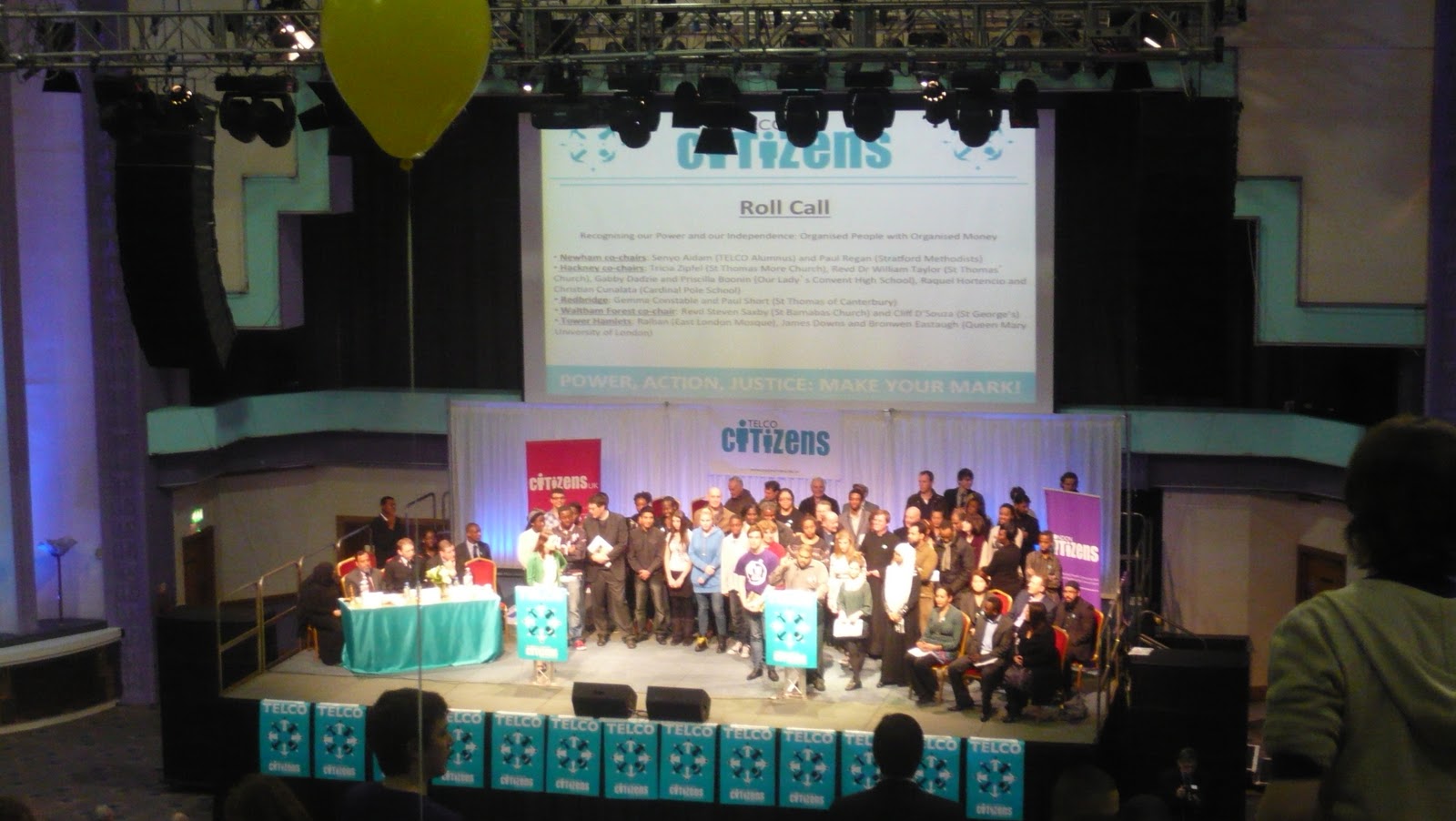
TELCO 15th Anniversary Assembly


I was at the Troxy tonight for the 15th Anniversary Assembly of The East London Communities Organisation (TELCO) which saw 2,200 TELCO citizens gather again in Tower Hamlets to celebrate a landmark 15 year relationship of organised communities working together to transform their neighbourhoods. Through bringing communities together and training leaders in the art of public action, TELCO has changed the way local communities make politics happen in east London.

TELCO is the founding chapter of London Citizens, the UK’S largest independent community alliance. Fifteen years on, in 2011, TELCO is now 65 community institutions strong, working in five major east London boroughs and has pioneered Community Organising in the UK as part of London Citizens with over 200 communities in membership.

The Assembly saw the first 50 TELCO members who have successfully applied for jobs at the 2012 Olympics receive certificates from Lord Coe together with reports of local action by TELCO institutions and updates on broader campaigns such as CitySafe and the Living Wage. It was very inspiring to see young and old, churches, mosques, schools and unions working together for the benefit of local communities by prioritising relationships and affirming the contribution and voice of all. Great too to see those, like Bishop Roger Sainsbury, who were involved at the very beginning of TELCO, and therefore CITIZENS UK too, present and their contribution also affirmed.

---------------------------------------------------------------------------------------

Jackson Browne - Lives In The Balance.  

Saturday, 26 November 2011

Free us, Lord, from our addictions

This was my assembly on addiction, given yesterday as chaplain of Venus College at St Edward's Church of England School and Sixth Form College:

Think of something that you really like and that makes you feel good. It can be anything you like; something you do, something you watch or listen to, something you eat, someone you like to be with.

Now think about the feeling that you get and how it makes you feel.

Imagine not simply enjoying that feeling but beginning to crave it; so that, rather than being something great when you happen to experience it, you start to want to have that same feeling more and more frequently.

Imagine now that you begin wake up craving that feeling so that you have to satisfy your craving that day.

Imagine that the craving is so strong that you will lie, steal, cheat, hurt, and maybe even kill to ensure you get that feeling that day.

What began as something good has become something ugly. What began as something you were free to enjoy has become something which controls everything about you. What began as something that enhanced your life has begun to destroy it.

That is how addiction works. We are most familiar with talk of addiction in terms of alcohol, drugs or smoking but we can actually become addicted to all sorts of things and addiction has taken hold when we can no longer cope without the thing to which we have become addicted. 

Earlier in the week I watched an interview with the shock rocker Alice Cooper; someone who has had a well-publicized battle with addiction, often consuming an entire bottle of whiskey each day. He has said, “Nobody ever sees the alcoholism coming. It’s one of those things that broadsides you. There’s never a place where the drug or the alcohol says, oh, by the way, it’s time to stop now. It just keeps going until your body tells you, ‘If you don’t stop you’re going to die.’ I never met anybody who was an alcoholic or a drug addict that ever walked out of it going, ‘Yeah, what a good idea that was.’ For me it was never a great idea.’”


Cooper has said that divine intervention is what broke his drinking habit in the mid-1980s. "I honestly think I was simply and completely healed. I guess you can call it a miracle. It's the only way I can explain it. It was absolutely eliminated from my life." He once told the Sunday Times, "Drinking beer is easy. Trashing your hotel room is easy. But being a Christian, that's a tough call."


So how can Christianity help when it comes to addiction. First, the Bible commends moderation to us. “Moderation is better than muscle, self-control better than political power.” (Proverbs 16. 32) We need to be clear that the Bible doesn’t try to ban the good things in life, but does say don’t allow those things to control by becoming addictions. The way to do that is to enjoy things in moderation. The second thing it encourages us to do is to put God first. “Do not get drunk with wine, which will only ruin you; instead, be filled with the Spirit.” (Ephesians 5. 18) If we put God at the centre of our lives then everything else will find its proper place and won’t be addictive or controlling.


So, with those thoughts in mind, let us pray:


Lord Jesus, You said, "I have come to set the captives free." We are captive and need Your healing touch. Free us, Lord, from our addictions, so that we will be:
... free from the cares and worries that stifle our happiness;
... free from sins that cling to us, and to which we cling;
... free from all compulsive behaviour that prevents us from becoming what You, Lord, have planned for us.

Bring us, loving Saviour, to the experience of abundant life which You promised. Amen.


---------------------------------------------------------------------------------


Alice Cooper - Poison.

Saturday, 23 January 2010

Inspired for service (2)

I spent yesterday trying to inspire others to serve and care through an assembly and a funeral. For the assembly I used material from Unicef:

Durga is 12 years old. She is an orphan and of the Sikh faith. A few years ago a relative borrowed money from an important family. In repayment he gave them Durga. She became ‘bonded’ to the family. A bonded labourer pays off a loan with their labour. But it is not just the loan but also the interest on the loan. Durga’s labour was valued at 50 Rupees a month (£0.88), because the family fed and clothed her. She would never have been able to pay off the loan but would have had to work for the family for life, never receiving any money.

Durga worked as housemaid and nanny in the large household. But the grown-up daughter of the house took a dislike to Durga and bullied her. One day she poured kerosene over Durga and set it alight. Fortunately, Durga acted swifty and dashed water from the sink over herself so she only has superficial burns. The family put ointment on her burns and locked her up. From a window, Durga attracted the attention of a newspaper journalist. He persuaded the family to release Durga from her bond on the condition that he would not write about the incident.

The journalist brought Durga to Mokhila Camp, near Hyderabad. It is like a boarding school which the state government has provided for children who have never been to school. Durga said, “I am so happy to be at the school. I can learn and help with the school. I can be a teacher or anything, I don’t have to be a servant all my life.”

The Convention on the Rights of the Child says that: children should not be separated from their parents unless it is for their own good; governments should protect children from work that is dangerous or might harm their health or their education; and children should be protected from any activities that could harm their development.

All those rights were broken in Durga’s life. That is unjust and she needed the help of the journalist and the state government to bring her justice. We all have these rights but social injustice still exists and to put that right people and organisations are needed to bring about social justice. An 11-year-old boy called Alan Barry wrote a poem about the Human Rights Act, which makes the point that for social justice to come we all need to play our part:

Human Rights

I am not very old
But I think I understand
How the Human Rights Act
Would work throughout the land.

Freedom within the law
To work and think and pray.
To speak out against injustice
Which many suffer from each day.

I am still a child
But I think I know what’s right,
Like standing up for friends
When a bully wants to fight.

We must all work together
To create a better place.
So that all people, everywhere
Can have a living space.

Life is very precious.
We all have much to give.
We must care for one another
And must live and let live.

Alan Barry (age 11)

Have a look at your hands. Your hands can be the hands of God if you use them to help those in need. St Teresa of Avila said:

'Christ has no body on earth but yours;Yours are the only hands with which he can do his work,Yours are the only feet with which he can go about the world,Yours are the only eyes through which his compassion can shine upon a troubled world.Christ has no body now on earth but yours.

Some of you were at the Solid:Remix event at Chelmsford Cathedral recently where lots of young people said that they what to use the lives and talents to serve God and other people. The granddaughter of one of the ladies in my church has the ambition of being an ambassador for peace in the world and is training with an MP in Parliament at the moment to help in fulfilling that ambition. Lots of the young people that we hear about in the media seem to just to want to make money or become famous for themselves but there are also lots of young people wanting to help others and make a difference in the world. Which will you be?

For the funeral I used the story of Ruth:

The story of Ruth, of which we have just heard the beginning, is a wonderful story of the benefits and joy of caring for others, even in the midst of tragedy. Ruth and her mother-in-law Naomi lost all their close family members but chose to stay together and care for one another even though there was the opportunity to go their separate ways.

Difficult circumstances and tragedy can be the prompt or spur for real acts of care, as we have seen recently in news stories of neighbours caring for elderly folk made housebound in the snow and in the financial response that there have been to the suffering being endured by the people in Haiti.

We know that Fred and Ivy also knew tragedy in their lives, particularly through the untimely deaths of their two children Ivy and Fred. Such heartbreak can cause people to look inward and shut themselves off from others and from God, but that was not the response of Fred and Ivy who continued to love and support each other, to care for Ivy’s parents in their old age and, then, Fred cared faithfully for Ivy as she approached death.

Ruth and Naomi returned to Naomi’s home where Ruth’s care for her mother-in-law was recognised and rewarded by Boaz, a landowner, who firstly found ways to support the two women and later married Ruth bringing an end to the poverty in which they had lived since the tragedy of their husband’s deaths.

Similarly, the need that Fred and Ivy had in their lives to receive support and care, as well as to give it, was also recognised. Their Cambridgeshire cousins stayed in regular contact, as did their long-time friends Sylvia and Roy. Closer to their home in Ilford, Fred was also to receive care and support from Janet and Gill.

Janet was put in touch with Fred and Ivy by Gordon Tarry, then the Vicar of St John’s, and initially helped Fred with moving into their bungalow on Aldborough Road while Ivy was in hospital. After Ivy’s death, Fred met Gill by attending the lunch club at the Downshall Centre. Since those times, the pair of them, supported by their families, have consistently kept an eye on Fred and have helped him find the support that he needed in his final days through the care that was provided at Rosewood Lodge and Woodlands.

St Teresa of Avila said that: “Christ has no body now but yours. No hands, no feet on earth but yours. Yours are the eyes through which He looks compassion on this world.Christ has no body now on earth but yours.” People may ask where was God in the tragedies that we have mentioned this afternoon; the deaths of Ruth and Naomi’s husbands; the untimely deaths of Fred and Ivy’s children; the horrendous loss of life in Haiti. Where is God? God is in the hands and feet, eyes and ears, the bodies of those that he inspires to go and care for those in need.

In talking with Janet about Fred, she said, “The Bible says that people should not live alone. We can’t always be close to those who need care. Others can be a substitute. Just keeping an eye on another is not to be sneezed at.” As we offer practical care to those nearby and the support of remaining in regular contact with those further away, we are the hands and feet, the eyes and ears of God in this world. Fred and Ivy were the hands of God as they cared for Ivy’s parents and they received God’s love and care through those that God inspired to support them in their times of need.

-----------------------------------------------------------------------------------

Larry Norman - I Am A Servant.