Wikio - Top Blogs - Religion and belief
Showing posts with label all souls. Show all posts

Thursday, 2 November 2023

The mother heart of God


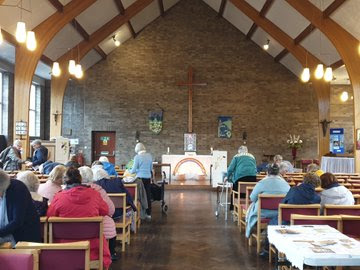
Here's the reflection that I shared in today's Mothers' Union Eucharist for All Souls Day at St Andrew's Wickford:

“Jerusalem, Jerusalem ... how many times I wanted to put my arms around all your people, just as a hen gathers her chicks under her wings, but you would not let me!” (Luke 13. 31 – end)

In this statement of his love for the people of Jerusalem, Jesus speaks of his concern and love for Jerusalem being typified by a mother hen gathering together all her chicks under her wing for safety and warmth. Lovingly, Jesus is saying he wants to be like the mother hen gathering God’s people to him where they will then experience safety and love. At the same time that he makes this specific statement to the people of Jerusalem, he is also paying a wonderful tribute to motherhood itself by equating the love which God shows towards us to the love that mothers show towards their offspring.

We tend to think most readily of God as a father but there are several places in scripture where God’s love is described as being like that of mother for her children.

Hannah Whitall Smith wrote “My children have been the joy of my life. I cannot imagine more exquisite bliss than comes to one sometimes in the possession and companionship of a child. To me there have been moments, when my arms have been around my children, that have seemed more like what the bliss of heaven must be than any other thing I can conceive of; and I think this feeling has taught me more of what God’s feelings towards his children are than anything else in the universe. If I, a human being with limited capacity, can find such joy in my children, what must God, with his infinite heart of love, feel towards his; In fact most of my ideas of the love and goodness of God have come from my own experience as a mother, because I could not conceive that God would create me with a greater capacity for unselfishness and self-sacrifice than He possessed Himself; and since this discovery of the mother heart of God I have always been able to answer every doubt that may have arisen in my mind, as to the extent and quality of the love of God, by simply looking at my own feelings as a mother.”

Hannah Whitall Smith lived in the United States in the 1850’s. She was born into a Quaker family but later became a Wesleyan preacher and was one of the inspirations behind the Keswick Convention. She wrote those words about the mother heart of God after reading Isaiah 66. 12 – 13, another passage of scripture in which God’s love for all people is described as being like a mother’s love for her children: "The Lord says, “You will be like a child that is nursed by its mother, carried in her arms, and treated with love. I will comfort you in Jerusalem, as a mother comforts her child.”

Jesus’ focus was on the safety that mothers’ seek to provide for their children out of love. Here, the focus is on the sense of comfort that the child receives from the love of its mother, particularly as it is nursed and fed. Isaiah also used motherly imagery in reference to God in Chapter 49. 15 where the focus is on the faithfulness of a mother’s love:

“The Lord answers,

“Can a woman forget her own baby
and not love the child she bore?
Even if a mother should forget her child,
I will never forget you.”

Nancy Hicks picks up on imagery around nursing the child when she writes about Psalm 131:

“Nursing was one of the most intimate acts I have ever been allowed to participate in, and what joy to be utterly depended upon! But a nursing baby is a demanding baby, “Pick me up NOW! Feed me NOW!” And when she fell asleep in my arms I felt needed, but not really appreciated for anything other than my capacity to satisfy hunger.

Then she was weaned. Now, when she crawled into my lap it was for relationship and comfort and intimacy. I understood God’s delight at the psalmist’s words, “Surely I have composed and quieted my soul; like a weaned child rests against his mother, my soul is like a weaned child within me.” 

In Psalm 131, the Psalmist pictures himself having the kind of intimacy with God that a weaned child has as it cuddles up on its mother’s lap. That intimacy comes after the child has been fed and has moved on from milk to solid food.

So, the picture that we gain from all these descriptions is of God’s love as the love of a mother for her child is that of God wanting to bring us into a place where we feel safe alongside her, where we know the comfort of being fed and therefore grow from the basics of the faith (the milk) to the depths of the faith (the solid food).

Do you experience the love of God in these ways? Have you thought, like Hannah Whitall Smith, that if we can find deep joy in our children, what must God, with his infinite heart of love, feel towards us? God loves you like a mother loves her child. As we reflect together on All Souls Day and pray for the souls of those we have loved and lost, God wants to take us into a deeper relationship with him and at the heart of that relationship is his infinite heart of love beating with the kind of love which mother’s commonly show towards their children. May we open up our lives and hearts to receive that love and enter in to that depth of relationship today! Amen.

There are two final points it is worth us noting. As we have already said, we commonly speak about God as male and yet the scriptures do use, as we have seen, female imagery of God. Interestingly, not just in terms of the mother heart of God, but wisdom and Spirit in particular are often feminine terms. This is of real significance in understanding that women and men are valued equally by God and were created by God to be equal.

Secondly, all talk about God as male and female, Father or Mother, is ultimately only descriptive language. God is always more than any label or image we use to help us understand him. Ultimately, God is Spirit and neither exclusively male or female. It is great to think of God as a loving Father or a loving Mother because those images help us understand and grasp something of the reality and significance of his love but God’s love is always greater and deeper than the love that we have experienced even from the most loving of parents.

Our Service for the Commemoration of the Departed is at 6.30 pm on Sunday at St Andrew's Wickford. All are most welcome.

-------------------------------------------------------------------------------------------------------------

Hildegard von Bingen - Voices of Angels - Voices of Ascension.

Wednesday, 2 November 2022

Counting the cost

Here's my reflection from today's Eucharist at St Andrew's Wickford:

From its earliest days, the Church has recognised as its foundation stones those heroes of the faith whose lives have excited others to holiness and have assumed a communion with the Church on earth and the Church in heaven. That is where the celebration of All Saints Day begins. We celebrated All Saints on Sunday, although the appointed day for All Saints was yesterday.

'The believer's pilgrimage of faith is lived out with the mutual support of all the people of God. In Christ all the faithful, both living and departed, are bound together in a communion of prayer.' This simple, agreed statement from the Anglican-Roman Catholic International Commission explains the purpose of the celebration on All Souls Day. Again, we held our annual All Souls Commemoration of the Departed on Sunday, although All Souls Day is today. Since its foundation, Christians have recognised that the Church, the ecclesia, the assembled people of God, is at its most perfect when it recognises its unity in God's redeeming love with all who have said, who say now, and who will say in the fullness of time, 'Jesus is Lord'.

In today’s Gospel reading (Luke 14. 27-33), Jesus says that we need to make our decision about saying ‘Jesus is Lord’ carefully, in a considered way. We have a choice. Do we want to become people and a society who are selfish regarding ‘greed as good’ or do we want to be people and a society that live in love? Our lives are not pre-determined and the decisions we make alter our lives for good or ill. Before we decide to say 'Jesus is Lord,' Jesus says we should first count the cost of making that claim.

Jesus tells two stories to illustrate this point. In the first, a man wants to build a tower but because he doesn’t make any plans he only gets as far as laying the foundations and then runs out of money. As a result, he becomes an object of ridicule. In the second, a King realises that he doesn’t have enough soldiers to win a battle against another King with a bigger army and so he asks for terms of peace. In the first story, the builder doesn’t plan ahead and can’t finish the job but in the second story the King does plan ahead and wins peace for his people.

As we reflect on these stories and the importance of planning ahead and counting the cost, we might also reflect on the mini-budget that Kwasi Kwarteng and Liz Truss recently introduced and the negative effects it has had on our economy because they hadn’t planned ahead, thought it through or counted the cost. Jesus says that if we are to be a people and a society that seek to follow him and live in love then we have to do that; plan ahead, think it through and count the cost in order to see it through and stay the course.

It is not easy living in love with others because others are not easy to live with. Jesus says it is like carrying a cross and walking towards your own death because what you do is what he did; you sacrifice yourself for the sake of others. It is much easier the Bible says to live for yourself and try to make as much and keep as much for yourself as possible. Many people live their lives that way today but, if you are on the receiving end of someone else’s greed, if, for example, you lose your job because someone else has made money from the collapse of your employer, you quickly realise what a miserable way to live life selfishness actually is.

It is not easy living in love with others Jesus says. You need to sit down and count the cost first before beginning but, ultimately, it is the only way not to destroy ourselves, our society and our planet. Fortunately, there are many that have followed Jesus in carrying their cross and walking the narrow path.

Which will we choose? The current turmoil in the financial markets, the example of the mini-budget, this service, these readings, the example of the saints; these are all opportunities for us to count the cost of our life choices and to decide whether we believe that greed is good seeking to live our lives selfishly or whether we will hear the call of Jesus and take up our cross to live a life of love for others.

When we do the latter, we become saints and join ourselves with all souls - past, present and future - who have said, who say now, and who will say in the fullness of time, 'Jesus is Lord'.

---------------------------------------------------------------------------------------------------------

Mark Heard - Satellite Sky.

Sunday, 5 November 2017

All Souls: All is safely gathered in

Here is my sermon from tonight's Choral Eucharist for All Souls at St Martin-in-the-Fields:

I was in a helicopter flying over mountain ranges in Kosovo. My father was alongside me. Also alongside were relatives from other bereaved families. We were part of a small squadron of helicopters carrying bereaved relatives from Pristina airport to view the site of a plane crash.

On Friday 12 November 1999, a plane chartered by the World Food Programme crashed in northern Kosovo. All 24 people on board died. 21 passengers and three crew, including my brother Nick, who was one of three Britons to die in the crash. The 21 passengers were all humanitarian workers for non-governmental agencies. Each had been travelling to contribute to the relief effort in Kosovo. Nick was one of a 15-strong Tearfund disaster relief team helping ethnic Albanians rebuild their homes. He had had one six week spell of relief work and was returning, with another member of the team, for a second period.

In foggy conditions, the plane had smashed into a mountaintop 20km north of Pristina. A few yards more and it would have cleared the mountaintop but that wasn’t to be and, as a result, we were being taken by helicopter to see for ourselves the wreckage strewn in small pieces near the top of the 4,600-foot mountain.

Confirmation that the plane had crashed and that there were no survivors did not come until the day after contact was lost with the plane. I remember taking a phone call from my parents who had been notified that contact had been lost with the plane and feeling absolutely unable to accept or comprehend the news. This was something that simply could not be happening.

Once the crash had been confirmed my father and I were flown to Rome by Tearfund to wait for further news together with the families of the other 23 people who died in the crash. After a few days we were flown to Kosovo to see the crash site for ourselves. On arrival at Pristina Airport we were loaded into helicopters and flown the short distance into the mountains and over the site of the wreckage. This was the worst moment for each one of us. As we saw the small pieces of the plane strewn over the mountainside we knew exactly what had happened to our loved ones and were faced full-on with the reality of their death.

When we returned to Pristina Airport, some refreshments had been organised for us in a tent and members of Tearfund who had worked with Nick had travelled to the airport to be with us. We sat and listened as they told us about the effect that Nick had had on the Albanian people with whom he had worked and also on other members of the team as they had valued his friendship, support and advice.

As they talked, the tears flowed; theirs and ours and, I believe, God’s as he was with us enabling us to express our grief. As they talked, I had a growing sense that Nick had gone into God’s presence and had been welcomed with the words, “Well done, good and faithful servant.” In that moment I glimpsed something of the glory into which Nick had entered and that glimpse continues to sustain and strengthen me in my loss.

Over subsequent days, I heard many more stories of the way in which Nick’s life had influenced others and over the years since I had seen the way in which the inspiration he provided led others to continue the work that he began. Young people whose lives were turned around through the youth project that Nick worked for have continued his youth work and also his charitable work in Uganda, while Nick’s involvement with Tearfund inspired another member of our family to join their Disaster Response Team. In these ways, the stories about Nick that begun to be told at Pristina Airport have continued to be told and in the telling my sense that Nick has been welcomed into glory has grown.

This evening we’re remembering All Souls which is, in part, about the finding of ways to come to terms with loss and waste and horror and grief. I believe Jesus’ words in John 6 provide a clue as to how that may, in some sense, be possible. My own experience of loss and waste and horror and grief which I have shared gives us, I think, one way of reflecting on Jesus’ words in today’s Gospel reading that it ‘is the will of him who sent me that I should lose nothing of all that he has given me, but raise it up on the last day.’

These words come in the middle of Jesus’ teaching about being the Bread of Life which followed shortly after the feeding of the 5,000 and the 12 baskets of fragments that were gathered up afterwards. The fragments of bread scattered on the hillside would not have looked dissimilar to my view from the helicopter of the plane’s wreckage scattered on that Kosovan mountain-side.

When Jesus gave thanks over the bread, the word used is ‘eucharistesas’, the word which gives us ‘Eucharist’. Jesus shared the bread around in communion, then, when everyone was satisfied, he instructed his disciples to pick up the fragments using that same phrase, ‘so that nothing may be lost.’ Just as none of this ‘eucharisticized’ bread was lost after the feeding, so, because ‘Jesus is the bread of life, [those who] see and believe in him … receive eternal life [and] become a fragment which he will gather up on the last day.’ (John, Richard Burridge, BRF 1998)

This teaching tallies with the use elsewhere of Harvest imagery for the Last Judgement – a sense that all can be safely gathered in - and is reinforced for us in the Letter to the Colossians where it is stated that in Christ all things hold together, as through him God was pleased to reconcile to himself all things, whether on earth or in heaven, by making peace through the blood of his cross. Christ came to gather up and reconcile to God all the disparate fragments of our lives that none should be lost, even through death. This is why he gives us parables of lost things being found. It is why he states that there is room for all – many rooms - in his Father’s house and that he goes there to prepare places for us. It is also why St Paul teaches in 1 Corinthians 13 that faith, hope and love remain. In other words that our deeds of faith, hope and love are not lost with our death in this life but continue into eternity.

As a result, we have, I think, a basis for saying with Walt Whitman that: ‘Nothing is ever really lost, or can be lost, / No birth, identity, form — no object of the world, / Nor life, nor force, nor any visible thing; / Appearance must not foil, nor shifted sphere / confuse thy brain. / Ample are time and space — ample the field and / nature. / The body, sluggish, aged, cold — the embers left / from earlier fires, / The light in the eye grown dim shall duly flame / again; / The sun now low in the west rises for mornings / and for noons continual; / To frozen clods ever the spring's invisible land / returns, / With grass and flowers and summer fruits and / corn.’

It was in the telling of tales about Nick that I found a measure of peace and acceptance in regard to what had happened to him and where he is now. The telling of tales about my brother confirmed our love of him and God’s love of him. This suggests to me that we should not be afraid of tears, of memories, of stories, as they are an expression of the love we feel. It is as we cry out in our grief that God meets with us. Jesus is alongside us through his Helper, his Spirit, and can speak to us and for us in groans that words cannot express. It is as we speak of those we have lost that a measure of peace will come.

After all what is the Eucharist, if it is not primarily a retelling of the story of Jesus’ death? It is as we re-tell and re-enact that story that we receive Christ and the peace, comfort, forgiveness and healing that he brings to our troubled lives, emotions and spirits. So, when we remember, we are eucharistizing. Telling tales about Nick was a way for us to begin to gather up the fragments of his life, as Christ is also doing. It was, therefore, a participation in the gathering in, the eucharistizing, and the reconciling of Nick to God that is the work of Christ and which means that God can and does say to him and to all those lost to death, ‘Well done, good and faithful servant.’ ‘Enter into my rest.’ That is also what we are doing at the altar rail tonight as we receive communion while remembering our loved ones before God; we are receiving the fragments and becoming one body together. That’s also what All Souls is.

----------------------------------------------------------------------------------------------

Sharon Jones & the Dap-Kings - Call on God.

Wednesday, 2 November 2016

Nothing shall be lost

Here is my sermon from today's Choral Eucharist at St Martin-in-the-Fields:

Yesterday, the Archbishop of Canterbury said that he welcomes “the Evening Standard’s campaign on tackling food poverty and waste,” as “hunger is a complex, widespread and shocking blight on our country and more needs to be done to highlight this issue.”

In commenting on this statement, the paper noted that the Archbishop has good scriptural reasons to join the Food for London campaign. They noted that after ‘feeding the five thousand, Christ instructed the waste to be gathered up afterwards’ and said that it was in that spirit that the Archbishop had supported this campaign.

It is positive to see a major newspaper quoting scripture and doing so with some understanding. This contemporary reminder of the feeding of the five thousand and the 12 baskets of fragments that were gathered up afterwards give us one way of reflecting on Jesus’ words in today’s Gospel reading (John 6. 37 – 40) that it ‘is the will of him who sent me, that I should lose nothing of all that he has given me, but raise it up on the last day.’

These words come in the middle of Jesus’ teaching about being the Bread of Life which followed shortly after the feeding of the 5,000. When Jesus gave thanks over the bread, the word used is ‘eucharistesas’, the word which gives us ‘Eucharist’. Jesus shares the bread around in communion, then, when everyone is satisfied, he instructs his disciples to pick up the fragments using that same phrase, ‘so that nothing may be lost.’ Just as none of this ‘eucharisticized’ bread was lost after the feeding, so, because ‘Jesus is the bread of life, [those who] see and believe in him … receive eternal life [and] become a fragment which he will gather up on the last day.’ (John, Richard Burridge, BRF 1998)

This is the reason why Christ came, which he reveals both here and in the parables he told about the lost sheep and coin. The shepherd and woman in those two stories are exactly the same; because of their concern for the sheep and coin which are lost, they will not give up searching until these have been found. The sheep and the coin are loved and this love is revealed or proved through the search.

The point of those parables is for us to know that we and all souls are similarly loved by God because he also searches for us until we are found. This search is the story of the Gospels:

‘Christ Jesus, who, though he was in the form of God,
did not regard equality with God as something to be exploited,
but emptied himself, taking the form of a slave,
being born in human likeness.
And being found in human form,
he humbled himself and became obedient to the point of death
— even death on a cross.’
(Philippians 2. 6 – 8)

Christ went on that search to seek and save those who are lost and thereby to ensure that none shall be lost and all souls shall be safely gathered in.

How much are we loved by God? So much that his Son left all he had in heaven to become a human being and die to rescue us for God. Jesus, the Good Shepherd, searches for all souls with God’s attentive love, looking and listening, finding and carrying; carrying us home, like a sheep on the shoulders, from the cliff edges of our lives.

The lost almost universally consider themselves worthless but these parables and this story specifically deny that assumption. What is lost is actually the most precious thing or person of all; the person or thing for which everything else will be given up or set aside. What is lost and found is us. We are the ones for whom Christ searches at the expense of all that he has, including, in the end, his own life. We are the most precious lost person for whom he searches. We are precious, we are loved.

As a result, we have a basis for saying with Walt Whitman that:

‘Nothing is ever really lost, or can be lost,
No birth, identity, form — no object of the world,
Nor life, nor force, nor any visible thing;
Appearance must not foil, nor shifted sphere
confuse thy brain.
Ample are time and space — ample the field and
nature.
The body, sluggish, aged, cold — the embers left
from earlier fires,
The light in the eye grown dim shall duly flame
again;
The sun now low in the west rises for mornings
and for noons continual;
To frozen clods ever the spring's invisible land
returns,
With grass and flowers and summer fruits and
corn.’

--------------------------------------------------------------------------------

Orlando Gibbons - O Lord, Increase My Faith.  

Monday, 2 November 2015

Discover & explore: Bereavement (All Souls)


St Stephen Walbrook held a special Discover & explore service for All Souls today. This service explored aspects of bereavement with readings, music, prayers and reflection. The Choir of St Stephen Walbrook and the Choral Scholars of St Martin-in-the-Fields joined together to sing pieces from Fauré's Requiem and the service ended with an opportunity to light candles in memory of loved ones. Here is the reflection that I shared during this service:

Psalm 23 is a picture of life. Our lives contain both times of refreshment and joy – those times by the still waters and in the green pastures – and times of trial and loss – as we walk through the valley of the shadow of death. These times of joy and times of trial are our common experience of life. But this Psalm says more. It says that God is with us in all of these experiences. He leads us beside the still waters and walks with us through the valley of the shadow of death. He can do this because in Jesus he has experienced human life for himself. God understands and will be alongside us in our grief.

How can that be, particularly when grief involves a whole mix of different emotions at different times – anger, sadness, love, guilt and numbness – which mean that it is a very individual experience? All we can really do, as a result, is to share our experiences of how it has been for us. That is what Alfred Lord Tennyson did in his poem ‘In Memoriam’, a sequence of lyric poems written over a 17 year period which comprise a requiem for the poet's beloved Cambridge friend Arthur Henry Hallam, who died suddenly of a cerebral haemorrhage in Vienna in 1833. Tennyson then wrote memorably again on the subject of death in ‘Crossing the Bar’ after he had survived a serious illness. Shortly before he died, Tennyson told his son whom he had tellingly named Hallam to "put 'Crossing the Bar' at the end of all editions of my poems". Just as Tennyson memorably shared his experience of God with him in his grief, I would like to do the same.

My younger brother, Nick Evens, died on 11th November 1999 in a plane crash in Kosovo. He was on a UN commissioned plane taking relief workers into Kosovo to work on reconstructing the country following the conflict there. Nick was part of Tearfund’s Disaster Response Team. He had been in Kosovo working with Kosovan villagers to rebuild homes, had returned home for a short break, and was returning to continue work on the rebuilding programme.

The plane went off course as it neared Pristina Airport and crashed in nearby mountains. I remember taking a phone call from my parents who had been notified that contact had been lost with the plane and feeling absolutely unable to accept or comprehend the news. This was something that simply could not be happening.

My father and I were flown to Rome by Tearfund to wait for news together with the families of the other 23 people who died in the crash. After a few days we were flown to Kosovo to see the crash site for ourselves. On arrival at Pristina Airport we were loaded into helicopters and flown the short distance into the mountains and over the site of the wreckage. This was the worst moment for each one of us. As we saw the small pieces of the plane strewn over the mountainside we knew exactly what had happened to our loved ones and were faced full-on with the reality of their death.

When we returned to Pristina Airport, some refreshments had been organised for us in a tent and members of Tearfund who had worked with Nick had travelled to the Airport to be with us. We sat and listened as they told us about the effect that Nick had had on the Kosovan people with whom he had worked and also on other members of the team as they had valued his friendship, support and advice. As they talked, the tears flowed; theirs and ours and, I believe, God’s as he was with us at the time enabling us to express our grief. But, as they talked, I also had a growing sense that Nick had gone into God’s presence and had been welcomed with the words, “Well done, good and faithful servant.” In that moment I glimpsed something of the glory into which Nick had entered and that glimpse continues to sustain and strengthen me in my loss.

Over subsequent days, I heard many more stories of the way in which Nick’s life had influenced others and over the years since I had seen the way in which the inspiration he provided has led others to continue the work that he began. Young people whose lives were turned around through the youth project that Nick worked for have continued his youth work and his charitable work in Uganda while Nick’s involvement with Tearfund inspired another member of our family to join their Disaster Response Team. In these ways, the stories about Nick that begun to be told at Pristina Airport have continued to be told and in the telling my sense that God is alongside me in my grief and that Nick has been welcomed into glory has grown.

My experience of grief suggests that it is as we cry out in our grief that God meets with us. He is alongside us through his Spirit and will speak for us in groans that words cannot express. We should not be afraid of tears, of memories or of stories, as they are an expression of the love we feel. As we share our grief together we may catch a glimpse of the glory that waits to be revealed to us and into which our loved ones have entered and that glimpse can sustain us as we re-enter our everyday lives. In these and other ways God offers to lead us through the times of trial until we come to live with him forever.

-------------------------------------------------------------------------------

Gabriel Fauré - Libera Me.

Friday, 30 October 2015

All Saints and All Souls

In our 10.00am Parish Eucharist at St Martin-in-the-Fields this Sunday we celebrate and give thanks for the saints who have witnessed to the Christian faith through the centuries. The preacher will be Revd Katherine Hedderly.

The Choir of St Martin-in-the-Fields sing Rutter’s Requiem at our evening All Souls Choral Eucharist, in our remembrance of all those we have loved and see no more and whose memories we treasure. I will preside and the preacher will be Revd Richard Carter.


At St Stephen Walbrook we will hold a special Discover & explore service for All Souls at 1.10pm on Monday 2nd November. This service with explore aspects of bereavement with readings, music, prayers and reflection. The Choir of St Stephen Walbrook and the Choral Scholars of St Martin-in-the-Fields will join together to sing pieces from Fauré's Requiem. The service will end with an opportunity to light candles in memory of loved ones.

The Choir of St Stephen Walbrook and the Choral Scholars of St Martin-in-the-Fields will join together again later in November for a shared service between St Martin-in-the-Fields and St Stephen Walbrook. This service will be a Choral Evensong on Sunday 15th November, 5.00pm, at St Martin-in-the-Fields.


The Discover & explore service series at St Stephen Walbrook will continue with the Choral Scholars of St Martin-in-the-Fields for services exploring Faith, Hope and Charity on:
  • Monday 9th November, 1.10 - 1.50pm – Charity.
  • Monday 16th November, 1.10 - 1.50pm – Hope.
  • Monday 23rd November, 1.10 - 1.50pm – Faith.
This series of services is part of our Philanthropy in the City programme.

-----------------------------------------------------------------------------------------------

Gabriel Fauré - Requiem.