Wikio - Top Blogs - Religion and belief
Showing posts with label icons. Show all posts

Monday, 16 February 2026

Portsmouth Cathedral and 'Sanctuary' exhibition


For centuries Portsmouth Cathedral has been a beacon for people on land and at sea, helping them navigate the passage of time with faith and confidence in God. It is a building of greatness and simple enduring beauty, and a lively, inclusive and compassionate community which has a positive impact on the lives of people in its own parish, as well as the City and Diocese of Portsmouth.

From humble beginnings in 1180 at the heart of Portsmouth's original settlement, this church, dedicated to Thomas Becket, became a parish church around 1320 and a Cathedral in 1927. It has been integral to the development of Portsmouth as a modern, vibrant city. There is much interesting art in the Cathedral.

Peter Eugene Ball placed major pieces of sculpture in some of the country’s great cathedrals as well as smaller figures in various parish churches. His intention was always to produce religious art which offers a sympathetic focus for thought and prayer and which complements and enhances the space in which it resides. Beneath the nave organ case in Portsmouth Cathedral is his Christus, while his four Saints and Bishops are to be found in the St Thomas' Chapel..
 
The nave organ case was designed by Didier Grassin in 2001; the inside of the panels were designed by Patrick Caulfield and painted by Alan Murphy:

‘The organ is in the middle of the design – enfolded by a circle. This speaks of unity of sound and glory. It is a universally accessible symbol, as was specified in the artist’s brief. They themselves echo the Grassin case design which features a fish (or Ickthus) motif on the front of the closed case. The four fish – two on the left and two on the right are Christian symbols which, in turn, enfold the circle within.

The left side depicts night. On the left is a stylised depiction of a lighthouse shining on the sea. Here, there is a particular and universal reference. The particular reference is to the motto of the City of Portsmouth, “Heaven’s Light our Guide.” The universal reference is to God in the mandala (or lozenge) shape at the top of the lighthouse. This shape is used in Orthodox iconography to encompass Christ in Glory. The universal in the particular can also be described theologically as Incarnation.

The right side depicts day. On this side is the sun, and a depiction of the hull of a fishing vessel. The Portsmouth fishing fleet uses the identification P. It is also a play on the Christian monogram – Chi-Rho – the first two letters of Christ in Greek.’

The icon of Our Lady of the Sign over the altar in the Lady Chapel, with its richly gilded background, was created by the famous Russian iconographer Sergei Fyodorov, and dedicated on the feast of the Nativity of the Blessed Virgin Mary on 8th September 2002.
 
The ‘sign’ in the title is the sign of Isaiah 7:14 – ‘The young woman is with child and will give birth to a son, whom she will call Emmanuel.’ Mary is the ‘God-bearer’, and Jesus prays within her and blesses us; the icon shows Christ in a roundel or medallion, making a gesture of blessing with his right hand. As Canon Alan Wilkinson, co-donor of the icon, wrote: ’Here is Christ praying in Mary. It is a sign and a reminder that our best prayers are when we are silent and let the Christ hidden in the depths of our being pray to the Father.’

At the time the Fyodorov icon was created, in 2001, the Dean William Taylor wrote about it: ‘Icons interact directly with those who look at them. … a quotation of St Augustine of Hippo sums up the meaning of the icon to those who look at it, or pray before it in faith: “Of what help is it that Jesus was born, if he is not born within us.”’

In the south tower transept is the bronze statue of St John the Baptist by David Wynne. It was cast in 1951 as a memorial to a Winchester College pupil killed on the Matterhorn.

Sanctuary, an exhibition by the artist Nicholas Mynheer is open daily from 18 February to 12 April 2026. The exhibition features paintings and sculptures that explore the experiences of refugees, both ancient and contemporary. The story of Jesus, Mary and Joseph fleeing to Egypt sits alongside the realities faced by people crossing the English Channel today. Mynheer's work doesn't offer easy answers – instead, it asks questions. What would we do if our home were no longer safe? How do we respond to those seeking refuge? What does it mean to hope for a better life when the risks are so great? The exhibition is open during standard cathedral opening hours, and is free to view.

--------------------------------------------------------------------------------------------------------

Tuesday, 29 July 2025

The Monastery of Saint John the Baptist


It was a joy to visit The Monastery of Saint John the Baptist today together with my friend Tim Harrold. We were grateful to Fr Andrew for his hospitality and information as we were shown around.

The Monastery of Saint John the Baptist, (also known as Community of Saint John the Baptist) is a monastic community which was founded in 1959 by Archimandrite Sophrony Sakharov (1896-1993). On 27 November 2019, Archimandrite Sophrony was added to the list of Saints by the Ecumenical Patriarchate in Constantinople. His Feast Day is on the day of his repose, the 11 of July. The Monastery is situated in Tolleshunt Knights near Tiptree, in the United Kingdom. It belongs to the Eastern Orthodox Christian Church, and is under the jurisdiction of the Ecumenical Patriarchate in Constantinople.

During the first decades after the community had moved to England, the building and decorating of the churches of the monastery required much of his prayer and attention. After having abandoned painting for many years, he began to paint icons and frescos for the new places of worship. He strove to express the Face of Christ which had been revealed to him in the Light. However, he was never satisfied with his work and often adjusted and repainted the icons of Christ he had created.

Art has the ability to touch that inner part of man and convey directly a creative experience and response difficult to express in words. It was the life long vocation of Saint Sophrony to offer this living experience through art. His artistic training had its roots in both Imperial and Soviet Russia where as a young student, he was influenced by the writings of Kandinsky on the spiritual in art. It was the spiritual life that called him ever more strongly and after working as a portrait and landscape artist in Paris, Father Sophrony abandoned his painting to become a monk on Mount Athos.

Sister Gabriela joined the Community of Saint John the Baptist in 1983 after studying iconography in Paris on Saint Sophrony’s insistence. She was part of the team which was painting the murals of Saint Silouan’s Chapel and worked closely with the saint. After the mural work, Saint Sophrony continued to teach her the art of icon painting, and she assisted him in some larger works. Her work includes a series of large icons created for Chelmsford Cathedral.

On the 3rd of December 1985, while Sister Gabriela and Father Sophrony were working on the murals in the chapel of St Silouan, Father Sophrony told her: “Later, you have to write a book about our experiences; which colours were used, the mistakes you made and so on.” Thirty three years later she set herself to the task and dealt with the time of her apprenticeship as a story, copied out from her notes and adding a few explanatory notes. Failures & Discoveries: Notes from an icon workshop is the book she wrote.

Since Saint Sophrony’s repose, to the extent that she has been able to understand them, Sister Gabriela has tried to further his vision and ideas in various artistic projects. This includes painting the icons and murals for the round chapel which was completed earlier this year. 

As Saint Sophrony’s mind was always very creative, he had many ideas about how to create a space for the celebration of the Liturgy. In 1992, he made a plan to build a round chapel and supervised the construction of a model which specified all the various dimensions as well as the exact location. Whilst at the time it was not possible to fulfil the project, its realisation came thirty years later. Initially, Saint Sophrony had wanted to dedicate the chapel to the Holy Trinity; but when he himself was numbered amongst the saints, it was decided to change the plan and name the chapel after our founding Father. 

The Monastery has not written a history, but the books written by Saint Sophrony and members of his Community provide an insight into the spiritual basis of its life. These books are on sale at the Monastery’s bookshop in Tolleshunt Knights, as well as online.

--------------------------------------------------------------------------------------------------------

John Tavener - Ikon Of Light.

Friday, 2 May 2025

Max Blake: Adventures in Joy


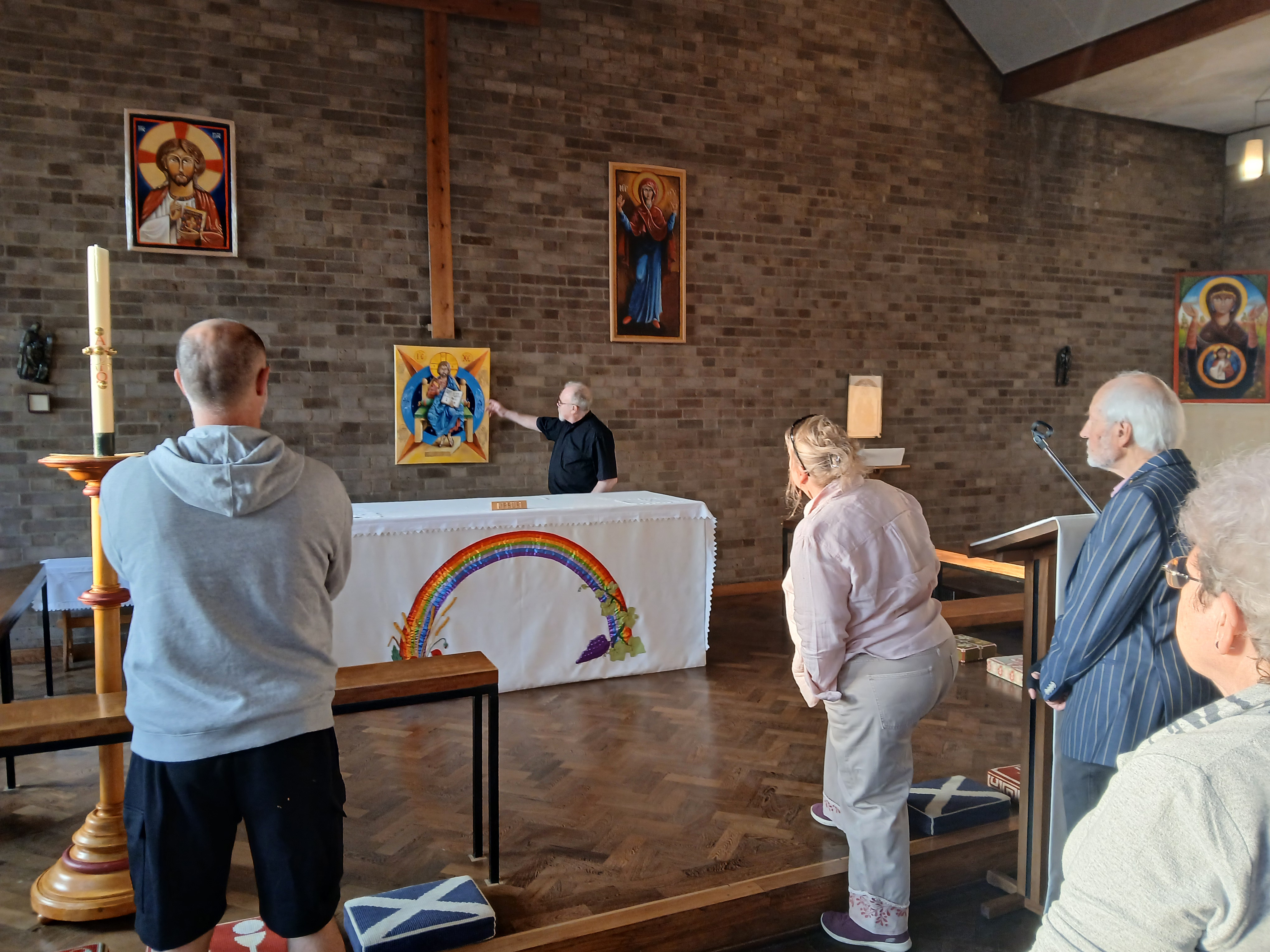
At tonight's Unveiled, our fortnightly Friday night arts & performance event at St Andrew's Wickford, we heard Max Blake talk about his wonderful exhibition 'Adventures in Joy'.

Adventures in Joy: An exhibition by Max Blake
2 May – 25 July 2025
St Andrew’s Church, 11 London Road, Wickford SS12 0AN


St Andrew’s is usually open: Sat 9am-12.30pm; Sun 9.30am-12 noon; Mon 2-3.45pm; Tue 1-4.30pm; Wed 10am-12 noon; Fri 10am-1pm. https://wickfordandrunwellparish.org.uk/whats-on.html

“Adventures in Joy” presents the most recent work produced by artist and cleric Max Blake. It includes some of the work he has developed though his studies of Icons, as well as his experiments in a more abstract and surreal direction. Max explores his own deep imagination, which is fed by his wide knowledge of religion and reflections amongst other things.

As a man of faith, much of his work expresses an exploration of the Christian faith. Over recent years, Max has studied Byzantine and Coptic Iconography and he has used this study to develop his own interpretations of the icon. Much of Max’s work is highly detailed and the viewer can find many hidden details, people, faces and shapes in his work. This creates a joyful adventure for the eye through bright and vivid worlds. Max uses a range of media including oil paints, inks and coloured pencils.

Max Blake was born in East London in the early 50s and then grew up in Basildon. After graduating as a teacher, Max taught art in secondary schools across south Essex. He also worked with children with anxiety and children with special needs. He was ordained deacon followed by priesting in the early 2000s. Although he is now retired, Max still works as a retired priest with Permission to Officiate in the United Benefice of Horndon, Orsett and Bulphan.

As well as artwork Max has also illustrated book covers and books for children. He continues to exhibit his vibrant work in various locations, including the Well House Gallery in Horndon on the Hill and St Catherine’s Church in East Tilbury. https://www.wellhousegallery.co.uk/art/max-blake

--------------------------------------------------------------------------------------------------------

Methuselah - My Poor Mary.