Wikio - Top Blogs - Religion and belief
Showing posts with label whall. Show all posts

Friday, 7 July 2017

Restoration! St John the Divine Richmond


There was a full house yesterday for a Victorian Society event at St John the Divine Richmond on 'Restoration!'. Paul Velluet and Peter Cormack led the event which highlighted the history of the church, its artistic and historical significance as well as its recent restoration. Additionally, there were presentations on the organ and the church textiles.

The Church of St John-the-Divine was built between 1829 and 1831 under the Church Building Commission’s funded programme for new churches as a chapel-of-ease to the Parish Church of St Mary Magdalene to serve the growing community of ‘New Richmond’.

Designed by the early Gothic Revival architect Lewis Vulliamy, it is a fine but much altered example of a Commissioners’ church – economical in design and construction, but distinguished by some delicate ‘Gothick’ features inside and out. The particular significance of the church lies in the reconstruction and major extension of its ‘eastern’ end carried out in 1904-1905 under the direction of designed by Arthur Grove and its enrichment in subsequent years with fittings and furnishings by leading designers, artists and craftsmen of the Arts and Crafts tradition including Nathaniel Westlake; stained glass artists Christopher Whall and Mabel Esplin; Henry Wilson; Eric Gill and Macdonald Gill; Ernest Gimson; William Bainbridge Reynolds; sculptors Richard Garde and A.G. Walker; and painter Dorothy Smirke.

Later works of note include the low-relief Stations of the Cross along the lower aisle walls carved by Freda Skinner who studied sculpture at the Royal College of Art under Henry Moore and Alan Durst.

Major works for the refurbishment and re-planning of the body of the church, the creation of a glazed narthex, the building of a new church-hall attached to the ‘north’ side of the church, and the construction of residential accommodation above the sacristy and vestry were undertaken in 1980-1981, designed by Dry Hastwell Butlin Bicknell, Architects. More recent redecoration of the interior has been undertaken under the direction of the Parish Architect, Peter Bowyer, and the very recent restoration of the reredos in the Lady Chapel undertaken by Howell and Bellion.

---------------------------------------------------------------------------------------------------

Peter Garvey - A Clear Midnight.

Saturday, 2 August 2014

Sabbatical art pilgrimage: Canterbury Cathedral


Commissioning contemporary art for the Mother Church of the Anglican Communion, the seat of the Archbishop of Canterbury, is always going to be a tall order. Those who take on the task - deans, architects and artists - require strong constitutions to deal with the inevitable criticism when such an iconic building sees change. 

Some of the modern commissions have, therefore, been relatively small interventions in larger and earlier works such as the bronze Christ by Klaus Ringwald in the Christchurch Gate or the continuing series of stained glass commissions for the Cloister. In addition, the fabric of the building requires very significant maintenance and repair - Brian Sewell, with his usual hyperbole, has described the building as 'parting at the seams' - which is understandably the primary focus of Canterbury Cathedral's fundraising programme.

As Sewell states: 'The building is a great corporate work of art, of architecture, sculptural monuments and stained glass. Its foundation reaches back all but a thousand years, to the Norman Conquest, and it is part of the "and all that" of 1066, when plans were laid to replace the much smaller and simpler cathedral buildings that had stood and fallen since the seventh century. The first stage of the current building took a century or so to complete; a second stage began two centuries later, in 1376; the great central tower, Bell Harry, was undertaken in c. 1495 when the first of the Tudor dynasty, the seventh Harry, was on the throne; and the north tower of the West Front was built in the later 1830s, concurrently with the greatest of Gothic Revival monuments, the Houses of Parliament. A little less than eight centuries under construction, the victim of fire, collapse, reconstruction, stylistic revision and the desecrations of Henry VIII and Oliver Cromwell, it is now parting at the seams, its ancient stones — from massive buttresses to delicate tracery — friable, and, after a dozen decades of exposure, shrinking, expanding, oxidising, the sheets of lead that cover the acres of its many roofs let in the rain'.

In between such extreme pressures the scope for significant new commissions has been less than in other settings. There is one window in the style of the Arts and Crafts movement which was created by Christopher Whall. Whall was the influential designer in this style and made this window in 1902 together with another, once in St Andrew’s chapel, that was lost during World War II. The surviving window shows the Resurrection in the centre of the top register with the archangels Uriel and St Michael on either side. In the centre register is the Agony in the Garden, with the figures of John the Baptist and St John the Evangelist flanking. In the bottom register of the window is the Nativity with St Bartholomew and St James. Whall created the jewel like quality of intense colours by the use of thickly moulded ‘slab glass,’ known as ‘Early English,’ although it had been recently developed at that point.

A further modern stained glass commission was for the St Anselm’s Chapel. This came when Harry Stammers, a well-known stained glass designer from York, replaced the glass lost in World War II with new brightly coloured glass in 1959. St Anselm was the second Norman archbishop between 1093 and 1109, a great theologian and initiated the building of the major extension of the earlier Norman church of Lanfranc. The main five lights show the five people important in his life and beneath a story connected with each.

Giles Blomfield, while architect at the Cathedral created the Beckett altar in the Martyrdom (1986) with the 'Swords Point' sculpture above (where two metal swords and their shadows form the four swords which did for Thomas Becket). Blomfield also added the Compass Rose (symbol of the Anglican Communion) to the floor of the Nave's east end in 1988, when it was dedicated by Archbishop Robert Runcie during the final eucharist of that year's Lambeth Conference.
.
The Beckett altar was the first new altar in the Cathedral for 448 years but was rather more swiftly followed in 2005 by the St Anselm's altar which is the work of sculptor Stephen Cox. The altar was a gift to Canterbury Cathedral from the people of the Regione Autonoma Valle d'Aosta, the birthplace of Saint Anselm. Created in Aosta marble, the altar's dark symmetric simplicity lies in stark contrast to the pale, curving stone of the chapel. In selecting the stone, Stephen Cox ensured that the beauty of the colour and unique markings told the story of the majesty of the mountainous region that is Aosta and honours Anselm, both as Archbishop and Theologian. Cox is interested in ‘the ‘transformational’ that occurs in art i.e. that mundane materials through a sequence of actions are transformed into a whole different area of understanding.’ In the same way, he states, his altars have been subjected to the ritual of consecration and are, in consequence, changed.

Earlier plans for a St Anselm’s altarpiece involving the Hungarian born sculptor Andor Mészáros seem to have gone unrealized, although his 14 bronze medallions of the ‘Stations of the Cross’ together with a 15th made by his son Mikhael were completed and can be seen in the Cathedral’s Treasury. A further version of ‘The Canterbury Series’ was made for the Chapel at Trinity College in Melbourne. Mészáros came to England in 1949 but returned to Australia the following year. The medallions were made between 1942 and 1970.

Another Hungarian born artist, Ervin Bossanyi, was to have a rather better experience of a commission for Canterbury. Bossanyi’s experience illustrates some of the reasons why caution is often applied to commissions in a setting like Canterbury Cathedral but also reveals the benefits of trusting the vision of the artist commissioned.

Bossanyi was a Hungarian Jew who arrived in Britain in 1934 having gained a significant reputation for himself in Hamburg across the disciplines of ceramics, murals, paintings, sculpture and stained glass. His most significant commission to that point had been stained glass windows for the Ohlsdorf crematorium, which had been designed by Fritz Schumacher. However when the Nazi's gained power shortly after this commission was completed, Schumacher was suspended as Chief Architect of Hamburg and Bossanyi's promising career there was ended. He came to Britain with a reference from Schumacher but that counted for little and Bossanyi struggled initially to find commissions.

There were two turning points. First, he gained the support of Charles Holden, an architect who had championed the early work of Jacob Epstein, Eric Gill and Henry Moore. Holden helped Bossanyi gain commissions for Goldsmith's Library and Uxbridge Station. Second, was the creation of a window for the Tate Gallery which was eventually installed in 1948. Bernard Rackham from the V&A was among those who had supported Bossanyi over the Tate window. He also introduced Eric Milner-White, who became Dean of York Minster, to Bossanyi's work by means of this window. After repeated viewings Milner-White was convinced of Bossanyi's genius and recommended him to the Revd. C.T. Wood, Director of the South African Church Institute, who commissioned Bossanyi for windows at Michaelhouse School in Balgowan, Natal. Wood was a friend of the Archdeacon of Canterbury and, when the Cathedral was planning to re-glaze windows in the south-east transept, took the Venerable Alexander Sargent to meet Bossanyi. Rackham, who had authored two books on Canterbury's stained glass, also commended Bossanyi, who in 1935 was invited to meet the 'Red Dean' Hewlett Johnson. The two men hit it off immediately and the subsequent commission explored themes to which both were deeply committed; peace, salvation, faith and action.

In the first window, dedicated to unity and peace and conceived throughout in radiant colours, the ascended Christ welcomes children of all races. In the second, four prisoners are raised up from the leaden hues of darkness and despair into a glittering freedom where butterflies and birds take flight. Above these two are smaller upper windows; 'to the east is 'Christ Walking on the Waves", with Christ walking on stormy waters, representing faith, and to the west 'St Christopher', representing action' (Ervin Bossanyi: Vision, Art and Exile, ed. J. Bossanyi and S. Brown, Spire Books Ltd, 2008).

As Paul San Casciani notes in ‘Ervin Bossanyi: Vision, Art and Exile’, the windows were controversial with some complaining ‘that the scale of the transept has been altered by these striking works.’ The biography of Bossanyi on the British Museum website agrees that these windows divided the critics: ‘On the one hand his Romanesque figure of Christ in the eighteen foot high window "Peace", was considered sublime, one of the most majestic images in Western Europe. On the other, by those who did not understand the spiritual message and symbolism of the work, as an intrusion, out of scale with the other Cathedral glass. As always the colour was a revelation, and the artistry beyond criticism’.

In her guidebook, published by the Friends of Canterbury Cathedral, Dagmar Hayes says: ‘The Dean and Chapter decided courageously to entrust the creation of the new glass to a contemporary artist who would refurbish these windows so that they would stand as a monument to 20th-century artistry and craftsmanship, rather than be a meaningless imitation of past doctrinal style.’

Bossanyi is similar to Marc Chagall in that, while his stained glass commissions often required the use of specifically Christian imagery, he recognized the 'profound inspiration' of all the great religions, possessed a 'reverence for life' and longed for a 'new cosmopolitan world order, in which ideological, racist and cultural differences no longer mattered' (Ervin Bossanyi: Vision, Art and Exile). Where his work differs significantly from that of his peers is in the influence of Asian, and in particular Indian, art on his own designs.


The Canterbury windows, which Bossanyi considered to be among his finest work, led to further major projects including commissions for the National Cathedral in Washington DC. On my sabbatical art pilgrimage I have greatly appreciated the opportunity to see work by Bossanyi at St John's College Chapel in Oxford, the Stained Glass Museum in Ely Cathedral and the Sacred Silver and Stained GlassGallery at the V&A.


At Canterbury, as Casciani notes, ‘Bossanyi was given that rare thing for a stained-glass artist – a free hand to interpret his own themes – and for Canterbury he chose those dearest to his heart: peace and salvation.’ The obituary for Bossanyi published by the Daily Telegraph summed up his work well in saying that he had ‘brought a flood of colour to the world’ (Daily Telegraph, 1 October 1979).

-------------------------------------------------------------------------------------------------

Sabrina Johnson - Peace.

Sunday, 13 July 2014

Sabbatical art pilgrimage: St Michael and All Angels Waterford


In 1919 designs by Harry Clarke for a two-light window, St Cecilia and a Listening Angel, commissioned for St Michael and All Angels Waterford were rejected by the Diocesan Advisory Committee (DAC) on the grounds that the design was out of keeping with the Pre-Raphaelite windows already in the church.

St Michael and All Angels is a minor gem of a Church which was consecrated in 1872, built in the style of Early English Gothic, and populated throughout with Pre-Raphaelite stained glass as well as mosaics from James Powell and Sons (the Whitefriars Studio). St Michael and All Angels, therefore, stands in a tradition which reflects a set of very English styles and influences.

Henry Woodyer, its architect, was a disciple of Augustus Pugin. Giles Worsley has written that Woodyer’s work is “predominantly muscular Gothic, in the spirit of A W N Pugin” and like Pugin “stems from his religious bent.” At its best, he argues, “there is an energetic vigour to his religious and secular work” and “a convincing vision of the Middle Ages, rich with colour and decoration.”

Augustus Welby Pugin - the architect, designer, writer, and theorist known as ‘God’s own architect’ - had a major influence on architecture and design throughout the English-speaking world well into the twentieth century. His importance lies both in his creation of the Neo-Gothic style and in his anticipation of many of the statements on design by John Ruskin which led to the formation of the Pre-Raphaelite Brotherhood, the work of Morris & Co., and the development of the Arts & Crafts Movement.

William Morris - poet, artist, philosopher, typographer and political theorist - was the greatest designer and one of the most outstanding figures of the Arts and Crafts Movement. In 1861, with a group of friends, he started the business Morris, Marshall, Faulkner & Co. which provided beautiful, hand-crafted products and furnishings for the home. Influenced by the ideas and writings of Thomas Carlyle and John Ruskin, the company revived many of the traditional arts which had been swept away by industrialisation including embroideries, tapestries and stained-glass.

In addition to the creation of new artefacts, Morris was also concerned about the preservation of art and architecture from earlier ages and so, in 1877, he and other notable members of the Pre Raphaelite brotherhood held the inaugural meeting of the Society for the Protection of Ancient Buildings (SPAB) in Bloomsbury. As founding members they were deeply concerned that well-meaning architects were scraping away the historic fabric of too many buildings in their zealous ‘restorations.’ When the DAC rejected Clarke’s design for St Michael and All Angels, they were in essence seeking to follow this strand of Morris’ thought; although whether he would have agreed with their decision is a moot point.

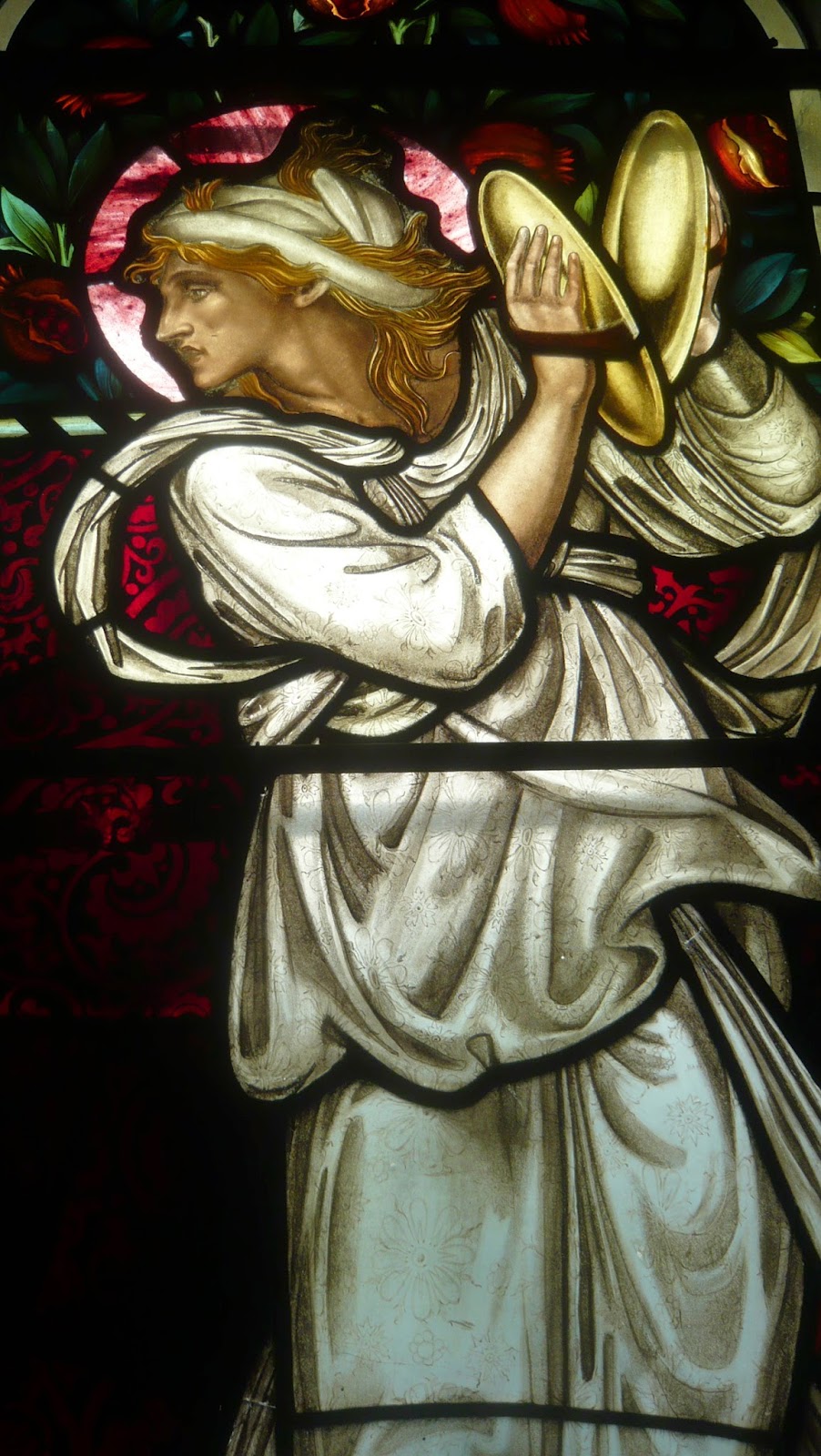
Many of the windows at St Michael and All Angels are by Morris & Co. and feature leading Pre-Raphaelites including Ford Madox Brown, Edward Burne-Jones, Morris, and, possibly, Dante Gabriel Rossetti. Later windows by Selwyn Image, Karl Parsons and Douglas Strachan are part of the same tradition and ensure that the feel of the building as a whole is cohesive. The third chancel window, which depicts the prophetess Miriam and was completed by Morris from a design by Burne-Jones, was included on a list of the 12 best stained glass windows in English churches as judged by photographer Lucinda Lambton.

The Whitefriars Company was a successful British glasshouse closely associated with leading architects and designers from the later portion of the 19th century onwards including Philip Webb who designed glass for William Morris. From 1876 James Crofts Powell ran the stained glass department which also developed mosaic techniques to the Byzantine standards of Ravenna. Powell’s opus sectile mosaics were tilted to deflect the light and gained sufficient credit to be used by William Blake Richmond in his work at St Paul’sCathedral. Whitefriars carried out the creation of the chancel mosaics at St Michael and All Angels to designs by J. P. Hutchinson.

Despite the beauty of the artwork and the building, it is not primarily the Pre-Raphaelite work that I have come to see here. The most recent of the windows, the 1929 St Cecilia and Angel by Karl Parsons, is described in the Church guide as being “especially beautiful when the summer evening sun shines through its vibrant colours.” Acid-etching and plating was used to create the enriched colour and texture found in this window. The window depicts St Cecilia, the Patron Saint of Music, and the music she has inspired on this occasion, which is included in the upper tracery section above the figures, is the fugue from Beethoven’s penultimate piano sonata.

Karl Parsons was pupil and assistant to Christopher Whall, who was an important member of the Arts and Crafts Movement, a leading designer of stained glass and a teacher at the Royal College of Art (RCA) and the Central School of Art and Design. In addition to his work in England, Whall also assisted in reviving the art of stained glass in Ireland. At the invitation of Edward Martyn, Whall, and his colleague Alfred Ernest Child, worked with Sarah Purser to set up a new school of stained glass in Dublin which was christened An Tύr Gloine (Tower of Glass), with a credo that “each window should be in all its artistic parts the work of one individual artist.’

Parsons, who also taught at the RCA and Central School was a craftsman of outstanding ability who worked from a studio at the Glass House Fulham; the centre for most stained glass designers during the first half of the twentieth century. He and Harry Clarke met in 1913, while Clarke was studying the craft and before he began work for his father’s glass workshop, the Clarke Studios, also based in Dublin. The two men remained close friends until Clarke’s death in 1931. The St Cecilia and Angel window at St Michael and All Angels, although “unmistakably by Parsons rather than Clarke” was based on Clarke’s rejected design and means that a trace of the rejected work is found in this church despite its perceived incongruity with the existing Pre-Raphaelite glass (Harry Clarke: The Life & Work, Nicola Gordon Bowe).

Among the many ironies of this story is the fact that Clarke has been described as “the last of the Pre-Raphaelites” and “played a major part in the Arts and Crafts movement in Ireland … as well as in the international stained glass revival which arose from the movement in England.” He “can also be seen as Ireland’s major Symbolist artist, whether in his illustrations or in his stained glass” (Gordon Bowe). Symbolism was also a wider international movement of which the Pre-Raphaelites were part. Therefore, the rejected design, while considered out of keeping with the Pre-Raphaelite windows already in the church, was actually part of a body of work that built on the foundation laid by the Pre-Raphaelites.

Clarke’s strange genius was to fuse “the Burne-Jones/Whall idiom” with “an eclectic and decadent Symbolism of medieval richness and Byzantine splendour” which was achieved by means of his having, as a young man, “absorbed Burne-Jones, [Aubrey] Beardsey, Charles Ricketts, Edmund Dulac, Kay Nielsen, the Glasgow School[Gustave] Klimt, the Japanese print, the Symbolists, and the Russian ballet.” As a result, “his art displays a wilful decadence and an ambivalent religious mysticism of medieval intensity which ranges from the sublimely beautiful to the grotesquely macabre, rarely found in the work of his Celtic peers.” (Gordon Bowe).

Similarly, James White has noted that Clarke “always carried the sensual-mystical conflict with him” - viewing “his drawings as an outlet from the religious subjects with which he was daily involved in his stained glass work” – and that, as a result, “few artists have been more concerned with the conflict of religion and sensuality.” His works are “uniquely imaginative creations” undertaken with remarkable technical skill meaning that “when he applied his minute and precise line to his process of plating and aciding he achieved an art form of extraordinary perfection.” Peyton Skipwith has suggested that by means of Clarke’s work, alongside that of Evie Hone at An Tύr Gloine, it was Ireland which revived the art of stained glass in the twentieth century (Gordon Bowe).

During his short life Clarke created 160 stained glass windows for churches and private patrons in Ireland, England, the United States and Australia. His unique style and technique combined rich colours with elongated figures that exude poise and grace. Deep blues and ruby reds were the hallmark of his work. As an illustrator of books, his five books for Harrap and Co show his genius in the area of graphic art. In England, work by Clarke is most easily seen at the Victoria & Albert Museum in London and the Stained Glass Museum in Ely.

--------------------------------------------------------------------------------------

The Blue Aeroplanes - Colour Me.

Thursday, 12 April 2012

A most interesting period of British stained glass


St John's Seven Kings is mentioned in a new Wikipedia entry for the artist Louis B. Davis. Davis designed the Nativity window at St John's, originally located in our baptistry and now part of our sanctuary.

The new entry has been compiled by researcher Gordon Lawson as part of his research into the work of Christopher Whall and his followers. Lawson started with Whall himself:
 
 
This led him to Whall's daughter, Veronica:
 
 
He then moved to Edward Woore, Margaret Chilton and Marjorie Kemp and Karl Parsons:
 
 
He plans similar works on Caroline Townsend  Mary Hutchinson, Arnold Robinson, Paul Woodroffe and a few others so that when he has finished he will have set out a reasonable source of research information on a most interesting period of British Stained Glass.

------------------------------------------------------------------------------------------------------------------------

Florence and the Machine - No Light, No Light.

Thursday, 12 August 2010

New Church Art Trail (5)

 'Nativity' window by Louis B. Davis

 'Christ & St John' window

'St Agnes & St Joan of Arc' window


Whitefriars mark on the right of the 'St Joan of Arc' window

Thanks to researcher Roy Albutt, we have been able to attribute the stained glass windows at St John’s Seven Kings in what was originally the baptistry and is now the Sanctuary. The clue was the Whitefriars mark on two of the windows which led Roy Albutt to the Whitefriars lists of stained glass, compiled by Dr Dennis Hadley, to be found on the NADFAS website, which contains the following information:

'Essex
Seven Kings St John
1908 2l (lights) L Davis
1931 2l Baptistry incl John Coakes, Hogan
1938 2l Baptistry incl Joan of Arc JH, JHH, Board E'

Roy Albutt writes that:

“The 1908 window, which I take to refer to the Nativity window, was designed by L. Davis. Louis B. Davis worked for Powell's from 1898 to 1909. He was an important Arts and Crafts stained glass artist. His windows at Dunblane Cathedral, Stirling are stunning, some of the most impressive stained glass I have seen. Davis trained with Christopher Whall, THE Arts and Crafts maker and teacher from c. 1893 until he moved to Powell's.”

Louis B.Davis was born and grew up in Abingdon. During the late-nineteenth and early-twentieth centuries he became known as a talented watercolourist, a playwright, book illustrator and above all a distinguished glass artist, continuing his work in the tradition of the Arts and Crafts movement. When referring to the splendidly translucent, glowing colours Davis loved so much, as evidenced in his windows at Cheltenham College chapel, Nikolaus Pevsner identified him as the last of the Pre-Raphaelites.

The obituary of Davis in the Abingdon Parish Magazine noted that ‘His colour and design satisfy the sense of beauty, and the actual craftsmanship will always be a wonder to those who understand the art of glass-making.’ The Times obituary commented: ‘Mr Davis may be said to have inherited the side of the pre-Raphaelite movement which was concerned with medieval glamour and Celtic twilight rather than with the method of fidelity to nature... Davis was so thoroughly imbued with the spirit of his school that he used all its devices and mannerisms with an easy, natural skill, and the sentiment of his pictures never seemed forced or affected...’

Among Davis’ most important work, in a distinctive Arts and Crafts style, was his scheme for glazing the choir windows at Dunblane Abbey (1913); several windows in the chapel of the Order of the Thistle at St Giles' Cathedral, Edinburgh; glasswork at Colmonell Church in Ayrshire; Paisley Abbey; Wemyss Castle; St Patrick's Cathedral, Dublin and Welbeck Abbey. He also decorated the private chapels of the Marquess of Londonderry at Wynyard Park, County Durham and the Duchess of Bedford at Woburn Abbey. In southern England examples of Davis's work can be found at Littlemore Church, Oxford (1900); Abingdon School Chapel (1924, inserted 1952); Barton Hartshorn Church near Bicester; Foxley Church, Wiltshire (1901); Stoke Poges Church, Buckinghamshire (1899); St Silas's Church, Kentish Town, London (1900) and at Pinner (1900) and Hatch End Churches (1903–1932) in Middlesex. At All Saints' church, Longstanton, Cambridgeshire a depiction of Faith, Hope and Charity (1938) re-uses the figure of Hope from St Silas's Church.

After 1917-18 Thomas Cowell (1870-1949) played a significant part in re-working or adapting earlier designs by Davis. Cowell was for many years the principal glass-painter for James Powell & Sons who translated Davis’s designs and cartoons into stained glass.

The Christ and St John windows were A.F. Coakes and James Hogan, while Hogan was also involved in designing the St Agnes and St Joan of Arc windows, together with E. Board. All were also Whitefriars designers.

The most enduring and successful glasshouse in Britain, the Whitefriars Company made stained glass, table and ornamental glass, and scientific glass. It had a reputation for innovative design and retained an identity distinct from that of other British glass making centres. There are Whitefriars windows reflecting the glory of God in cathedrals and churches all over the world - from St. Paul's Cathedral, London, to St. Thomas's, New York; from Wellington Cathedral, New Zealand, to the great twentieth-century Anglican Cathedral of Liverpool, and village churches throughout the shires of England.

In 1720, a glasshouse was established on part of the site of the former medieval 'White Friars' monastery, situated south of Fleet Street. The factory really came into its own when James Powell a London wine merchant and entrepreneur, purchased the factory in 1834, the idea was to give his three sons a viable occupation. The Powell’s were related to Baden Powell, the Scout Movement founder.

The Powell’s were initially ignorant of the art of glass making, but by necessity soon acquired the skills needed and adapted and improved upon the new technologies of the industrial revolution. A Victorian barrister and archaeologist, Charles Winston, the authority for cathedral and church window restoration, had investigated the properties of medieval stained-glass, analysing the colouring agents used in the Middle Ages. He persuaded Powell to produce such glasses. By 1854 they were experimenting with the chemical mixes to achieve mediaeval coloured glass [quarries] for Winston. This innovation set them up as leaders in the field when hundreds of new Victorian churches were being built across the country and indeed the world.

Through Winston’s recommendation Powell was supplying Edward Burne-Jones with stained glass muff with the right mix of air bubbles and brilliant natural colours to match mediaeval glass. Soon Powell was commissioning cartoons from Edward Burne-Jones, Henry Holiday, Anning Bell, Edward Poynter, Ford Maddox Brown and George Cattermole. During the later portion of the 19th century the Powell’s became closely associated with leading architects and designers notably T G Jackson, Edward Burne Jones, William De Morgan and James Doyle. Not to mention Philip Webb who designed glass for William Morris that was manufactured by Whitefriars. By the late 1850’s the firm’s attention began to include designs and production of domestic table glass after manufacturing glass for William Morris's revolutionary Red House.

James Crofts Powell, his cousin, ran the stained glass department from 1876 using in-house designers and famous artists like Burne-Jones for important commissions. Under Crofts Powell the stained glass department did traditional work but also developed mosaic techniques to the Byzantine standards of Ravenna. His opus sectile mosaics were tilted to deflect the light and gained sufficient credit to be used by William Blake Richmond in his work at St Paul’s Cathedral.

The 'Whitefriars' trade name was added only in 1919, four years before the firm relocated from the City to a new site at Wealdstone, Harrow. In 1973 the Whitefriars Company closed its stained glass studio, and came under increasing financial pressure. When the company closed in 1980, the Museum of London acquired its archive of business papers, photographs, designs and pictures; some manufacturing tools and equipment; the contents of the glassworks' museum; and examples of the factory's final products.

This information will now be added to that included in our local Church Art Trail and will be of particular interest because our neighbouring parish of St Paul's Goodmayes also have several Whitefriars windows.

--------------------------------------------------------------------------------------------
 
Keith Green - Stained Glass.