Wikio - Top Blogs - Religion and belief

Sunday, 21 April 2024

Team Rector of the Billericay & Little Burstead Team Ministry


Check out this exciting opportunity to develop, innovate and co-ordinate a parish wide Team ministry in the vibrant town of Billericay which has easy access to both London and the countryside.

The role of Team Rector for The Billericay and Little Burstead Team Ministry is an exciting opportunity to work with four Churches and one Chapel of Ease. You would be leading and working alongside experienced and committed Clergy, Licensed Lay Ministers, Church Wardens and laity.

In recent years the Team Churches have developed ways of working together allowing friendships and fellowship to grow. We are looking for the right person who will enable this to continue, as well as encouraging an ever-deepening relationship with Christ, and equipping everyone to share the Good News of the Gospel.

We are seeking someone to lead the team who:
  • has an evangelical conviction and has a passion for growing churches
  • will enjoy developing, innovating and co-ordinating a parish wide ministry
  • values working alongside and developing lay people as part of an effective team
Closing date: 28th May 2024

Click here for more information and here for the Parish Profile.

------------------------------------------------------------------------------------------------------

Ricky Ross, Hannah White & Keiron Marshall - Pale Rider.

Windows on the world (463)


London, 2024

---------------------------------------------------------------------------------------------------------

T Bone Burnett - The Pain Of Love.


Friday, 19 April 2024

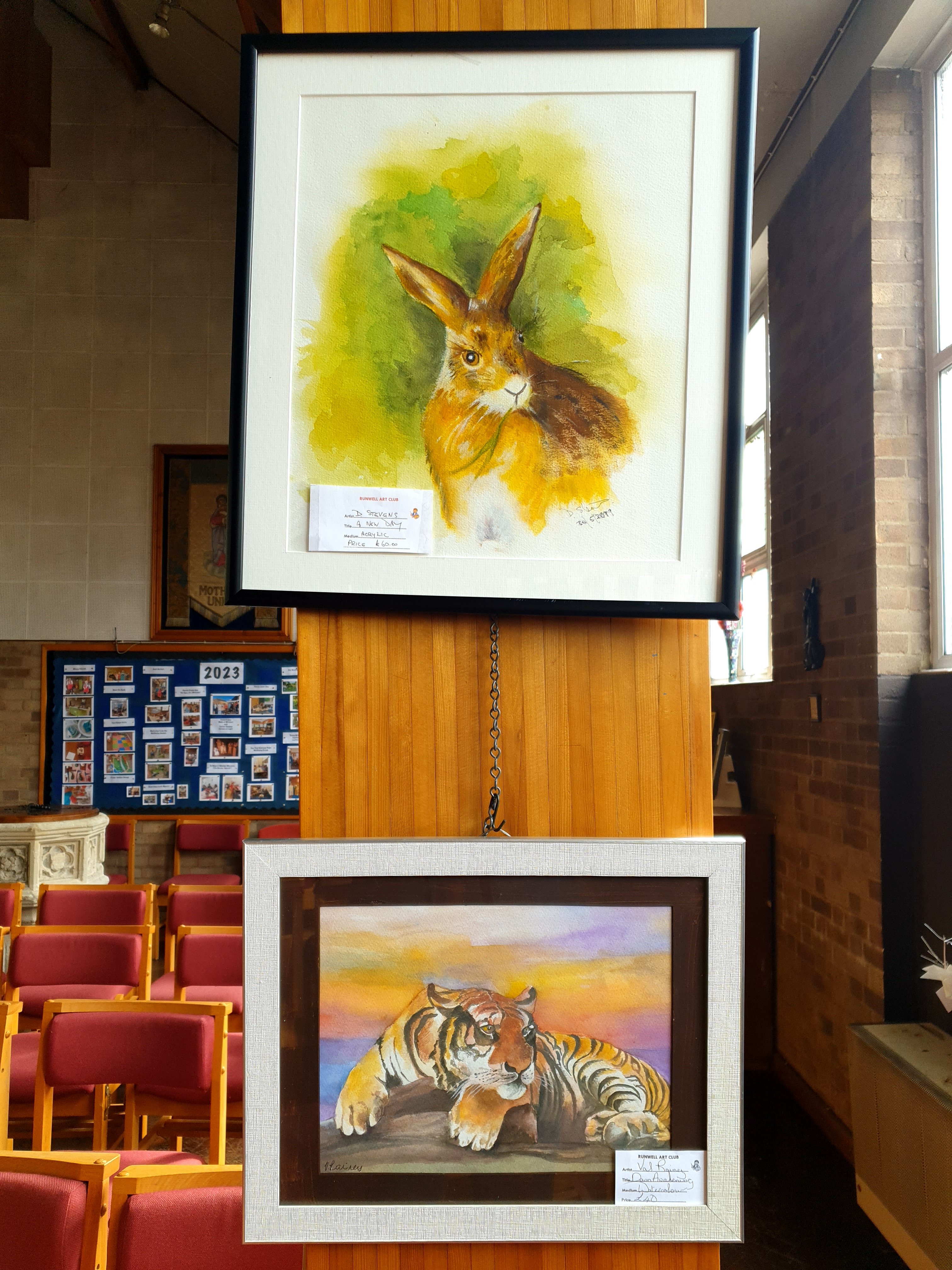
Brand New Day: Runwell Art Club exhibition


Brand New Day: Runwell Art Club exhibition
Friday 19 April – Friday 26 July 2024
St Andrew’s Church, 11 London Road, Wickford, Essex SS12 0AN


The summer exhibition at St Andrew's Wickford is called 'Brand New Day' and is a group show by Runwell Art Club. The theme is explored through landscapes and portraits with animals, babies and sunrises featuring prominently.

Runwell Art Club is a small but thriving art club that was started in 2010 by two dedicated artists, Carole Wellby and Paula Sloane. They meet in Runwell, every Friday at 10am.

St Andrew’s is usually open: Sat 9am-12.30pm; Sun 9.30am-12 noon; Mon 2-3.45pm; Tue 1-4.30pm; Wed 10am-12 noon; Fri 10am-1pm.

Exhibition viewing evening at ‘Unveiled’ - Friday 3 May, 7.00 pm.

See http://wickfordandrunwellparish.org.uk/whats-on.html for fuller information.

------------------------------------------------------------------------------------------------------------

Water into Wine Band - Hillclimbing For Beginners.

Wednesday, 17 April 2024

Testimony in the courtroom of life

Here's the sermon I shared at St Andrew's Wickford this morning:

Saint Stephen was the first Christian martyr, and was stoned to death (Acts 7. 54-60). Saul (the future Saint Paul) guards the clothes of those who stone Saint Stephen outside the city. In the Acts of the Apostles, Stephen is described as one of the seven deacons whose job it is to care for the widows in the early Church in Jerusalem. His eloquent speech before the Sanhedrin, in which he shows the great sweep of Jewish history as leading to the birth of Jesus, the long-expected Messiah, and his impassioned plea that all might hear the good news of Jesus, leads to his inevitable martyrdom by being stoned to death. 

As the author of Acts, Luke's description of Stephen bears direct parallels to that of Christ: for example, being filled with the Holy Spirit; seeing the Son of God as the right hand of God, as Jesus promised he would be; commending his spirit to Jesus, as Jesus commended his to the Father; kneeling as Jesus did in Gethsemane and asking forgiveness for his persecutors. Witnessing to Jesus by acting like Jesus in every way is thus seen by Luke as of the essence of the Christian life.

The Greek word "martus" signifies a "witness". It is in this sense that the term first appears in Christian literature; the Apostles were "witnesses" of all that they had observed in the public life of Christ. The Apostles, from the beginning as the story of St Stephen makes clear, faced grave dangers, until eventually almost all suffered death for their convictions. Thus, within the lifetime of the Apostles, the term martus came to be used in the sense of a witness who at any time might be called upon to deny what he testified to, under penalty of death. From this stage the transition was easy to the ordinary meaning of the term, as used ever since in Christian literature: a martyr, or witness of Christ, as a person who suffers death rather than deny his faith.

There continue to be Christians who experience persecution or martyrdom today and we must pray for and support our brothers and sisters in the persecuted Church. It is, probably, unlikely that we will share with St Stephen in this experience, even so, we can still share with St Stephen in the other meaning of martus; that of being a witness who gives testimony. The missiologist Lesslie Newbigin has explained that testimony is what is given by a witness in a trial. A witness makes his or her statement as part of a trial in which the truth is at stake and where the question, ‘What is the truth?’ is what is being argued. Newbigin has argued that this is what is “at the heart of the biblical vision of the human situation that the believer is a witness who gives his testimony in a trial.”

Where is the trial? It is all around us, it is life itself? In all situations we encounter, there is challenge to our faith and there is a need for us to testify in words and actions to our belief in Christ. Whenever people act as though human beings are entirely self-relient, there is a challenge to our faith. Whenever people argue that suffering and disasters mean that there cannot be a good God, we are on the witness stand. Whenever people claim that scientific advances or psychological insights can explain away belief in God, we are in the courtroom. Whenever a response of love is called for, our witness is at stake.

What is the content of our testimony? Witnesses are those who have seen or experienced a particular event or sign or happening and who then tell the story of what they have seen or heard as testimony to others. That is what Jesus called us to do before he ascended to the Father; to tell our stories of encountering him to others. So, we don’t have to understand or be able to explain the key doctrines of the Christian faith. We don’t have to be able to tell people the two ways to live or to have memorized the sinner’s prayer or to have tracts to be able to hand out in order to be witnesses to Jesus. All we need to do is to tell our story; to say this is how Jesus made himself real to me and this is the difference that it has made.

Malcolm Guite sums up these thoughts as follows:

Witness for Jesus, man of fruitful blood,
Your martyrdom begins and stands for all.
They saw the stones, you saw the face of God,
And sowed a seed that blossomed in St. Paul.
When Saul departed breathing threats and slaughter
He had to pass through that Damascus gate
Where he had held the coats and heard the laughter
As Christ, alive in you, forgave his hate,
And showed him the same light you saw from heaven
And taught him, through his blindness, how to see;
Christ did not ask ‘Why were you stoning Stephen?’
But ‘Saul, why are you persecuting me?’
Each martyr after you adds to his story,
As clouds of witness shine through clouds of glory. ()

Prayer: Gracious Father, who gave the first martyr Stephen grace to pray for those who took up stones against him: grant that in all our sufferings for the truth we may learn to love even our enemies and to seek forgiveness for those who desire our hurt, looking up to heaven to him who was crucified for us, Jesus Christ, our Mediator and Advocate, who is alive and reigns with you, in the unity of the Holy Spirit, one God, now and for ever. Amen.

----------------------------------------------------------------------------------------------------

Malcolm Guite and Rob Groves - Angels Unawares.

Monday, 15 April 2024

Jackie E. Burns and Lunar Lullabies


Jackie E. Burns is a Fellow of the International Association of Astronomical Artists and seeks to foster the inquisitive joy of art and astronomy while inspiring people to the awe and beauty of space and astronomy. As an astronomical artist, she specializes in terrestrial and extra-terrestrial landscapes. She also creates celtic and medieval illuminations. She is a workshop designer, gives illustrated lectures and is an art exhibition curator for conferences and conventions. 

Jackie exhibited at St Andrew's Wickford last year and now her work is to feature in a major exhibition of space art at Firstsite. Lunar Lullabies will offer a galactic journey through 200 years of space exploration. 

Join Colchester’s own Jane Taylor on a celestial adventure, inspired by her timeless poem, “Twinkle Twinkle Little Star.” Embark on a cosmic odyssey as Firstsite commemorate the 200th anniversary of the Essex writer’s passing and trace the fascinating legacy of the beloved nursery rhyme and its influence on modern-day comics and video games. 

Discover how science, art and imagination have intertwined over the centuries to shape our culture and fuel our dreams of distant galaxies.

Lunar Lullabies will showcase stunning artworks which explore space and science, alongside historical artefacts and contemporary pop culture nods. Explore objects ranging from meteorites and asteroid rocks to Lego Star Wars sets up close, discover all about humanity’s ‘giant leap’ to the moon and get lost in Peter Elson’s fantastical visions of space.

Families will have the opportunities to bring their own cosmic creations to life, transforming the gallery into an immersive playscape of imagination and discovery. From interactive space objects, and immersive extra-terrestrial landscapes to sculptures of robots and rockets, there’s something for every space enthusiast, young and old. Join this stellar voyage, where art, science, and dreams collide. Your journey to the stars awaits!

--------------------------------------------------------------------------------------------------------

David Bowie - Space Oddity.

Sunday, 14 April 2024

Windows on the world (462)


Lyvden, 2024

--------------------------------------------------------------------------------------------------------------

Scott Stapp - Ready To Love.


The only true leadership

Here's the sermon I shared at St Mary Magdalene Great Burstead this morning:

“In a pastoral society like ancient Israel, sheep and shepherds were used to describe the relationship of God with his people: ‘the Lord is my shepherd’ and ‘we are his people, the sheep of his pasture’ (Pss 23:1; 100:3)” (Richard A. Burridge, John).

In Jesus’ time, sheep were very important as they provided both food and clothing. Shepherd’s had to have a nomadic lifestyle because of the available pasture. They had to travel with their sheep from one region to another as the seasons changed. This created the close relationship between sheep and shepherd that we hear Jesus describing and using in this reading: “The Shepherd cares for his sheep, calls them by name, leads them to pasture and water, finds shelter for them in inclement weather, defends them against bandits and wolves, and willingly lays down his life for them. The sheep have great confidence in the shepherd. They recognize his voice, obey his commands, and they follow wherever he leads them” (http://www.frksj.org/homily_the_good_shepherd.htm).

“The word “good” (kalos …) means first and foremost beautiful – the good shepherd is attractive. At the same time he is good at his work. So this attractive and very skilled shepherd draws us to himself and is able to provide accurately for our needs” (Stephen Verney, Water into Wine)

The Good Shepherd lays down his life for the sheep (John 10. 11 – 18): “The word “life” (psychē …) is impossible to translate by any one English word. The psychē means the self, or the ego, or the soul. It can be the centre of our earthly life, or the centre of our supernatural life. If the shepherd lays down his psychē for the sheep he is offering them this centre of his inner life, in all its varied aspects …” (Verney).

Lesslie Newbigin writes that: “Here is the unmistakable criterion by which true leadership is to be distinguished from false. We are familiar with the kind of leadership which is simply a vast overextension of the ego. The ultimate goal – whether openly acknowledged or not – is the glory of the leader. The rest are instrumental to this end. He does not love them but makes use of them for his own ends. He is a hireling – in the business of leadership for what he can get out it. By contrast the mark of the true leader is that of the cross” (The Light Has Come).

“Jesus …is the good shepherd, who knows his own sheep as they know him (10:14). Shepherds called their sheep out of the fold by their names and the flock followed their voice (10:3-4). The Greek word for church literally means ‘called out’, ec-clesia, from which all our ‘ecclesiastical’ words are derived. Jesus’ knowledge of his sheep is rooted in his knowledge of his Father and his Father knowing him as his Son.” (Burridge) Stephen Verney writes that “… the Son can do nothing of himself, but he simply looks at the Father and whatever he sees the Father doing so he does too … the Father holds back nothing for himself but gives everything to the Son. So it is, says Jesus, between the Good Shepherd and his sheep – between me and mine, and mine and me. They are in my heart, and there I see them in all their human ambiguity. I see what they are and what they can be, and I give myself to them. And I am in their hearts … That is how the Good Shepherd knows his sheep, and how they know him. They do not simply know about him, or pass examinations in theology, or even read books about John’s gospel. They know him in their personal experience.” (Verney).

“What is more, God’s love is universal, so the shepherd must also be concerned for ‘other sheep … not of this fold’, who will also hear his voice and be brought together into one flock (10:16)” (Burridge). What Jesus says here is that what he offers is not simply for a little exclusive group but is for the whole human race.

This is a challenge then to all involved in the pastoral care of God’s people. It takes time and effort to know everyone individually, even as God knows us, and caring for them as Christ laid down his life for us may demand the ultimate sacrifice. The ordination charge for priests in the Church of England says ‘as servant and shepherd … set the Good Shepherd always before you as the pattern of your calling … to search for his children in the wilderness of this world’s temptations … the treasure now to be entrusted to you is Christ’s own flock’. This is true whether we are an Archbishop or a bible study group leader, a minister or just visiting an elderly person around the corner – we love others as the good shepherd loves us.” As Lesslie Newbigin writes, “This is the way for all humankind, and to follow this way is to learn the only true leadership.” May it be so for each one of us. Amen.

----------------------------------------------------------------------------------------------------------