Wikio - Top Blogs - Religion and belief

Friday, 13 January 2023

Wickford & Runwell Team Ministry: Events and initiatives


Unveiled, the regular arts and performance evening at St Andrew's Church (11 London Road, Wickford SS12 0AN), returns tonight (Friday 13 January) at 7.00 pm with 'From Rettendon Turnpike to Halls Corner: A Journey in Time', a talk by Geoff Whiter of Wickford Community Archive. Unveiled includes exhibitions, open mic nights, performances, talks and more!
  • Unveiled – a wide range of artist and performers from Essex and wider, including Open Mic nights (come and have a go!).
  • Unveiled – view our hidden painting by acclaimed artist David Folley, plus a range of other exhibitions.
Our Spring Programme for 2023 is as follows:
  • 13 January – 'From Rettendon Turnpike to Halls Corner: A Journey in Time'. A talk by Geoff Whiter of Wickford Community Archive.
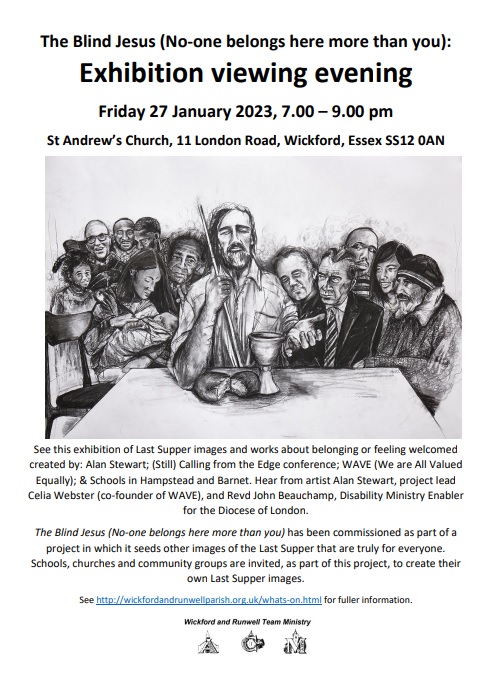
  • 27 January – 'The Blind Jesus (No-one belongs here more than you)': Exhibition viewing evening. See this exhibition of Last Supper images and works about belonging or feeling welcomed. Hear from artist Alan Stewart, project lead Celia Webster (co-founder of WAVE), and Revd John Beauchamp, Disability Ministry Enabler for the Diocese of London.
  • 10 February – An evening with composer Silvio Bartoli. Numerous performances of his pieces have been done during the last years in London, by The Hermes Project, The Explore Ensemble, different solo pieces, and the RCM Philarmonia. In addition to his career as a composer, he teaches composition, harmony, piano, theory and solfege.
  • 17 February – 'God Gave Rock and Roll to You': a talk by Jonathan Evens about the religious influences in Rock, Pop, and Soul music.
  • 3 March – Open Mic Night with John Rogers. Everybody is welcome to come along and play, sing or just spectate. Hope to see you there for a great evening of live music!
  • 17 March – St Martin’s Voices, one of the UK’s most versatile professional vocal ensembles, performing concerts on the international stage as well as giving regular BBC broadcasts and special services at London’s iconic St Martin-in-the-Fields. The ensemble performs regularly alongside the Academy of St Martin in the Fields and London Mozart Players and is featured in the Church of England’s online worship resources that have attracted over 4 million downloads.
These events do not require tickets (just turn up on the night). There will be a retiring collection to cover artist and church costs.

We are also running a fundraising campaign for urgent work that is required to the Tower of St. Catherine’s Church Wickford as a result of ground movement caused by the long dry summer. This resulted in subsidence of the foundations in the North West corner of the church which caused a number of large cracks to appear in the walls and some stonework to fall. As a result, urgent safety and weather protection work costing £23,000 is required followed by the investigations needed to design a long-term solution to the problem.

A fundraising campaign to raise an initial £23,000 has been launched, but this is only the beginning of a much longer project to effectively underpin the church in order to prevent the regular recurrence of the issue. This first stage of the project will involve: removing or temporarily fixing loose stonework; undertaking temporary roof repairs and loose filling of walls for weather protection; removal of loose internal plasterwork; temporary covering of affected windows; and the reinstatement of the lightning conductor.

"Our churches are seeking to be at the heart of the community in Wickford but also need the support of the wider community in the town, particularly as we address the problems of subsidence at St Catherine's Church and the expense of maintaining this much-loved community building given the effects of significant climate change."

“Our recent consultation exercise in the Parish revealed that the churches in Wickford and Runwell are seen as contributing to the sense of community and are valued both for the support they bring to others and as centres for peace and prayer which provide a sense of Christian presence. Many local people have been baptised or married at St Catherine’s or have family members commemorated in the churchyard. For all these reasons, we believe many locally will want to support this campaign to ensure that this much-loved community building is repaired and secured for the future.”

Our fundraising campaign begins with a series of fundraising events involving Ladybirds Song Group, Rumatica Ukulele Group and a Quiz Night:
  • Ladybirds Song Group: Saturday 21 January, 7.30 pm, St Andrew’s Church (11 London Road, Wickford SS12 0AN). The Ladybirds Song Group sing all over South Essex performing popular songs from the 1950s to the present. No tickets required. A retiring collection will be taken.
  • Quiz Night: Saturday 4 February, 7.00 pm, 1st Runwell Scout Hall (Runwell Gardens SS11 7DW). £5.00 p/head. Tables of up to eight. Bring your own snacks & drinks (Tea and Coffee available). To book a table email StCatherinesQuiz@hotmail.com. Street parking in Church End Lane.
  • Rumatica Ukulele Group: Saturday 11 March, 3.00 pm, St Catherine’s Church (120 Southend Road, Wickford SS11 8EB). A local band playing and singing a wide range of popular songs including rock, pop, country, swing, rock and roll. Enjoy a cream tea afterwards in the church hall.
Those wishing to contribute to this campaign, can send cheques made out to Wickford and Runwell Parochial Church Council to The Rectory, 120 Southend Road, Wickford SS11 8EB or phone 07803 562329 / email jonathan.evens@btinternet.com for the bank details to use for a bank transfer.

We are also continuing with our Contemplative Commuters and Saturday Solace initiatives:
  • Contemplative Commuters is a Facebook group for any commuter wanting quiet reflective time and content on their journeys to and from work. Those joining receive a short weekly reflection, prayer and link to a useful resource at the beginning of the week. These can be used as group members wish, at any point throughout the week. Also available are 30-minute online services of Morning Prayer recorded on Tuesdays, Wednesdays & Thursdays at churches in Wickford & Runwell. Group members can share requests for prayer, whether personal or for family, friends, colleagues, also for home, work or world situations. Prayers are offered in the online services of Morning Prayer.
  • Saturday Solace provides regular 10-minute reflection and Christian mindfulness sessions between 10.00 am and 12 noon on Saturdays at St Andrew’s Wickford to any in need of rest and renewal. Drop in whenever you can or combine your visit with food & drink at our popular Coffee Morning in the St Andrew’s Centre.
Like many local churches, the three churches in the Wickford and Runwell Team Ministry each contain interesting collections of art works from a range of periods and in a range of styles. As these artworks demonstrate, churches have for many years been significant patrons of the visual arts and contain important and interesting works of art. A case study on the Parish for Gods' Collections explores the artwork in our three churches and ways to share such works more widely.

-------------------------------------------------------------------------------------------------------

Silvio Bartoli - After.

Thursday, 12 January 2023

Ministry and withdrawal, ministry and moving out

Here's the sermon I preached at St Andrew’s Wickford during yesterday's midweek Eucharist:

Mark’s Gospel begins a little like an action movie. Before we have completed the first chapter John the Baptist has preached, Jesus has been baptised, tempted in the desert, called the disciples, and healed a man in the synagogue. The pace of action is breathtaking. Read it at home and see for yourself!

So we are still in the first chapter with today’s Gospel reading (Mark 1. 29-39) and, although that is the case, we have here ten verses that show us the pattern of Jesus’ whole ministry. This is what Mark is so good at doing. He doesn’t just tell us the story straight; this happened then that happened. Instead he tells stories that sum up what the whole of Jesus’ mission and ministry were about, so that we can follow in Jesus’ footsteps by doing the same.

The first pattern that we see in this story is the balance been ministry and spirituality. The first few verses of the story describe an intense period of ministry. Jesus returns from the synagogue where he has just healed a man to find that Simon’s mother-in-law is unwell. He heals her and then spends the evening healing many “who were sick with all kinds of diseases and drove out many demons.” We know how busy and exhausted we can often feel through the ministry we do in our workplaces, homes, community and here at St John’s. We can imagine how Jesus would have felt following his day of ministry.

In the morning, everyone is again looking for Jesus but he is nowhere to be found. Long before daylight he had got up, left the town and gone to a lonely place where he could pray. In order to pray effectively and well to needed to get away from the demands of ministry and away from his disciples. He needed to be alone with God in order to recharge his batteries for further ministry to come and this is Jesus’ pattern throughout his ministry; active mission together with others combined with withdrawal for individual prayer and recuperation.

This needs to be our pattern too. The busyness of ministry here and in our weekday lives cannot be sustained if it is not fed by regular times of withdrawal for prayer and recuperation. The two are clearly separated in Jesus’ live and ministry and he is prepared to disappoint people, as in this story, in order to ensure that he has the times of prayer and recuperation that he needs in our to sustain his active ministry.

The second pattern that we find in this story is that of ministry and moving on. Jesus has this time of active ministry with the people at Capernaum and then he moves on to preach in the other villages around this town and indeed across the whole of Galilee. The people don’t want him to go. The disciples tell Jesus that everyone is looking for him. They want more of what he has already given them. But he refuses them and moves on to preach to others.

There are two aspects to the pattern of Jesus’ ministry here. First, is his concern for all to hear. That is why he has come, he says, that he should bring God’s message to all. We need that same motivation. The message of salvation cannot stay wrapped up inside this building or our congregation but must go out from here. That also needs to happen for our own growth and development. We grow as Christians not by staying where we are and being ministered to but by getting up and following in Jesus’ footsteps ourselves; by becoming active ministers of the Gospel ourselves.

That is why Jesus constantly challenges his hearers to take up their cross and follow him. It is not that he wants to condemn all of us to suffering and a hard life instead he wants us to become people who learn how to give more than we receive. If all that we do as Christians is receive then our faith is ultimately a selfish one that is about what we can gain for ourselves. But what Jesus models for us is a way of life based on giving not getting and it is as we follow in his footsteps by giving that we grow and mature as Christians not the other way around. When we get up and go, we are putting our faith into action and genuinely trusting God. In that way, our faith is stretched and strengthened and grows.

William Temple, who was probably the greatest twentieth century Archbishop of Canterbury, famously said, “The Church is the only society that exists for the benefit of those who are not its members.” What he meant is that the Church is not about us members getting our needs and wants satisfied; it is instead about equipping and motivating us, the members, to bless others in the love of Christ. That is what Jesus sought to achieve by moving from town to town, village to village and challenging his disciples to travel with him. 

We need to mirror these patterns of ministry and withdrawal, ministry and moving out in our lives and our Church. We must be a society that exists for the benefit of those who are not its members. As we follow Christ, we cannot simply be about getting our needs and wants satisfied but need to be about being equipped by God through times of prayer and recuperation to be signs of Christ outside of this building, outside of our congregation, out where it makes a difference, out in our community and workplaces.

------------------------------------------------------------------------------------------------------------

Steve Bell & Malcolm Guite - Epiphany on the Jordan.

Tuesday, 10 January 2023

Launch of Fruits of the Spirit - Art from the Heart,

The launch of the virtual exhibition Fruits of the Spirit - Art from the Heart, curated by the Rev Dr Ayla Lepine (2021–22 Ahmanson Fellow in Art and Religion, The National Gallery) and Dr Susanna Avery-Quash, Senior Research Curator (History of Collecting) at the National Gallery was held tonight at The Foundling Museum.

The 'fruits of the Spirit' are a list of nine qualities found in Saint Paul's Letter to the Galatians in the New Testament. They include peace, joy, love, and patience. Fruits of the Spirit – Art from the Heart focuses on these terms in relation to paintings in the National Gallery's collection, from Titian and Rembrandt to Monet and Van Gogh, featured alongside works from UK regional collections. This exciting new digital project opens new doors regarding accessible online arts content and focuses on the nine qualities themselves as ways of amplifying wellbeing for all people, of all faiths or none.

Fruits of the Spirit: Art from the Heart, is an online exhibition and trail, pairing nine paintings from the National Gallery with nine works in public collections across the UK. Visit the online exhibition.

Each pair represents one of the nine ‘Fruit of the Spirit’ – love, joy, peace, patience, kindness, goodness, faithfulness, gentleness, self-control – positive attributes outlined in a letter from Saint Paul in the New Testament.

The virtual exhibition is combined with a free digital catalogue of essays. Over twenty authors, including curators, artists and community groups, as well as a new poetry commission by Dr Aviva Dautch, explore the importance of the exhibition’s themes, from love and family life to self-control in relation to climate change. Including words from a Nurse-in-Residence, a care-experienced young person and social justice charities, these essays aim to bring voices not normally heard in gallery catalogues to the fore. Creating links between paintings within and beyond the National Gallery and fostering interactions through different perspectives in communities and cultures encourages new ways of seeing and more open ways of engaging with one another. As a digital exhibition, 'Fruits of the Spirit' is freely accessible to both new and regular visitors from the UK and beyond.

The Foundling Museum’s ‘Fruit’ is Faithfulness and focussing on maternal faith the National Gallery’s The Finding of Moses by Orazio Gentileschi, dating from the early 1630s, has been paired with their Isabella, Duchess of Manchester, 1738, by Andrea Soldi.

In the story of Moses, his birth mother places him in a basket in the river to avoid certain death, demonstrating immense faith that her child will survive. Her faith is rewarded, and the Gentileschi painting depicts the moment of rescue and hope. This maternal faith is also reflected in our portrait of Isabella, Duchess of Manchester, who was instrumental in the formation of the Foundling Hospital. As with Moses, the birth mothers of children given up to the care of the hospital faced heart-breaking decisions that demanded enormous faith and trust.

As part of the collaboration visitors to the Foundling Museum are able to see in person The Finding of Moses painting, attributed to Venetian artist Francesco Zugno, which is on display next to Soldi’s Isabella, Duchess of Manchester on the first floor.

Lizzie Jones, whose painting 'Couple' at Southampton City Art Gallery is paired with 'The Painter;s Daughter with a Cat' by Thomas Gainsborough, was among those present. With a commitment to direct action in different forms involving making connections with people in order to influence and inform change around issues of military violence and harm, she takes painting commissions for public spaces, for charitable organisations and community groups and for special events / private spaces. She has created and is maintaining the Dye Garden at Southampton's Arches studio complex, while utilising those plants and their colour in print and paint. Puppet Back Up sees giant puppets getting involved in live concerns and beginning to turn up - in time - brought to life with the participation of many.

Canterbury Cathedral’s altarpiece, 'Scenes from the Life of Saint Martin of Tours', 1928–33, by Winifred Knights, also features in the exhibition. It is a powerful example of religious art by a British woman of the last century. This painting represents ‘peace’. A young woman who arrived in Kent as a refugee reflected on the painting in relation to this theme and identified a strong connection between the altarpiece and her story of family, uncertainty, and courage. Knights’s painting is paired with Claude Monet’s 'Water-Lilies' from the National Gallery’s collection. Monet described this work, painted during the First World War, as a ‘monument to peace’. In her catalogue essay, Revd Dr Ayla Lepine argues that contemplating sacred and secular art and relating it to people’s lives today can inspire us all to work for peace when it is most urgently needed around the world.

This free virtual exhibition also includes paintings by Jan Van Eyck, Vincent van Gogh, Frank Auerbach, Turner, Titian, Ernst Neuschul, Eugène Delacroix, Ron Stenberg, Orazio Gentileschi, Andrea Soldi and Thomas Gainsborough.

Other participating organisations:
The Bowes Museum
The Barber Institute of Fine Arts
Canterbury Cathedral
The McManus
Leicester Museum & Art Gallery
Ben Uri Gallery & Museum
The Box
Southampton City Art Gallery

-------------------------------------------------------------------------------------------------------

Carleen Anderson - True Spirit.

Monday, 9 January 2023

The mystery at the heart of music (2)

My original post titled 'The mystery at the heart of music' highlighted 'Surrender', the memoir by Bono, Bob Dylan's 'The Philosophy of Modern Song', 'Faith, Hope and Carnage', Nick Cave's conversation with Sean O'Hagen, and Richard Koloda's 'Holy Ghost: The Life and Death of Free Jazz Pioneer Albert Ayler'. I concluded that, in different ways, these books and the music they describe inhabits the space of genuine mystery and deep yearning that Nick Cave argues is 'at the heart of songwriting.'

To these four, needs to be added, 'Walking Back Home: Deacon Blue and Me' by Ricky Ross. Chris Deerin writes that: 

'Step back, and Ross’s life and trajectory seem ludicrously gilded: early success, Top of the Pops, sell-out stadium gigs, tours of the US, rubbing shoulders with Springsteen and Bono. But this book takes us in closer, to the struggles and the doubts and the losses; to a somewhat repressive upbringing in a Dundee Brethren family; a painful divorce from his first wife; the regrettable explosions of his burgeoning pop star ego; the sudden, unexpected loss of a career and an income; the moments of apparent hopelessness and vanished muse; the tragic death of a bandmate.

Ross is bracingly honest with the reader and himself, and his capacity to learn both from his successes and failures has forged an unusually deep level of wisdom. He is sustained by his religious faith, though is never heavy-handed about that ...

And through it all there has been the music: “The only thing I have ever been fascinated by was the power of a song, and what a song could do to me when it really connected.”'

Paul English in an interview for The Scotsman suggested to Ross that the pursuit of joy, 'whether on stage in front of 250,000 headlining Glasgow’s Big Day in 1990 or visiting slums in Brazil with Christian Aid', was a recurring theme in the book. Ross responded that: 

'It’s the constant search in the book ... I think that’s the search for most people – to realise when you are happy, to realise when life is good. I don’t want to use the cliche of Calvinism, but there is a sense in which sometimes that can dominate our lives, that somehow you deny yourself.

I think you have to allow yourself to celebrate these moments. I talk about a gig we played in Kilmarnock prison, and the chaplain Fr Joe Boland saying to me that where there’s joy there’s God. And that was such a great thing.”

Greg Clarke in an article on Bono, Nick Cave, and their spiritual quests based on their books writes that: 'Submit, surrender, let God be God, recognise a higher power. These are the concluding observations of two of the most famous musicians of the past forty years. It’s not very rock and roll.' 

But it maybe that these five books appearing together indicates that such observations are actually very rock and roll; something that should come as no surprise as rock, soul, and R&B grew from the roots of gospel through artists such as Sam Cooke, who transitioned from gospel to secular music, Sister Rosetta Tharpe and her early rock stylings, and Elvis Presley, who helped expose white audiences to gospel music. Examples of some of the most beloved contemporary pop music of the last 60 years, from artists such as Aretha Franklin, Paul Simon, and Ray Charles, illustrate gospel music’s ongoing influence.

Add to these roots: first, the Church's appropriation, beginning with the career of Larry Norman, of rock and pop to speak explicitly about Christian faith; second, a growing appreciation for and understanding of the biblical language and imagery of stars like Bob Dylan, Van Morrison and Bruce Springsteen; and third, musicians from After The Fire and Bruce Cockburn to U2 and Deacon Blue, in the words of T Bone Burnett, singing about the world as seen through the light (of Christ) as opposed to singing about the light (of Christ) as CCM artists did. These all take us to a place where the embrace and examination of Christianity in these books is perhaps as rock and roll as sex and drugs have been.

--------------------------------------------------------------------------------------------------------------

Deacon Blue - Keeping My Faith Alive.

Saturday, 7 January 2023

Windows on the world (407)


 Dulwich, 2023

----------------------------------------------------------------------------------------------------------------

Dominique Lawalrée - Listen to the quiet voice.

Friday, 6 January 2023

Poetry Update

ImageUpdate, a free weekly e-newsletter with reviews of books, albums, artists, gallery openings, and more, is always worth a read. Each issue also includes recommendations from the Image staff, links to some of the best stuff from around the web each week, and a community message board.

The most recent ImageUpdate led me to the following poets and books of and on poetry:
  • A Poet for ‘Bruised Evangelicals’ - Kara Bettis' profile of the poet Malcolm Guite for Christianity Today positions him as a sort of tribal elder for younger generations of Christians. 'Guite’s doorway—his poetry—brings Scripture to life, struggles with doubt, and reveres Christ through a “baptized imagination,” a phrase Guite borrows from Lewis, one of his role models. Evangelicals love Guite because he is “so obviously orthodox,” Begbie argues. “He’s obviously a believer, but he brings that world alive, so you rediscover its freshness.”' In setting the context for why 'the readership for Christian poetry seems to be growing' Bettis cites Micah Mattix, professor of English at Regent University and co-editor of an Anthology of Christian Poetry in America since 1940, who is optimistic about the future of poets who write through the lens of redemption.
  • Christian Poetry in America Since 1940: An Anthology by Micah Mattix (Editor), Sally Thomas (Editor). Showcasing thirty-five American poets born in or after 1940, this anthology confirms that one of the most vibrant developments in contemporary verse has been a renewed engagement with the Christian faith. Andrew Frisardi writes that, 'With superb biographical and critical prefaces placed before each poet’s work, the anthology provides a substantial introduction to contemporary Christian poetry in America, as well as food for thought and multiple models for where such poetry might go in the future.' Louis Markos says, 'This slim but substantial volume gives the lie to those who complain that believers in Christ have abandoned the fine arts. There are still many poets out there with their sleeves rolled up, ready to wrestle with temporal and eternal issues.' J. Mark Bertran says, 'The introduction by Micah Mattix makes a intriguing case for why every lover of poetry, regardless of creed, should be reading Christian poets.' Mattix writes, 'What has been unexpected is that so many gifted poets should write openly religious work that would be published in major trade and university presses—and that one of those volumes, Franz Wright’s Walking to Martha’s Vineyard, which begins with an apology for the existence of God, should win the Pulitzer Prize in 2004.'
  • Walking to Martha's Vineyard by Franz Wright. In this radiant collection, Franz Wright shares his regard for life in all its forms and his belief in the promise of blessing and renewal. In an interview for Image Journal, Wright said: 'I think of my writing and my religious experience as very separate, though I know that the religious experience colors the writing. For me, there is no real poetry without a previous visionary experience. In a way, the writing is an attempt to save the experience, to give it a permanent form, to carry it through life after it has waned ... The poems were all attempts to find a place to store the joy and certainty of the ultimate goodness and coherence and tenderness of reality.'
  • Ancient Salt: Essays on Poets, Poetry, and the Modern World by Andrew Frisardi. The subjects of the essays are Scottish poet Edwin Muir (1887–1959); Italian modernist Giuseppe Ungaretti (1888–1970); Irish poet W. B. Yeats (1865–1939); Welsh poet Vernon Watkins (1906–1968); English poet and Blake scholar Kathleen Raine (1908–2003); English poet-editor Peter Russell (1921–2003); American poet and Alaskan homesteader John Haines (1924–2011); English poet Richard Berengarten (formerly Burns) (1943–); and American poet-critic David Mason (1954–). Frisardi offers close readings of these poets, and considers their work in light of the challenges of living and writing amid the extraordinary transformations of the modern era. Some of the poets are religious, some are agnostic or perhaps atheist, but all of them articulate a human-poetic response to modernity: its pluralism, mobility, scientific discoveries, innovations, and unprecedented global awareness; as well as its rootlessness, fragmentation, dehumanizing mechanization, materialism, environmental catastrophes, and even systematic genocide. Frisardi's new collection of poems, The Moon on Elba, will be out from Wiseblood Books in early 2023.
  • To One Kneeling Down No Word Came is a post by Jonathan Chan explaining why, for the last four years, he has been haunted by the voice of R. S. Thomas. Thomas was an Anglican priest who tended to a parish in Wales while also working as a poet. Chan writes: 'His poems have stood as lodestones in the corners of my mind each time I have prayed, or sat down to write a poem of my own. Thomas’ poems are characteristically spare, suspicious of certainty, hostile to mechanisation, and filled with the ache of doubt.' Chan's debut collection of poetry, going home, was published in 2022 with Landmark Books in Singapore. Rowan Williams says, 'These are poems in which the meaningfulness of the convergence of body and soul is wonderfully captured; a rare, vivid, sensitive, precise voice.'
-----------------------------------------------------------------------------------------------------------

Franz Wright - Progress and A Word for Joy.

Thursday, 5 January 2023

St Andrew's Wickford: The Blind Jesus (No-one belongs here more than you) exhibition

Image description 1: An altar behind which is a drawing of a blind Jesus welcoming all to the Lord's Supper.

An altar behind which are three artworks. Artwork 1 has photos of the Challenge Group which welcomes young children with additional needs. Artwork 2 shows a blind Jesus welcoming all to the Lord's Supper. Artwork 3 shows a number of empty chairs.

A photograph of a Last Supper scene created by members of WAVE church and hung in St Andrew's Church.

A photograph of a Last Supper scene created by members of WAVE church and hung in the Jesus Chapel of St Andrew's Church.

A display panel with text by Maia Webster showing Pope Francis alongside disabled children.

A photograph of a Last Supper scene created by members of WAVE church and hung in the Jesus Chapel of St Andrew's Church.

A tree with colourful roots and leaves made by children from St Paul’s CofE School in Friern Barnet and hung in St Andrew's Church, Wickford.

An artwork by children from St Mary's Catholic Primary School in Muswell Hill showing a number of empty chairs and a dove of peace.

A display panel with photos of the Challenge Group which welcomes young children with additional needs.

The Blind Jesus (No-one belongs here more than you) exhibition will be in St Andrew's Church (11 London Road, Wickford SS12 0AN) from 9 January until Easter. St Andrew’s Church is usually open: Saturdays from 8.30 am to 12.30 pm; Sundays from 9.30 am to 12.00 noon; Mondays from 1.30 to 3.45 pm; Tuesdays from 1.00 to 4.30 pm; and Wednesdays from 10.00 am to 12.00 noon. To arrange a visit with in-person audio description please contact Revd Jonathan Evens on tel: 07803 562329 or email: jonathan.evens@btinternet.com. See http://wickfordandrunwellparish.org.uk/whats-on.html for fuller information.

The Blind Jesus (No-one belongs here more than you) is an image in charcoal of the Last Supper by Revd Alan Stewart, which includes the central character of a visually impaired Jesus, surrounded by twelve people of differing ages, backgrounds and abilities. At the table, an empty chair invites the viewer to find themselves at the table.

The Blind Jesus (No-one belongs here more than you) has been commissioned by Celia Webster, Co-Founder of Wave (We’re All Valued Equally), as part of a project in which it seeds other images of the Last Supper that are truly for everyone. Schools, churches and community groups are being invited as part of this project to create their own Last Supper images.

The exhibition includes additional Last Supper images created by: (Still) Calling from the Edge conference; WAVE (We are All Valued Equally); St Mary's Catholic Primary School in Muswell Hill; and St Paul's CE Primary School in Barnet.

The photographs of the WAVE Church Last Supper were taken by Maria de Fatima Campos. St Mary's Catholic Primary School focused their piece on the empty chair included in Alan Stewart’s drawing. Pupils in year 1 and 2 at St Paul’s CofE School in Friern Barnet created their work with their amazing art teacher, Dimple Sthalekar. The work shows how we begin as roots and then grow. The leaves of the tree are multi-coloured and moveable to show how we can move into different spaces and communities. St Paul's is a hugely welcoming and inclusive school that welcomes children from all backgrounds and faiths and uses the medium of art to convey this.

The Blind Jesus (No-one belongs here more than you) has been shown previously at St Martin-in-the-Fields, St Andrew's Hertford and Muswell Hill Methodist Church.

Celia writes: “When our third little girl was born with learning disabilities my experience was of no longer fitting in, and of feeling that we didn’t belong anywhere. For me the piece is very moving. The young man leaning on Jesus’ shoulder reminds me of the trust my daughter seems to have in God (well, most of the time!) which often teaches and challenges me. The wounded Jesus reassures me that He is never a distant God and like any loving parent experiences his children’s hurt and suffering as his own. His vulnerability reflects the God that came as a vulnerable baby and then refugee and then victim of torture. It reminds me that, whilst sadly we Christians are a very poor advert for Christianity and can appear bigoted, racist, exclusive, homophobic and judgemental, Jesus is not like this. Jesus is the friend of the overlooked and those on the edge. He is the God of an upside-down Kingdom. However worthless, not good enough, whatever sense of failure we might feel, we are shown in this picture that our true identity is found in Jesus who just wants us to be close to him and love him and allow him to love and transform us!”

The artist, Rev Alan Stewart, intends that this Jesus challenges theological and Biblical imagery of blindness as sin or something to be cured. This is a Jesus who comes from a place of vulnerability, unaffected by the visual appearance of others. Responding to the image, a visually impaired friend of Alan’s has written “as a visually impaired person an image of Jesus who is like me makes me feel accepted … I wish my visual impairment would be cured. But I am glad that Jesus embraces it.”

Revd John Beauchamp, Diocesan Disability Ministry Enabler for the Diocese of London, writes that: “In this Last Supper the marginalised and excluded and devalued are invited to the table. Invited to be with Jesus. To sit and eat with Him. To find themselves with Him and recognise themselves in Him. To find that their embodiment is not a barrier but in fact their passport into the kingdom where all of our human diversity is redeemed and celebrated in a riot of joy and celebration.”

The image is offered as the beginning of a conversation. The questions it asks include:
  • What associations do we have with blindness?
  • How does this Jesus ‘see’ me?
  • Is his outstretched hand a welcome or an asking for help?
  • Why has each figure been chosen?
  • What are their stories?
  • Who else should be at this meal?
  • Is the empty chair for you?
On Friday 27 January we will be holding an exhibition viewing evening at St Andrew's from 7.00 pm. See this exhibition of Last Supper images and works about belonging or feeling welcomed. Hear from artist Alan Stewart, project lead Celia Webster (co-founder of WAVE), and Revd John Beauchamp, Disability Ministry Enabler for the Diocese of London. In-person audio description will be available during this event. All are welcome.

--------------------------------------------------------------------------------------------------------

Leonard Cohen - Anthem.