Wikio - Top Blogs - Religion and belief

Friday, 13 October 2017

Prophetic voices calling from the edge


Vox pop interviews given by participants at Prophets & Seers: Calling from the Edge, the 2016 conference on Disability and Church, organised in partnership between St Martin-in-the-Fields and Inclusive Church. Participants shared their message to the Church.

Here is my Thought for the Week for the Parish Newsletter at St Martin-in-the-Fields:

“My weakness and my weariness can be something like a gift.”

“It is really important to have a chance to tell our stories, hear them underpinned by theology and find out how they can – or should – influence wider public policy.”

“We need to move on from welcoming disabled people as an act of grace and see them as whole people with as much right to be there as anyone else.”

“Disabled people are not so much a pastoral problem as a prophetic potential. We need to ask not how the church can care for disabled people but to ask what is the prophetic message of the church in our culture and how disabled people can make a unique contribution to that renewal.”

“Our disabilities don’t necessarily detract from how whole we are, please don’t presume we need to be healed or that we have nothing to contribute – everyone has gifts to give.”

These quotes come from ‘Calling from the Edge’, a beautifully produced booklet celebrating the first five disability conferences that have been held as a partnership between St Martin-in-the-Fields and Inclusive Church. In the booklet you will find stories and reflections that tell the story that underlies this significant series of conferences. We are launching this booklet during a weekend of events that includes the sixth conference in the series, in which we are exploring what being disabled says about God and what the stories of disabled people tell us about God’s story.

All this is predicated on the basis that nothing should be said about us without us and, as a result, that the conference is organised by and for disabled people. The prophetic voices we hear emanating from the conference and booklet are, rightly, challenging for the Church but, as Sam Wells says in his Foreword to the booklet, we need to recognise the sin of how much we have rejected in the past, and celebrate the grace that God gives us back what we once rejected to become the cornerstone of our lives. That’s what prophetic ministry means.

----------------------------------------------------------------------------------------------

St Martin's Voices - Gloria.

Rose Finn-Kelcey: Life, Belief and Beyond

Life, death and spirituality were recurrent themes in Rose Finn-Kelcey’s work. She had a simple explanation as to why this was so:

“I was brought up in a family that was quite religious. I was sent to a religious school, so it was quite a big part of my life, and it was something I felt ambivalent about but also at the same time very conscious of. So I wanted to explore that: the spiritual located in the ordinary.”

Driven by the twin desires of reinventing herself and responding to specific sites for her work, she moved from performance based work in the early part of her career to installation and object based work in the latter. Thrilling examples from every phase of her diverse body of work can be found at Modern Art Oxford in this, the first posthumous retrospective of Finn-Kelcey’s artistic practice.

At the Gallery entrance is an immediate instance of Finn-Kelcey’s ability to wryly play with the material and the beyond. God Kennel – A Tabernacle makes us look to the heavens by placing a dog’s kennel on the ceiling. This is to play with the reversibility of dog and God in order to question our perceptions of heaven and earth through the inversion and elevation of the lowly.

Our perceptions of God are further explored in Visual Questionnaire, a project undertaken with ordinands in 1996, while a Sargent Fellow at the British School in Rome. She asked Roman Catholic ordinands to provide visual responses to the questions ‘Where does God live?’ and ‘What does God look like?’ 40 sheets of responses are displayed along one long wall with the mix of simple abstract and complex figurative imagery running along a continuum from traditional religious to secular iconography; all serving to demonstrate the impossibility of visualising the infinite. Several of the ordinands found the exercise impossible to contemplate visually and therefore resorted to words instead of images.

Sally O'Reilly wrote of Finn-Kelcey’s Angel, an installation on the exterior of St Paul’s Bow Common (2004), that she seemed to be emphasising the “difficulty of finding the eloquence to voice the unvoicable, the absurdity of evoking the spiritual from the material.” Yet, as Guy Brett has written, Angel, and other of Finn-Kelcey’s religiously themed works, combine irreverence and genuine spiritual longing in order to both debunk and venerate. Her work is therefore mischievous, challenging, ironic and truthful.

In 1999 she contributed an outdoors sculpture for the Millennium Dome’s public walkways. Four customized vending machines (one of which features in this exhibition) dispensed non-denominational prayers with the prayers being animated on illuminated LED display boards, each named after a popular chocolate bar. Finn-Kelcey explained how It Pays to Pray worked:

"Insert 20p and view your prayer. Press 6 for FLYTE and the animated text goes into action: I Need to be Brave, I Want to be Brave, I don't feel Brave, I feel Scared, Scared to Death. Or press 2 for Ripple: I am so Happy, So Very Very Happy, So Happy to be me, Thank you. I am so Happy; Happy, Happy, Happy, So very Happy just to be me. Then press the return button and get your 20p back."

It Pays to Pray dispenses with the priest as intermediary, a critique both of organised religion and of consumerism, while connecting with the reality that, just as we go to a chocolate vending machine when our blood sugar levels are low, we pray when our spiritual levels are low. Finn-Kelcey also demonstrated this reality through a questionnaire compiled for the catalogue of The British Art Show 4 in which she asked artists and critics, ‘Do you pray? If so to whom and for what?’ thereby discovering that some did, primarily when in need. Finn-Kelcey answered her own question by saying she prayed “To God – ‘Thy will be done’ – but please let me know what it is.”

As this retrospective amply demonstrates, Finn-Kelcey combined avant-garde experimentation with socio-political aims and the exploration of life, belief and beyond. She worked in the belief that, by choosing new mediums and making specific things for specific places, she could continue to reinvent herself and remain a perennial beginner. As Guy Brett has noted this means that no “two works of hers are physically alike; each represents a fresh challenge.” Each is essentially a resurrection or rebirth; an approach to life and art from which a Church needing to re-present the Gospel afresh in each generation could potentially learn.

Rose Finn-Kelcey: Life, Belief and Beyond, Modern Art Oxford, until 15 October 2017 - www.modernartoxford.org.uk/

-------------------------------------------------------------------------------------------

Jimi Hendrix - Angel.

Tuesday, 10 October 2017

Discover & explore: The Early Church in Rome


Discover & explore: The Early Church in Rome at St Stephen Walbrook with the Choral Scholars of St Martin-in-the-Fields began in the round. The music sung by ‪the wonderful Choral Scholars of St Martin in the Fields included Cantate Domino by Monteverdi & a Te Deum by Scarlatti. We also heard an extract from a book by George Edmundson, painting a picture of Rome in the 1st century.

‪Next Monday at 1.10pm "Discover & Explore" St Alban as the #Londinium series continues - https://ssw.churchapp.co.uk/events/p8gmbsfw‬.

In my reflection I said:

The Roman Empire was the dominant political and military force during the early days of Christianity, with the city of Rome as its foundation. Therefore, it's helpful to know something of the Roman Empire at that time in order to gain a better understanding of the Christians and churches who lived and ministered in Rome during the first century A.D.

At the time Paul wrote the Book of Romans, the total population of that city was around 1 million people. This made Rome one of the largest Mediterranean cities of the ancient world, along with Alexandria in Egypt, Antioch in Syria, and Corinth in Greece. Rome was the hub of the Roman Empire, which made it the centre of politics and government. It was a relatively wealthy city and included several economic classes -- including slaves, free individuals, official Roman citizens, and nobles of different kinds (political and military). First-century Rome was filled with all kinds of decadence, from the brutal practices of the arena to sexual immorality of all kinds.

During the first century, Rome was heavily influenced by Greek Mythology and the practice of Emperor worship (also known as the Imperial Cult). Thus, most inhabitants of Rome were polytheistic -- they worshiped several different gods and demigods depending on their own situations and preferences. For this reason, Rome contained many temples, shrines, and places of worship without a centralized ritual or practice. Most forms of worship were tolerated and Rome was also a home to "outsiders" of many different cultures, including Christians and Jews.

Nobody is certain who founded the Christian movement in Rome and developed the earliest churches within the city. Many scholars believe the earliest Roman Christians were Jewish inhabitants of Rome who were exposed to Christianity while visiting Jerusalem - perhaps even during the Day of Pentecost when the church was first established (see Acts 2:1-12).

What we do know is that Christianity had become a major presence in the city of Rome by the late 40s A.D. Like most Christians in the ancient world, the Roman Christians were not collected into a single congregation. Instead, small groups of Christ-followers gathered regularly in house churches to worship, fellowship, and study the Scriptures together. As an example, Paul mentioned a specific house church that was led by married converts to Christ named Priscilla and Aquilla (see Romans 16:3-5). Priscilla and Aquila first appear in Acts of the Apostles when Paul arrives in Corinth during his second missionary journey (18:1-2). Tentmakers by trade, this Jewish-Christian couple had recently left Rome after Emperor Claudius expelled Jews from the city. Settling in Corinth, they allowed Paul, a fellow tentmaker, to stay at their home and assisted in his ministry. When Paul went to Ephesus, this holy couple accompanied him. When Paul decided to move on again, Priscilla and Aquilla remained in Ephesus and let their home be used as a church (1 Corinthians 16:19). Paul’s Letter to the Romans indicates that Priscilla and Aquilla later returned to that city and established yet another house church there. (https://www.franciscanmedia.org/house-churches-in-the-new-testament/)

The story of Priscilla and Aquilla demonstrates ease of movement throughout the Roman Empire. Roads were the lifeblood of Ancient Rome. Over the course of 700 years, the Romans built more than 55,000 miles of paved highways throughout Europe—enough to encircle the globe. These engineering marvels ensured the swift movement of goods, soldiers and information across the Empire, including the ability for the Gospel of Christ to spread rapidly and widely.

From Paul’s greetings in Romans 16, we can discern the existence of several other gatherings of Christians in the city. As well as the house church of Priscilla and Aquilla, two more groupings of Christians surface in verses 14 and 15. So, the evidence points to the existence of at least three house churches, with the possibility of even more (https://bible.org/article/origins-church-rome). According to Yale University archaeologists, “The first Christian congregations worshipped in private houses, meeting at the homes of wealthier members on a rotating basis . . . Worship was generally conducted in the atrium, or central courtyard of the house.” (https://ntrf.org/index.php/2016/08/03/first-century-house-churches/) From the New Testament, we learn that house church gatherings included the singing of Psalms, hymns and spiritual songs, teaching (including the telling of stories about Jesus) and sharing in the Lord’s Supper.

While the people of Rome were tolerant of most religious expressions, that tolerance was largely limited to religions that were polytheistic - meaning, the Roman authorities didn't care who you worshiped as long as you included the emperor and didn't create problems with other religious systems. That was a problem for both Christians and Jews during the middle of the first century as both were fiercely monotheistic; proclaiming the unpopular doctrine that there is only one God and refusing to worship the emperor or acknowledge him as any kind of deity.

For these reasons, Christians and Jews began to experience intense persecution. The Emperor Claudius banished all Jews from the city of Rome in 49 A.D.; this decree lasted until Claudius's death 5 years later. Christians began to experience greater persecution under the rule of Emperor Nero. Paul wrote the Book of Romans during the early reign of Nero, when Christian persecution was just beginning. Persecution became worse near the end of the first century under Emperor Domitian.

The earliest Christian converts in Rome were of Jewish origin and the early Roman churches were dominated and led by Jewish disciples of Jesus. When Claudius expelled all Jews from the city of Rome, however, only the Gentile Christians remained. Therefore, the church grew and expanded as a largely Gentile community from 49 - 54 A.D. When Claudius perished and Jews were allowed back in Rome, the returning Jewish Christians came home to find a church that was much different from the one they had left. This resulted in disagreements about how to incorporate the Old Testament law into following Christ, including rituals such as circumcision.

For these reasons, much of Paul's letter to the Romans includes instructions for Jewish and Gentile Christians on how to live in harmony and properly worship God as a new culture - a new church. For example, Romans 14 offers strong advice on settling disagreements between Jewish and Gentile Christians in connection with eating meat sacrificed to idols and observing the different holy days of the Old Testament law. Despite these many obstacles, the church at Rome experienced healthy growth throughout the first century which explains why Paul was so eager to visit the Christians in Rome and provide additional leadership during their struggles.

Paul, as we heard in our first service in this series, was so desperate to see the Christians in Rome that he used his rights as a Roman citizen to appeal to Caesar after being arrested by Roman officials in Jerusalem (see Acts 25:8-12). He was sent to Rome and spent several years in a house prison - years he used to train church leaders and Christians within the city. Although eventually released, he was arrested again for preaching the gospel under renewed persecution from Nero. Church tradition holds that Paul was beheaded as a martyr in Rome -- a fitting place for his final act of service to the church and expression of worship to God. (https://www.thoughtco.com/the-early-church-at-rome-363409)

So, to sum up, non-apostolic Jewish Christians brought the faith of Christ to Rome in the early decades of the church. After generating both interest and controversy within the synagogues, Christianity was forced to reorganize in the wake of Claudius’s edict against the Jews. The resulting Gentile-dominated church that received Paul’s letter in the late 50’s met in small groups around the city of Rome but maintained communication and held onto a common identity and mission. Paul and Peter left their mark on these believers, though they merely strengthened the work that had already begun to flourish in the capital city. (https://bible.org/article/origins-church-rome)

Prayers

O Educator, be gracious to thy children, O Educator, Father, Guide of Israel, Son and Father, both one, Lord. Give to us, who follow thy command, to fulfill the likeness of thy image, and to see, according to our strength, the God who is both a good God and a Judge who is not harsh. Do thou thyself bestow all things on us who dwell in thy peace, who have been placed in thy city, who sail the sea of sin unruffled, that we may be made tranquil and supported by the Holy Spirit, the unutterable Wisdom, by night and day, unto the perfect day, to sing eternal thanksgiving to the one only Father and Son, Son and Father, Educator and Teacher with the Holy Spirit. Lord, in your mercy, hear our prayer.

—Clement of Alexandria (c. 150–215)

We ask you, Master, be our helper and defender. Rescue those of our number in distress; raise up the fallen; assist the needy; heal the sick; turn back those of your people who stray; feed the hungry; release our captives; revive the weak; encourage those who lose heart. Let all the nations realize that you are the only God, that Jesus Christ is your Child, and that we are your people and the sheep of your pasture. Lord, in your mercy, hear our prayer.

—1 Clement (c. 96)

O Lord God, your Son Jesus Christ suffered and died for us. In his resurrection he restores life and peace in all creation. Comfort, we pray, all victims of intolerance and those oppressed by their fellow humans. Remember in your kingdom those who have died. Lead the oppressors towards compassion and give hope to the suffering. Lord, in your mercy, hear our prayer.

Blessing

Bless your servants, whose trust is all in you; bless all Christian souls, the sick, those tormented by evil spirits, and those who have asked us to pray for them. Show yourself as merciful as you are rich in grace; save and preserve us; enable us to obtain those good things to come which will never know an end. And the blessing of God almighty, the Father, the Son, and the Holy Spirit, be among you and remain with you always. Amen.

—A Syriac Christmas liturgy (late third or early fourth century)

---------------------------------------------------------------------------------------------

Domenico Scarlatti - Te Deum.

Business Harvest Festival


You are invited to the Business Harvest Festival at St Stephen Walbrook at 12.45pm on Thursday 12th October, followed by a light lunch. Our preacher on this occasion will be The Ven. Luke Miller, Archdeacon of London.

Traditionally, harvest is a time when the country gives thanks for the natural gifts of the land and the safe harvesting of them.

At St Stephen Walbrook, we give thanks for that but, as you may know, have a tradition of inviting representatives of local businesses to bring a symbol of their work and place it on the Henry Moore altar at the start of the service. Some examples of symbols presented in the past have been books, building development plans, food, financial accounts, a bottle of wine, a trowel, an insurance policy, a scaffolding bolt, and items of clothing. All will be returned after the service.

We very much hope that you will be able to join us and also include your business associates in the invitation. If you are able to attend, please do consider bringing a symbol of your work with you to place on the altar. Do stay afterwards, if you can, for a light lunch.

It would be a great help for catering purposes if you could let us know whether you or your colleagues can join us and present a symbol of your work. Please RSVP to office@ststephenwalbrook.net or phone 020 7626 9000.

------------------------------------------------------------------------------------------

Cat Stevens - Morning Has Broken.

Sunday, 8 October 2017

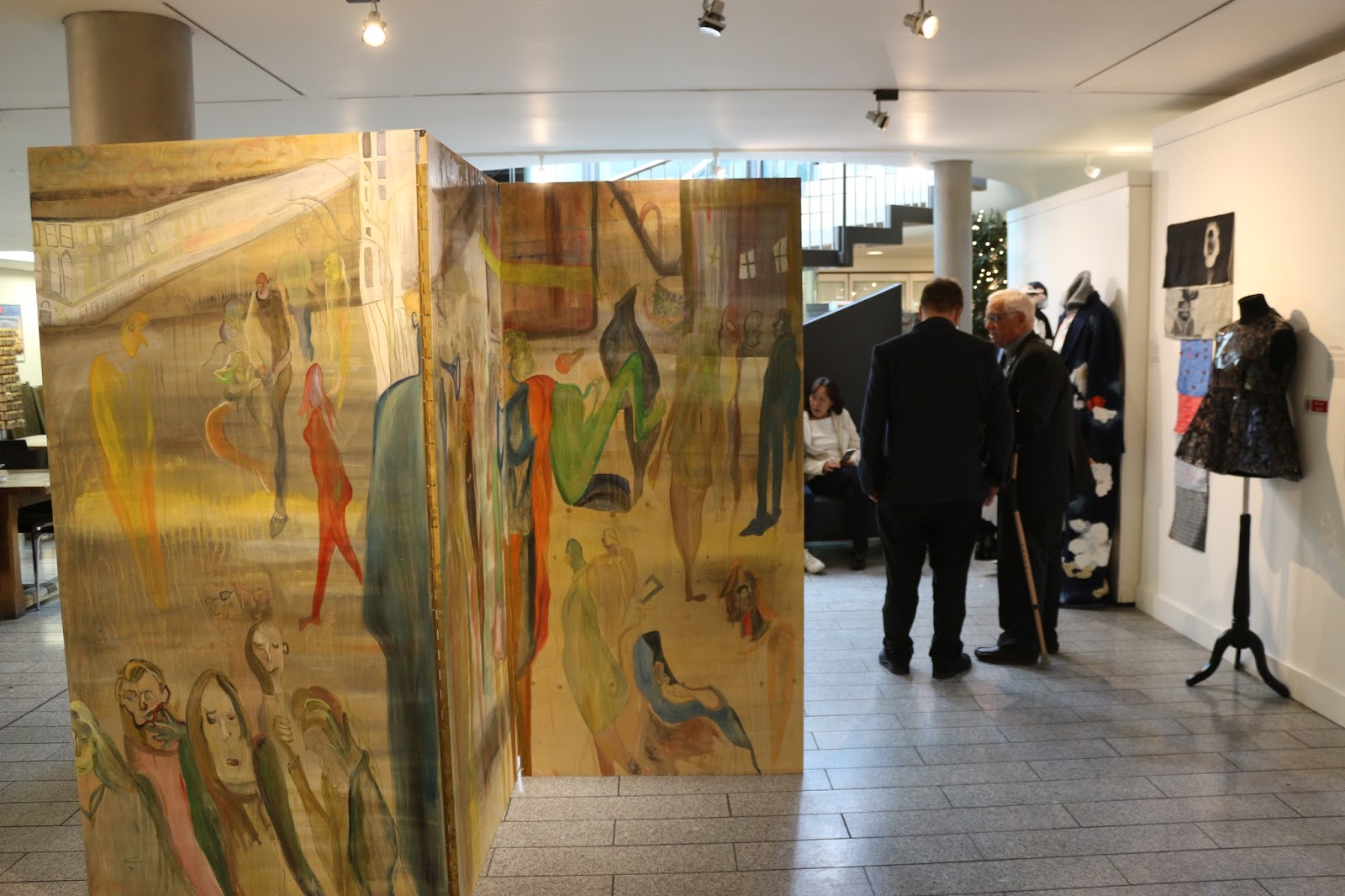
central saint martins in the fields


Thursday 5 October – Saturday 4 November
central saint martins in the fields


An exhibition of work by recent art and design graduates from Central Saint Martins, University of the Arts London


St Martin’s School of Art was established in 1854 by St Martin-in-the-Fields. The Revd Henry Mackenzie and others were concerned that art and design training should be developed alongside the religious and general education already provided by Church schools, to ‘extend the influence of science and art upon productive industry’ following the Great Exhibition of 1851.

The art school soon became independent, and over a century later in 1986 merged with Central School of Art and Design to become Central Saint Martins. Today, the College is an internationally recognised centre for art and design education and research, based in King’s Cross.

For this exhibition Central Saint Martins returns to one of its roots, St Martin-in-the-Fields. Over 150 years later, our connection remains the belief in the power of creativity as a catalyst for change in both individuals and the wider community.

Curated by Angela Sanchez del Campo and Mark Dunhill

Organised by Mark Dean, UAL Chaplaincy and Jonathan Evens, St Martin-in-the-Fields

Supported by University of the Arts London and Diocese of London University Chaplaincy

Special thanks to The Vicar and Churchwardens of St Martin-in-the-Fields, Allyson Hargreaves, Paul Haywood, Anne Smith, Andrew Willson

#CSMITF

Opening times –

Monday: 8.00am – 8.00pm
Tuesday: 8.00am – 8.00pm
Wednesday: 8.00am – 10.30pm
Thursday: 8.00am – 9.00pm
Friday: 8.00am – 9.00pm
Saturday: 9.00am – 9.00pm
Sunday: 11.00am – 6.00pm

----------------------------------------------------------------------------------------------

The Jam - Art School.

Saturday, 7 October 2017

Windows on the world (365)


London, 2016

-------------------------------------------------------------------------------------------

Gerald Finzi - Magnificat, Op. 36.

Thursday, 5 October 2017

Tim Rollins and K.O.S., The moonlight was behind them...

“Great art is an instrument of God,” says Tim Rollins, founder of K.O.S. (Kids of Survival) who are exhibiting at Maureen Paley Gallery until 12 November. This is so, Rollins states, because you have to “bring faith to art as you do to God” and artists imitate “the penultimate creativity of God.”

However, you won’t see overtly religious imagery if you visit The moonlight was behind them...; in part, because the title of this exhibition finds its root in the gothic novel Dracula by Bram Stoker with an ominous darkness that Rollins and K.O.S. think relates to our current political and social condition.

Rollins’ collaboration with the members of K.O.S. takes the form of drawings, sculptural objects, paintings on canvas and paper. They highlight quotes from books, plays, operas and prose with which they engage as they relate the stories to their own experiences or to politics. Their art is created directly on these inspirational texts.

In this exhibition: “Gretchen am Spinnrade (after Goethe and Schubert) reflects on the swooning for Faust by Gretchen, distracted by her treadle. With the Brothers Grimm tale Rumpelstiltskin, the spinning of straw into gold hints at the blind pursuit of material splendour in a late capitalist period that might be seen to discourage critical thought. Tim Rollins and K.O.S. also revisit George Orwell's Animal Farm, with the relevance of the allegorical narrative only becoming more potent since its original publication. Other work makes reference to Goethe’s epistolary novel The Sorrows of Young Werther, 1774.”

Although they have engaged, on other occasions, with religious texts and imagery – as with I See the Promised Land or The Temptation of Saint Anthony – the religious underpinning of their work is not primarily found in their use of symbolism. Rather, it concerns their processes of creation.

These involve reading and researching inspirational texts in order to find images that make literature visible. K.O.S. artist Robert Branch has spoken of this process as one which involves struggle in a social experience. He says, “Art making doesn’t come with written instructions, with a step-by-step process.” Instead, you “just kind of feel it out” because art “is a process of faith.” In this way, Rollins suggests, you “become an instrument for something that cannot be articulated any other way.” “Like the paint, you’re a medium” for “some spirit … making something manifest.” This process of faith, Rollins says, is about making “the invisible visible, vision becoming visible, and making hope material, power manifest, and Spirit sensuous.”

Rollins is “an active member in the music, arts, and HIV/AIDS ministries at Memorial Baptist Church in Harlem” and draws deeply on his church experiences in discussing art as a process of faith. He speaks about Holy Ghost moments saying that people “underestimate the power of the Holy Spirit”: “We don’t make this work. It is not like speaking in tongues. It is the Holy Spirit present … Painting is capable of rapture. Our paintings are ecstatic utterances made material and visible.”

So, if you want to experience rapture, spiritual ecstasy and, even, the “glory of God,” then this exhibition based on horror, fairy tale and political allegory may be just the place to go.

-----------------------------------------------------------------------------------------

The Voices of East Harlem - Simple Song Of Freedom.