Sunday, 11 August 2013
Jujol and Subirachs
Josep Maria Jujol developed his unusual architectural style through many years of close, creative collaboration with Antoni Gaudí. He helped create the doors for Casa Batlló as well as the ceramic facade, the ceilings and columns of Casa Milà, as well as the wrought iron banisters, and was responsible for the colourful ceramics decorating the serpentine seats and ceilings of Park Güell. Jujol was famous for utilizing waste materials such as broken tiles, plates, bottles, cups, glasses, and jugs when creating mosaics.
Jujol’s work 'is characterized by a high degree of sensibility to the forms of nature, an emphatically anti-geometric aesthetic, attention to workmanship and detail, as well as the imaginative use of old and previously utilized material. It is an eloquent expression of his affection for the Catalonian landscape, his modesty, and deep religious faith.'
Jujol's work was not restricted to collaborations with
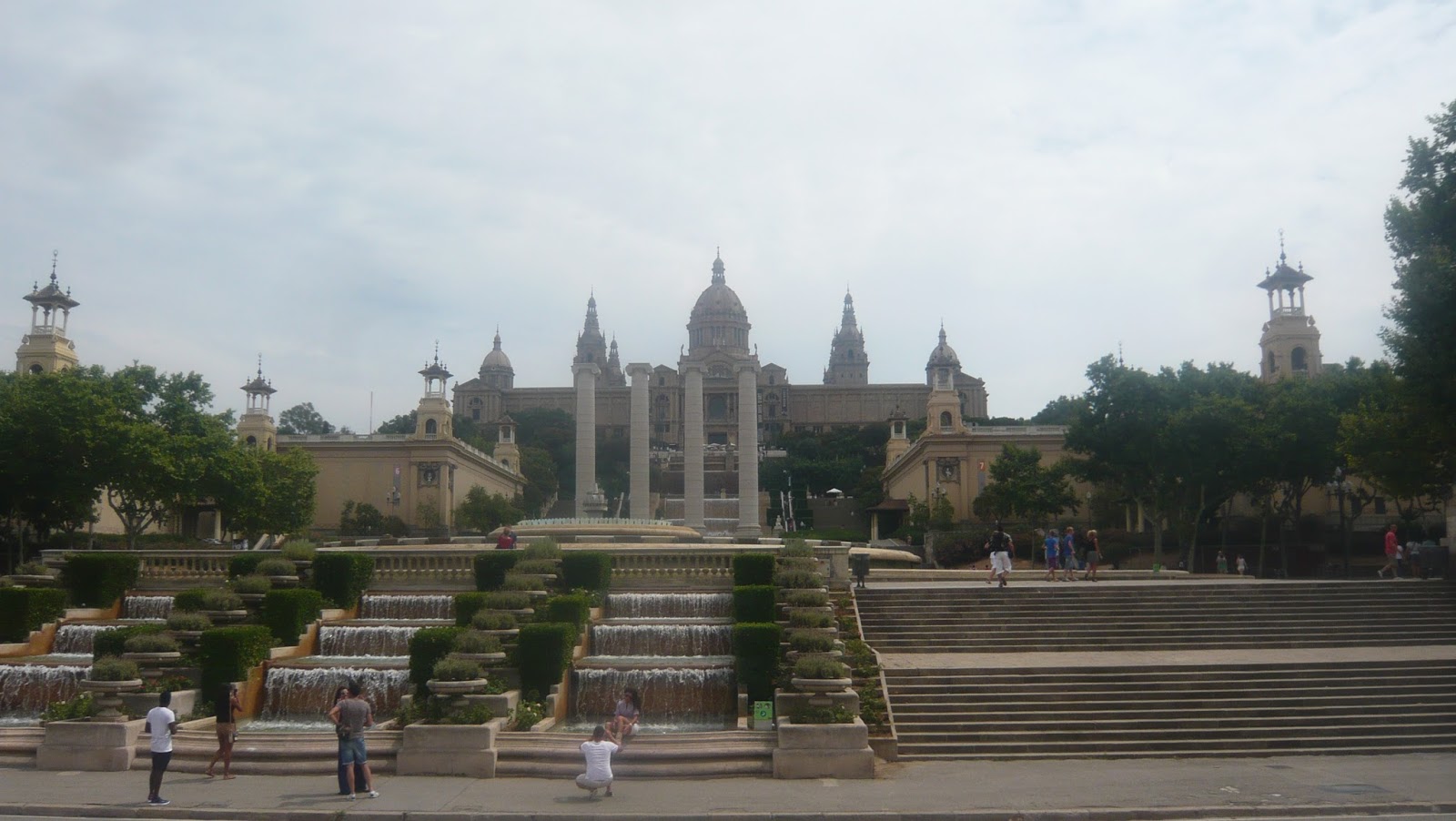
Gaudí and an interesting piece Richard Eilers in the Guardian describes visits to some sites associated with Jujol. The monument at the Plaça d'Espanya (see photograph above) is also by Jujol, although not one of his lighter and better works.
Josep Maria Subirachs is the Catalan sculptor who, in 1986, was commissioned to create the groups of sculptures on the Passion Façade of the Sagrada Família. 'Subirachs dedicated almost twenty years (1987 to 2005) to this group of works, which can be considered the synthesis and culmination of his career as a sculptor, comprising more than one hundred figures sculpted in stone and four bronze doors. To represent the last two days in the life of Jesus Christ, he revisited his figurative expressionism stage in search of the dramatic effect the theme required.'
'The expressionist aspect of Subirachs' works is more formal than conceptual and can be found, above all, in the typically distorted angular bodies and in the treatment of textures, when he incorporates grattage, refraining from leaving surfaces smooth, making them rough, jagged, coarse, in order to accentuate the expressive capacity of the material.' His work on public sculptures has been considered a milestone in the artistic renovation of Spain in the 20th century.
'A multi-faceted artist, Subirachs has not only expressed himself through tridimensional creation, but also by means of other techniques such as painting, drawing, graphic art (etching, drypoint, serigraphy and lithography), tapestry, book illustration, medal minting and designing jewellery and other utilities.' Much work by Subirachs can be found in Barcelona, including the monument to the president of the Catalan Government, Francesc Macià, at the Plaça de Catalunya (see photograph above).
-------------------------------------------------------------------------------------------------
Adrian Snell - Gethsemene.
Labels:
architecture,
barcelona,
catalonia,
collage,
expressionism,
gaudi,
jujol,
monuments,
public art,
sculpture,
subirachs,
trencadis
Barcelona views
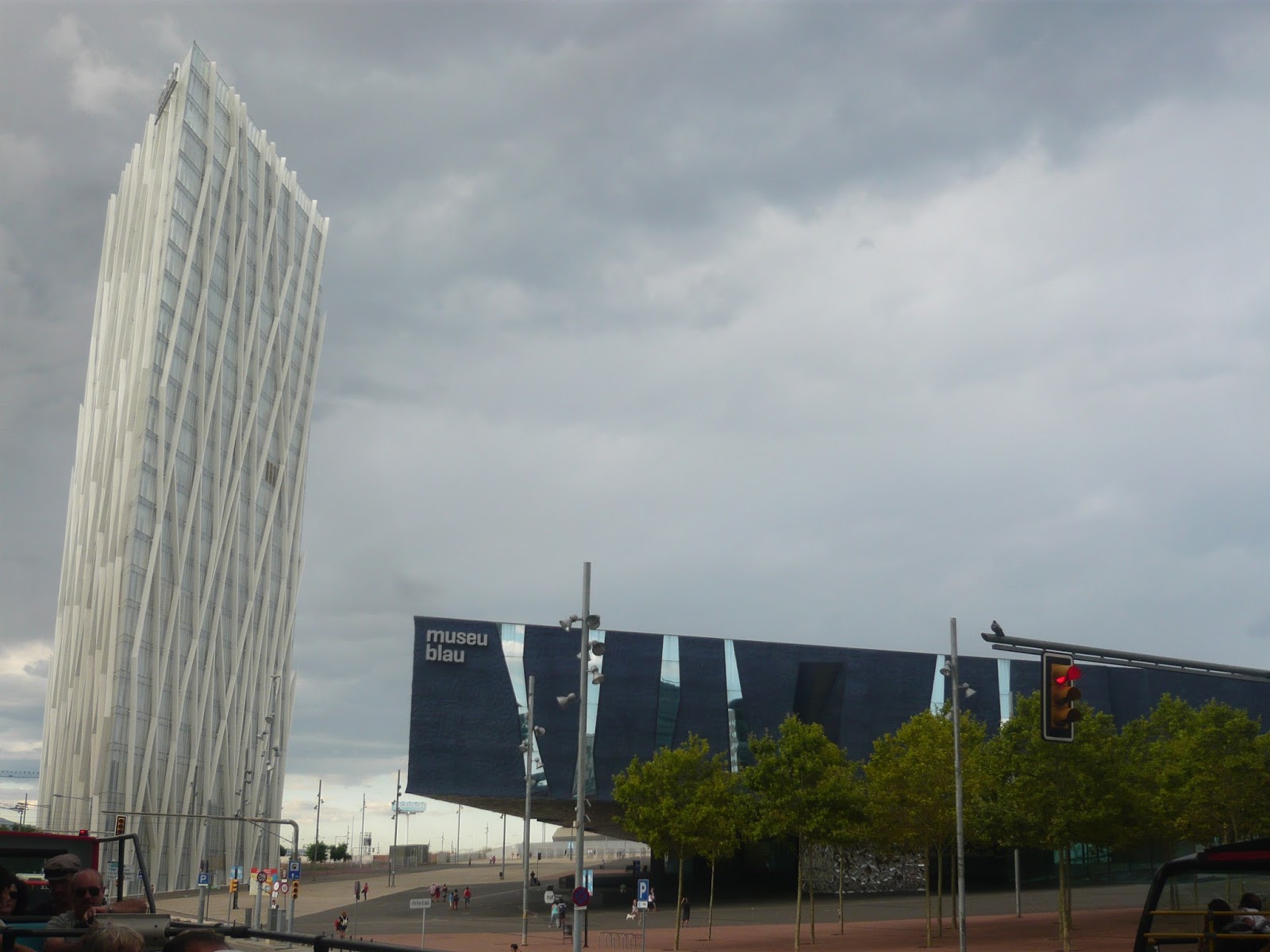
Five days in Barcelona was just what was needed to relax and recharge batteries. Our hotel was just off La Rambla, so close to both Barri Gòtic and Port Vell. We used the tourist buses to get an overview of the city and find our way around while stopping off at some of the Gaudí sites we wished to visit. These included Casa Batlló, Casa Milà, Palau Güell, Park Güell, Plaça Reial and the Sagrada Familia, as well as a day spent visiting Colònia Güell and its Gaudí designed Crypt. We also visited the Cathedral and saw exhibitions at the Diocesan Museum (Goya and his Inheritors. The Follies nowadays) and the Arts Santa Mònica (Pure Views: Transformations of Chinese Contemporary Art).
The Follies was the last important collection engraved by Francisco de Goya between 1819 and 1824. They are among the most difficult of his engravings to interpret, images with nightmarish visions, absurd scenes, personages that are not from this world, hidden obsessions revealed in his old age; mysterious and enigmatic, inscrutable and personal. Taking The Follies as its starting point, this exhibition creates a journey through contemporary art and current engraving linking Goya and 12 of his plates to 21 20th century artists including: José Manuel Broto, Eduardo Arroyo, Günter Grass, Martín Chirino, Luis Feito, Juan Genovés, Manolo Valdés, Luis Caruncho, Andrés Rábago (El Roto), José Beulas, Ricardo Calero, Julio León, Alicia Díaz Rinaldi, Darío Villalba, Luis Gordillo, José Hernández, Rafael Canogar, Jaume Plensa, Víctor Mira, Pascual Blanco and Guinovart.
Pure Views. Transformations of Chinese Contemporary Art, curated by Lu Peng, the prestigious Chinese art historian and director of the Chengdu Museum of Contemporary Art, is an attractive and comprehensive survey of Chinese contemporary art. Back in 1995, under the title From the Country of the Centre. Artistic Avant-gardes in China, this same art centre mounted a seminal display of key, innovative Chinese artworks of the day, one of the first exhibitions of its kind in Europe. Since then, Chinese art has evolved significantly.
Pure Views corroborates the developments experienced by Chinese art in the last thirty years. Starting from the final days of Socialist Realism, it charts the trend towards a diversity of techniques and styles, responding to the expectations of a new society that, at the same time, is reflecting profoundly on its tradition. The exhibition includes work by
Cao Jingping, Fang Lijun, He Sen, Hong Lei, Jin Jiangbo, Li Chao, Li Qing, Li Rui, Mao Tongqiang, Mao Xuhui, Na Wei, Qiu Anxiong, Shao Wenhuan, Shen Na, Shi Jinsong, They, Tu Hongtao, Wang Guangyi, Xie Fan, Yang Mian, Yang Qian, Yang Xun, Ye Yongqing, Yue Minjun, Zhan Wang, Zhang Jian, Zhang Peili, Zhang Xiaogang, Zhang Xiaotao, and Zhang Ya, Zhou Chunya.
-------------------------------------------------------------------------------------------------
Pablo Casals - Bach Cello Suite 3 Praeludium.
Labels:
art,
arts santa monica,
barcelona,
bus,
china,
colonia guell,
etching,
exhibitions,
follies,
gaudi,
goya,
holiday,
peng
Subscribe to:
Posts (Atom)