Wikio - Top Blogs - Religion and belief

Sunday, 13 November 2011

The significance of unknown and unregarded actions

At the west end of the Nave of Westminster Abbey is the grave of the Unknown Warrior, whose body was brought from France to be buried there on 11 November 1920. The grave, which contains soil from France, is covered by a slab of black Belgian marble from a quarry near Namur. On it is the following inscription, composed by Herbert Ryle, Dean of Westminster: 

 BENEATH THIS STONE RESTS THE BODY
OF A BRITISH WARRIOR
UNKNOWN BY NAME OR RANK
BROUGHT FROM FRANCE TO LIE AMONG
THE MOST ILLUSTRIOUS OF THE LAND
AND BURIED HERE ON ARMISTICE DAY
11 NOV: 1920, IN THE PRESENCE OF
HIS MAJESTY KING GEORGE V
HIS MINISTERS OF STATE
THE CHIEFS OF HIS FORCES
AND A VAST CONCOURSE OF THE NATION
THUS ARE COMMEMORATED THE MANY
MULTITUDES WHO DURING THE GREAT
WAR OF 1914-1918 GAVE THE MOST THAT
MAN CAN GIVE LIFE ITSELF
FOR GOD
FOR KING AND COUNTRY
FOR LOVED ONES HOME AND EMPIRE
FOR THE SACRED CAUSE OF JUSTICE AND
THE FREEDOM OF THE WORLD
THEY BURIED HIM AMONG THE KINGS BECAUSE HE
HAD DONE GOOD TOWARD GOD AND TOWARD
HIS HOUSE

Around the main inscription are four texts:

“THE LORD KNOWETH THEM THAT ARE HIS.”
“GREATER LOVE HATH NO MAN THAN THIS.”
“UNKNOWN AND YET WELL KNOWN, DYING AND BEHOLD WE LIVE.”
“IN CHRIST SHALL ALL BE MADE ALIVE.”

The idea for this burial seems first to have come to a chaplain at the Front, the Reverend David Railton (1884-1955), when he noticed in 1916 in a back garden at Armentières, a grave with a rough cross on which were pencilled the words "An Unknown British Soldier". In August 1920 he wrote to the Dean of Westminster, Herbert Ryle, through whose energies this memorial was carried into effect. The body was chosen from unknown British servicemen exhumed from four battle areas, the Aisne, the Somme, Arras and Ypres. (The number of bodies exhumed varies in different accounts between four and six). The remains were brought to the chapel at St. Pol on the night of 7 November 1920. The General Officer in charge of troops in France and Flanders, Brigadier General L.J.Wyatt, with Colonel Gell, went into the chapel alone, where the bodies on stretchers were covered by Union Flags. They had no idea from which area the bodies had come. General Wyatt selected one and the two officers placed it in a plain coffin and sealed it. The other bodies were reburied.

In the morning Chaplains of the Church of England, the Roman Catholic Church and Non-Conformist churches held a service in the chapel before the body was escorted to Boulogne. The next day the coffin was placed inside another made of two-inch thick oak from
Hampton Court
, lined with zinc, sent over from England. It was covered with the flag that David Railton had used as an altar cloth during the War (known as the Ypres or Padre's Flag, which now hangs in St George's Chapel). The destroyer HMS Verdun transported the coffin to Dover and it was then taken by train to Victoria station in London where it rested overnight.

On the morning of 11 November the coffin was placed on a gun carriage drawn by six black horses and began its journey through the crowd-lined streets to the north door of Westminster Abbey. The coffin was borne to the west end of the Nave through a guard of honour of 100 holders of the Victoria Cross, under the command of Colonel Freyburg VC. During the shortened form of the Burial Service, after the hymn "Lead kindly light", the King stepped forward and dropped a handful of French earth onto the coffin as it was lowered into the grave.

On 11 November 1921 the present black marble stone was unveiled at a special service. General Pershing, on behalf of the United States of America, conferred the Congressional Medal of Honor on the Unknown Warrior on 17 October 1921 and this hangs in a frame on a pillar near the grave. The body of the Unknown Warrior may be from any of the three services, Army, Navy or Air Force, and from any part of the British Isles, Dominions or Colonies and represents all those who died who have no other memorial or known grave.

Our Bible readings tonight are also of those whose role or responsibilities or sacrifice is potentially overlooked. In our first reading (1 Kings 1. 15-40), Solomon, who had been promised the throne by his father David, is in danger of being overlooked and out manoeuvred when his elder step-brother claims the throne for himself. In our second reading (Revelation 1. 4-18), we read of the glory of the risen and ascended Jesus, but that picture also then reminds us that during his life, and in his death, he was despised and rejected by humanity. In both readings we also see those who have been overlooked then being recognised and honoured; Solomon is affirmed as King by David and Christ is glorified following his ascension.    

Here at St John’s Seven Kings we have our own story of those who fought and died in the First World War yet were overlooked because their names were, for many years, absent from the War Memorial here in church. The absence of the names of Charles Brooks Smith and Frederick Allam Smith from the memorial commemorating those from the parish who in the First World War was discovered as a result of a successful entry in 2006 to a TV competition in Channel 4's Lost Generation season.

Sara James, one of our young people at St. John’s Seven Kings, together with her friends Rebecca Smith and Zeenat Pelaria, won first prize out of 1000 students who had entered the competition. Entries were open to students aged 11-16, working in groups of three or five to create a short project about World War One. For their project Sara, Rebecca and Zeenat decided to adopt the war memorial dedicated to those who lost their lives in the First World War from St. John’s. The three 14 year olds represented the Chadwell Heath Foundation School and were up against GCSE students from the best private and grammar schools from all over England, Wales, Scotland and Northern Ireland.

Initially they obtained information from historical research of St. John’s. They then compared the names on our War Memorial with a photograph of the church football team from a few years before the war and found that several of the names matched. They were able to obtain more information on the internet using sites such as the Commonwealth War Graves Commission, 1837 Online and the Western Front Association in order to find out more about some of those who had died.

Their competition entry, along with all the others, was judged by a panel of historians, writers, teachers and others involved in Channel 4’s history programmes. They won a ClipBank History Library worth £700 for their school’s history department, which will enable everyone to obtain further wide-ranging historical materials about the two World Wars. There was also a VIP trip for Sara’s class of around 30 students, along with some humanities teachers, to the Imperial War Museum
in London.

As a result of their research featuring on the website of St John's Seven Kings we were contacted by the family of Charles Brooks Smith, in the football photo, and his brother Frederick Allam Smith. Both had been killed during WW1, Charles Brooks Smith at the Somme, but their names had not been included on the War Memorial. Their family, therefore, asked whether their names could be added to the Memorial and earlier this year that
work was completed with the letter cutting being undertaken by Mark Tremaine of Woodenyou. We are thrilled that members of the family can be here this evening.

So today, as we remember all those who have given their lives in the service of others through the armed forces, we remember particularly Charles Brooks and Frederick Allam Smith and we rededicate this War Memorial, with the addition of their names, to the glory of God and in memory of all those from this parish who lost their lives during the First World War in the name of God almighty, Father, Son and Holy Spirit.

All this is also a reminder and encouragement to each of us in our service of God through our own lives. The contribution we make through our lives and the service we offer to others may not be well known and may not be publicly celebrated but it is significant and of real and lasting value nonetheless. Most importantly, it is seen and known by God and will be valued and celebrated when we, like Jesus, are in his presence. The reality for most of us is that our contribution to others and to the wider community is known only to our friends and family, but it is nonetheless important and significant for all that. The significance of service is to be found in what people do rather than in what is known of what people do. In his ministry Jesus criticised the leaders of his day for actions designed to impress and St Paul in his letter to the Thessalonians says make it your ambition to lead a quiet life. As with all those we have thought about today, including Charles Brooks and Frederick Allam Smith, it can be our unknown and unregarded actions which are actually the most significant of all. As Jesus says in the Sermon on the Mount, “your Father, who sees what is done I secret, will reward you.”

------------------------------------------------------------------------------

George Harrison - All Things Must Pass.

Friday, 11 November 2011

Armistice Day and Remembrance Sunday services

As padre to the Ilford branch of the Royal British Legion, I shall be leading the Armistice Day service at Redbridge Town Hall on Friday 11th November, the Civic Service of Remembrance at Ilford War Memorial on Sunday 13th November, and preaching at the Service of Remembrance, held with the Ilford branch of the Royal British Legion, at St John's Seven Kings, 6.30pm, on Sunday 13th November.
It is a privilege to lead others on these occasions in remembering the sacrifices made by all those who give their lives in the service of others in times of conflict and within the armed forces. This year is additionally significant because 2011 is the 90th anniversary of the Royal British Legion and because the 11th hour on the 11th day of the 11th month of 2011 is a once-in-a-lifetime moment of remembrance on Armistice Day.  
The Remembrance service at St John's Seven Kings this year will also have particular poignancy because of the addition of two names to our WW1 War Memorial earlier this year. Representatives from the families of Charles Brooks and Frederick Allam Smith, whose names were added to the Memorial, will be present at this service as we remember these two brothers, and the sacrifice of their lives, in particular during this service  
The absence of the names of Charles Brooks Smith and Frederick Allam Smith from the memorial commemorating those from the parish who in the First World War was discovered as a result of a successful entry in 2006 to a TV competition in Channel 4's Lost Generation season.
Sara James, one of our young people at St. John’s Seven Kings, together with her friends Rebecca Smith and Zeenat Pelaria, won first prize out of 1000 students who had entered the competition. Entries were open to students aged 11-16, working in groups of three or five to create a short project about World War One. For their project Sara, Rebecca and Zeenat decided to adopt the war memorial dedicated to those who lost their lives in the First World War from St. John’s. The three 14 year olds represented the Chadwell Heath Foundation School and were up against GCSE students from the best private and grammar schools from all over England, Wales, Scotland and Northern Ireland.


Initially they obtained information from historical research of St. John’s. They then compared the names on our War Memorial with a photograph of the church football team from a few years before the war and found that several of the names matched. They were able to obtain more information on the internet using sites such as the Commonwealth War Graves Commission, 1837 Online and the Western Front Association in order to find out more about some of those who had died.

Their competition entry, along with all the others, was judged by a panel of historians, writers, teachers and others involved in Channel 4’s history programmes. They won a ClipBank History Library worth £700 for their school’s history department, which will enable everyone to obtain further wide-ranging historical materials about the two World Wars. There was also a VIP trip for Sara’s class of around 30 students, along with some humanities teachers, to the Imperial War Museum
in London.

As a result of their research featuring on the website of St John's Seven Kings we were contacted by the family of Charles Brooks Smith, in the football photo, and his brother Frederick Allam Smith. Both had been killed during WW1, Charles Brooks Smith at the Somme, but their names had not been included on the War Memorial. Their family, therefore, asked whether their names could be added to the Memorial and that was done in
May 2011, with the letter cutting being undertaken by Mark Tremaine of Woodenyou.
More information about the Lost Generation project can be found at: http://www.stjohns7kings.org.uk/ and http://www.channel4.com/learning/microsites/L/lostgeneration/competition.html.
----------------------------------------------------------------------------------------------------------------------------
Annie Lennox - Into The West.

Thursday, 10 November 2011

Run with the Fire

Run with the Fire is an arts project for the London 2012 Olympics organized by CANA, commission4mission and Veritasse based on the image of fire which links the Church’s Pentecost celebration with that of the Olympic runner.

Run with the Fire aims to celebrate creativity, cultural exchange and hope for the future by providing a virtual exhibition of international artwork for use in Olympics-themed events organised by churches in 2012.

Run with the Fire will provide a virtual exhibition of international artwork available on DVD, for display on large scale HD TV or monitor, or for projection using a digital projector. This digital exhibition can be presented as part of Olympics-themed events organised by churches in 2012 plus arts events or exhibitions organized by local churches.

The Run with the Fire DVD will come with an electronic resource package, to accompany the virtual exhibition, which will give ideas for churches on how to organize and facilitate community/arts events.

The Run with the Fire resources (virtual exhibition DVD & electronic resources package) cost £50.00 and can be ordered by contacting Jonathan Evens on 020 8599 2170 or jonathan.evens@btinternet.com.
 
Latest news of Run with the Fire can be found on our blog at http://runwiththefire.blogspot.com/. Two recent articles about the project can be found at: http://www.artway.eu/content.asp?id=1043&lang=en&action=show and http://www.artway.eu/artway.asp?id=225&lang=en&action=show&type=current.
 
------------------------------------------------------------------------------
 
The Call - You Run.

Sunday, 6 November 2011

Windows on the world (169)


London, 2011

------------------------------------------------------------------------------------

The Kinks - Waterloo Sunset.


Building on firm foundations


This morning at St John's Seven Kings, our young people did a sponsored car wash during the main morning service to raise funds for the Agape Youth work which we support in the Democratic Republic of Congo. They washed 11 cars in under an hour and raised £120.00.

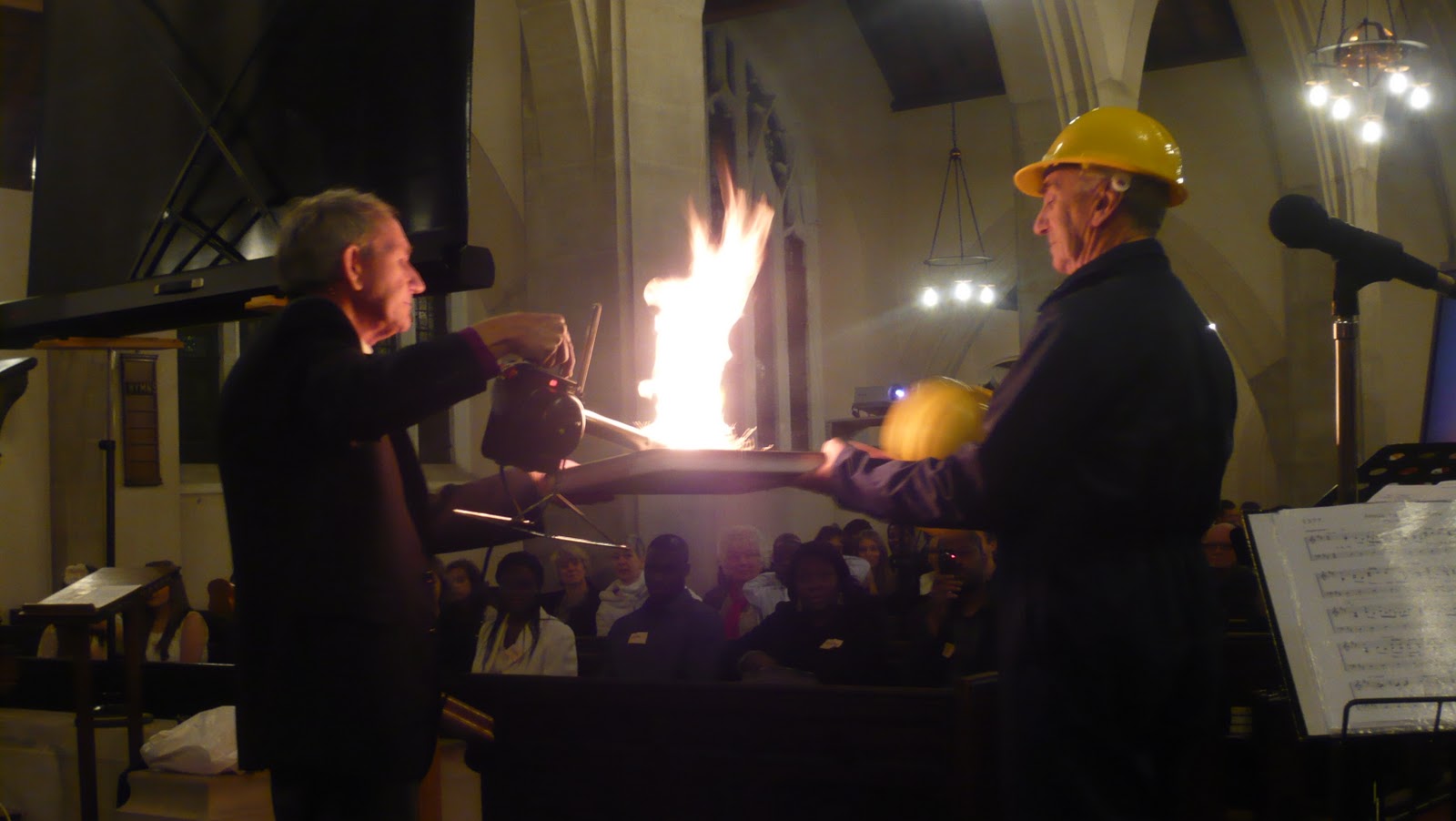
This evening we joined with All Saints Goodmayes for a Confirmation Service at which 14 were confirmed, including three candidates from St John's. The Bishop of Barking spoke about the candidates having made Jesus the foundation for their lives and then discussed the kinds of materials we should use in building on that foundation. He gave a real-time demonstration of the flammability of straw and then asked the grandfather of one of our candidates to demonstrate bricklaying. He concluded that we need to be built together as a community of God's people all standing firm in our faith as we build on the foundation of Christ.

-----------------------------------------------------------------------------------------------

Sixpence None the Richer - The Melody of You.

Saturday, 5 November 2011

Beyond 'Airbrushed from Art History' (8)

The Pilgrim Project features artists across different practices – art, music, writing, poetry, film, cultural groups and more – that bring back storytelling. It is a network of artists concerned with the expression of the search for the sacred and engagement of the human experience and builds connections across different audiences and demographics.
Michael Galovic engages himself in a few parallel directions: traditional icons, contemporary religious and non religious art. He keeps revisiting the theme he graduated with: The Flight and Fall of Icarus as well as the Crucifixion theme, but has been particularly focused lately on building a body of work on Uluru, the sacred Rock in the Northern Teritory of Australia. He says, ‘I am attracted to the powerful imagery in general. [It is] the highest possible drama of mankind ever seen and experienced… It talked to me. It resonated with me on that level immediately before I embraced any kind of faith.’

Patricia Varney adopts Christian themes in her works and utilises them in the contemporary practice of painting. Her focus is best identified by a layering of symbolism through the mystery of Christian paradoxes: the meeting of heaven and earth (divine geometry), the Annunciation (the possibility of Christ becoming man) and the illustrative expressions of what it means to ‘see’.

Eleni Antoniou Holloway is heavily influenced by the material she uses – clay is not only a process of making, but is the conceptual foundation for her work. She explores the work of clay through its historical function and through the personal narratives, metaphors and Christian symbolism of the ancient material: creation, the desire to create, the imprint of the maker, transformational processes and the pouring and containment of meaning.

Kristone Capistrano’s art practice is driven by an ongoing fascination with the person – moving beyond a story into connecting with the very essence of personhood. Working within the traditions of portraiture, he moves towards a questioning of presence and how it continues to linger, despite the departure of the person. His work functions in capturing, (re)presenting and (re)constructing the (corpo)real presence the composition of his work.

The Mandorla Art Award is a thematic religious art prize, attracting some of Australia’s finest artists since its 1985 inception. This achievement represents the dream of a small group of committed Christians, who call themselves “The Mandorla Centre of Inner Peace”. They were concerned by the overwhelmingly secular nature of contemporary art and so set about reviving an interest in and patronage of religious art. The Mandorla Art Award employs a thematic spiritual inspiration that changes with each exhibition. These inspirations are defined by quotations from the Bible and all participating artists are requested to interpret these in their own way.

The root of Art is compassion. At times we may forget beauty and neglect the dignity of each other’s story. The expression of our lives brings us into direct conversation with each other: it gives us the opportunity to stop and learn from and about one another and see ourselves in another’s eyes. These stories allow us to enter into our humanity and help us realise that we are not alone, but travel alongside each other in a pilgrimage that calls for transformation.

----------------------------------------------------------------------------------------

Eli Moore - What Good Am I?

Friday, 4 November 2011

Planting the Seeds, Spreading the Flames

Steve Scott has written an article for ArtWay about the ideas behind Run With The Fire, the joint Olympics-themed art project organised by CANA, commission4mission, and Veritasse. Steve concludes the article by writing: 
"We are compiling the results [of the artist's work] into a digital video presentation for projection on screen or monitor in a local church or community settings. The exhibition organizers will also put a show of local artwork on display to accompany the digital display. This combination of virtual presentation and real local art can open in multiple locations at the same time. Each exhibition combines the global with the truly local. Some churches and organizations have already expressed an interest in being part of this. We are hoping that, along with the complementary global and local aspects of the display, the overall ‘image’ of a digitally created network can be seen as part of the larger, all inclusive ‘art work.’
While it has been a journey of adventures, detours and surprising connections so far, I still view this very much as a beginning. Who knows where a global/local conversation about art, imagination and peace might go in this chaotic, digitally connected world?"
------------------------------------------------------------------------------------------
Steve Scott - No Memory of You.