I recently met up with Professor Reina Lewis, Artscom Centenary Professor of Cultural Studies at the London College of Fashion, who is running a very interesting project looking at Modest Fashion.
Faith-based Fashion and Internet Retail studies the growing market for modest clothing among women of the three Abrahamic faiths: Islam, Christianity and Judaism. With increasing numbers of women who are religiously motivated to dress modestly, online retailing is making it easier for women who dress this way to combine fashion with faith.
For women seeking fashionable ways to dress modestly, like the growing numbers of Muslim women who obtain modest clothing over the web, the internet has been indispensible. Other faith groups that have dress requirements show similar developments in the commercial production and distribution of clothing: observant and orthodox Jews, and some Christian groups like the Church of the Latter-day Saints (Mormons).
Internet marketing has been invaluable for consumers who want specialist items and has reduced overheads for specialist producers and retailers. This has been especially important in clothes marketing, where consumers seeking non-standard items can now shop online to replace or augment the high street. In most cases, internet marketing allows brands to reach beyond their immediate location, serving consumers internationally. Women are now far more likely to be able to dress in line with their sense of piety but still in fashion.
The project has three main aims:
1. To discover if the expansion and diversification through e-commerce of clothes for modest dressing is creating a new retail and style category of 'modest fashion' that has the potential to transcend specific religions and reach out to consumers across faith groups.
2. To explore the extent to which 'modest fashion' is beginning to be recognisable as a form of dressing adopted by women from different faith communities.
3. To evaluate the social and personal impact of modest fashion for the future development of interfaith dialogue and religious/secular community relations.
---------------------------------------------------------------------------------------
Jennifer Warnes - Famous Blue Raincoat.

Wednesday, 13 July 2011


Monday, 11 July 2011
Windows on the world (152)

Birmingham, 2010
----------------------------------------------------------------------------------
The Mighty Wah - Come Back.
Saturday, 9 July 2011
The News of the World as soap opera
Ian Jack, in today's Guardian, suggests that with the closure of the News of the World "the great age of Britain's popular press is drawing squalidly to its close."
What he calls the great age of the popular press, he characterises in two vignettes. First, the owning by the News of the World of "what the Victorians knew as our baser selves" through the paper's specialisation in "salacious accounts of sex and violence." Second, the "enterprising devotion" of the popular press to the frivolous as characterised by Lord Northcliffe, who "spread the word to his staff like a preacher: roughly, to subvert the words of Philip Larkin, readers were forever surprising a hunger in themselves to be more trivial."
"Crime exclusives," Northcliffe noted: "are noticed by the public more than any other sort of news. They attract attention, which is the secret of newspaper success. They are the sorts of dramatic news the public always affects to criticise but is always in the greatest hurry to read ... Watch the sales during a big murder mystery, especially if there is a woman in it. It is a revelation of how much the public is interested in realities, action and mystery. It is only human."
This "only human" principle of feeding our baser selves with a daily diet of reality, action, sex, violence, and the trivial has led, in time, to the ongoing reality soap opera which forms the substance of the redtops, celebrity mags, reality TV, and online chats/tweets encompassing as it does the 'who has been seen where', 'who is with who', 'who has broken up with who', 'who has attacked who', and 'who has cracked up and/or rehabilitated' of the real (and, sometimes, manufactured for money) lives of celebrities, entertainers, politicians, sportstars and victims of serious crime.
This ongoing soap opera which blurs the boundaries between fact and fiction has become 'the news' for many, if not most of us. In what Ian Jack calls "the great age of Britain's popular press," it was the redtops which provided this daily diet to millions of us but, with the advent of rolling news and the internet, the ability of the redtops to deliver, sufficiently quickly, the public face of this celebrity reality soap opera has diminished pushing the News of the World into its alleged illegal focus on the secret face of the celebrity reality soap opera.
This soap opera now provides our sense of the sacred. Gordon Lynch, writing in the same edition of the Guardian, explains that: "Coverage of the death of Baby P or processions at Wootton Bassett honouring soldiers killed in action momentarily bind their audiences together in strong, moral sentiment, either through their recognition of a particular sacred form or horror at its pollution ... The moral credibility of news media lies partly in their ability to work with the grain of sacred meanings shared with their audience ... The degree to which the News of the World profaned what many people take as sacred is unprecedented in post-war media history ... The tipping point came when the actions of people associated with the News of the World became profanations, an evil polluting the cherished sacred significance embodied in the stories of Milly Dowler, Holly Wells and Jessica Chapman, and the 7/7 bombings."
The death of the News of the World, however, does not diminish in any way the celebrity reality soap opera. Instead, it feeds it. Rupert Murdoch, Rebekah Brooks and Andy Coulson have all become part of the story in ways that they never intended - indeed they are 'the story' for the moment - but, because we are fed by this ongoing soap opera and therefore need those who become stories in it, I predict that - as in the career of Piers Morgan - the story will rehabilitate them at some point in the future and by means of some other role in the soap opera, as long as they come to accept that they have, by foul means, become characters within the ongoing celebrity reality soap opera that they themselves have helped to perpetuate.
-----------------------------------------------------------------------------------
Echo and The Bunnymen - The Puppet.
What he calls the great age of the popular press, he characterises in two vignettes. First, the owning by the News of the World of "what the Victorians knew as our baser selves" through the paper's specialisation in "salacious accounts of sex and violence." Second, the "enterprising devotion" of the popular press to the frivolous as characterised by Lord Northcliffe, who "spread the word to his staff like a preacher: roughly, to subvert the words of Philip Larkin, readers were forever surprising a hunger in themselves to be more trivial."
"Crime exclusives," Northcliffe noted: "are noticed by the public more than any other sort of news. They attract attention, which is the secret of newspaper success. They are the sorts of dramatic news the public always affects to criticise but is always in the greatest hurry to read ... Watch the sales during a big murder mystery, especially if there is a woman in it. It is a revelation of how much the public is interested in realities, action and mystery. It is only human."
This "only human" principle of feeding our baser selves with a daily diet of reality, action, sex, violence, and the trivial has led, in time, to the ongoing reality soap opera which forms the substance of the redtops, celebrity mags, reality TV, and online chats/tweets encompassing as it does the 'who has been seen where', 'who is with who', 'who has broken up with who', 'who has attacked who', and 'who has cracked up and/or rehabilitated' of the real (and, sometimes, manufactured for money) lives of celebrities, entertainers, politicians, sportstars and victims of serious crime.
This ongoing soap opera which blurs the boundaries between fact and fiction has become 'the news' for many, if not most of us. In what Ian Jack calls "the great age of Britain's popular press," it was the redtops which provided this daily diet to millions of us but, with the advent of rolling news and the internet, the ability of the redtops to deliver, sufficiently quickly, the public face of this celebrity reality soap opera has diminished pushing the News of the World into its alleged illegal focus on the secret face of the celebrity reality soap opera.
This soap opera now provides our sense of the sacred. Gordon Lynch, writing in the same edition of the Guardian, explains that: "Coverage of the death of Baby P or processions at Wootton Bassett honouring soldiers killed in action momentarily bind their audiences together in strong, moral sentiment, either through their recognition of a particular sacred form or horror at its pollution ... The moral credibility of news media lies partly in their ability to work with the grain of sacred meanings shared with their audience ... The degree to which the News of the World profaned what many people take as sacred is unprecedented in post-war media history ... The tipping point came when the actions of people associated with the News of the World became profanations, an evil polluting the cherished sacred significance embodied in the stories of Milly Dowler, Holly Wells and Jessica Chapman, and the 7/7 bombings."
The death of the News of the World, however, does not diminish in any way the celebrity reality soap opera. Instead, it feeds it. Rupert Murdoch, Rebekah Brooks and Andy Coulson have all become part of the story in ways that they never intended - indeed they are 'the story' for the moment - but, because we are fed by this ongoing soap opera and therefore need those who become stories in it, I predict that - as in the career of Piers Morgan - the story will rehabilitate them at some point in the future and by means of some other role in the soap opera, as long as they come to accept that they have, by foul means, become characters within the ongoing celebrity reality soap opera that they themselves have helped to perpetuate.
-----------------------------------------------------------------------------------
Echo and The Bunnymen - The Puppet.
50/50 Auction and the Big Society


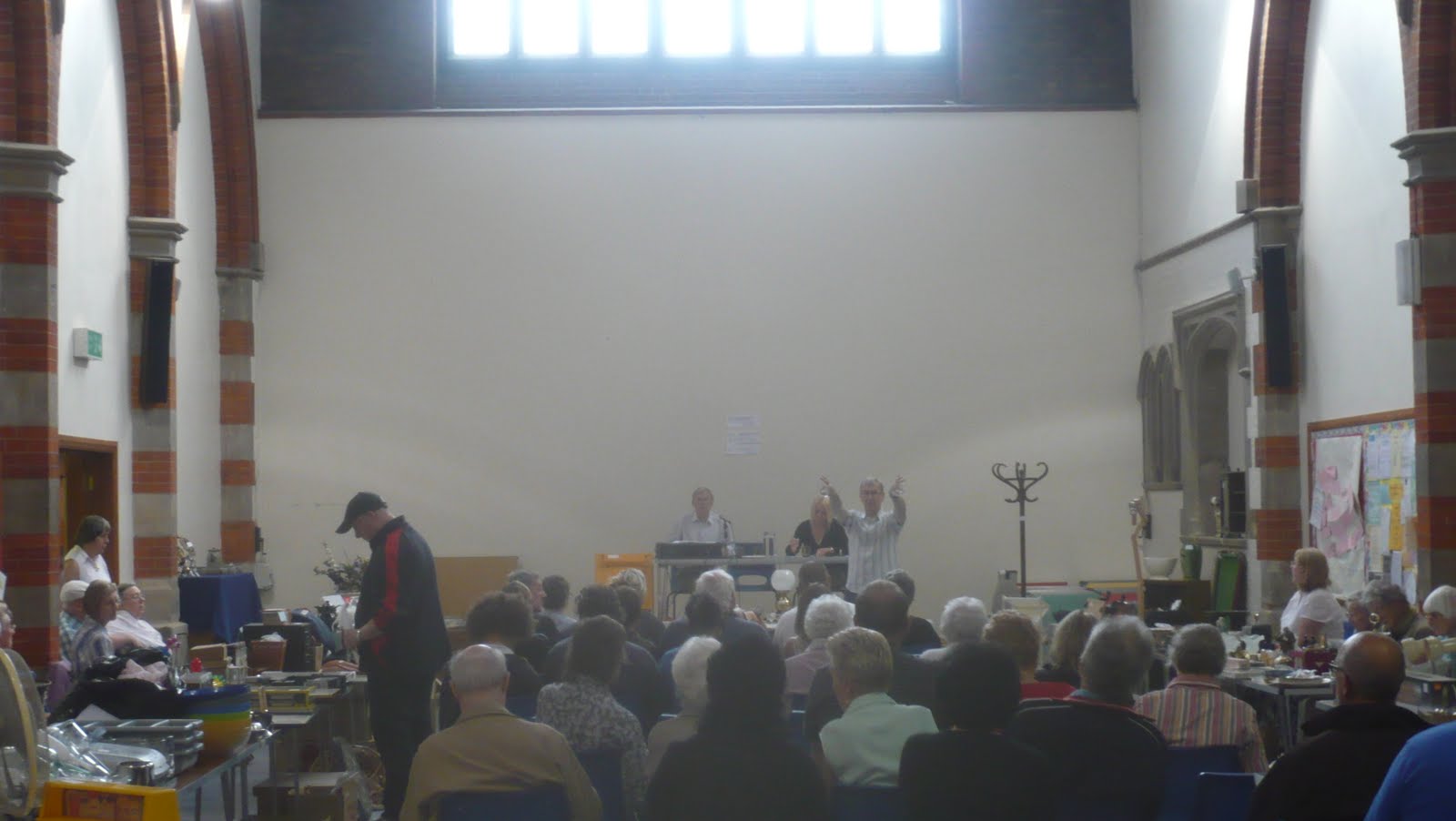
St John's Seven Kings held its 50/50 Auction today where 50% of the sale price comes to the church. Although we had stopped holding annual auctions and hadn't held an auction for three years, this one proved very successful.
This event, as with our other social and fundraising events, is an illustration of some of the reasons why churches generate community and contribute substantially to the Big Society. Those who organised the event gave a significant amount of their time in order to arrange a successful community event that generated funds for a community group and facility. The 220+ lots were all items that were being recycled by being sold and all sellers gave 50% of their income to the church. The event also brought together a wide range of different people from our local community to meet together for a shared activity which included shared food and conversation over the viewing of lots and lunchtime refreshments.
It would of course be possible to take a cynical line about our event seeing it simply as a money making exercise which is therefore tapping into consumerism or to argue a purist line that such fundraising distracts from the Church's core mission and reinforces stereotypes of the Church as an organisation which is always asking for money. Despite this event being a combination of gift and exchange economies, both these views ignore the significant levels of giving involved in such events and the degree of community engagement and cohesion that a regular programme of such events provide. Neither of these would be features of more commercially orientated sales or auctions and both are core elements of committed Christian living.
Earlier in the week, at Redbridge's Big Society mapping event, I quoted Jonathan Sacks, the Chief Rabbi, as saying “Religion creates community, community creates altruism and altruism turns us away from self and towards the common good ... There is something about the tenor of relationships within a religious community that makes it the best tutorial in citizenship and good neighbourliness.” Today's event is one small example of the point he makes being realised in practice and should be celebrated as such, particularly in a week where the main news item has forcefully demonstrated the corrupting and corrosive effect on personal, community and societal relationships of rampant aggressive consumerism.
---------------------------------------------------------------------------------------------
Sufjan Stevens-All Delighted People
Friday, 8 July 2011
New Church Art Trail (7)
Since setting up the local Church Art Trail between St Peter's Aldborough Hatch, St John's Seven Kings, St Paul's Goodmayes and All Saint's Goodmayes, we have uncovered new information about several of the works which can be found on the Trail.
Most recently, this has been the case in relation to information gained by Ron Jeffries about the Crucifixion which has hung above the main doors at St. Peter's since it was purchased by the then Vicar, the Revd Lawrence Pickles, in the late 1950s or early 1960s. The painting was part of an exhibition in the tennis courts at Valentines Park in Central Ilford. The Revd Pickles took members of the St. Peter's congregation to see the painting, including two youngsters who sang in the choir – both of whom continue to be members of St. Peter's to this day. From the moment it was first brought to St. Peter's people have either appreciated or disliked it – for the painting has been the subject of controversy over those 50 or so years.
The painting is the work of Leonard Wyatt (1922-2008) who was born in Forest Gate and trained at the Hornsey College of Art. He joined the Free Painters Group in its very early days and remained an active member until poor health forced his retirement at the turn of the century. His first one-man exhibition was at the Woodstock Gallery, London, in March 1960, and since that time he exhibited continuously in over 170 exhibitions - including 22 one-man shows. His paintings have been seen in most parts of the UK as well as in Norway, South Africa, USA and Germany.
In 1987, he represented Britain with 11 large paintings in the 49th World Science Fiction Convention, held in Brighton. Although his themes frequently reflected man's quest into space, he was a lover of the English countryside, into which he frequently ventured; he also illustrated five rambling books.
Philip Worth, President of the Free Painters Group, said in July 2008 for Wyatt's Memorial Retrospective Exhibition in Ilford:
“Len gave his all to FPS, not only his riveting artwork in countless group and solo exhibitions, but his huge energy and enthusiasm which helped to mould its destinies. And, in a way, his approach to his own work echoed the sacred objects of FPS – to strive for originality with excellence and, above all, to be completely free in style and in the search for themes. Len was truly a free spirit, going wherever his inspiration took him and owing little to hallowed wisdom or blinkered ‘-isms’.”
------------------------------------------------------------------------------------------------
The Byrds - Eight Miles High.
Tuesday, 5 July 2011
Big Society mapping event
Today I spoke on the Big Society in Redbridge from a faith perspective at the Big Society Mapping Event which I have been involved in organising together with the local authority. The event has developed out of meetings between the ecumenical borough deans and the local authority and was held at Holy Trinity Barkingside.
In my presentation I said:
The ideas that underpin the Government’s vision of a ‘Big Society’ – strong families, strong communities, strong relationships through the encouragement of social responsibility – are familiar to all faith groups. "If we're searching for the big society, [religion] is where we will find it," wrote Jonathan Sacks, the Chief Rabbi, in his recent article in the edition of the New Statesman guest edited by the Archbishop of Canterbury.
He had two reasons for making that statement. First, he quoted new research by the Harvard sociologist Robert Puttnam, showing that places of worship still bring people together in "mutual responsibility": “The evidence shows that religious people - defined by regular attendance at a place of worship - actually do make better neighbours.”
Second, he argued that: “Religion creates community, community creates altruism and altruism turns us away from self and towards the common good... There is something about the tenor of relationships within a religious community that makes it the best tutorial in citizenship and good neighbourliness.”
The truth of this can be demonstrated through research commissioned by the Cinnamon Network; a group of over 40 Chief Executive Officers of faith-based charities developing responses to the Government's Big Society agenda. Their research reveals that churches and their congregations contribute significant time as well as monies to their communities.
The 284 churches involved in the sample delivered a total of 439,000 hours of volunteer service in the last 12 months, which equates to 1,925 per church on average. These churches contributed £1,234,000 to finance social action work, or £7,568 per church, spent on an average of 3.3 projects. Projecting these figures against population and church going for the UK gives an estimate of 72 million hours of volunteering for Church-led initiatives over 12 months. When you add in other faith groups too that figure would be substantially more.
Equivalent figures could no doubt be replicated in Redbridge yet we do not have such figures to hand specifically for this borough. This event provides an opportunity to begin mapping the voluntary service contribution of faith groups to this borough and that will be the main focus of our discussion groups today. We know, however, that if properly mapped the voluntary service contribution of faith groups to this borough will involve the provision of buildings for a wide range of community activities and services combined with the delivery of a wide range of community activities and services.
Once we have a better map of the voluntary service contribution of faith groups to this borough, then two further possibilities can come into play. First, our buildings could be considered for the delivery of Council services and/or the services of other Government agencies. It makes no sense for precious local authority finances to be used on new builds when existing community buildings may have spare capacity? Use of existing community buildings, such as those we own, locates Council services firmly in the local community and provides support to the voluntary and community sector through rental income. That is a win win situation.
Second, faith groups, the wider voluntary and community sector and the local authority can then together take an informed look at the range of existing provision in the borough, signpost to existing services more effectively, identify gaps in provision, and work together to develop new services which meet real local needs.
Therefore, the work that we are beginning here today has real potential, not simply to recognise the real and actual contribution that faith groups make in our borough, but for developing a strategy in this borough that engages the voluntary and community sector, including the faith groups, as fully as possible in the development of the Big Society in Redbridge.
Finally, though, we also need to say that our response to the Big Society is that of a critical friend. We have many questions to ask about the direction of travel both here in the borough and nationally. The Archbishop of Canterbury articulated some of these issues in the editorial which he wrote for the edition of the New Statesman that I mentioned earlier.
He wrote that:
“If civil society organisations are going to have to pick up responsibilities shed by government, the crucial questions are these. First, what services must have cast-iron guarantees of nationwide standards, parity and continuity? (Look at what is happening to youth services, surely a strategic priority).
Second, how, therefore, does national government underwrite these strategic "absolutes" so as to make sure that, even in a straitened financial climate, there is a continuing investment in the long term, a continuing response to what most would see as root issues: child poverty, poor literacy, the deficit in access to educational excellence, sustainable infrastructure in poorer communities (rural as well as urban), and so on? What is too important to be left to even the most resourceful localism?”
Our role as faith groups is, I believe, to ask these questions at the same time as we play our part in expanding the Big Society within Redbridge."
We also heard from John Powell, Director of Adult Services and Housing in the London Borough of Redbridge and Tasnim Iqbal, Redbridge CVS and Chair of the Big Society Working Group for the borough. In small groups we discussed what kind of services and facilities faith groups in the borough currently provide and ways of working more closely with the local authority.
The event's aim was to gain an overview of the types of services and facilities that faith groups in the borough currently provide and how faith groups and the Council can work together to develop new opportunities. There was general surprise at the wide range of activities and services delivered by faith groups in the borough while issues of housing and homelessness were identified as the most pressing issue curently where new initiatives are required.
------------------------------------------------------------------------------------------
Arcade Fire - Ready To Start.
In my presentation I said:
The ideas that underpin the Government’s vision of a ‘Big Society’ – strong families, strong communities, strong relationships through the encouragement of social responsibility – are familiar to all faith groups. "If we're searching for the big society, [religion] is where we will find it," wrote Jonathan Sacks, the Chief Rabbi, in his recent article in the edition of the New Statesman guest edited by the Archbishop of Canterbury.
He had two reasons for making that statement. First, he quoted new research by the Harvard sociologist Robert Puttnam, showing that places of worship still bring people together in "mutual responsibility": “The evidence shows that religious people - defined by regular attendance at a place of worship - actually do make better neighbours.”
Second, he argued that: “Religion creates community, community creates altruism and altruism turns us away from self and towards the common good... There is something about the tenor of relationships within a religious community that makes it the best tutorial in citizenship and good neighbourliness.”
The truth of this can be demonstrated through research commissioned by the Cinnamon Network; a group of over 40 Chief Executive Officers of faith-based charities developing responses to the Government's Big Society agenda. Their research reveals that churches and their congregations contribute significant time as well as monies to their communities.
The 284 churches involved in the sample delivered a total of 439,000 hours of volunteer service in the last 12 months, which equates to 1,925 per church on average. These churches contributed £1,234,000 to finance social action work, or £7,568 per church, spent on an average of 3.3 projects. Projecting these figures against population and church going for the UK gives an estimate of 72 million hours of volunteering for Church-led initiatives over 12 months. When you add in other faith groups too that figure would be substantially more.
Equivalent figures could no doubt be replicated in Redbridge yet we do not have such figures to hand specifically for this borough. This event provides an opportunity to begin mapping the voluntary service contribution of faith groups to this borough and that will be the main focus of our discussion groups today. We know, however, that if properly mapped the voluntary service contribution of faith groups to this borough will involve the provision of buildings for a wide range of community activities and services combined with the delivery of a wide range of community activities and services.
Once we have a better map of the voluntary service contribution of faith groups to this borough, then two further possibilities can come into play. First, our buildings could be considered for the delivery of Council services and/or the services of other Government agencies. It makes no sense for precious local authority finances to be used on new builds when existing community buildings may have spare capacity? Use of existing community buildings, such as those we own, locates Council services firmly in the local community and provides support to the voluntary and community sector through rental income. That is a win win situation.
Second, faith groups, the wider voluntary and community sector and the local authority can then together take an informed look at the range of existing provision in the borough, signpost to existing services more effectively, identify gaps in provision, and work together to develop new services which meet real local needs.
Therefore, the work that we are beginning here today has real potential, not simply to recognise the real and actual contribution that faith groups make in our borough, but for developing a strategy in this borough that engages the voluntary and community sector, including the faith groups, as fully as possible in the development of the Big Society in Redbridge.
Finally, though, we also need to say that our response to the Big Society is that of a critical friend. We have many questions to ask about the direction of travel both here in the borough and nationally. The Archbishop of Canterbury articulated some of these issues in the editorial which he wrote for the edition of the New Statesman that I mentioned earlier.
He wrote that:
“If civil society organisations are going to have to pick up responsibilities shed by government, the crucial questions are these. First, what services must have cast-iron guarantees of nationwide standards, parity and continuity? (Look at what is happening to youth services, surely a strategic priority).
Second, how, therefore, does national government underwrite these strategic "absolutes" so as to make sure that, even in a straitened financial climate, there is a continuing investment in the long term, a continuing response to what most would see as root issues: child poverty, poor literacy, the deficit in access to educational excellence, sustainable infrastructure in poorer communities (rural as well as urban), and so on? What is too important to be left to even the most resourceful localism?”
Our role as faith groups is, I believe, to ask these questions at the same time as we play our part in expanding the Big Society within Redbridge."
We also heard from John Powell, Director of Adult Services and Housing in the London Borough of Redbridge and Tasnim Iqbal, Redbridge CVS and Chair of the Big Society Working Group for the borough. In small groups we discussed what kind of services and facilities faith groups in the borough currently provide and ways of working more closely with the local authority.
The event's aim was to gain an overview of the types of services and facilities that faith groups in the borough currently provide and how faith groups and the Council can work together to develop new opportunities. There was general surprise at the wide range of activities and services delivered by faith groups in the borough while issues of housing and homelessness were identified as the most pressing issue curently where new initiatives are required.
------------------------------------------------------------------------------------------
Arcade Fire - Ready To Start.
Upcoming activities and ministry (3)
commission4mission, an exhibition designed to encourage the commissioning of contemporary Christian art opened in the Crypt Gallery at St Martin-in-the-Fields yesterday.
Fifteen commission4mission artists are showing works in a variety of media, including concept drawings, fused glass, paintings, reliefs and textiles. The exhibition also includes examples of some completed commissions and information about the commissioning process. It aims to demonstrate some of the ways commissioned art can be used to enhance a place of worship and add another dimension to a church’s mission. Some of the work is for sale, and enquiries are invited. The exhibition continues each day until 17 July. Open 10.00am - 8.00pm (Sundays, 11.00am - 6.00pm).
To see views of the exhibition click here and for photographs from the private view click here.
----------------------------------------------------------------------------------------------
McIntosh Ross - All My Trust I Place In You.
Fifteen commission4mission artists are showing works in a variety of media, including concept drawings, fused glass, paintings, reliefs and textiles. The exhibition also includes examples of some completed commissions and information about the commissioning process. It aims to demonstrate some of the ways commissioned art can be used to enhance a place of worship and add another dimension to a church’s mission. Some of the work is for sale, and enquiries are invited. The exhibition continues each day until 17 July. Open 10.00am - 8.00pm (Sundays, 11.00am - 6.00pm).
To see views of the exhibition click here and for photographs from the private view click here.
----------------------------------------------------------------------------------------------
McIntosh Ross - All My Trust I Place In You.
Subscribe to:
Posts (Atom)