Sunday morning I was offsite as we attended the main service at
St Giles in Uley, the village where we were staying.
Revd. Ian Gardener, from
Dursley Parish Church, led the service and preached an excellent sermon on having the courage to ask the difficult questions - very appropriate for a Greenbelt weekend! Ian was also interested to hear something of our experiences of ministry when we talked after the service.

Some of those difficult questions were being asked when I did get back to the Festival later in the day. There was a large crowd to hear
Gene Robinson speak on sexuality and spirituality. His was a very considered contribution which highlighted the earthy ever-present nature of sexuality in the Hebrew scriptures and the Jewish tradition generally, most notably in the Song of Songs. He spoke about each of us as sexual beings and emphasised that the incarnation means that Jesus too was a sexual being. Jesus understood the need we have for a soul mate (i.e. 'the disciple that Jesus loved') and was criticised for his radical respect of women. At the heart of both the incarnation and a wholesome, holistic sexuality is the making of ourselves vulnerable with another. Sex, at its best, is a learning laboratory for vulnerability and a means of becoming good steward's of another person's vulnerability.
Robinson needs to be heard, particularly by his opponents, as he, and what he has come to stand for in the Anglican Communion, is grounded in an understanding of scripture and the Christian tradition. His opponents often characterise him as playing fast and loose with scripture and present their interpretation of scripture as being God's word on the issue of homosexuality but the reality is that on both sides of the debate what we are grappling with are our interpretations of scripture which are not definitive. Hearing Robinson unpack his understanding of scripture is to hear a man with a real and live spirituality.
 Alistair McIntosh
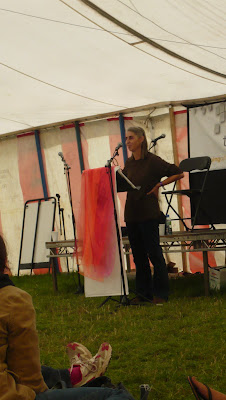
 in this photo appears to have a minimal audience but we had all retreated to the stands by this stage because of the cold. McIntosh presented a dystopic vision of the future by arguing that our response to climate change is too little too late and that it is probable that there is now insufficient time as well as insufficient political will to make the changes that are required. He cited
Abbé Pierre's understanding of the atonement as explanation of where we are in relation to climate change; seeing ourselves as addicts who have imprisoned ourselves. He spoke movingly about premature death of his baby and linked this to our need as human beings to look death in the face in order to look through death into life. We need the spirit of Jeremiah, he suggested, as we face the consequences of our consumerist addiction and seek, through community with others, our world and with God, to recover what it means to be truly human.
Margaret Barker, although a Biblical scholar as opposed to an activist, is deeply concerned to highlight the environmental implication of understanding the Temple theology which she argues underpins both the teaching of the Old Testament, Jesus and the Early Church. In her session she gave a brief synopsis of Temple theology. In her view, the structure of the tabernacle and Temple are based on the six days of creation revealing the different relationships in creation itself. Barker's ideas suggest that eternity is an ever-present reality, the kingdom, into which Jesus understood himself to be bringing us, through his death on the cross which completes the New Creation. Having come through the veil into the Holy of Holies, we are now angels and saints, in Barker's view.
This is the second time that I have heard Barker speak (click
here for a post about the first occasion) and I keep waiting for more radical consequences for the way in which Jesus understood himself and his teaching from this model than actually seems to arrive in what Barker says. Perhaps I need to go beyond her
introduction to Temple Theology in order to find this.

I then finally heard
Rob Bell, along what must have been the biggest crowd that any speaker drew over the weekend, when he was interviewed at the Jerusalem stage by, I think,
Martin Wroe. I described Bell to someone who hadn't heard him as intelligent on the scriptures, post-modern in his presentation, and evangelical in his theology. That seemed a reasonable description of his contribution to this conversation. What stayed most in the memory was his commitment to living a 'normal' life despite the popularity of his book, church, and film ministries and his summary of Christianity in 10 words or less (which was roughly): whatever tiny signs of hope you find are real.
 Chris Dingle's argument that music stops time
 seemed to be borne out with the contrasting concerts which ended Sunday. The Greenbelt Festival Orchestra played a selection of works by
Sir John Tavener, by intercutting the seven sections of
The Protecting Veil with a selection of his choral works drawn mainly from
The Veil Of The Temple. This was blissfully beautiful music in which the sense of time passing was suspended. On a more intellectual level, however, I do question the appropriateness of sectioning up a work like
The Protecting Veil which, although moving through seven sections to its completion, features an almost continuous cello line that was broken by the decision not to perform the work as a continuous whole.
 Duke Special
 was the polar opposite of the Tavener; gothic theatrical vaudeville with a compassionate core, a dramatic high energy set that was never less than engaging. His MySpace page describes him as "the fucked up ringmaster of a broken down circus, the lead dancer in a forgotten ballroom of ghosts, the loudest singer in a midnight choir and the first on his knees in an old time revival tent" and all of those facets were on show in this performance. "Everybody wants a little something good," is what he sang and that's exactly what we got.
--------------------------------------------------------------------------------
Duke Special -
No Cover Up.

 Adrienne Chaplin had a go at defining art in her session exploring why we should bother with art. She did acknowledge the difficulties of definitions but suggested that what artists do is to make sense of the world as it appears and feels to us. So that good art teaches us to see, hear, sense and feel better; articulates the way we experience life as felt. Or, perhaps, as Richard Harries puts it in his introduction to Forms of Transcendence: The Art of Roger Wagner (a book I bought at the Festival and read in the queue for The Rising) "every work of art is a deeply felt response to life seen in a particular way."
 Martyn Joseph conversed and performed with three emerging and engaging artists in The Rising and then with poet and lyricist Stewart Henderson. Humourous and profound by turn and in tandem, this was a performance littered with lingual brilliance. At the end they took questions from the audience which led both to state why Greenbelt is so important to them. As for many who go, the combination of friendships, art, questions, and challenge make it 'church' for them (for a similar statement from a punter, click here for a post by Steve Lawson).
 While waiting for Athlete I made what for me this year was a rare foray over to the Performance Cafe but was rewarded by a short but sweet set from Sister Jones. Their folk/r&b style was fused with gospel lyricism to great effect and in a seemingly effortless fashion.
 Athlete played a great gig but are in need of some U2-style reinvention. The new album, Black Swan, has more light and shade than Beyond the Neighbourhood but both are locked into the anthemic template of the excellent Tourist without tapping into the originality of Vehicles and Animals. Maybe they need to take their own advice and make some magical mistakes. Despite this, they sent me home on a high with the sense that it will be alright and that hope is never light years away.


